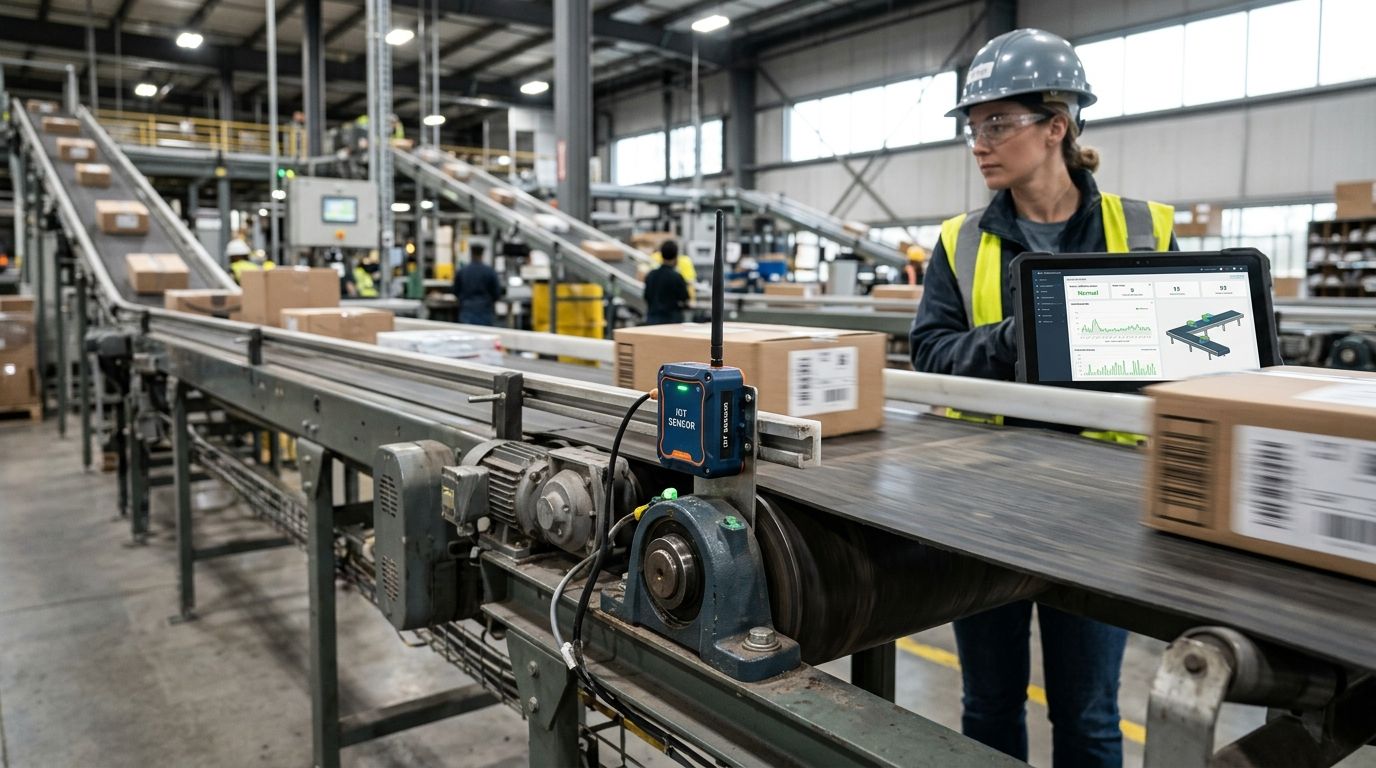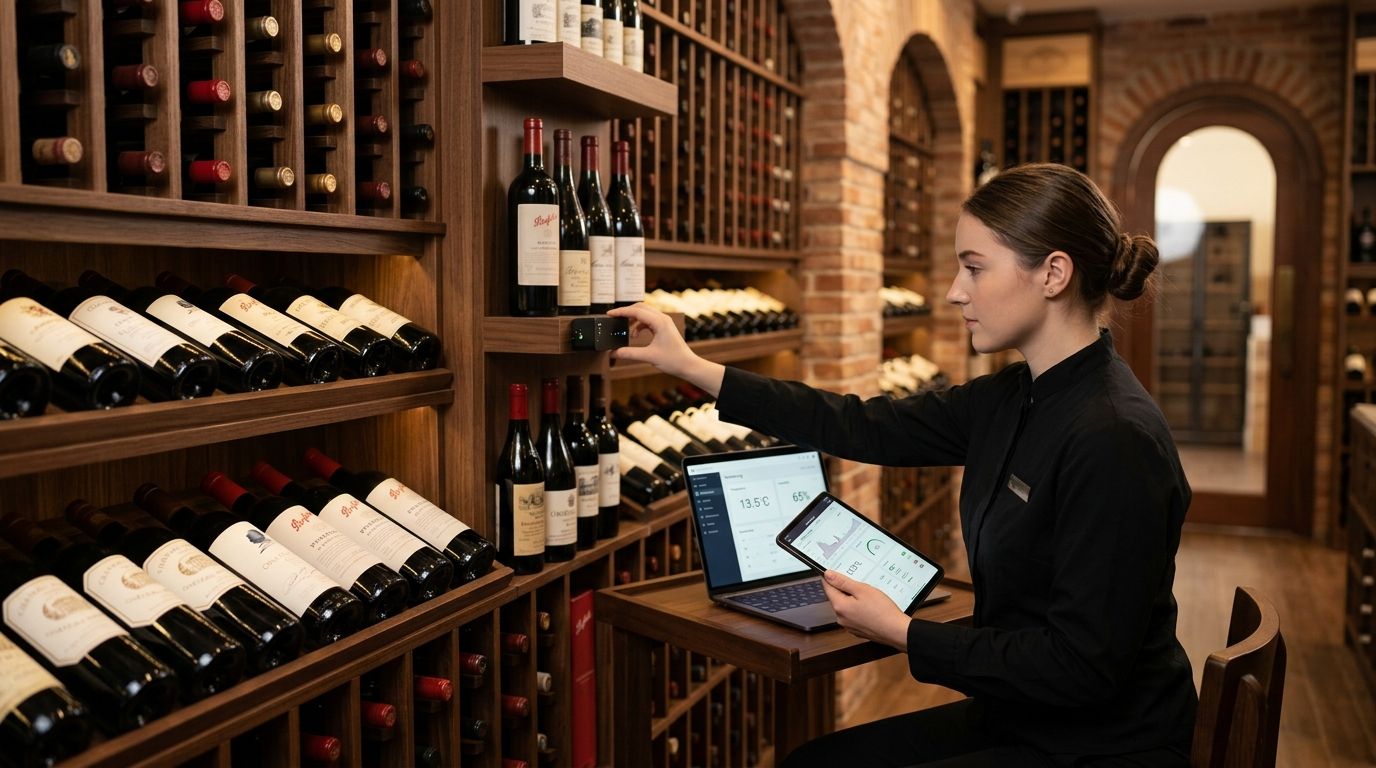
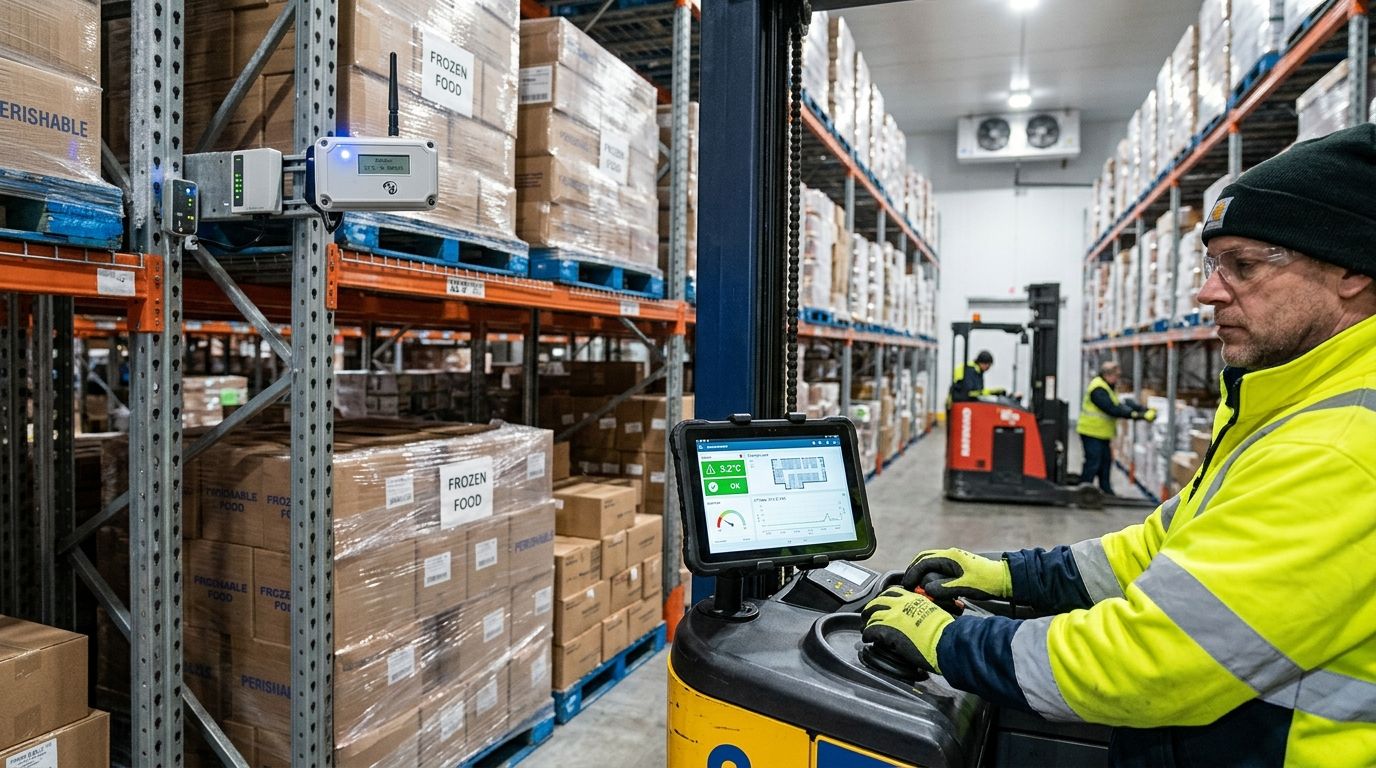
IoT temperature monitoring for 3PL warehouses puts wireless sensors, automated alarms and client-facing reports on every cold storage zone a third-party logistics provider runs, so a compressor drifting two degrees overnight shows up as a text message instead of a rejected pallet the next morning. A single-tenant cold room and a 3PL running five clients off three shared compressors need very different setups, and this guide covers the difference.
- IoT temperature monitoring for 3PL warehouses replaces manual chart recorders with sensors that alarm before product spoils.
- The FDA Food Code sets 41°F (5°C) as the maximum holding temperature for TCS foods in most adopting jurisdictions.
- The FSMA Sanitary Transportation Rule, in force since 2016, puts temperature-control obligations on carriers and receivers handling food.
- The Kilo IoT Platform runs LoRaWAN or mioty sensors with per-client dashboards and no separate network server to deploy.
- Most excursions trace back to a dock door left open, not a broken compressor — monitor both together.
Why do 3PL warehouses need IoT temperature monitoring?
A 3PL running cold storage carries someone else's product under someone else's contract, so a missed excursion is a liability event, not just a spoiled pallet. Client SLAs increasingly write temperature-logging requirements directly into the contract, and a paper log doesn't hold up when a client requests a timestamped export during a dispute.
The FDA Food Code sets 41°F (5°C) as the maximum holding temperature for time/temperature control for safety (TCS) foods, and the FSMA Sanitary Transportation Rule, in force since 2016, puts temperature-control obligations directly on carriers and receivers moving food in interstate commerce. A 3PL warehouse sits inside that chain of custody whether the client's contract mentions it or not.
Multi-client sites add a second layer: one refrigeration loop often serves several zones holding product for different customers under different contracts. A monitoring setup built for one tenant doesn't scale to a 3PL running five client SLAs off three compressors. The Kilo IoT Platform is built for exactly that shared-infrastructure problem — it segments dashboards and alarms per client while still running rules across shared equipment.
How do you set up IoT temperature monitoring in a 3PL warehouse?
The steps below go in order: map the site first, then instrument it, then automate the response. Skipping the mapping step is the most common reason 3PL rollouts stall halfway through.
Map your temperature zones and SLAs by client
Every cold storage site needs a zone map before hardware goes up. Pull each client's contract language on temperature range and excursion tolerance before you touch a sensor.
- List every cold room, freezer, dock door and staging area as a separate zone, not "the warehouse"
- Copy each client's contract-required temperature range and allowed excursion window into one reference sheet
- Mark which zones share a compressor, condenser or refrigeration loop
- Separate zones holding FDA-regulated TCS product from ambient or non-regulated storage
- Record how each zone is logged today — manual chart, spot-check clipboard, or nothing
Choose sensors rated for the actual temperature range
Consumer-grade Wi-Fi sensors are built for kitchen refrigerators, not blast freezers running at -20°C to -30°C. Cold drains batteries faster than the spec sheet suggests, and a 3PL site can't afford a dead sensor mid-audit.
- Confirm the sensor's operating range covers your coldest zone, not just standard refrigeration
- Set a reporting interval of 1-5 minutes so a door left open for ten minutes actually shows up in the data
- Check the IP rating for wash-down bays and condensation-heavy dock doors
- Test battery life at the zone's real temperature, not the manufacturer's room-temperature estimate
- If sourcing and validating hardware isn't worth the time, Kilo Electronics ships pre-configured sensors worldwide that pair directly with the Kilo IoT Platform
Deploy a private LoRaWAN or mioty network across the site
Metal racking and insulated freezer walls attenuate wireless signal fast, so gateway placement in a 3PL warehouse takes more planning than a small office retrofit.
- Run a signal test in the coldest, most metal-dense zone before finalizing sensor placement
- Budget roughly one gateway per 5,000-10,000 square feet, doubling that in solid metal-shelf areas
- Favor mioty over LoRaWAN where interference and packet collisions are a known problem, since mioty's telegram splitting spreads a message across time and frequency
- With Kilo's built-in LoRaWAN and mioty network server, sensors report straight into the platform without a separate network server to deploy and maintain
- Confirm gateway coverage reaches the dock doors too — excursions often start there, not in the freezer
Build automated alarms and escalation chains, not one shared inbox
A single alarm email to a shared inbox is how a Friday-night compressor failure turns into a Monday-morning claim. Escalation has to route to a person, not a folder.
- Set the alarm threshold to each client's contract number — 41°F (5°C) for TCS zones, not one blanket figure site-wide
- Add a second alarm tier for a slow drift over hours, separate from a hard threshold breach
- Route an unacknowledged alarm from the on-shift operator to a facility manager within a set window
- Use quiet hours for non-critical ambient zones so staff don't get desensitized by low-priority pages
- The Kilo IoT Platform runs five severity tiers with multi-step escalation over email, SMS and push, plus a centralized inbox, so a freezer alarm isn't buried next to a low-battery notice
See the platform behind these alarms
Explore how the Kilo IoT Platform handles multi-client cold storage sites.
Generate excursion reports your clients can audit
A 3PL's real deliverable to a food or pharma client isn't "the product stayed cold" — it's proof. That means a timestamped, per-zone, per-client export, not a spreadsheet reconstructed after the fact.
- Export temperature history filtered by zone and by client contract period
- Timestamp every alarm, acknowledgment and resolution as one audit trail
- Match the report format to whatever standard the client's product falls under
- Automate the export on a schedule — a structured temperature excursion report for cold chain audits turns this into a repeatable process instead of a one-off spreadsheet before every audit
Add dock door and loading bay monitoring to find root causes
Most excursions in a 3PL warehouse don't start with a broken compressor — they start with a door propped open during a slow unload. Sensors that only watch the freezer miss the cause.
- Track dock door open/close events alongside zone temperature, not as a separate system
- Correlate door-open duration with truck arrival and departure times to spot slow-loading patterns
- Flag zones where door-open frequency is rising even before temperature breaches — it's a leading indicator
- Dock door and loading bay monitoring on the same dashboard as temperature data shows the door event that preceded a spike, instead of leaving a facility manager to guess
Review historical data on a set schedule
Sensors that only trigger alarms deliver half their value. Reviewing trend data quarterly catches problems before they ever trip a threshold.
- Watch for gradual upward drift in a zone's baseline temperature — often the first sign of a failing compressor
- Compare humidity trends alongside temperature for zones storing produce or other moisture-sensitive product
- Check sensor battery levels and calibration drift, not just live readings
- Pull a full-site summary before contract renewal season so account managers walk in with real uptime data
Which cold chain monitoring option fits a 3PL warehouse in 2026?
| Option | Best for | Key limitation |
|---|---|---|
| Manual paper logs / chart recorders | A single-site 3PL with very few cold zones and no client audit requirement | No real-time alarm; relies on staff walking the floor on a fixed schedule |
| Standalone consumer Wi-Fi sensors | One freezer or a small standalone cold room | Wi-Fi range struggles in metal-dense warehouses; no per-client dashboard segmentation |
| Building Management System (BMS) add-on | Sites already running a full BMS for HVAC | Cold storage-specific alarms and per-client reporting are often low priority for the BMS vendor |
| Kilo IoT Platform (LoRaWAN/mioty wireless sensors) | 3PLs monitoring multiple clients, zones and dock doors on one dashboard | Requires initial sensor placement and gateway coverage planning across the site |
“The dock door, not the compressor, is where most cold chain excursions start in a 3PL warehouse.”
What mistakes do 3PL warehouses make with cold chain monitoring?
- Blanket thresholds: applying one temperature alarm site-wide instead of each client's contract number
- No root-cause correlation: watching freezer temperature but never the dock doors that cause most excursions
- Shared-inbox alarms: sending every alert to one address with no escalation, so a weekend excursion sits unacknowledged
- Trusting paper over sensors: keeping the manual log as the "legal" record even after installing IoT sensors, so nobody treats the dashboard as the source of truth
- Sensor placed at the door: mounting sensors near the door or thermostat instead of deep in the pallet stack, which reads warmer air rather than actual product temperature
FAQ
What's the best IoT temperature monitoring setup for a 3PL cold chain warehouse?
A setup with wireless sensors reporting every 1-5 minutes, per-client dashboards, tiered alarm escalation and automated excursion reports covers most 3PL contract requirements in 2026. Single-reading alarms without escalation or reporting leave gaps a client audit will find.
How many sensors does a 3PL warehouse need per cold storage zone?
There's no fixed ratio, but each distinct zone, dock door and shared compressor loop needs its own sensor rather than one reading for the whole building. A zone map built from each client's contract terms determines the actual count.
Is LoRaWAN or mioty better for a warehouse with dense metal racking?
mioty's telegram-splitting technique spreads each message across time and frequency, which tends to hold up better in dense metal-shelf environments than standard LoRaWAN. Both run on the Kilo IoT Platform's built-in network server, so the choice comes down to the site's interference profile.
How do 3PL warehouses generate temperature reports for client audits?
Export a timestamped, per-zone, per-client temperature history along with every alarm and its resolution time. Automating that export on a schedule avoids reconstructing a manual spreadsheet before every audit.
What temperature triggers an alarm under the FDA Food Code?
The FDA Food Code sets 41°F (5°C) as the maximum holding temperature for time/temperature control for safety (TCS) foods in most jurisdictions that adopt it. Each client contract may set a tighter tolerance on top of that baseline.
Can one IoT platform monitor multiple clients' cold storage zones separately?
Yes — a platform with per-zone dashboards and scoped access lets a 3PL segment data by client while still running site-wide rules on shared equipment. The Kilo IoT Platform does this through zone-level dashboards and permissioned access.
How does IoT temperature monitoring reduce chargebacks from clients?
Automated alarms catch excursions in minutes instead of during a scheduled walk-through, and timestamped reports give the 3PL proof of holding conditions instead of a disputed paper log. That documentation is usually what resolves a chargeback claim.
Do 3PL warehouses need cellular connectivity for temperature sensors?
Most warehouse deployments run on LoRaWAN or mioty rather than cellular, since a single gateway covers a large indoor footprint without a per-device data plan. Cellular becomes relevant for tracking product in transit rather than fixed warehouse zones.
What's the one cold chain number most 3PL warehouses miss?
Air temperature and product temperature are not the same reading, and most sensors get mounted near the door where air temperature is easiest to reach. A pallet's core holds its temperature far longer than the air around it, so a sensor near the door can show a breach — or hide one — that the actual product never experienced. Placing at least one sensor deep in the pallet stack per zone, not just near the door, is the detail that separates a monitoring setup that survives a client audit in 2026 from one that just looks good on a dashboard.