
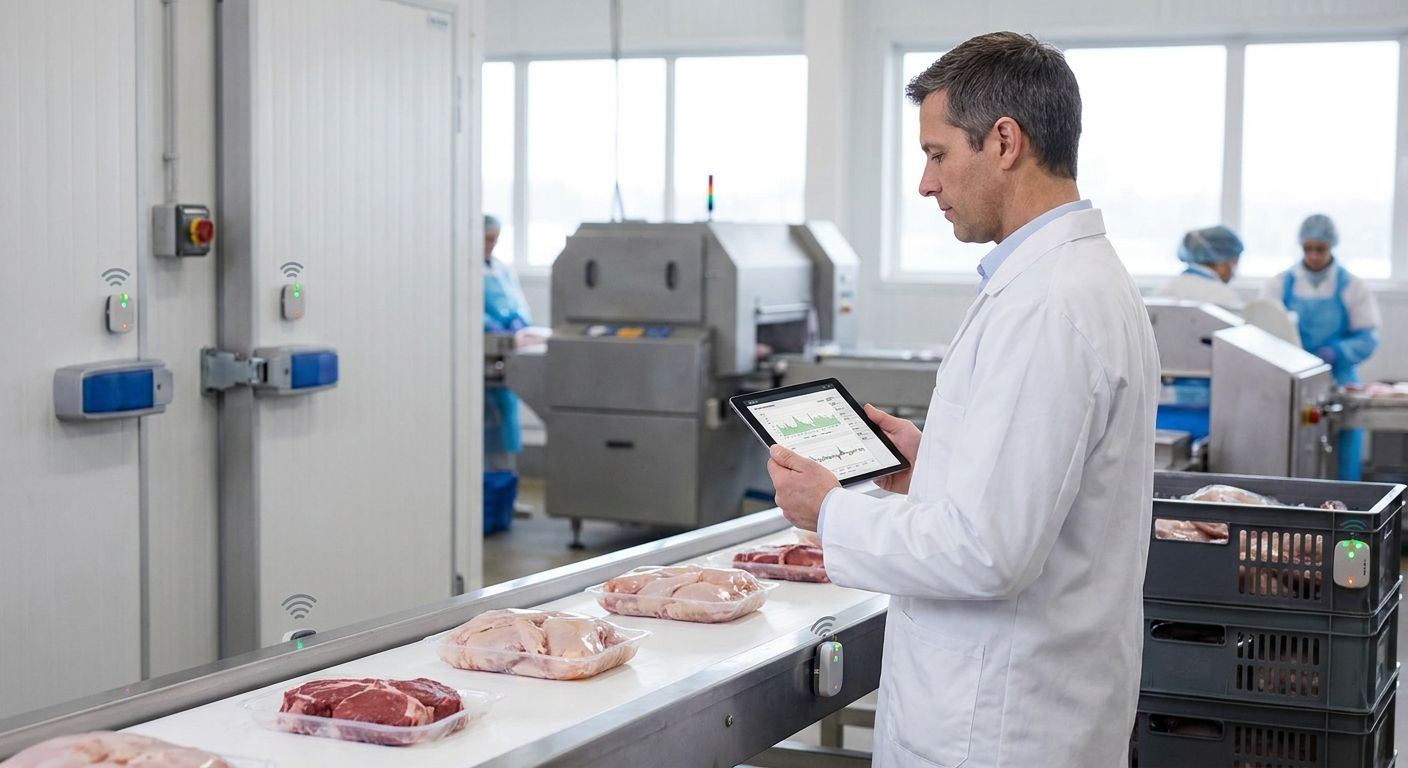
A single blast chiller malfunction or a walk-in door propped open for 20 minutes can turn a shift's worth of poultry into a write-off and a USDA finding on the same day. IoT temperature monitoring for meat and poultry processing plants closes that gap: sensors log continuously, and alarms escalate before product crosses a critical limit instead of after a spot check catches it.
- IoT temperature monitoring for meat and poultry processing catches chiller drift before product crosses USDA's 40°F poultry chilling target.
- Wireless LoRaWAN sensors cover multi-room plants without new wiring; mioty handles RF-dense lines with hundreds of nodes.
- The Kilo IoT Platform timestamps every reading against HACCP critical control points and escalates alarms by email, SMS and push.
- Manual logging alone fails audits when a compressor drifts overnight and nobody walks the floor until morning shift.
What happens when temperature control fails in a meat or poultry plant
The FDA Food Code sets 41°F (5°C) as the cold holding limit for potentially hazardous, time/temperature-control-for-safety foods, and USDA's Food Safety and Inspection Service requires poultry carcasses to reach an internal temperature of 40°F within a chilling window set by carcass weight class under 9 CFR 381.66. Between 40°F and 140°F, USDA and FDA both classify the range as the temperature danger zone, where pathogens like Listeria monocytogenes and Salmonella grow fastest.
A plant that misses those limits doesn't just risk spoilage. An FSIS inspector who finds an out-of-range cooler can issue a Noncompliance Record, hold product, or in a repeated pattern, suspend inspection on the line entirely — which stops production. Cold chain compliance monitoring exists precisely to produce the timestamped evidence that a limit was never crossed, or to catch the excursion within minutes instead of at the next manual round.
Who needs continuous temperature monitoring in meat and poultry processing
This is built for the HACCP coordinator who has to defend critical control point records during an FSIS audit, the plant quality assurance manager running multiple chill rooms and blast freezers on one shift, and the maintenance lead who needs to know a compressor is drifting before a QA tech finds spoiled product the next morning. It also matters for further-processing and cold storage operations attached to a slaughter plant, where product moves between rooms with different HACCP critical limits and different equipment ages.
A small further-processing plant with two coolers and one blast freezer has different needs than a high-throughput poultry line running dozens of chill tunnels, spiral freezers, and holding coolers across a 24-hour shift pattern. Both need continuous readings; the second needs a network that scales to hundreds of sensor points without falling over.
What to look for in an IoT temperature monitoring system for meat and poultry plants
CCP coverage and sensor placement
Every HACCP critical control point — chill room air temperature, product core temperature at the end of a chill cycle, blast freezer setpoint — needs its own sensor, not a single reading extrapolated across a room. Plants with uneven airflow near doors and evaporator coils see the biggest gap between what one sensor reports and what product actually experiences.
Wireless range through steel and concrete
Meat and poultry plants are full of stainless steel equipment, concrete block walls, and insulated panel coolers that block Wi-Fi and Bluetooth signals fast. LoRaWAN's sub-GHz signal penetrates multiple walls and steel doors far better than 2.4 GHz protocols, which is why it's become the default for multi-room cold storage retrofits.
Node density in RF-crowded plants
A large processing floor with hundreds of sensor points, PLCs, and existing wireless equipment can run into interference that degrades LoRaWAN's aloha-based access. mioty, standardized under ETSI TS 103 357, uses telegram splitting to hold up in exactly that kind of RF-dense, high-node-count deployment — worth checking against sensors for mioty-based industrial monitoring if the plant runs one line with a large sensor count.
Alarm escalation speed and structure
An alarm that only sends one email to one inbox fails the moment that person is off shift. A usable system needs multi-step escalation — first responder, then a supervisor, then a wider group — across email, SMS, and push, with severity tiers so a 2°F drift and a compressor failure don't ring the same way.
Audit-ready data retention
FSIS auditors and third-party HACCP auditors want continuous records, not a spreadsheet someone filled in from memory. A digital log with timestamps, sensor IDs, and an immutable history holds up better in a compliance review than paper logs that get transcribed after the fact.
Integration with existing PLC and refrigeration controls
Most plants already run PLCs on compressors and ammonia refrigeration systems. An MQTT connector that pulls readings straight from that equipment avoids installing a second, redundant sensor network on top of controls that already report temperature.
Types of IoT temperature monitoring systems for meat and poultry processing
Wired RTD and thermocouple loggers. Class A RTDs under IEC 60751 hold accuracy to roughly ±0.15°C at 0°C, and Type T thermocouples are common in food processing for their range and stability near freezing. These work well for a single fixed point but don't scale cheaply across a multi-room plant, since every sensor needs a home-run cable back to a logger or PLC.
Wireless LoRaWAN sensor networks. LoRaWAN sensors report on battery for months to years depending on reporting interval, which matters in a freezer where cold temperatures already stress battery chemistry faster than at room temperature. The Kilo IoT Platform runs a built-in LoRaWAN network server, so a plant deploying these sensors doesn't need to stand up a separate network server alongside the hardware — sensors join, and readings land straight in the dashboard.
mioty networks for RF-dense, high-node-count lines. Where a plant runs hundreds of sensor points on one processing floor alongside other wireless equipment, mioty's telegram-splitting approach holds up better under interference than standard LoRaWAN. Kilo's network server supports mioty alongside LoRaWAN and MQTT, which matters if a plant is mixing sensor types across old and new lines rather than committing to one protocol.
Manual spot-checks. A handheld probe and a paper log are still the fallback in smaller plants, but they only capture a single moment. A compressor that fails at 2 a.m. and recovers by the 6 a.m. round leaves no record that product spent four hours in the danger zone — which is the exact gap continuous monitoring is built to close. Reducing cold storage spoilage from temperature monitoring gaps like this one is usually the fastest payback a plant sees after switching off manual-only rounds.
Sensors rated for wash-down environments and sustained sub-zero exposure are available worldwide through Kilo Electronics, Kilo's hardware sister company, for plants that need freezer-rated hardware rather than general-purpose sensors.
Common IoT temperature monitoring mistakes in meat and poultry plants
- Treating one sensor per room as CCP coverage. A single sensor near the door reads differently than the coldest and warmest corners of a chill room; place sensors at the CCP itself, not wherever installation was easiest.
- Setting alarm thresholds at the regulatory limit instead of before it. An alarm that fires exactly at 41°F gives no time to react before the excursion is already a violation; set the threshold a few degrees inside the limit so staff can respond before it becomes a compliance issue.
- No escalation path past the first responder. If the only alert goes to one phone and that person is on a break or off shift, the alarm effectively didn't fire. Reducing false alarms in an alert system matters here too — over-alerting trains staff to ignore notifications entirely, which is worse than under-monitoring.
IoT temperature monitoring approaches compared for meat and poultry plants
| Approach | CCP coverage | Install effort | Audit trail | Alarm speed |
|---|---|---|---|---|
| Manual spot-checks | Single point in time | Low | Paper, gaps between rounds | Hours |
| Wired RTD/thermocouple logger | Strong at fixed points | High — cable runs per sensor | Digital, continuous | Minutes |
| Wireless LoRaWAN network | Strong, scales across rooms | Moderate — no cabling | Digital, continuous | Minutes |
| Wireless mioty network | Strong at high node counts | Moderate | Digital, continuous | Minutes |
See temperature alarms built for a plant floor
Explore how the Kilo IoT Platform handles CCPs, escalation and audit logs.
FAQ
What temperature should meat and poultry cold storage stay at?
FDA's Food Code sets 41°F (5°C) or below as the cold holding limit for potentially hazardous foods, and USDA FSIS requires poultry carcasses to reach 40°F within a chilling window set by weight class under 9 CFR 381.66. Continuous IoT temperature monitoring for meat and poultry processing catches drift toward either limit before it becomes a violation.
How often should HACCP temperature logs be recorded in a meat plant?
HACCP critical control points require monitoring frequent enough to detect a deviation before product is affected, which for most cold chain CCPs means continuous or near-continuous readings rather than periodic spot checks. Electronic logging from wireless sensors satisfies this more reliably than hourly manual rounds.
Is LoRaWAN or mioty better for a meat processing plant?
LoRaWAN suits most multi-room cold storage retrofits because its sub-GHz signal penetrates steel and concrete well and hardware costs less per node. mioty, standardized under ETSI TS 103 357, holds up better in RF-dense plants running hundreds of sensor points on one busy processing floor.
Can IoT sensors replace manual HACCP paperwork entirely?
Continuous electronic logs can satisfy the CCP monitoring requirement under 9 CFR 417.5, but most plants keep manual checks as a verification step rather than the primary record. The shift is from manual rounds as the main defense to manual checks confirming what the sensors already caught.
How much does an IoT temperature monitoring platform cost?
Platform pricing varies by vendor; Kilo's free tier covers up to 5 devices, 1 dashboard and 1 rule with no card required, and its Starter tier is 25 EUR per month for up to 25 devices. Sensor hardware is a separate cost sourced through a hardware vendor such as Kilo Electronics.
How fast should an alarm fire if a walk-in cooler door is left open?
The alarm should fire within minutes of the door-open event or the temperature threshold being crossed, not at the next scheduled round. A multi-step escalation chain that moves from the first responder to a supervisor after a set delay prevents a missed alert from turning into hours of exposure.
Do wireless temperature sensors work reliably in blast freezers?
Sensors built for sustained sub-zero exposure and rated for wash-down environments hold up in blast freezers, though cold temperatures reduce battery life faster than at room temperature. Choosing freezer-rated hardware over general-purpose sensors avoids early battery failure in the coldest zones.
What's the difference between wired and wireless temperature monitoring for food plants?
Wired RTD and thermocouple systems offer strong accuracy at fixed points but require a cable run to every sensor, which gets expensive across a multi-room plant. Wireless LoRaWAN or mioty sensors trade a small amount of per-node accuracy for scale, since adding a new sensor doesn't mean running new cable.
Can IoT sensors replace manual HACCP temperature logs
Not entirely, but they change what manual checks are for. Under 9 CFR 417.5, continuous electronic monitoring can serve as the CCP monitoring record itself, which shifts manual rounds from the primary defense to a verification step that confirms the electronic data matches reality. Plants that make this switch in 2026 are doing it less for the labor savings and more because a continuous digital record holds up better in an FSIS audit than a clipboard filled in once an hour.