
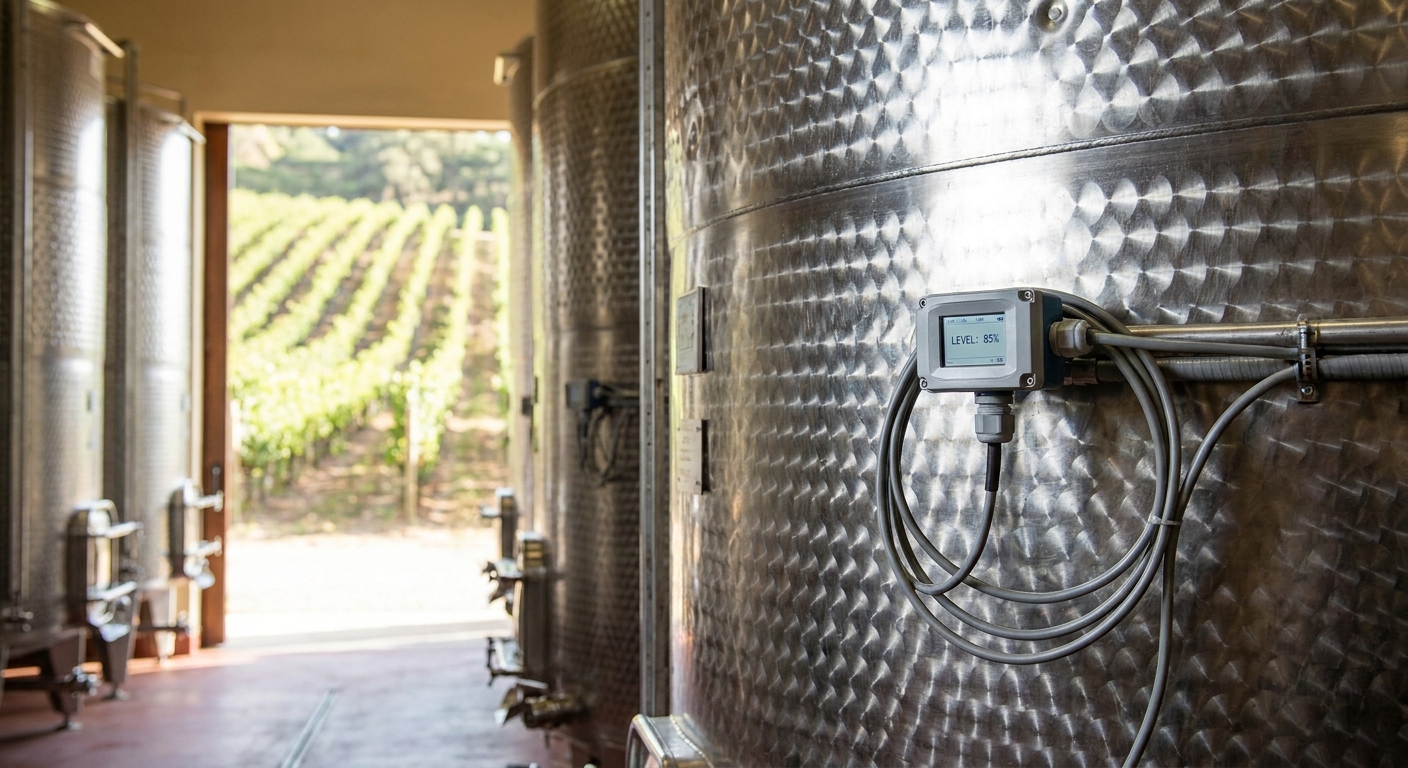
Wine tanks don't fail loudly. A stuck pump-over valve, a slow leak in a jacketed fermenter, or a forgotten valve on a must tank can cost a harvest's worth of juice before anyone notices — and most wineries still check tank levels by walking the cellar with a flashlight. This guide breaks down what tank level monitoring for wineries and vineyards actually needs to do, and which setup fits your cellar and your acreage.
- LoRaWAN ultrasonic sensors on Kilo Cloud are the default pick for cellar tank farms in 2026 — buy.
- Use mioty sensor mesh when tanks sit inside thick concrete or dense steel racking that kills standard LoRaWAN range.
- Rural vineyard tanks without cellular coverage need a remote-monitoring fallback, not a hope the signal shows up.
- Skip generic WiFi tank gauges for cellar use — WiFi drops the moment the cellar door closes and the router's out of range.
- Tank level monitoring for wineries and vineyards should tie into automated overflow alerts, not just a dashboard nobody checks.
Why this matters
Harvest season runs on a clock. Between late August and October, fermentation tanks fill, ferment, and need racking on a schedule that doesn't pause for a missed reading. A tank that overflows during an active pump-over doesn't just waste juice — it puts sugar and acid runoff on a cellar floor that then needs cleanup before the next lot goes in.
Outside harvest, the risk shifts to slow leaks and temperature drift in bulk storage. A 5,000-gallon storage tank losing a few gallons a day over a month is a measurable loss nobody catches without a sensor logging it. Tank level monitoring for wineries and vineyards exists to close that gap — catching level changes and alarm conditions in minutes instead of during the next scheduled walk-through.
Who this is for
This guide is built for winery operations leads and vineyard managers running multiple tanks — fermentation, storage, and irrigation reservoirs — across a cellar, a barrel room, and often acreage with no cell tower nearby. If you're running one or two small tanks with daily hands-on checks, a sensor system is overkill. If you're running a facility with 10+ tanks, seasonal staff turnover, and irrigation ponds a half-mile from the tasting room, this is the audience the setup below is designed for.
What to look for in tank level monitoring for wineries and vineyards
Connectivity that survives concrete and steel
Cellars are built to be cold and dark, which also means thick concrete, steel tank jacketing, and racking that blocks radio signal. A monitoring system that works fine in an open warehouse can drop half its readings in a barrel room. Look for a protocol built for penetration through dense materials, not just marketed range numbers from an open field.
Battery life measured in years, not weeks
Nobody wants to climb a 20,000-gallon tank every few months to swap a battery. Wireless tank sensors built for industrial use are designed to run for years on a single battery, reporting on intervals of minutes rather than continuously. Anything requiring frequent battery swaps adds a maintenance task nobody budgeted for.
Alarms that fire before the overflow, not after
A dashboard that shows a tank is full at 98% is useless if nobody's looking at it during a pump-over. The system needs rules that trigger a text or call at a set threshold — say 85% — with enough lead time for someone to act. This is the single biggest gap between a monitoring dashboard and an actual overflow alert.
Coverage for tanks outside cell range
Vineyard irrigation reservoirs and remote storage tanks often sit well outside reliable cellular coverage. A system that assumes every sensor can reach a cell tower will leave your furthest tanks blind exactly when you need them monitored — during irrigation season or after a hard rain.
A rules engine that doesn't require an integrator every time you change a threshold
Harvest thresholds change year to year based on yield and tank allocation. If adjusting an alarm trigger means calling a systems integrator, the setup won't keep pace with a working cellar. Look for a rules engine and dashboard an ops lead can adjust directly.
Data that ties level to temperature, not just level alone
Fermentation tanks need level and temperature tracked together — a level reading with no temperature context misses half the risk during active fermentation, when a stuck jacket valve can spike must temperature past 90°F in hours.
“If the alarm needs a person walking the cellar at midnight to catch it, it isn't automation.”
Top picks for tank level monitoring in a winery or vineyard
LoRaWAN ultrasonic sensors on a rules-driven platform — the default pick
Ultrasonic level sensors mounted on tank tops read level without touching the liquid, which matters for anything holding must, juice, or finished wine. Paired with Kilo Cloud for rules and alarms, a cellar with 10-30 tanks gets level readings on a set interval and automated overflow alerts that fire on a threshold you set, not a fixed factory default. This is the setup most wineries running standard concrete or steel-frame cellars in 2026 should start with. Buy.
mioty sensor mesh for dense cellar or barrel-room layouts — the wildcard
Some cellars stack tanks tight against steel racking or sit below grade in thick concrete, and that kills range for protocols not designed for it. mioty sensors built for industrial monitoring handle dense, obstructed layouts better than standard setups because the protocol is designed for exactly that interference pattern. If your cellar has more than two floors between the sensor and the gateway, this is worth testing before committing to a full rollout. Consider.
Remote monitoring for vineyard tanks without cellular coverage
Irrigation reservoirs and remote storage tanks out on the acreage often sit beyond any cell tower. A setup built for tank monitoring without relying on cellular signal covers those blind spots instead of leaving them unmonitored until the next physical inspection. If any tank on your property is more than a few hundred yards from the tasting room's WiFi or a cell tower, this is not optional. Buy.
Generic WiFi tank gauges — looks affordable, isn't built for this
WiFi-based tank gauges show up cheap in search results, and they work fine in a house with one router covering every room. A cellar or barrel room isn't that room. The moment a tank sits behind two concrete walls, the connection drops, and the gauge stops reporting exactly when you need it. Skip.
What to avoid
- Municipal-grade water tower systems repurposed for wine tanks. They're built for large, static, single-liquid storage — not the temperature-sensitive, frequently-racked tanks in an active cellar.
- Continuous-polling sensors marketed as "real-time." Constant polling drains batteries fast and doesn't add meaningful value over a well-tuned interval read every few minutes.
- Single-vendor lock-in hardware with no open rules engine. If you can't adjust an alarm threshold yourself before next year's harvest, you'll be paying an integrator every season for a five-minute change.
Verdict comparison
| Approach | Best for | Connectivity | Verdict |
|---|---|---|---|
| LoRaWAN ultrasonic + rules engine | Standard cellar, 10-30 tanks | LoRaWAN | Buy |
| mioty sensor mesh | Dense concrete/steel cellars | mioty | Consider |
| Remote/no-cellular setup | Vineyard reservoirs, remote tanks | Non-cellular fallback | Buy |
| Generic WiFi gauge | Not recommended for cellar use | WiFi | Skip |
Map your tank monitoring setup
See how Kilo Cloud handles level alarms across cellar and vineyard tanks.
FAQ
What is tank level monitoring for wineries and vineyards?
It's a wireless sensor and alarm setup that tracks liquid level in fermentation, storage, and irrigation tanks and sends alerts before a tank overflows or runs dry. It replaces manual walk-throughs with continuous, automated readings.
Is LoRaWAN or mioty better for wine cellar monitoring?
LoRaWAN works well for standard cellar layouts with normal concrete and steel construction. mioty performs better in dense, obstructed layouts with thick concrete or heavy steel racking that block standard wireless signal.
Can tank level sensors prevent overflow during fermentation?
Yes, when the sensor system is paired with automated threshold alarms that fire before the tank reaches capacity. A level reading alone without a rules-driven alert does not prevent overflow — the alarm trigger is what matters.
Do tank level sensors work without cellular signal at remote vineyards?
Standard cellular-dependent sensors will not report from areas without coverage. A setup designed for remote tank monitoring without relying on cellular signal is required for reservoirs and tanks far from a cell tower.
How accurate are ultrasonic tank level sensors for wine tanks?
Ultrasonic sensors typically measure level in millimeters rather than inches, which is precise enough for tracking racking schedules and catching slow leaks in storage tanks.
What tank sizes can be monitored with IoT sensors?
Ultrasonic and pressure-based level sensors scale from small 500-gallon fermenters up to 50,000-gallon bulk storage tanks, since the sensor measures distance or pressure rather than tank volume directly.
How long do wireless tank level sensors last on battery?
Industrial wireless level sensors are built to run for years on a single battery when reporting on set intervals rather than continuously, which matters for tanks that aren't checked daily.
Do I need a separate system for irrigation reservoirs versus cellar tanks?
No, a single platform with a rules engine can monitor both cellar tanks and vineyard irrigation reservoirs, as long as the connectivity setup covers areas without cellular signal for the reservoirs.
One last thing
The cellars that get the most value out of tank level monitoring aren't the ones with the most sensors — they're the ones that set alarm thresholds low enough to act on before a problem, not after. A threshold set at 95% full gives you almost no time to respond during an active pump-over in 2026's compressed harvest windows; one set at 80-85% gives an ops lead time to actually walk over and check.