
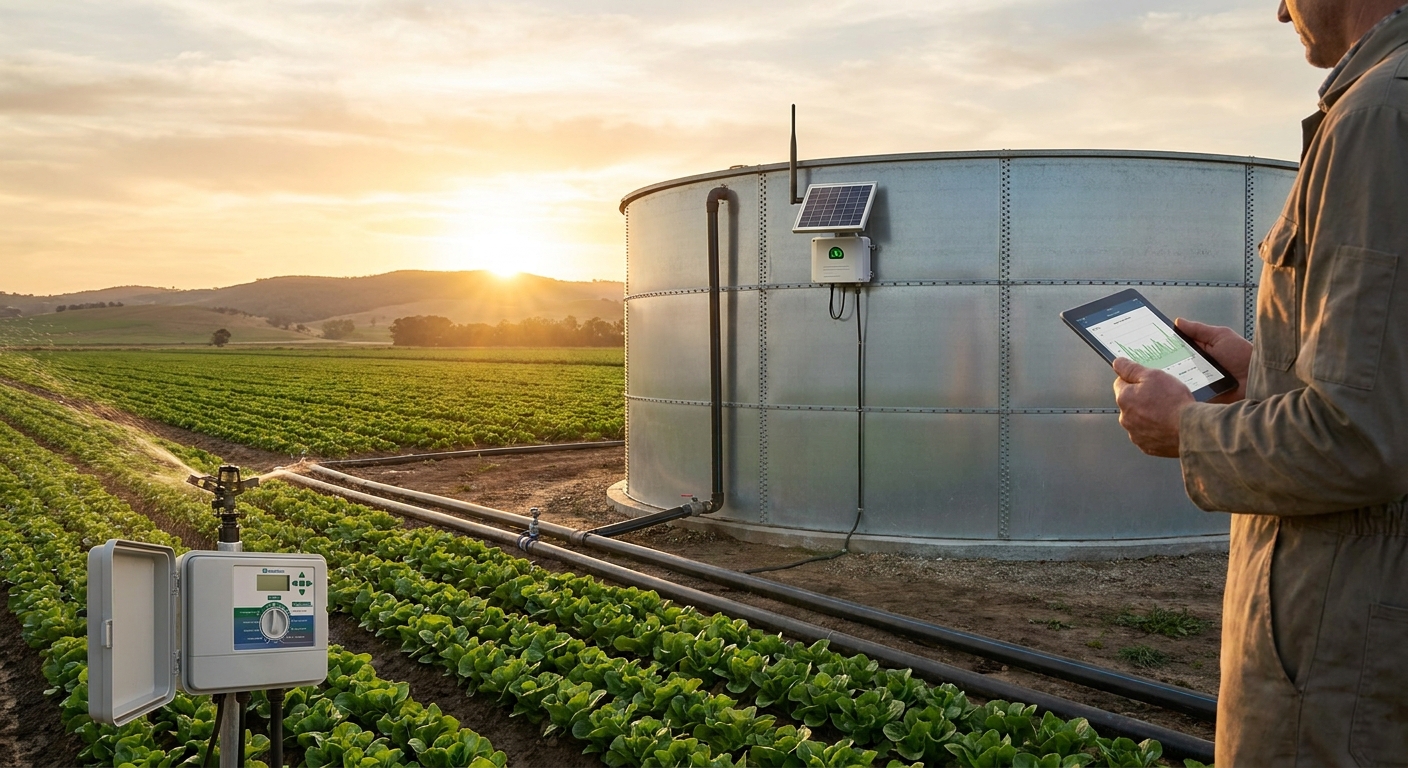
Irrigation tanks fail quietly. A float switch sticks, a pump keeps running against an empty supply tank, or a reservoir tops out and overflows into a ditch you'll be cleaning up for a week. Tank level monitoring for irrigation systems fixes that by putting real-time level data — and an alert before the problem — on a dashboard instead of on a clipboard.
- Ultrasonic sensors over LoRaWAN are the safe pick for above-ground poly and steel supply tanks in 2026.
- Hydrostatic pressure sensors handle buried cisterns and in-ground reservoirs where lids block ultrasonic reads.
- mioty-based sensors fit large multi-field operations running dozens of tanks; overkill for a single farm.
- Cellular IoT tank sensors via Kilo Connectivity's global SIM cover one remote tank with no gateway nearby — buy for that case only.
- Consumer Wi-Fi float sensors are a skip for irrigation because tanks sit far past router range.
Why this matters
A dry-run irrigation pump burns a motor in minutes, and a missed overflow wastes a full tank of pumped or metered water. Neither shows up until you're standing at the tank. In 2026, most of the operational cost isn't the sensor hardware — it's the gap between when a tank crosses a threshold and when a human finds out. Kilo IoT closes that gap with sensors feeding a rules engine that fires alarms the moment a level crosses a line you set, not whenever someone next drives past the field.
Who this is for
This is for irrigation managers and farm operations leads running center-pivot supply tanks, drip-line header tanks, or field reservoirs across one or more properties, who are currently checking levels by sight, dip stick, or a float gauge nobody reads until something's already wrong. If you manage tanks feeding automated irrigation across multiple fields or farms, the calculus shifts toward a platform that can show every tank on one dashboard rather than five separate apps.
What to look for in tank level monitoring for irrigation
Sensor type matched to tank shape and material
Ultrasonic sensors read distance to the water surface and work well on open, above-ground poly or steel tanks. Buried cisterns, in-ground reservoirs, and tanks with fittings that block a clear ultrasonic path need a hydrostatic pressure sensor instead, since it measures the water column directly rather than bouncing a signal off the surface.
Connectivity range across fields
A single tank near the farmyard is a different problem than a dozen tanks spread across three sections. LoRaWAN gateways cover a wide radius from one base station, mioty is built for handling more sensor nodes across denser deployments, and cellular connectivity skips the gateway entirely for a lone remote tank. Picking the wrong one means either paying for infrastructure you don't need or missing coverage on the tank that matters most.
Alarm and rules engine flexibility
A level alert that only fires at empty is nearly useless — by then the pump has already been running dry. Look for a rules engine that supports multiple thresholds per tank: an early warning at 30% remaining and a hard alarm at 10%, so there's time to act before the pump cavitates or the field goes dry mid-cycle.
Multi-site dashboard visibility
If you're running tanks across more than one farm or field block, checking five separate sensor apps defeats the purpose of monitoring at all. A dashboard built for multi-site facility teams puts every tank, every threshold, and every active alarm on one screen.
Integration with existing irrigation controllers
Tank data is only useful if it reaches the system already running your pumps and valves. A platform that lets you integrate sensor data with your dashboard via API means tank levels can trigger a pump shutoff or a valve close automatically instead of waiting on a phone call.
Top picks
Ultrasonic sensor over LoRaWAN — the safe pick. Non-contact reading, works on any open above-ground tank, and pairs with a tank level monitoring system built for exactly this kind of level tracking, just swapped from fuel to water. Buy for standard poly and steel supply tanks feeding center pivots or drip headers.
Hydrostatic pressure sensor over LoRaWAN — the pick for buried and in-ground reservoirs. It measures the water column directly, so lids, baffles, or turbulence don't throw off the reading the way they can with an ultrasonic unit. Buy for cisterns and any tank you can't get a clear line of sight into.
mioty-based sensors for large multi-field operations — the long-range, high-density pick. mioty is built to handle more nodes spread over more ground without every sensor competing for the same channel, which matters once you're past a dozen tanks across several fields. Consider it if you're scaling past a single farm; Skip it for one or two tanks, where a standard LoRaWAN gateway already covers the ground you need.
Cellular IoT tank sensor via Kilo Connectivity — the no-gateway pick. Kilo Connectivity runs on 800+ connectivity partners with worldwide SIM coverage, so a single remote tank with no other IoT infrastructure nearby can go straight to cellular instead of justifying a private gateway for one node. Buy for that one isolated tank; Skip once you're deploying enough sensors that a LoRaWAN gateway pays for itself faster.
Consumer Wi-Fi or Bluetooth float sensor — the tempting shortcut. It's cheap and easy to set up, but it only works within range of a router, and irrigation tanks sit in fields, not next to Wi-Fi access points. Skip for irrigation use — the range mismatch defeats the purpose before you've measured a single tank.
“If you're still climbing a ladder to check a tank gauge in 2026, the tank is monitoring you, not the other way around.”
What to avoid
- A single low-power Wi-Fi sensor on a remote tank — it reads fine in the yard and goes silent the moment the tank is out past the shed, which is exactly where most irrigation tanks sit.
- Manual dip-stick checks as the sole method — they work until the day nobody drives past that field, which is the day the tank runs dry or overflows.
- A generic consumer flood alarm marketed for basements — it detects water where it shouldn't be, not water level trending toward a threshold, so it can't warn you early enough to shut off a pump in time.
See tank alerts on one dashboard
Check live tank levels and alarms across every field from a single screen.
Verdict comparison
| Pick | Best for | Connectivity | Verdict |
|---|---|---|---|
| Ultrasonic sensor | Above-ground poly/steel tanks | LoRaWAN | Buy |
| Hydrostatic pressure sensor | Buried cisterns, in-ground reservoirs | LoRaWAN | Buy |
| mioty-based sensor | Large multi-field, many-tank operations | mioty | Consider |
| Cellular IoT sensor | One remote tank, no gateway nearby | Cellular via Kilo Connectivity | Buy (single tank) |
| Consumer Wi-Fi float sensor | Near-router use only | Wi-Fi/Bluetooth | Skip |
FAQ
What's the best tank level monitoring for irrigation systems in 2026?
For most farms, an ultrasonic or hydrostatic sensor over LoRaWAN feeding a rules-based dashboard is the best tank level monitoring for irrigation in 2026. The right sensor type depends on whether the tank is above ground and open or buried and sealed.
Is LoRaWAN or cellular better for irrigation tank sensors?
LoRaWAN wins once you have more than one or two tanks, since a single gateway covers a wide radius across fields. Cellular, run through a network like Kilo Connectivity, makes more sense for one isolated remote tank where building gateway infrastructure isn't worth it yet.
How much does tank level monitoring cost for a farm?
Cost depends on the number of tanks, sensor type, and connectivity chosen, so there's no single figure that applies across farms. Check current sensor and platform options directly rather than relying on a generic estimate.
Can one platform monitor tanks across multiple farms?
Yes, a dashboard built for multi-site facility teams can show tank levels and alarms from several farms or field blocks on one screen. That matters once checking each site separately starts costing more time than the monitoring saves.
Do tank sensors work without cell coverage or Wi-Fi?
LoRaWAN and mioty sensors don't need cell coverage or Wi-Fi at all — they connect to a private gateway instead. That's exactly why they outperform Wi-Fi float sensors on tanks sitting out in a field.
How do I get alerts when a tank runs low?
Set a rules engine threshold, typically an early warning around 30% remaining and a hard alarm near 10%, so the alert fires before the pump runs dry. Alerts route to a dashboard or notification rather than requiring someone to check the tank in person.
What sensor works for buried or underground irrigation reservoirs?
A hydrostatic pressure sensor is the right choice for buried cisterns and in-ground reservoirs, since it measures the water column directly instead of relying on a clear line of sight to the surface. Ultrasonic sensors struggle in these tanks because lids and fittings block the reading.
Is mioty better than LoRaWAN for large farms?
mioty handles more sensor nodes spread over a larger area without the network congestion that dense LoRaWAN deployments can hit. For one or two tanks it's unnecessary, but past a dozen tanks across several fields, it starts to make sense.
One last thing
The overflow problem gets less attention than the run-dry problem, but it's just as expensive: a tank that tops out mid-fill wastes every gallon that already ran through the pump to get there. Set a high-level threshold alongside the low-level one — most operators only remember to configure the empty-tank alarm and skip the full-tank alarm entirely, then wonder in 2026 why the reservoir overflowed on a night nobody was watching.