
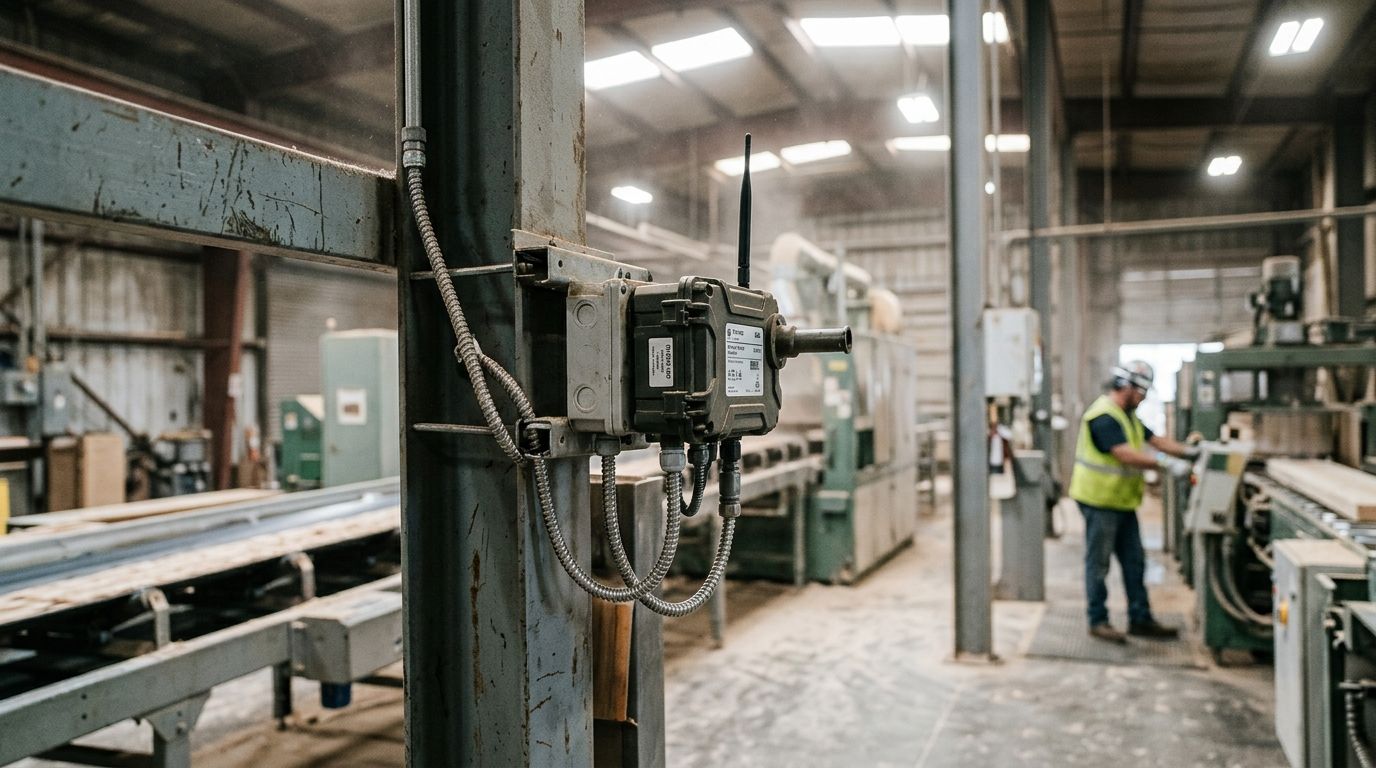
Picking the wrong particulate sensor for industrial dust monitoring gets you one of two failure modes: a compliance report that doesn't hold up in an inspection, or a floor full of alarms nobody trusts. The five sensing methods below cover the real spread of industrial use cases, from real-time trend alarms to EPA-equivalent compliance data.
Best overall for continuous industrial dust monitoring: optical light-scattering sensors feeding a rules engine over LoRaWAN or MQTT. Best for baghouse and dust collector leak detection: triboelectric particulate sensors. Best for regulatory-grade PM2.5/PM10 reporting: beta attenuation monitors (BAM). Best for OSHA respirable dust compliance verification: gravimetric filter sampling. Best for size-binned process diagnostics: laser diode optical particle counters.
- The best IoT particulate matter sensor for industrial dust depends on the job: optical scattering sensors for real-time alarms, BAM units for regulatory PM2.5/PM10 reporting.
- Triboelectric probes catch a failed baghouse bag within minutes, before dust becomes a permit excursion.
- OSHA's respirable dust PEL is 5 mg/m3 TWA, and gravimetric filter sampling is still the method inspectors trust.
- None of these sensor types are mutually exclusive — most industrial dust monitoring programs run two or three in parallel by 2026.
Why industrial dust monitoring needs continuous sensor data
A single quarterly gravimetric sample tells you what dust levels looked like on one shift. It says nothing about the spike that happened at 2 a.m. when a filter bag split, or the three hours a grinding line ran without local exhaust. Industrial dust monitoring done with continuous IoT sensors closes that gap: readings stream in at intervals measured in minutes, not months.
The practical reason this matters is exposure and combustion risk, not just paperwork. OSHA's permissible exposure limit for particulates not otherwise regulated sits at 5 mg/m3 for the respirable fraction and 15 mg/m3 for total dust (29 CFR 1910.1000, Table Z-1). ACGIH's threshold limit value for particulates not otherwise specified is tighter still, at 3 mg/m3 respirable and 10 mg/m3 inhalable. Combustible dust adds a second layer: NFPA 652, the Standard on the Fundamentals of Combustible Dust, requires a documented dust hazard analysis for any process handling a combustible particulate.
The Kilo IoT Platform doesn't manufacture particulate sensors — it ingests readings from whichever sensing method fits the job over LoRaWAN, mioty, or MQTT, and turns a threshold breach into an alarm with an escalation chain instead of a number nobody watches.
What makes a good industrial dust monitoring sensor?
- Response time — does it report in seconds/minutes (optical, triboelectric) or hours/shifts (BAM, gravimetric)?
- Regulatory standing — is it an EPA Federal Equivalent Method, or a trend indicator that needs correlation?
- Size selectivity — does it separate PM2.5, PM10, or respirable/thoracic/inhalable fractions per ISO 7708?
- Duct vs. ambient placement — some methods are built for stack/duct monitoring, others for room-level air quality.
- Connectivity — does the sensor output over MQTT, Modbus, or a wireless protocol a platform can actually pull in?
- Maintenance load — filter tape changes, lens cleaning, and calibration intervals all affect uptime.
Industrial dust particulate sensors at a glance
| Sensor type | Best for | Standout feature | Key limitation |
|---|---|---|---|
| Optical light-scattering sensors | Continuous trend monitoring and alarms | Real-time PM1/PM2.5/PM10 output over LoRaWAN or MQTT | Needs periodic correlation against a reference method |
| Triboelectric particulate sensors | Baghouse and dust collector leak detection | Flags a filter failure within minutes | Relative signal, not a calibrated mass reading |
| Beta attenuation monitors (BAM) | Regulatory PM2.5/PM10 compliance | EPA Federal Equivalent Method status on many models | Higher unit cost, source licensing, slower response |
| Gravimetric filter sampling | OSHA respirable dust compliance verification | The reference method inspectors compare everything else to | No real-time data, lab turnaround required |
| Laser diode optical particle counters | Size-binned dust diagnostics | Individual particle counts across size bins | Coincidence error at high concentrations |
1. Optical light-scattering sensors: best for continuous dust trend monitoring
An optical scattering sensor shines a laser or LED across an air sample and measures the light bounced back by particles, converting that signal into a PM1, PM2.5, or PM10 concentration in real time. It's the workhorse of continuous industrial dust monitoring because it's small, low-draw, and reports constantly instead of once a shift.
Optical scattering sensor pros:
- Continuous, near-instant readings suited to threshold alarms
- Low power draw, fits battery or wireless-powered deployments
- Straightforward to wire into an MQTT connector or a LoRaWAN uplink
Optical scattering sensor cons:
- Not a regulatory reference method on its own
- Humidity and oil mist both distort the scattering signal
- Assumes a particle size/density profile that may not match your dust
Once the sensor is reporting, the value comes from what happens with the reading. Kilo's visual rules engine runs CEL expressions against incoming values, so a sustained PM10 reading above a set threshold triggers an alarm that escalates through email, SMS, and push instead of sitting in a log file.
Verdict: deploy this as the default sensor for floor-level trend monitoring and early alarms.
2. Triboelectric particulate sensors: best for baghouse and dust collector leak detection
A triboelectric probe sits inside ductwork downstream of a baghouse compartment and measures the electrostatic charge generated as particles strike or pass near the probe tip. The signal jumps sharply the moment a filter bag tears, which is exactly the failure mode that turns a routine collection system into a permit violation.
Triboelectric sensor pros:
- Extremely sensitive to sudden leak events
- Standard instrument on many baghouse compliance programs
- Doesn't need a calibrated absolute-mass reading to be useful as an alarm trigger
Triboelectric sensor cons:
- Gives a relative signal, not a calibrated concentration
- Duct velocity changes and moisture both shift the baseline
- Mounting position affects sensitivity, so placement needs planning
Because the output is typically a 4-20 mA or Modbus signal rather than a native wireless protocol, these usually connect through a gateway. If you're wiring baghouse instrumentation into a dashboard for the first time, connecting Modbus PLCs to a cloud IoT dashboard is the practical starting point before any alarm logic gets built on top.
Verdict: install one per baghouse compartment where an undetected bag failure is the costliest outcome.
3. Beta attenuation monitors: best for regulatory PM2.5/PM10 compliance reporting
A beta attenuation monitor (BAM) draws air through a filter tape and measures how much a beta radiation source is attenuated by the particulate collected on the tape, producing an hourly mass concentration. Many BAM models carry EPA Federal Equivalent Method (FEM) designation, which is why they show up at sites with an air permit that specifies PM2.5 or PM10 reporting.
BAM pros:
- Recognized method for state and federal air permit reporting
- Hourly-resolution mass data with documented QA/QC procedures
- Well-understood by regulators and third-party auditors
BAM cons:
- Higher unit cost than optical sensors
- Radioactive source handling adds licensing overhead
- Slower response than optical or triboelectric methods, and filter tape needs periodic replacement
EPA's 2024 revision to the National Ambient Air Quality Standards lowered the annual PM2.5 standard to 9.0 µg/m3 (from 12.0 µg/m3), with the 24-hour PM10 standard still at 150 µg/m3. Facilities whose permits reference these thresholds are exactly where a BAM earns its cost.
Verdict: install where the permit requires FEM-grade data, not as a general-purpose alarm sensor.
4. Gravimetric filter sampling: best for OSHA respirable dust compliance verification
Gravimetric sampling pulls air through a pre-weighed filter, often behind a size-selective cyclone that isolates the respirable fraction per ISO 7708's 4 µm 50%-cut-point convention, over a full work shift. The filter is then weighed in a lab to produce a single integrated mass concentration for that period.
Gravimetric sampling pros:
- The reference method OSHA and NIOSH use to validate other instruments
- Defensible in an inspection, including personal breathing-zone sampling
- No power, network, or calibration drift concerns during the sample period
Gravimetric sampling cons:
- Not real-time — no alarm capability during the shift itself
- Lab weighing adds days of turnaround
- One sample equals one data point; it can't show intra-shift spikes
This is a compliance-verification tool, not a monitoring tool, and it works best run alongside continuous sensors rather than instead of them — the continuous data catches the spike, the gravimetric sample defends the average.
Verdict: run in parallel with a real-time sensor, never as a substitute for one.
5. Laser diode optical particle counters: best for size-binned dust diagnostics
A laser diode particle counter counts individual particles as they pass through a sensing volume, sorting them into size bins (commonly 0.3 to 10 µm) rather than reporting a single mass figure. That size distribution is useful when you need to know whether a dust source is fine grinding fume or coarse material handling dust.
Particle counter pros:
- Granular size-bin data useful for tracing a dust source to a specific process
- Suited to spaces adjacent to cleanroom-classified areas where particle count matters as much as mass
- Detects changes in dust character even when total mass stays flat
Particle counter cons:
- Higher cost per unit than a basic optical scattering sensor
- Converting counts to mass requires assumptions about particle density and shape
- Coincidence error appears at high concentrations, undercounting in heavy dust
Verdict: reserve this for diagnostic deployments and process troubleshooting, not routine facility-wide coverage.
How were these dust monitoring sensors ranked?
Each sensor type was scored against the criteria above: response time, regulatory standing, size selectivity, placement fit, connectivity, and maintenance load. None of the five wins every category — that's the point. A facility running combustible dust processes typically needs at least two of these methods, not one instrument doing every job.
Which particulate matter sensor should you choose for industrial dust monitoring?
If you're starting from zero in 2026, install optical light-scattering sensors first for continuous coverage and real-time alarms, add triboelectric probes on any baghouse or dust collector where a leak would be costly, and layer in gravimetric sampling as the periodic compliance check. Reach for a BAM only when a permit specifically requires FEM-grade PM2.5/PM10 data, and use particle counters as a diagnostic tool when you need to trace a dust source rather than just alarm on it.
Sensors compatible with LoRaWAN, mioty, and MQTT outputs are available worldwide through Kilo Electronics, Kilo's hardware sister company, if you're sourcing new instrumentation for the deployment.
Turn dust sensor data into alarms
Ingest particulate readings over LoRaWAN, mioty, or MQTT and set threshold alarms in Kilo Cloud.
Combustible dust processes add a hazard layer that changes sensor housing requirements. NFPA 652 requires a documented dust hazard analysis, and instrumentation in a classified area needs a housing rated for that environment — worth reviewing explosion-proof IoT sensors for hazardous industrial environments before specifying hardware for a combustible dust zone.
FAQ
What is the best IoT particulate matter sensor for industrial dust monitoring?
Optical light-scattering sensors are the best general-purpose choice for continuous industrial dust monitoring because they report PM1/PM2.5/PM10 in real time over LoRaWAN or MQTT. Regulatory reporting still needs a beta attenuation monitor or gravimetric sample alongside it.
Is a laser dust sensor accurate enough for OSHA compliance?
On its own, no — OSHA compliance is verified against gravimetric filter sampling, the reference method described in 29 CFR 1910.1000. Optical sensors are valuable for continuous trend alarms but need periodic correlation against a gravimetric or reference sample.
How does a triboelectric dust sensor detect a baghouse leak?
A triboelectric probe measures the electrostatic charge generated when particles strike or pass near it inside the duct, and that signal spikes sharply the moment a filter bag tears. It's a relative signal built for leak detection, not a calibrated mass reading.
What's the difference between PM2.5 and PM10 in industrial dust monitoring?
PM2.5 refers to particles 2.5 micrometers or smaller in aerodynamic diameter, and PM10 refers to particles 10 micrometers or smaller. EPA's NAAQS sets separate standards for each, with the 2024 revision setting the annual PM2.5 standard at 9.0 µg/m3.
Can particulate matter sensors run over LoRaWAN?
Yes — optical light-scattering PM sensors commonly report over LoRaWAN for battery-powered, wireless deployments across a facility floor. Duct-mounted instruments like BAM units and triboelectric probes more often connect via Modbus or MQTT through a gateway.
How often should gravimetric dust samples be taken?
Gravimetric sampling is typically run per work shift for OSHA respirable dust compliance verification, since each sample produces one integrated mass reading for that period. Continuous sensors fill the gap between sampling events with real-time trend data.
What OSHA dust limit applies to industrial facilities?
OSHA's permissible exposure limit for particulates not otherwise regulated is 5 mg/m3 (TWA) for the respirable fraction and 15 mg/m3 for total dust, per 29 CFR 1910.1000, Table Z-1. ACGIH's threshold limit value for similar particulates is tighter, at 3 mg/m3 respirable.
Do combustible dust sensors need explosion-proof housings?
In any area classified as hazardous under a documented dust hazard analysis, yes — NFPA 652 requires that analysis, and instrumentation placed in the classified zone needs a housing rated for that environment.
A detail most industrial dust monitoring deployments miss
Most dust monitoring programs pick one sensor type and stop. The gap that actually causes compliance findings is usually the seam between methods: a facility with a great continuous optical sensor network but no gravimetric verification has real-time data nobody can defend in an inspection, and a facility running only quarterly gravimetric samples has zero visibility into the three-hour spike that happened between samples. Running two methods in parallel, even a cheap optical sensor next to the compliance-grade instrument, closes that gap for a fraction of the cost of upgrading either one alone.