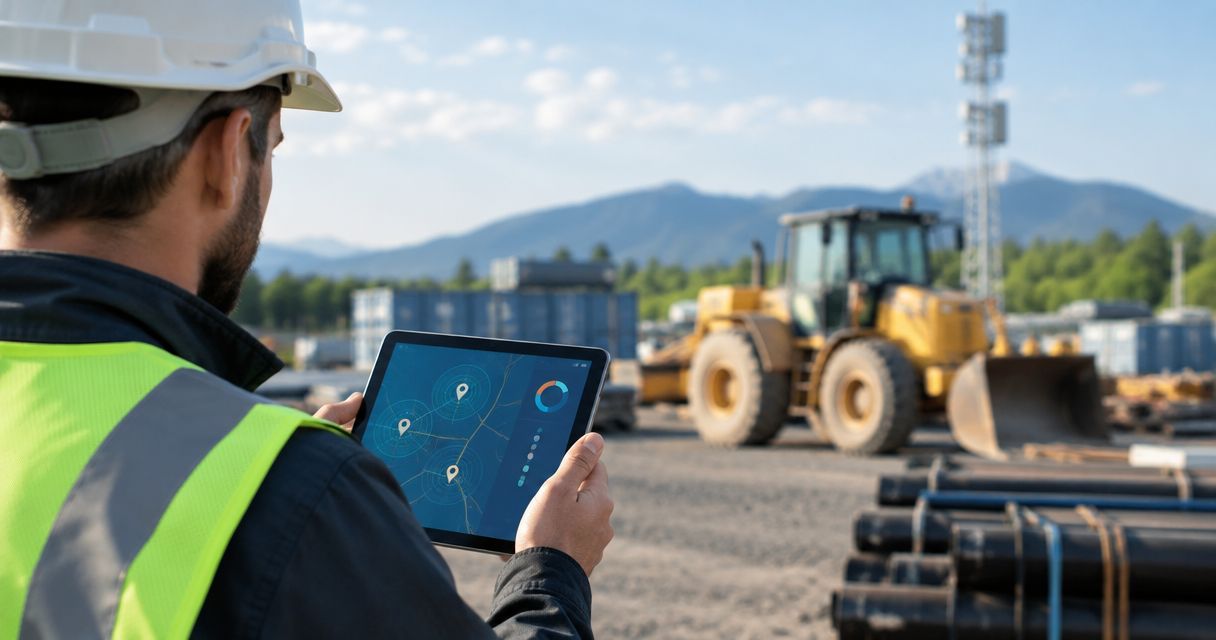
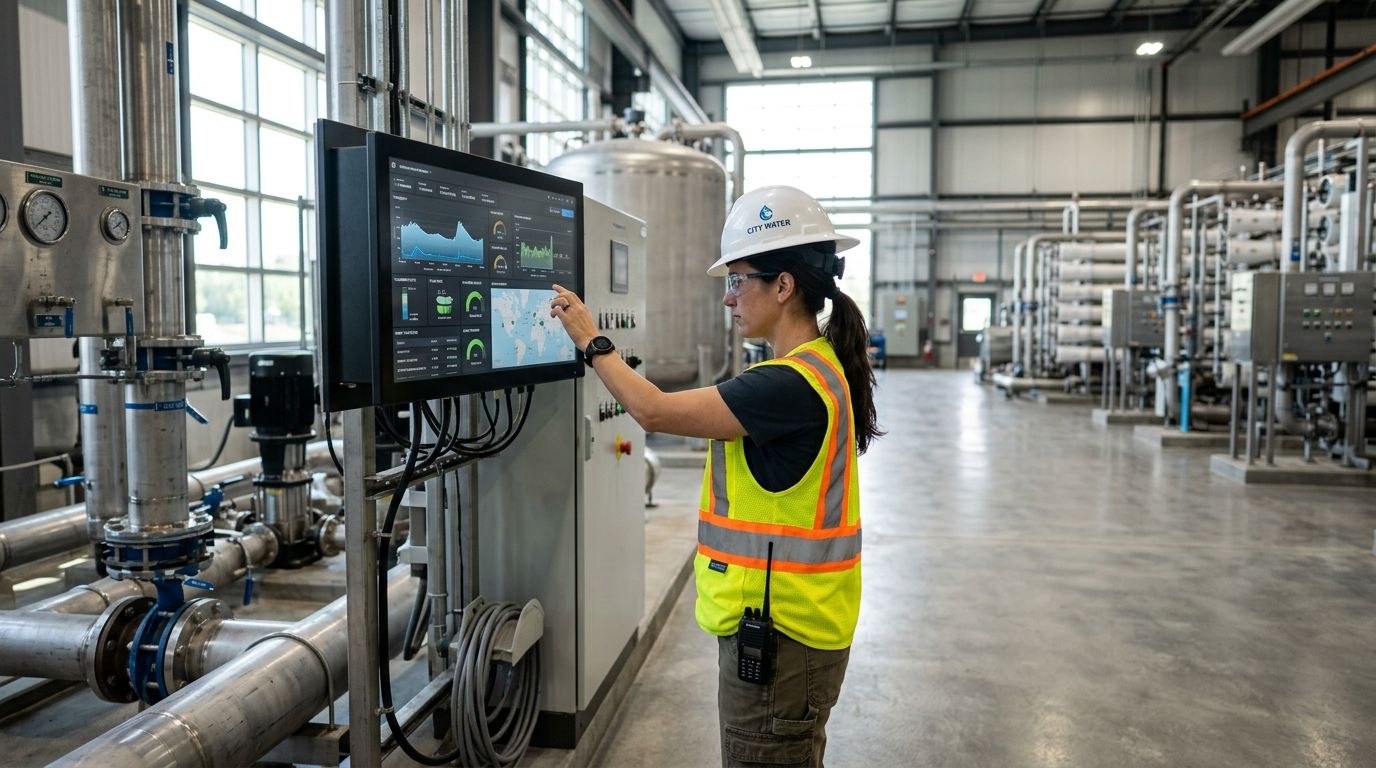
A municipal drinking water treatment plant runs on tank levels, chlorine residual, turbidity, pump vibration and clearwell temperature — and most plants still track those readings across three or four disconnected systems. The right iot platform for drinking water treatment plants pulls LoRaWAN, mioty and MQTT sensor data into one alarm and dashboard layer instead of five separate logins, and in 2026 that consolidation is what separates a plant that catches a residual drop before a violation from one that finds out after a regulator calls.
- Kilo IoT Platform consolidates LoRaWAN, mioty and MQTT sensors for tanks, pump stations and clearwells in one alarm system.
- Ignition by Inductive Automation wins for plants replacing an aging SCADA HMI that need deep PLC and OPC-UA driver support.
- ThingsBoard fits utilities with in-house developers who want to self-host and avoid vendor lock-in.
- AVEVA historian software suits multi-plant utilities extending an existing PI-style trend database rather than replacing it.
- Licensed UHF/VHF radio telemetry remains the practical fit for remote lift stations with a radio SCADA network already installed.
How does IoT monitoring fit into SDWA and AWIA compliance at a water treatment plant?
The Safe Drinking Water Act sets the contaminant testing baseline every community water system already knows. America's Water Infrastructure Act of 2018 added a second layer: any community water system serving more than 3,300 people has to complete a risk and resilience assessment and file an emergency response plan. Neither statute names a specific software category, but both assume the plant can show, with a timestamped record, that it caught a problem and responded to it.
Chlorine residual is the clearest example. The EPA's Surface Water Treatment Rule sets a minimum disinfectant residual of 0.2 mg/L entering the distribution system. A plant that logs residual on paper every four hours has four-hour blind spots. A plant with a chlorine analyzer publishing over MQTT into an alarm rule catches a drop in minutes, not hours — and has the execution history to prove when the alarm fired and who acknowledged it.
One option for that layer is the Kilo IoT Platform, which treats LoRaWAN, mioty and MQTT devices as one inventory instead of three separate vendor consoles. It is not the only option, and it is not built to replace an existing PLC-based SCADA system outright — it sits alongside one, or covers the sites that never got wired into SCADA in the first place, like a remote tank or an outlying lift station.
What makes the best IoT platform for drinking water treatment plants
- Protocol coverage — native LoRaWAN and mioty support for wireless sensors, plus an MQTT connector for PLCs, energy meters and BMS points that already publish data.
- Alarm escalation with severity tiers — a chlorine residual drop and a low tank level are not the same urgency, and the platform should route each differently.
- Audit trail and access control — every alarm acknowledgment and every rule change needs a timestamp and a named user, not a shared login.
- Digital twin visualization — a plan-view or 3D layout of tanks, pump stations and clearwells beats a spreadsheet when an operator is triaging at 2 a.m.
- On-premise or hybrid deployment — critical infrastructure procurement often requires the option, even if the utility ends up choosing cloud.
- Deployment cost that scales with sensor count, not with a fixed enterprise SCADA license, since most treatment plants add sensors gradually.
IoT platforms for municipal drinking water treatment plants at a glance
| Platform | Best for | Standout feature | Key limitation |
|---|---|---|---|
| Kilo IoT Platform | Consolidating tank, pump and clearwell sensors under one rules engine | Built-in LoRaWAN and mioty network server plus MQTT connector | PLCs connect via MQTT gateway, not a native OPC-UA driver library |
| Ignition by Inductive Automation | Plants replacing an aging SCADA HMI | Unlimited-client licensing model, deep native PLC/OPC-UA drivers | Not built around wireless LoRaWAN/mioty sensor onboarding |
| ThingsBoard | Utilities with in-house developers who self-host | Open-source, fully customizable rule chains | No built-in LoRaWAN or mioty network server |
| AVEVA historian software | Multi-plant utilities extending an existing historian | Mature long-term trend and compliance record data model | Historian-first architecture, needs an integrator for new points |
| Licensed radio telemetry | Remote lift stations with a radio SCADA network already installed | No recurring carrier dependency, works with zero fiber backhaul | Adding a new sensor type usually means a radio engineering change order |
1. Kilo IoT Platform: best for consolidating tank, pump and clearwell sensors
Kilo runs a built-in LoRaWAN and mioty network server, so a treatment plant does not stand up a separate network server before sensors show data. Tank level sensors on a water tower, chlorine analyzers publishing over MQTT, and pump vibration sensors in an underground vault all land in one device inventory, each with its own digital twin. The dashboard layer supports map widgets, chart widgets, gauges and image floor-plan pins, so an operator can see the plant layout with live readings pinned to tanks and pumps instead of scrolling a tag list.
Alarms run on five severity tiers with multi-step escalation chains — a chlorine residual drop can page the on-call operator by SMS after email goes unacknowledged for a set window, with quiet hours respected outside emergencies. Rules are built visually with a BPMN-based engine and CEL expressions, version-controlled with one-click deploy and rollback, and can be stepped through against a test payload before going live. The built-in AI assistant can onboard a new sensor, draft that escalation rule and set the alarm threshold through a plain-language conversation, scoped to the signed-in user's permissions and confirming before anything consequential deploys.
Kilo IoT Platform pros:
- Single console for LoRaWAN, mioty and MQTT devices instead of three vendor logins
- Five-tier alarm escalation with SMS, email, push and quiet hours
- ABAC access control and an immutable audit trail for who acknowledged what and when
- On-premise deployment option alongside the cloud platform
Kilo IoT Platform cons:
- PLCs and existing SCADA tags connect over an MQTT gateway rather than a native OPC-UA driver library
- Kilo Lens camera context is listed as coming soon, not available now
- No historian-depth, decade-long trend archive comparable to a dedicated SCADA historian
Best for: treatment plants adding wireless sensor coverage — tanks, remote vaults, pump rooms — without standing up a parallel SCADA project first. Sensors for tanks, chlorine analyzers and pump monitoring can be sourced through Kilo Electronics (kiloelectronics.com), which ships hardware worldwide.
2. Ignition by Inductive Automation: best for plants replacing an aging SCADA HMI
Ignition is a SCADA/HMI/MES platform built for on-premise control-room deployment, licensed per server rather than per client seat. It has a deep native driver library for PLCs and OPC-UA tags, which is exactly what a plant with twenty years of Allen-Bradley or Siemens hardware already needs.
Ignition pros:
- Unlimited-client licensing removes per-seat cost friction on the HMI side
- Extensive native PLC and OPC-UA driver support
- Long track record specifically inside water and wastewater plants
Ignition cons:
- Not built around wireless LoRaWAN or mioty sensor onboarding
- Remote alarm escalation via SMS or push is not a native out-of-box workflow
- Primarily an on-prem control-room tool, not a lightweight cloud dashboard
Best for: a plant that is fundamentally replacing its SCADA HMI and needs native PLC integration first, wireless sensor coverage second.
3. ThingsBoard: best for utilities that want to self-host
ThingsBoard is an open-source IoT platform with MQTT, CoAP and HTTP device connectivity and a configurable rule-chain engine, distributed under a free community edition.
ThingsBoard pros:
- No vendor lock-in — the utility owns the source and the data
- Rule chains are fully customizable down to the code
- Free to start on the community edition
ThingsBoard cons:
- No built-in LoRaWAN or mioty network server — a separate network server is required for wireless gateways
- Self-hosting means the utility's own staff owns patching, uptime and hardening, which matters under AWWA G430 cybersecurity risk-management expectations
- No packaged alarm escalation chain out of the box; it has to be built
Best for: a utility with a software team on staff that wants to run and modify its own stack rather than depend on a vendor roadmap.
4. AVEVA historian software: best for multi-plant utilities extending an existing historian
AVEVA (formerly Wonderware, now including OSIsoft PI) is historian and analytics software widely used across water and wastewater utilities for long-term trend storage and compliance reporting.
AVEVA pros:
- Mature historian data model built for years-long compliance trend records
- Wide existing systems-integrator base in the water sector
- Strong fit for utilities already reporting off historian trend exports
AVEVA cons:
- Historian-first architecture, not built around onboarding wireless LoRaWAN or mioty sensors directly
- New tag or point configuration typically needs an integrator, not a self-service workflow
- Cost and complexity scale with the historian license, not with sensor count
Best for: a multi-plant utility that already has a historian and mainly needs to extend it to new remote sites, not replace it.
5. Licensed radio telemetry: best for remote lift stations without a wireless sensor network
Licensed UHF/VHF radio SCADA telemetry has been the standard for remote lift stations and outlying tanks for decades, predating IP-based IoT entirely.
Licensed radio telemetry pros:
- No recurring carrier dependency since the utility owns the licensed frequency
- Works in areas with no existing fiber or wireless backhaul
- Proven reliability at sites that have run on it for years
Licensed radio telemetry cons:
- Adding a new sensor type usually means a radio engineering change order, not a config change
- No native dashboard, digital twin or mobile-style alerting
- Data model is fixed by whoever built the original network
Best for: a utility with a legacy licensed-radio network already installed at its remote sites and no near-term plan to replace the backhaul.
How to score IoT vendors in a water treatment plant RFP
Every item above was scored against the same six criteria from the section above: protocol coverage, alarm escalation depth, audit trail and access control, digital twin visualization, deployment flexibility, and cost that scales with sensor count rather than a fixed enterprise license. None of these five platforms wins on all six — that's the point of the table, not a flaw in it. A plant scoring vendors for procurement can lift these same six criteria directly into a water treatment plant RFP instead of starting from a blank scoring sheet.
See the platform before the RFP
Walk through alarms, dashboards and the digital twin on real sensor data.
Which IoT platform should a municipal water treatment plant choose?
A plant with a legacy PLC investment and a control room already running an HMI should extend Ignition rather than rip it out. A utility with in-house developers and a preference for owning its stack should look at ThingsBoard and budget the time to build the LoRaWAN network server layer itself. A multi-plant utility already running a historian should extend AVEVA rather than duplicate compliance trend data in a second system. A remote lift station on a working licensed-radio network has no urgent reason to switch backhaul in 2026.
For the common case — a plant adding wireless sensor coverage across tanks, clearwells and pump rooms, wanting one alarm escalation chain and one digital twin instead of three separate consoles — the Kilo IoT Platform is the practical starting point because LoRaWAN, mioty and MQTT already share one rules engine.
Do underground clearwells block LoRaWAN signal at a water treatment plant?
Concrete clearwells, buried vaults and below-grade pump rooms are exactly where standard LoRaWAN can lose link margin — thick concrete and rebar attenuate the signal harder than an open yard. mioty's telegram-splitting approach spreads a transmission across sub-packets sent on different frequencies and time slots, which improves the odds that enough sub-packets get through even in a lossy underground pocket. That's why a plant with buried assets often runs mioty for those specific points and LoRaWAN for surface tanks and yard equipment on the same platform, rather than picking one protocol for the whole site. The underground and shielded environments sensor guide covers which sensor types hold up in vaults specifically.
FAQ
What is the best IoT platform for drinking water treatment plants in 2026?
There is no single best platform for every plant — it depends on whether SCADA already exists. Kilo IoT Platform fits plants consolidating LoRaWAN, mioty and MQTT wireless sensors under one alarm system; Ignition fits plants replacing an aging SCADA HMI with heavy PLC integration.
Does a water treatment plant need SCADA and an IoT platform, or just one?
Most plants run both. SCADA/HMI handles real-time process control on wired PLC tags, while an IoT platform typically covers sites and sensors that were never wired into SCADA, like remote tanks, lift stations and retrofit chlorine analyzers.
Is mioty better than LoRaWAN for a water treatment plant?
Neither wins universally. mioty's telegram-splitting handles underground vaults and shielded clearwells better, while standard LoRaWAN is proven and lower-cost for surface tanks and yard equipment. Plants with both site types often run both protocols on one platform.
What sensors does a drinking water treatment plant typically monitor with IoT?
Common points include tank and reservoir level, chlorine residual, turbidity, pump vibration, clearwell temperature and pressure at distribution points. Each maps to a compliance requirement, like the EPA's 0.2 mg/L minimum chlorine residual rule.
Does AWIA 2018 require a specific IoT platform for water utilities?
No. America's Water Infrastructure Act of 2018 requires community water systems serving more than 3,300 people to complete a risk and resilience assessment and an emergency response plan, but it names no specific software or vendor.
Can an IoT platform replace an existing water treatment plant SCADA system?
Usually not outright. Most utilities run the IoT platform alongside SCADA, covering wireless sensors and remote sites, while SCADA keeps handling wired PLC-based process control in the plant itself.
How much does an IoT platform for a water treatment plant cost?
Cost varies by sensor count, deployment size and whether hardware is included, so check current terms directly with each vendor rather than relying on a fixed figure.
What alarm features matter most for drinking water compliance monitoring?
Severity tiers, escalation chains that reach a second person if the first doesn't acknowledge, and a timestamped audit trail matter most, since a regulator will ask when an alarm fired and who responded, not just whether one exists.
A detail most RFP checklists skip: ask whether the vendor's alarm escalation respects quiet hours for non-emergency alerts. A plant that pages the same operator for a minor turbidity blip at 3 a.m. every night trains that operator to ignore alerts within a month — which defeats the entire point of the system.