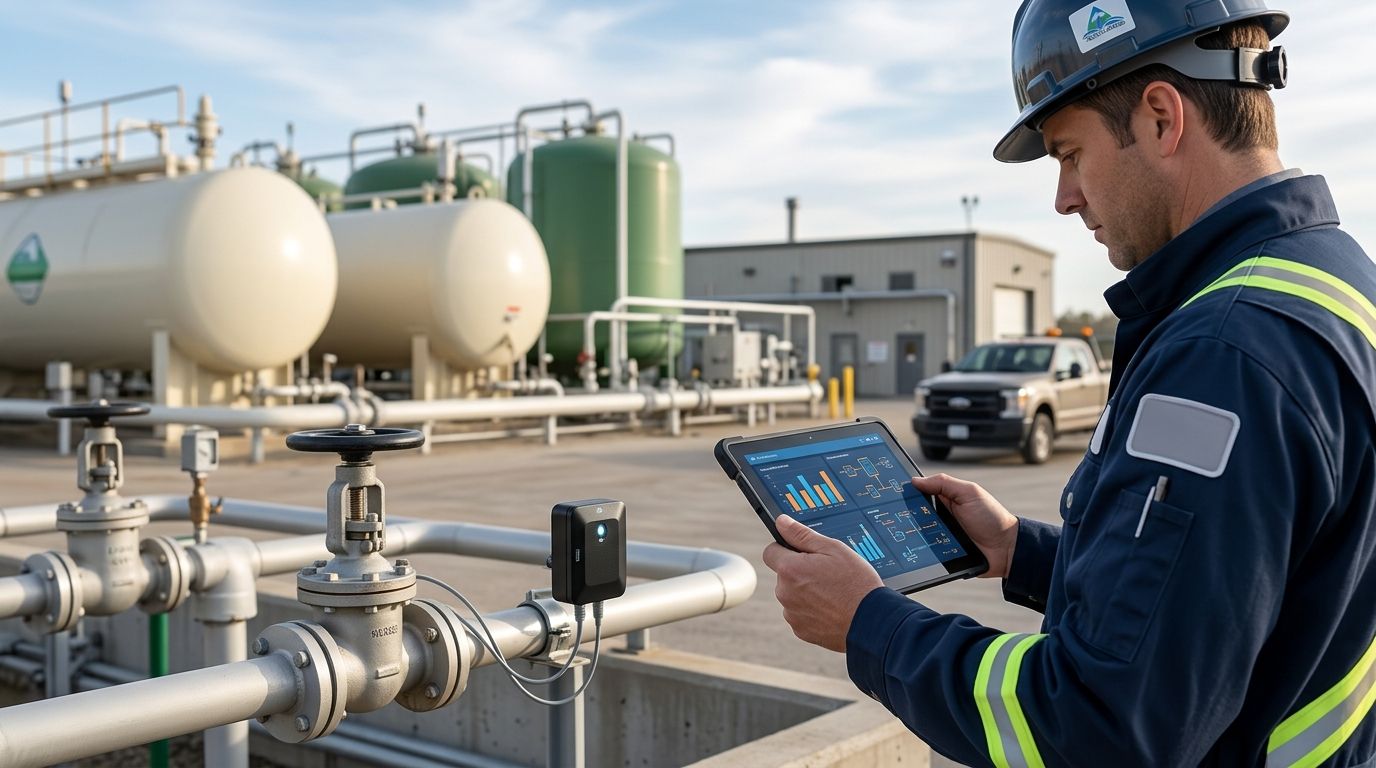
Propane and biogas distribution sites run on tanks, valves, and compressors that can't afford a missed reading. Bulk plants, cardlock stations, and anaerobic digesters all need level, pressure, and gas-detection data that reaches the right person before a threshold turns into an incident.
- The best IoT platform for propane distribution combines explosion-safe LoRaWAN or mioty connectivity with tank level, pressure, and methane leak sensors.
- NFPA 58 and OSHA 29 CFR 1910.110 both expect documented alarm response, not just a sensor reading on a screen.
- Kilo pairs a built-in LoRaWAN and mioty network server with a five-tier alarm system and a digital twin per tank or site.
- A Free Kilo plan covers up to 5 devices at 0 EUR; Starter runs 25 EUR per month for up to 25 devices, with gateways unlimited on both.
What does a propane or biogas distribution site need from IoT monitoring in 2026?
A propane bulk plant has tanks, transfer pumps, and truck-loading racks spread across an outdoor yard where running new cable is expensive and often not allowed near vapor-recovery lines. A biogas facility adds a digester headspace where methane concentration has to stay tracked continuously, not spot-checked.
Both site types answer to the same regulatory backdrop: NFPA 58, the LP-Gas Code, governs storage and handling distances and equipment; OSHA 29 CFR 1910.110 covers LP-gas storage and handling on the operations side. Neither standard cares whether you have a sensor — they care whether you can show a documented response when a threshold is crossed.
That's the real test for an iot platform for propane distribution: does it get a reading from a tank in a Class I hazardous area to a dispatcher's phone, and does it keep a record that an inspector can pull up in 2026 or five years from now.
What makes the best IoT platform for propane distribution sites
- Explosion-safe wireless connectivity — LoRaWAN or mioty radio that skips new cable runs through hazardous areas
- Tank level and pressure sensors with configurable low/high thresholds, not just raw readings
- Methane and combustible-gas detection tied directly into an alarm rule, not a separate silo
- Multi-step alarm escalation with quiet hours and a record an inspector can review
- A digital twin per tank or site so a multi-plant distributor isn't juggling spreadsheets
- Open MQTT and API access to feed existing dispatch or SCADA tools instead of replacing them
IoT platform capabilities at a glance for propane and biogas sites
| Capability | Why it matters here | What good looks like |
|---|---|---|
| Tank level monitoring | Prevents run-outs on delivery routes and overflow at bulk plants | Continuous readings with low-level alarms tied to dispatch |
| Methane / combustible gas detection | Required near valves, compressors, and digester headspace | Threshold rules that fire before LEL limits are reached |
| Explosion-safe wireless (LoRaWAN/mioty) | Hazardous-area zones need battery sensors, not new conduit | Long-range radio through tank farms and earthen berms |
| Alarm escalation and audit trail | NFPA 58 and OSHA inspections expect documented response | Severity tiers, escalation chains, immutable history |
| Digital twin per site | Distributors running several bulk plants need one view | 3D twin with sensors bound to tanks, pumps, and racks |
| Off-grid power | Rural yards and remote digesters often lack grid power | Battery sensors rated for multi-year field duty |
How does IoT tank level monitoring work for propane and biogas storage?
Ultrasonic or radar level sensors mount on the tank and report over LoRaWAN or mioty on a set interval — often every 15 to 60 minutes for a bulk propane tank, tighter for a digester that needs closer visibility. Each reading lands against a device's own digital twin, so an operator sees the tank's actual fill trend, not a single number frozen in time.
The threshold work happens in a rules engine: a low-level rule triggers a delivery alert before a route runs dry, a high-level rule catches an overfill before it becomes a compliance problem. A detailed breakdown of sensor types and reporting intervals for tank level monitoring for fuel distributors covers the hardware side in more depth.
What methane and gas leak detection do biogas distribution sites need?
A digester headspace, a compressor skid, or a truck-loading rack all need combustible-gas sensors wired into an alarm rule, not a dashboard nobody watches. The sensor reports a concentration; a CEL expression compares it against a threshold tied to the lower explosive limit for the gas in question, and the rule fires before the reading gets dangerous, not after.
That rule needs to escalate past a single notification. A first alert to the on-site technician, a second to the shift supervisor if nobody acknowledges it, and a permanent record either way — that escalation chain is what separates a real safety system from a sensor that just logs numbers. The specific sensor models and placement guidance in methane and gas leak detection sensors is worth reading before a rollout.
“If an alarm can't reach the right person before the LEL threshold, the sensor was decoration.”
Do LoRaWAN sensors work in explosion-hazard zones?
LoRaWAN and mioty radios themselves aren't what makes a deployment safe in a Class I Division 1 or 2 area — the sensor housing and its certification are. Intrinsically safe or explosion-proof enclosures come from the device manufacturer, and a propane distributor should confirm that rating against the specific zone classification before installing anything near valves, pumps, or vapor-recovery lines.
What the wireless protocol does solve is the cable problem: no new conduit runs through a hazardous area, no trenching across a tank farm. mioty in particular holds up well in dense metal environments — steel tanks, berms, and compressor housings — because of its telegram-splitting transmission, which is why it shows up often in industrial and underground deployments. Kilo Electronics carries sensor hardware rated for these environments and ships worldwide if a distributor needs to source certified units alongside the platform.
What alarm escalation rules matter for propane distribution compliance?
NFPA 58 and OSHA 29 CFR 1910.110 don't specify a software feature list, but both expect that a hazard gets a documented response. That's the operational gap most spreadsheet-based monitoring never closes: a reading that crossed a line but nobody can prove anyone saw it.
A platform built for this needs five things: severity tiers so a routine reading doesn't get treated the same as a leak, multi-step escalation so an unacknowledged alert reaches someone else, quiet hours so overnight staffing doesn't drown in false pages, a centralized inbox so nothing falls through a group text, and an audit trail that survives a regulator's request. The compliance angle specifically — what an inspector expects to see — is covered in hazmat storage compliance platform guidance.
How much does an IoT platform for propane distribution cost in 2026?
Pricing varies by vendor, but as a reference point: Kilo's Free plan runs at 0 EUR for up to 5 devices, 1 dashboard, and 1 rule, with no card required and no expiration — enough to pilot a single tank before committing budget. Starter moves to 25 EUR per month for up to 25 devices. Gateways are unlimited on every tier and never count against the device cap, which matters for a bulk plant covering several acres with more radio infrastructure than sensors.
How Kilo fits a propane or biogas distribution deployment
The Kilo IoT Platform runs a built-in LoRaWAN and mioty network server, so there's no separate network server to stand up before sensors start reporting. An MQTT connector picks up data from tank gauges, PLCs, or existing compressor controllers that already publish over MQTT, which matters when a bulk plant has legacy SCADA hardware it isn't replacing.
Each tank or piece of equipment gets its own digital twin, and a live 3D building or site twin binds sensors to their physical location across a yard. The visual rules engine handles the threshold logic — version-controlled, deployable with one click, and testable against a sample payload before it goes live on a real tank. Alarms carry five severity tiers, multi-step escalation, quiet hours, and a centralized inbox, all logged for the audit trail an inspector will ask about.
Kilo's built-in AI assistant can draft and deploy a rule from a plain-language description — "alert the shift lead if tank 3 drops below 20 percent and escalate to the site manager after 15 minutes unacknowledged" — and it confirms before anything consequential deploys. It operates inside the signed-in user's own permissions, so it isn't a shortcut around access control.
Try Kilo on one tank first
Free plan covers up to 5 devices, no card required, never expires.
FAQ
What is the best IoT platform for propane distribution sites?
The best fit combines explosion-safe LoRaWAN or mioty connectivity, tank level and gas-leak sensors, and multi-step alarm escalation with an audit trail. Kilo covers all three through a built-in network server, rules engine, and five-tier alarm system.
How does IoT tank level monitoring work for a propane bulk plant?
An ultrasonic or radar sensor mounts on the tank and reports fill level over LoRaWAN or mioty on a set interval. Low and high thresholds trigger delivery alerts or overfill alarms automatically.
Can IoT sensors detect methane leaks at a biogas facility?
Yes, combustible-gas sensors placed near digester headspace, compressors, and loading racks report concentration data that a rules engine compares against a lower-explosive-limit threshold. The alarm fires before the concentration reaches a dangerous level.
How much does an IoT platform for propane distribution cost in 2026?
Kilo's Free plan is 0 EUR for up to 5 devices with no card required; Starter is 25 EUR per month for up to 25 devices. Gateways are unlimited on both tiers.
Do LoRaWAN sensors work in explosion-hazard zones at propane sites?
The radio protocol itself doesn't determine hazardous-area safety — the sensor enclosure's certification does. Confirm the device rating against the site's zone classification before installing near valves or vapor-recovery lines.
What alarm response do NFPA 58 and OSHA expect from propane monitoring?
Neither standard mandates specific software, but both expect a documented response to a hazard reading. That means escalation chains and an audit trail, not just a dashboard number.
Is mioty or LoRaWAN better for a propane tank farm?
mioty's telegram-splitting transmission holds up well around dense steel tanks and berms, while LoRaWAN has broader sensor availability. Kilo runs both through the same built-in network server, so the choice depends on the specific site's radio environment.
How many devices can I monitor for free with Kilo?
The Free plan covers up to 5 devices, 1 dashboard, and 1 rule at 0 EUR, with no card required and no expiration date.
How to choose an IoT platform for propane distribution rollout
Start with one tank and one alarm rule before committing to a full yard. A pilot on a single bulk tank — level sensor, one threshold rule, one escalation step — surfaces radio coverage problems and false-alarm tuning issues before they're expensive across 40 tanks.
The detail that trips up most distributors isn't the sensor accuracy, it's the escalation chain: an alarm that only pages one person fails the moment that person is off shift. Build the second and third escalation step before go-live, not after the first missed alert.