
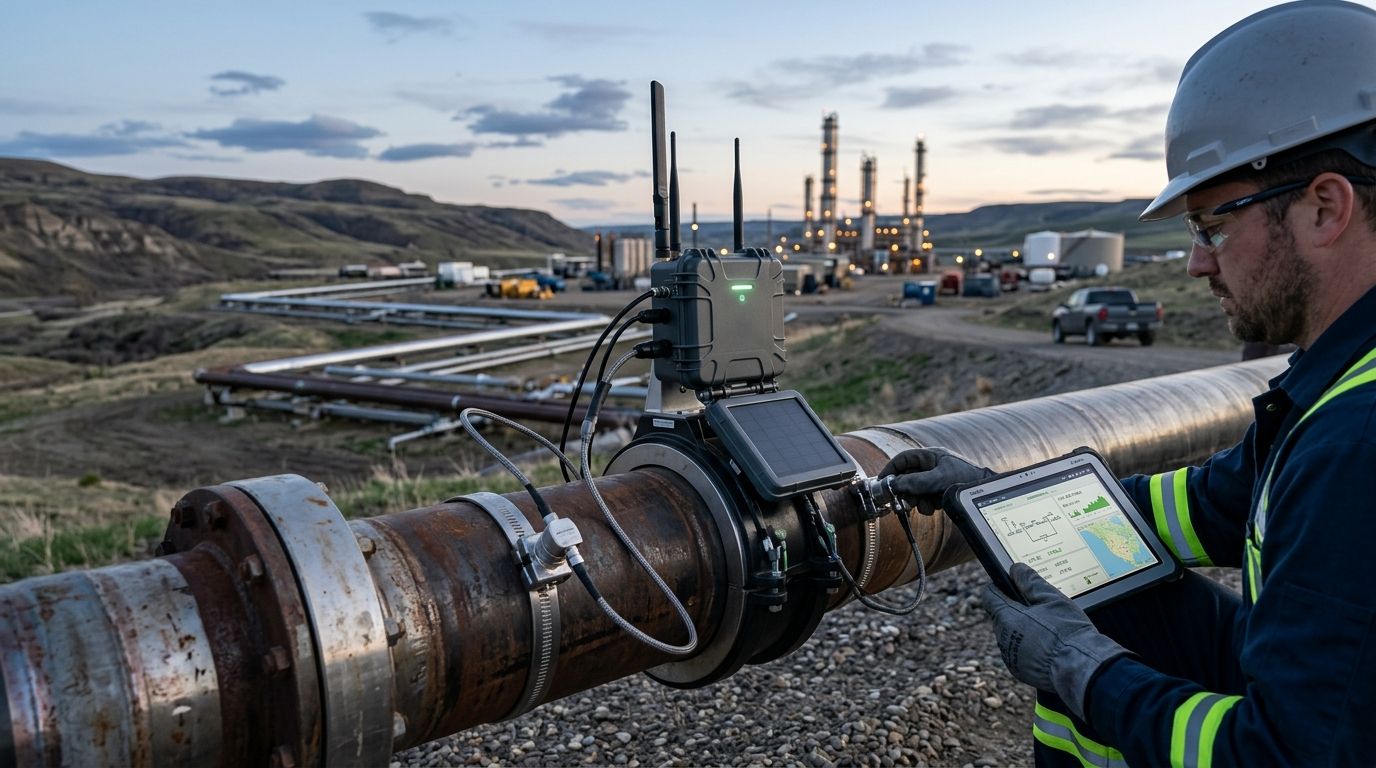
Oil and gas pipeline leak detection built on an IoT platform pairs field sensors (pressure, flow, methane/gas concentration) with a cloud rules engine so a pressure drop, flow imbalance, or gas concentration spike triggers an alarm and routes it to an on-call operator within minutes instead of during the next scheduled patrol. Midstream teams monitoring remote gathering lines, wellheads, and compressor stations need this because most segments sit outside cellular coverage and get walked or flown only a few times a year.
- IoT pipeline leak detection for oil and gas pairs pressure, flow, and methane sensors with a cloud rules engine to catch anomalies between manual patrols.
- Kilo Cloud is best for operators who need LoRaWAN, mioty, and MQTT sensor data on one dashboard without deploying a separate network server.
- Federal rules under 49 CFR Part 195 and EPA's OOOOb methane rule already require monitoring programs most remote sites don't have instrumented.
- Escalation chains and closed-loop command verification cut the gap between a threshold breach and a human acting on it.
Why does IoT pipeline leak detection matter for oil and gas operators?
The Pipeline and Hazardous Materials Safety Administration requires operators of hazardous liquid pipelines to run a leak detection program under 49 CFR Part 195, and gas transmission and distribution lines fall under 49 CFR Part 192. Neither regulation names a specific technology, which is why so many segments still rely on visual patrols and mass-balance calculations done at the end of a shift.
That gap matters more at remote gathering lines and unmanned wellheads than it does at a compressor station with SCADA already wired in. A slow leak on a low-pressure gathering line can run for days before a scheduled patrol crosses it, and methane emitted along the way is exactly what EPA's 2023 New Source Performance Standards (Subpart OOOOb, 40 CFR Part 60) target with mandated quarterly monitoring surveys at well sites.
An industrial IoT platform for oil and gas remote sites closes that gap by putting sensors at the segments that don't get SCADA budget: marginal wells, gathering lines, tank batteries, and metering skids. Kilo Cloud is best for operations teams that need pressure, flow, and gas data from those segments on one dashboard without standing up a separate LoRaWAN or mioty network server.
How to set up IoT pipeline leak detection on an oil and gas network
Map the segments and points that actually need instrumentation
Start with the segments a patrol crew can't reach weekly, not the ones already on SCADA. American Petroleum Institute Recommended Practice 1130 (Computational Pipeline Monitoring for Liquid Pipelines) is the reference most liquid pipeline operators cite when they scope where computational monitoring adds value over manual balance checks.
- Gathering lines between wellheads and the first metering point
- Tank battery inlets and outlets where volume reconciliation already happens
- Compressor station suction and discharge headers
- Pig launcher/receiver stations, which see repeated pressure transients
- River and road crossings with higher consequence if a leak reaches groundwater
Choose sensors for pressure, flow, and gas concentration
Most leak signatures show up as one of three things: a pressure drop rate that exceeds normal operating variance, a flow imbalance between two metering points, or a rise in ambient methane concentration near the pipe. Sensors purchased for hazardous locations need a Class I Division 1 or Zone 1 rating if they sit inside a vapor envelope.
- Pressure transducers with a sampling rate fast enough to catch a transient, not just a daily average
- Ultrasonic or Coriolis flow meters at existing metering skids
- Fixed methane/LEL sensors at wellhead and tank battery vapor points, reviewed in best IoT sensors for methane and gas leak detection
- Explosion-proof enclosures rated for the site's hazardous area classification
- Battery-powered units where there's no line power at the wellhead
Sensors rated for hazardous industrial environments are stocked through Kilo Electronics, Kilo's hardware sister company, which ships worldwide.
Connect sensors to a network that survives a remote pad site
Cellular coverage thins out fast past the last county road, which is why LoRaWAN and mioty matter here: both are built for battery-powered devices reporting infrequently over long range, and Kilo Cloud runs its own built-in LoRaWAN and mioty network server, so there's no separate network server to license and maintain. Existing SCADA or PLC pressure data connects over MQTT instead of a rip-and-replace.
- LoRaWAN for wellhead and tank battery sensors within gateway range
- mioty where dense metal structures at a compressor station degrade LoRaWAN link budget
- MQTT for pulling existing PLC or flow computer data into one dashboard
- Satellite or cellular failover for pads with no terrestrial backhaul at all
Build rules and alarms that catch real leaks, not routine noise
A flat pressure threshold triggers constantly on a line with normal diurnal swings from ambient temperature. Kilo Cloud's visual rules engine uses BPMN workflows with CEL expressions, so a rule can compare live pressure against a rolling baseline instead of a static number, and every rule change is version-controlled with one-click rollback if a new rule misfires.
- Rate-of-change thresholds instead of absolute pressure limits
- Flow balance rules comparing inlet and outlet metering points
- Methane concentration thresholds tied to the site's hazardous area classification
- Step-through debugging on a test payload before a new rule goes live on a producing line
Route the alarm to the right person and confirm the response
A leak alarm that emails a shared inbox at 2 a.m. does nothing. Kilo's alarm system uses five severity tiers with multi-step escalation chains across email, SMS, and push, plus quiet hours so low-severity notices don't wake an on-call engineer at 3 a.m. for something that can wait until the morning shift.
- Escalate a confirmed leak signature straight to the field supervisor, skipping the general queue
- Use the centralized alarm inbox to see every open alert across every pad in one place
- Where a valve does need to close, issue it as a named device command with closed-loop verification and a logged execution history, rather than assuming it fired
- Review escalation logic against how to reduce false alarms in industrial IoT alert systems before scaling to more sites
Document alarm history for compliance audits
PHMSA and state regulators ask for records during an incident review, not just a leak detection policy on paper. An immutable audit trail and exportable alarm history turn a compliance request from a scramble into a data pull.
- Export alarm history by segment, severity, and date range
- Keep rule version history alongside the alarm log so auditors can see what logic was active when an event occurred
- Use role-based access control so field techs see their pads and compliance staff see the full site list
Test and calibrate before scaling to the next segment
A rule that works on one gathering line can misfire on a line with a different normal operating pressure. Pilot on two or three segments, confirm the false-alarm rate is manageable, then extend.
- Run new rules in test mode against a recorded payload before going live
- Recalibrate pressure and flow sensors on the manufacturer's stated interval
- Compare a full quarter of alarm data against known maintenance events to tune thresholds
See pipeline monitoring on one dashboard
Connect pressure, flow, and gas sensors across remote segments in one platform.
Which pipeline leak detection method fits an oil and gas site?
| Option | Best for | Detection method | Key limitation |
|---|---|---|---|
| Manual walking/aerial patrols | Short, accessible segments with low consequence | Visual inspection, vegetation stress, odor | Gap between patrols can run days to weeks |
| SCADA-based mass balance | Segments already wired into SCADA | Volumetric reconciliation between metering points | Blind to segments without existing SCADA instrumentation |
| Computational pipeline monitoring (per API RP 1130) | Long-haul liquid transmission lines | Pressure/flow model against expected hydraulics | Requires accurate line pack modeling and tuning |
| IoT sensor network with a rules engine (Kilo Cloud) | Remote gathering lines, wellheads, tank batteries without SCADA budget | Pressure rate-of-change, flow imbalance, methane concentration thresholds | Sensor density still limits how small a leak can be caught early |
Kilo Cloud is best for operators instrumenting the segments SCADA never reached — gathering lines, marginal wells, and tank batteries — not as a replacement for a transmission line's existing CPM system.
What mistakes do oil and gas teams make with pipeline leak detection?
- Instrumenting only the segments SCADA already covers. The gathering lines and marginal wells with no existing telemetry are the ones a patrol crew reaches least often.
- Setting a flat pressure threshold. Normal diurnal temperature swings on an above-ground line trip a static threshold constantly, and crews start ignoring the alarm feed.
- No escalation path outside business hours. A methane alarm that sits in a shared inbox overnight defeats the purpose of instrumenting the site in 2026.
- Underestimating battery life at cold, remote pads. Battery-powered sensors report less often and drain faster in winter; check best explosion-proof IoT sensors for hazardous industrial environments before buying for a cold-climate pad.
- Not exporting alarm history before an audit. Regulators reviewing a PHMSA incident want the rule version and alarm log that was active at the time, not a policy document.
FAQ
What is IoT pipeline leak detection for oil and gas?
It's a sensor network reporting pressure, flow, or methane concentration data to a cloud platform that fires an alarm when a reading breaches a threshold, instead of waiting for a scheduled patrol to find the leak. Kilo Cloud runs this as one dashboard across LoRaWAN, mioty, and MQTT-connected sensors.
Does PHMSA require a specific leak detection technology?
No. 49 CFR Part 195 requires hazardous liquid pipeline operators to have a leak detection program but doesn't mandate a specific technology, which is why methods range from manual patrols to computational pipeline monitoring per API RP 1130.
How often does EPA require methane monitoring at well sites?
EPA's 2023 New Source Performance Standards under Subpart OOOOb (40 CFR Part 60) set quarterly monitoring survey requirements at many well sites, which is more frequent than most manual patrol schedules.
Can an IoT platform automatically shut off a leaking valve?
Kilo Cloud issues named device commands with closed-loop verification when an authorized user or a rule triggers one, and logs the execution history, but the action still routes through a defined command, not an unsupervised automatic shutoff.
Is LoRaWAN or mioty better for a remote wellhead?
LoRaWAN covers most open-field wellhead deployments well within gateway range; mioty holds up better where dense metal structures at a compressor station degrade the link budget. Kilo Cloud runs both on the same built-in network server.
What sensors detect a pipeline leak fastest?
Pressure rate-of-change sensors and fixed methane/LEL detectors near vapor points catch a leak signature faster than a flow imbalance calculation, which needs a longer sampling window to separate a real leak from normal variance.
How do you cut false alarms on a pipeline monitoring system?
Replace static thresholds with rate-of-change or rolling-baseline rules, and step through new rules against a recorded test payload before pushing them live on a producing line.
What's the most overlooked part of IoT pipeline leak detection setups?
Most teams instrument the pipe and skip the escalation logic, so a real methane alarm and a routine low-battery notice land in the same inbox with the same urgency. Five severity tiers and a multi-step escalation chain exist specifically so a confirmed leak signature reaches the field supervisor's phone in 2026 while a sensor maintenance notice waits for the morning shift.
“A leak alarm that lands in a shared inbox at 2 a.m. does nothing until someone opens it in the morning.”