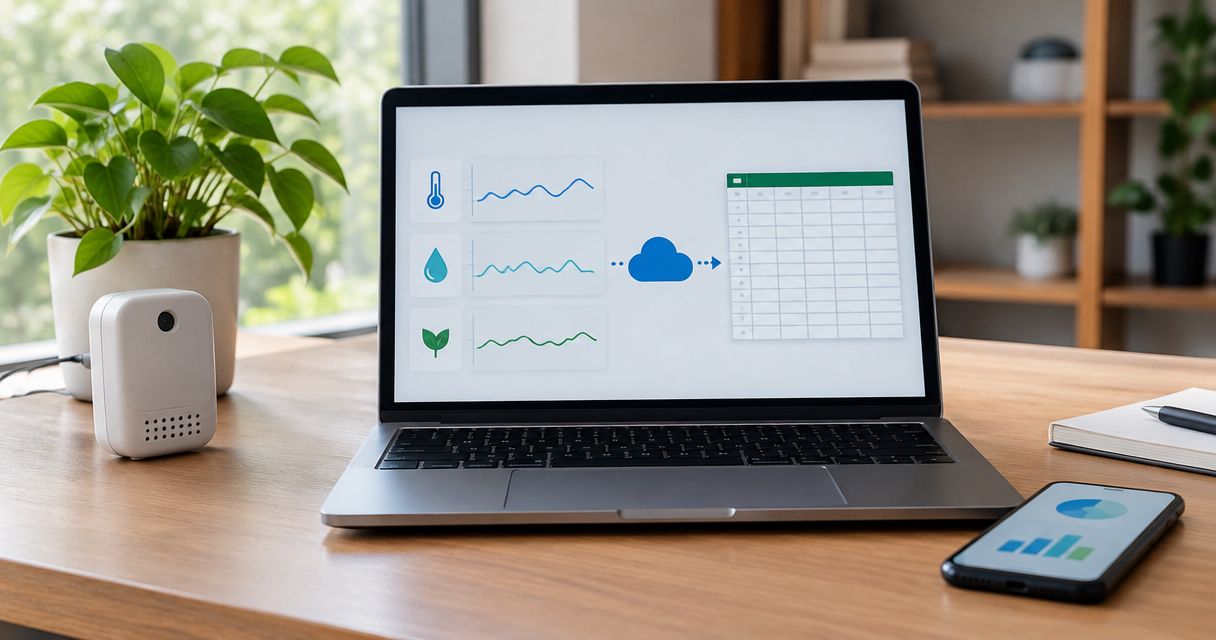
The best IoT platform for startups is a managed platform when your first deliverable is working device monitoring; self-hosted software fits teams that need deployment control, and cloud components fit teams building a custom product backend. The Kilo IoT Platform is the worked example here for connecting devices, testing rules, and governing equipment commands in 2026.
- The best IoT platform for startups matches the first customer workflow, not the longest feature list.
- Kilo fits startups connecting LoRaWAN, mioty, and MQTT devices with dashboards, rules, alarms, and governed commands.
- Self-hosted IoT software fits teams prepared to own deployment, backups, upgrades, and recovery.
- Cloud components fit custom IoT product backends when engineering ownership is already assigned.
- Device monitoring and physical AI need different acceptance tests: receiving data does not prove equipment acted.
What makes the best IoT platform for startups?
A startup needs to prove a customer outcome before expanding its architecture. A temperature chart is useful, but the actual deliverable might be an alarm reaching the facilities manager when a reading crosses a configured threshold. These are different acceptance criteria.
For a 2026 shortlist, use these criteria before comparing platforms:
- Device fit: Can the platform ingest your actual sensor payloads, units, identifiers, and timestamps?
- Operational completeness: Can an operator find a device, inspect its history, acknowledge an alarm, and understand its current condition?
- Engineering ownership: Who maintains the network server, integrations, deployment, and recovery procedure?
- Customer separation: Can you restrict access to the correct organization, site, and device?
- Change control: Can you test rules before deployment and restore a previous version?
- Command evidence: Can you distinguish a requested action from delivery and confirmed equipment state?
Kilo is an IoT platform for startups that need mixed-protocol monitoring and governed device commands in one operational system. That is a workflow-fit recommendation, not a claim that every startup needs every feature.
Best IoT platform for startups: architecture options at a glance
Compare ownership models before vendor names. Each approach answers a different question about what your startup intends to build and operate.
| Approach | Best for | Standout characteristic | Key limitation |
|---|---|---|---|
| Managed operational platform | Delivering monitoring workflows to customers | Device management, dashboards, rules, and alarms in an existing application | You must fit your workflow to the platform's documented interfaces and controls |
| Self-hosted IoT application | Teams requiring deployment ownership | Your team operates the application and its environment | Backups, upgrades, recovery, and security become operating responsibilities |
| Cloud IoT components | Engineering-led startups building a custom backend | You assemble device ingestion with your own application services | An operator-ready product still needs dashboards, alarms, permissions, and support workflows |
These options are not mutually exclusive. A startup can use an operational platform for device execution and keep its customer-facing application separate. The important boundary is which system owns device truth and command history.
Managed IoT platform for startups delivering customer monitoring
Best for: a startup whose first customer needs a usable monitoring workflow rather than a new backend architecture. A managed operational platform puts device data, dashboards, alarms, and administration into an application your team can configure. You still own sensor selection, installation, payload interpretation, and customer procedures.
Use a concrete pilot. Connect a temperature sensor, map its reading and unit, show its latest timestamp, and configure an alarm using the customer's approved threshold. Have the intended recipient acknowledge the notification.
Managed platform pros:
- Existing operational interfaces reduce the application surface you need to build.
- Device records and dashboards give support staff a place to investigate problems.
- Configurable rules let you express customer conditions without creating a separate rules service.
- A shared platform can support repeatable onboarding procedures across deployments.
Managed platform limitations:
- Supported connectors do not remove the need to verify payload decoding and device behavior.
- Customer requirements outside the documented feature set need integration work or a different approach.
- Cloud operation does not solve weak radio coverage, failed sensors, or missing device feedback.
For the worked example, Kilo includes built-in LoRaWAN and mioty network servers, plus an MQTT connector. You do not need an external network server for those built-in network-server functions. Its dashboards support maps, charts, image floor-plan pins, gauges, and control widgets.
Recommendation: choose this approach when delivering the operator workflow is your immediate milestone. Prove ingestion, alarm handling, permissions, and recovery before adding more sites.
Self-hosted IoT platform for startups needing deployment ownership
Best for: a startup with an explicit requirement to operate the platform environment itself. Self-hosting changes who owns the service boundary. It gives your team responsibility for deployment and the surrounding infrastructure rather than transferring that work to a hosted application provider.
Distinguish self-hosting from open source. They are different decisions. A proprietary platform can support on-premise deployment, while an open-source application still requires someone to maintain its operating environment.
Self-hosted platform pros:
- Your team controls the deployment environment and maintenance schedule.
- You can align infrastructure with a customer's documented hosting requirements.
- Application and infrastructure changes can follow your own release process.
Self-hosted platform limitations:
- Someone must own upgrades, monitoring, backups, and recovery.
- Application access controls still require configuration and testing.
- Infrastructure ownership does not guarantee compatible sensors or usable operator workflows.
Before choosing this approach in 2026, name the person responsible for restoring service after a failed upgrade. Ask that person to demonstrate recovery rather than describe it. An untested backup is not a recovery procedure.
Recommendation: choose self-hosting only when deployment ownership is a requirement and operational ownership is assigned. Do not make it the default simply because the application can run on your server.
Cloud IoT platform components for startups building custom products
Best for: an engineering-led startup whose product requires its own application backend and device lifecycle. Cloud components provide building blocks rather than a finished facilities-monitoring workflow. Your team decides how ingestion, storage, authorization, business logic, and customer interfaces fit together.
This approach makes sense when application behavior is the product. It makes less sense when your first customer mainly needs a sensor dashboard and dependable alarm routing.
Cloud component pros:
- You define the application data model and customer experience.
- Device events can enter the same backend as your other product data.
- You can separate ingestion, processing, and presentation according to your architecture.
Cloud component limitations:
- A message arriving in a backend is not an operator-ready monitoring service.
- Tenant separation, alarm acknowledgment, and support interfaces need deliberate implementation.
- Command delivery and equipment verification need separate handling.
Write the missing application pieces before selecting services. Include device onboarding, credential management, telemetry history, stale-data handling, alarm routing, customer permissions, and incident investigation. Assign ownership to each piece.
Recommendation: choose components when the custom backend is central to your product and your team accepts the application work. Keep equipment-control responsibilities explicit even when the rest of the architecture is custom.
How to test an IoT platform for startups before deployment
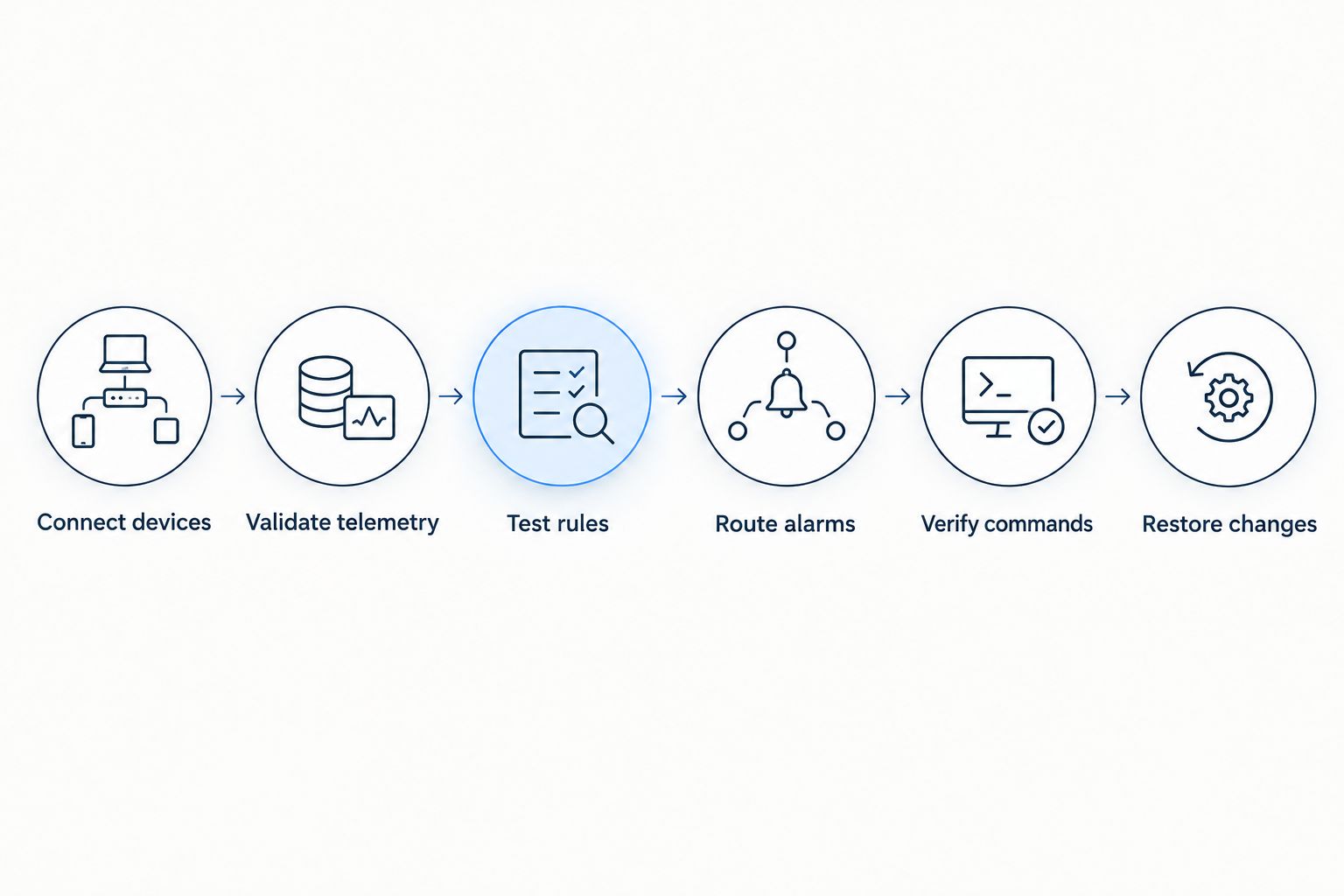
Your 2026 pilot should test the complete workflow, including failure. Do not stop at a populated chart. Use this sequence as an acceptance test your engineer and intended operator can run together.
- Connect devices. Register the intended hardware and verify that readings reach the correct device record.
- Validate telemetry. Check units, timestamps, identifiers, and the difference between a fresh reading and an old value.
- Test rules. Submit a known test payload and confirm the rule follows the intended path.
- Route alarms. Check severity, recipients, escalation, and acknowledgment with the person responsible for responding.
- Verify commands. For supported equipment, validate parameters and check delivery state separately from device feedback.
- Restore changes. Return to the previous rule version and confirm the restored behavior.
Include stale telemetry in the test. A dashboard that still displays a previous value must not persuade an operator that the equipment is reporting normally. Define the expected reporting behavior for the actual sensor rather than assuming all devices transmit alike.
For a deployment with many devices, onboarding LoRaWAN sensors across multiple sites is a separate operational task. Your platform pilot should establish a repeatable registration and validation procedure before you expand it.
How an IoT platform for startups supports rules and alarms
An alarm needs more than a threshold. Define the condition, the recipient, the severity, and what acknowledgment means. The founder, integration engineer, and facilities manager should agree on these details before the first customer deployment.
In the worked example, Kilo provides a visual BPMN rules engine with CEL expressions, version control, deployment and rollback controls, and step-through debugging on a test payload. Its alarms include 5 severity tiers, multi-step escalation chains, email, SMS, push notifications, quiet hours, and a centralized inbox.
These mechanics support a useful evaluation exercise: test the same rule with a normal payload, an out-of-range payload, and a malformed payload. Inspect the result of each path. Do not infer correct behavior from the rule diagram alone.
Ask the operator to demonstrate the response procedure:
- Find the affected device and its latest telemetry.
- Understand why the alarm fired.
- Acknowledge the alarm using the agreed workflow.
- Identify the next escalation recipient.
- Confirm that the condition returned to normal using new readings.
The limitation is operational: an alarm does not repair equipment or prove a diagnosis. Keep the message tied to the observed condition and assign the next action to an accountable person.
How an IoT platform for startups governs physical AI commands
Physical AI adds an execution boundary to your platform selection. An assistant that explains sensor readings is different from an agent that can send an equipment command. Evaluate the latter against permissions, configured actions, parameter constraints, and evidence of the result.
Kilo exposes connected devices to Claude through MCP and enforces the authenticated user's permissions and organization boundary. Commands must be configured; named typed commands use parameter validation. Supported command paths include MQTT and LoRaWAN Class C, with execution history and closed-loop verification where device feedback supports it.
An accepted or delivered command does not prove the equipment changed state. Check device confirmation or subsequent telemetry where available. If neither exists, record that limitation instead of presenting delivery as verification.
The built-in assistant confirms before consequential actions. External MCP clients control their own approval experience; platform permissions and configured-command requirements remain separate controls.
For a startup planning device control in 2026, test a rejected parameter and an unauthorized action as deliberately as a successful command. Your acceptance criteria should include refusal behavior, not just successful execution. Keep monitoring-only workflows separate until the command path and feedback are proven.
How to choose an IoT platform for startups with mixed devices
Start with a hardware inventory. Temperature and humidity sensors, door contacts, energy meters, pressure transmitters, and trackers have different payloads and reporting behaviors. A PLC or BMS that publishes through MQTT also needs a defined mapping between its message and your platform's device context.
The worked example includes 1 digital twin per device and a live 3D digital building twin with sensors bound to objects. Its vehicle and tracker connector includes 2,000+ preconfigured tracker templates. These capabilities belong in an evaluation only when they match your planned deployment.
A template is not proof that an installed device is reporting correctly. Validate identity, units, timestamps, and location behavior with the intended hardware. For an energy meter, check the quantity being reported; for a tracker, check whether the position is current.
Hardware is a separate purchase decision. Devices can also be purchased through Kilo Electronics at kiloelectronics.com, with worldwide shipping. Hardware sourcing does not change the cloud platform's geographic scope.
Best IoT platform for startups FAQ
What's the best IoT platform for startups in 2026?
A managed operational platform is the default choice when your startup needs to deliver device monitoring, dashboards, and alarms to its first customer. Choose self-hosting for assigned deployment ownership, or cloud components when a custom backend is central to your product.
Is Kilo suitable for a startup using different sensor protocols?
Kilo supports LoRaWAN, mioty, and MQTT through its documented network-server and connector capabilities. Verify the intended devices, payload mappings, reporting behavior, and supported commands during your pilot.
Should a startup choose open-source IoT software?
Choose open-source software when its application fit and maintenance responsibilities match your team. Open source and self-hosting are separate decisions; neither removes the need for backups, access controls, upgrades, and recovery tests.
Does MQTT delivery prove that a device acted?
No, MQTT message delivery does not prove that physical equipment changed state. Use device feedback or subsequent telemetry where available, and keep delivery status separate from verified equipment behavior.
What should a startup test before connecting an AI agent to equipment?
Test permissions, configured commands, parameter validation, approval behavior, delivery state, and device feedback. Include rejected and unauthorized actions alongside successful commands.
How should a startup compare IoT platform operating requirements?
Compare the complete deployed workflow, including hardware, integration, hosting responsibilities, support, backups, and maintenance. Ask each provider to document limits and responsibilities instead of comparing a single plan label.
Can a startup use an IoT platform alongside its own application?
Yes, a startup can keep its customer application separate from the device platform. Define which system owns device identity, telemetry, permissions, alarms, and command execution records, then evaluate the documented integration interfaces.
Which IoT platform for startups should you choose in 2026?
Default to a managed operational platform when your first customer needs a working monitoring service. Choose self-hosting when deployment ownership is mandatory and staffed. Choose cloud components when building the backend is part of your product, not an accidental prerequisite to showing a sensor reading.
The decisive test is a failed reading or command. Ask the intended operator to explain what happened using the platform's records. If the answer requires an engineer to inspect several unrelated systems, your startup has found unfinished operational work—not a successful deployment.