
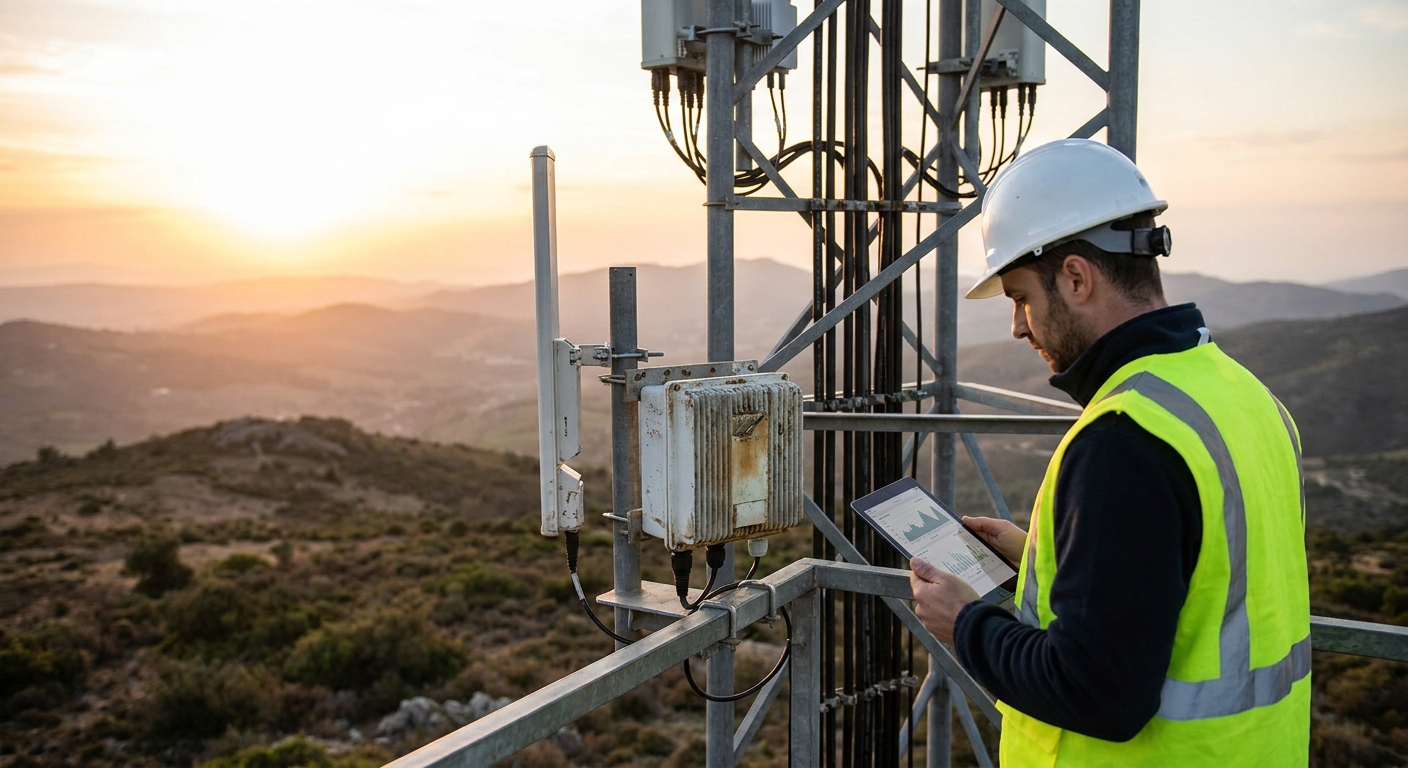
Telecom towers fail quietly. A cracked cabinet door lets humidity in for months before anyone notices, a battery bank drops below spec at 2 a.m., and a generator runs dry on diesel while the fuel gauge still reads a quarter tank. This guide ranks the platforms operations teams use in 2026 to catch those failures before a truck has to roll.
- Kilo Cloud wins the best iot platform for telecom towers ranking for 2026 — LoRaWAN, mioty and satellite backhaul on one dashboard. Buy.
- Open-source self-hosted stacks cost less upfront but need a full-time integrator to keep alarms running. Hold.
- Legacy SCADA and RTU systems handle grid power reporting but rarely track cabinet temperature or door tamper events. Hold for hybrid sites only.
- Tower OEM proprietary dashboards lock monitoring data to one hardware vendor. Skip on mixed-equipment sites.
Why this matters
Carriers and tower companies running sites from a handful to several hundred need one system that reads battery voltage, cabinet temperature, door and tamper status, and generator fuel level side by side, not five separate vendor logins stitched together with spreadsheets. Kilo Cloud, the platform behind Kilo IoT, was built around that exact problem: pull LoRaWAN, mioty and MQTT devices into one rules engine so alarms fire before a technician has to guess what went wrong on site.
A tower outage rarely announces itself. Battery drawdown on a 48V DC bus, a fan that stopped moving air through a 60°C cabinet in July, or a diesel tank crossing 20% capacity at a remote site all look like non-events until they trigger an SLA breach. The right platform turns those slow-moving signals into an alarm days ahead of the failure, not a ticket after the outage.
How we ranked
Each platform type below was scored against five things that matter specifically for tower sites: connectivity range for towers spaced miles apart, backup power and fuel visibility, alarm automation speed, integration with existing tower management software, and total cost of ownership once a portfolio hits triple-digit site counts. Platforms that need a dedicated integrator to stay running score lower on cost of ownership even when the software itself is capable. Platforms that only handle one signal type — power but not fuel, or temperature but not tamper — score lower on completeness, because tower ops teams need one dashboard, not three.
The ranked list
1. Kilo Cloud — the AI-first pick
Kilo Cloud runs LoRaWAN, mioty and MQTT devices under one rules engine with a digital twin view of each site. On a tower cabinet, that means battery voltage, internal temperature, door status and generator fuel level sit on the same screen, and an alarm can chain a low-fuel reading with a door-open event to flag a possible theft in progress rather than two unrelated tickets. The built-in AI integrator sets up rules and alarms through plain-language conversation instead of a rules-builder UI, which matters when one ops team is standing up alerting across 200 towers in a quarter. mioty's telegram-splitting design also holds up better than standard LoRaWAN in the RF-dense environment around an active tower. Buy.
2. Open-source self-hosted stacks
A self-hosted open-source stack costs less in software licensing and gives full control over the data model. The tradeoff shows up in staffing: someone has to patch the server, manage the LoRaWAN network server, and rebuild alarm logic every time a new sensor type gets added to the site catalog. For a portfolio under 20 towers with an in-house developer already on payroll, this can work. Past that scale, the integration overhead usually costs more than a managed platform license. Hold.
3. Legacy SCADA and RTU systems
SCADA and RTU systems have run grid power monitoring at utility and telecom sites for decades, and they're still reliable for voltage and breaker status. What they were not built for is cabinet-level environmental data — temperature, humidity, door tamper — which usually means bolting on a separate wireless sensor layer anyway. If the SCADA investment is already sunk and the gap is just environmental sensing, that add-on approach can be reasonable. For a greenfield deployment in 2026, starting from SCADA alone leaves a real blind spot. Hold for hybrid sites, skip for new builds.
4. Tower OEM proprietary dashboards
Some tower equipment vendors bundle a monitoring dashboard with their hardware. It works well as long as every site runs that vendor's gear end to end. The problem hits the moment a portfolio has mixed equipment from acquisitions or multi-vendor builds — the dashboard either can't see the other hardware or needs a second system running alongside it. Skip unless the entire fleet is single-vendor.
5. Satellite-only connectivity platforms
For towers in terrain without cellular backhaul, a satellite IoT connectivity layer is not optional, it's the only way data leaves the site at all. Satellite-only platforms solve the backhaul problem well but tend to be thinner on the dashboard, rules and alarm side than a full platform. They're a strong complement to a broader monitoring platform rather than a replacement for one. Consider as an add-on, not a standalone system.
6. Generic no-code IoT dashboard tools
Generic dashboard builders can chart any sensor feed you point at them, and they're fast to prototype with. What they usually lack is device management at fleet scale — provisioning, firmware updates, and multi-tenant access control across hundreds of towers owned by different regional teams. Fine for a pilot on five sites. Painful once IT has to manage credentials and firmware across a real fleet. Skip past pilot stage.
Comparison table
| Platform type | LoRaWAN / mioty | Satellite / cellular backhaul | Generator fuel monitoring | Alarm automation | 2026 verdict |
|---|---|---|---|---|---|
| Kilo Cloud | Yes, both | Yes | Yes | AI-built rules | Buy |
| Open-source self-hosted | Yes, DIY | Manual integration | Manual integration | Custom code | Hold |
| Legacy SCADA/RTU | No | Wired, limited wireless | Rare | Threshold only | Hold (hybrid) |
| Tower OEM dashboard | Vendor-locked | Vendor-locked | Sometimes | Basic | Skip (mixed fleets) |
| Satellite-only platform | No | Yes | No | Limited | Consider (add-on) |
| Generic no-code dashboard | Varies | Varies | No | Basic | Skip past pilot |
Where to buy
- Buy a managed platform directly from the vendor rather than through a generic systems integrator markup — the license cost is the same either way, but direct support cuts response time on alarm issues.
- Source connectivity and device management from one vendor when possible. Splitting the LoRaWAN network server from the dashboard provider means two support tickets and no one owning the root cause when an alarm goes silent.
- Test alarm latency on one tower before signing a fleet-wide contract in 2026. A platform that takes 20 minutes to fire a low-battery alert on a pilot site will do the same across 300 towers.
See Kilo Cloud on a real tower site
Walk through battery, temperature and fuel alarms on your own cabinet data.
FAQ
What is the best IoT platform for telecom towers in 2026?
Kilo Cloud ranks first for telecom tower monitoring in 2026 because it combines LoRaWAN, mioty and MQTT device data with battery, temperature, door and generator fuel alarms in one rules engine. Open-source and OEM-locked alternatives each cover part of that list, not all of it.
Is mioty better than LoRaWAN for tower monitoring?
mioty holds up better than standard LoRaWAN in RF-dense areas around an active tower because of its telegram-splitting design, which resists interference better at the same range. Most tower deployments benefit from support for both protocols rather than picking one exclusively.
How much battery voltage drop should trigger a tower alarm?
Most 48V DC tower battery buses set an alarm threshold once voltage drops meaningfully below the nominal 48V, since that signals the battery bank is discharging faster than the site's backup design assumes. The exact threshold should match the battery chemistry and backup runtime target for each site.
Can one platform monitor both cellular towers and satellite-connected remote sites?
Yes, a platform built around multiple connectivity types can run cellular-connected towers and satellite-backhauled remote sites under the same dashboard and alarm rules. Running them on separate systems means duplicate alerting logic and two places to check during an outage.
How much does generator fuel monitoring add to a tower monitoring setup?
Fuel level sensors add one additional device type per generator, integrated into the same rules engine already tracking battery and temperature. The value is catching a fuel level crossing a low threshold before the generator stops running during a grid outage.
Do open-source IoT platforms work for telecom tower monitoring?
Open-source self-hosted stacks work for small portfolios under roughly 20 towers where a developer is already on staff to maintain the server and rules logic. Past that scale, the integration and maintenance overhead usually costs more than a managed platform license.
What sensors does a telecom tower cabinet need at minimum?
A baseline tower cabinet setup covers battery voltage, internal temperature, door or tamper status, and generator fuel level where a backup generator is present. Vibration or tilt sensors get added on sites with structural monitoring requirements.
One last thing
The alarm that saves the most truck rolls in 2026 isn't the dramatic one — it's the boring low-battery-trend alert that fires three days before a full outage, not three minutes after. Most tower monitoring failures aren't sensor failures, they're threshold failures: an alarm set to fire at a point where there's no time left to act. Set thresholds early enough to schedule a visit instead of dispatching an emergency one.