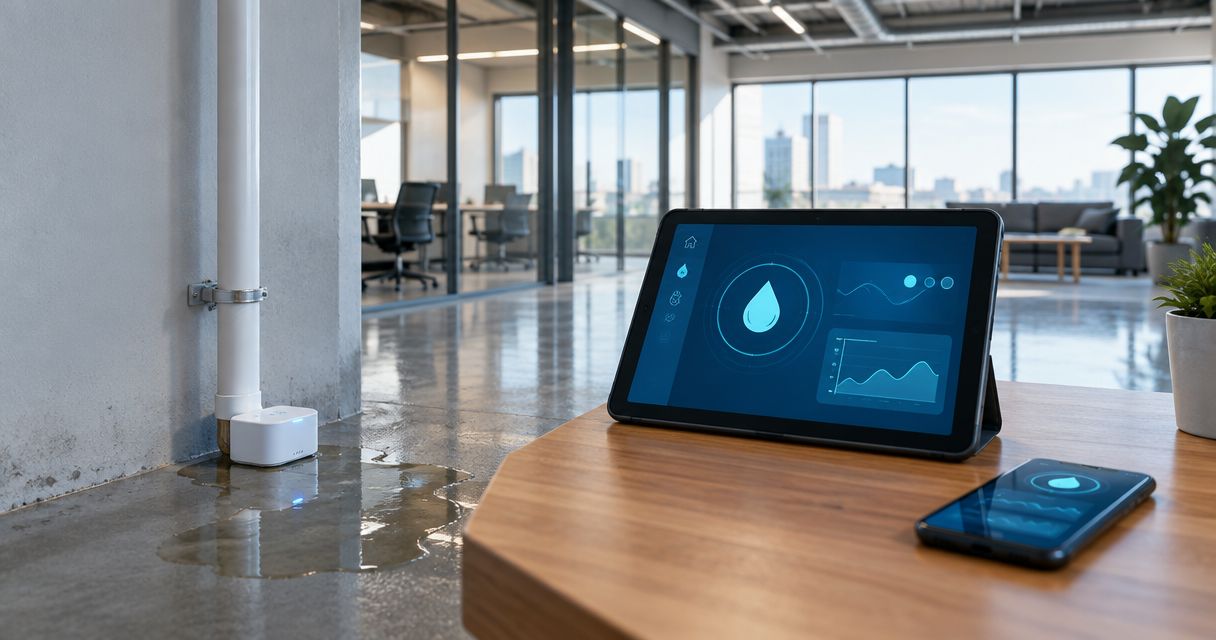
Best overall for a commercial building: a hybrid water leak detection system that combines point sensors, leak-detection cable, and flow monitoring where each fits. Best for a defined equipment risk: cable sensing. Best for monitoring water use at the supply: flow monitoring. The Kilo IoT Platform is best for facilities teams that need to bring compatible sensor data into one dashboard, apply rules, and route alarms; it is the monitoring layer, not a leak sensor or an automatic shut-off system.
- A hybrid water leak detection system gives commercial buildings the broadest coverage when sensor locations and response routes are planned together.
- Use leak-detection cable along equipment perimeters, point sensors at isolated risks, and flow monitoring at the supply.
- Kilo is best for facilities teams that need compatible sensor data, location context, rules, and alarms in one IoT platform.
- A leak alarm calls for inspection; a delivered command alone does not prove that water stopped flowing.
Why does a commercial water leak detection system need more than sensors?
A wet-floor alert is useful only if someone can identify the location, judge the risk, and respond. A sensor under one sink does not cover a riser several floors away. A supply meter can reveal unusual flow without showing which room is wet. Coverage and response must be designed together.
For 2026 procurement, separate the decision into where water can escape, what each sensor can observe, and who receives the alarm. If your building already has mixed devices, the Kilo IoT Platform can bring compatible LoRaWAN, mioty, and MQTT data into dashboards and rules. Confirm sensor compatibility and the path from the device to the platform before specifying hardware.
What makes the best water leak detection system for a commercial building?
- Coverage matched to the risk: Put point sensors beneath isolated equipment, cable along a wider exposure path, and flow measurement where a supply branch needs monitoring. None replaces the others everywhere.
- A known detection method: Ask whether the device reports direct water contact, a measured flow change, or a local alarm contact. That distinction determines what an alert actually proves.
- A tested communications path: Check signal coverage in plant rooms, risers, basements, and shielded spaces. A sensor that cannot report is not active protection.
- Actionable location context: Map every sensor to a floor, room, asset, or supply branch. A building-level alert without that context costs the response team time.
- Alarm ownership: Define severity, recipients, escalation, and quiet-hour behavior before occupancy or site rollout. An unassigned alert is a missed alert.
- Verification after response: Record the sensor state and inspect the area. If a separate control system receives a command, check its feedback or subsequent telemetry where available rather than treating delivery as proof of a physical result.
These criteria matter more than the number of sensors on a proposal. Ask each vendor or integrator to show a site plan, an example alarm, and the procedure for a device that stops reporting.
Which water leak detection system is best at a glance?
| Approach | Best for | Standout feature | Key limitation |
|---|---|---|---|
| Hybrid sensing with a shared monitoring platform | Multi-zone commercial buildings | Combines distinct detection methods in one response workflow | Needs sensor selection, integration, and alarm design |
| Leak-detection cable | Equipment perimeters and exposed runs | Detects water contact along the installed cable | Only covers the route where cable is installed |
| Flow monitoring | Supply branches and water-use investigation | Shows a change in measured flow | Does not by itself locate a wet floor |
| Point water-contact sensors | Isolated assets and small risk areas | Places detection at a specific location | Leaves gaps between sensor positions |
For most multi-zone buildings, choose the hybrid approach only after mapping the highest-risk areas. A smaller site with one defined exposure can start with the relevant single method. This ranking compares detection approaches, not unverified product specifications.
1. Hybrid sensing: best water leak detection system for multi-zone buildings
A hybrid system puts each sensor type where its measurement is useful. Point sensors cover individual assets; cable follows an exposed perimeter; flow monitoring adds a supply-level view. A shared monitoring layer then connects readings to named locations and alarm procedures.
Kilo is a worked example of that layer, not a packaged water leak detector. Its built-in LoRaWAN and mioty network servers and MQTT connector provide routes for compatible devices. Each device has a digital twin, while dashboards, a visual rules engine, and alarms give facilities teams a place to organize readings and responses. One digital twin per device helps keep an alarm tied to the device that reported it; it does not identify a leak beyond the sensor's actual coverage.
Hybrid sensing pros:
- Matches different detection methods to different building risks.
- Gives operators both local contact alerts and supply-level context when those devices are installed.
- Supports one escalation procedure across monitored zones.
Hybrid sensing cons:
- Requires a coverage plan and compatibility checks for every sensor type.
- Takes more commissioning work than a standalone detector.
- Does not make an uncovered space observable or stop water automatically.
Best for: Facilities teams responsible for multiple rooms, floors, or buildings. Verdict: choose a hybrid design when gaps between equipment-level and supply-level monitoring would leave the response team guessing.
2. Leak-detection cable: best water leak detection system for equipment perimeters
Leak-detection cable is installed along the path where water contact needs to be noticed, such as an equipment perimeter or a run beneath exposed pipework. Its useful coverage is the installed route, not the whole room. Confirm how the chosen cable and controller report an event before connecting either to a wider monitoring system.
Cable placement needs a physical inspection. Keep it on the likely path of escaping water, account for raised edges and drains, and protect it from routine disturbance. A drawing of the room is not a substitute for checking where water can actually travel across the floor.
Leak-detection cable pros:
- Covers a continuous installed route rather than one contact point.
- Works well around a defined equipment footprint.
- Gives the installer a clear coverage path to document and test.
Leak-detection cable cons:
- Misses water that never reaches the cable.
- Routing around equipment and floor features takes planning.
- Its event detail depends on the selected cable, controller, and integration.
Best for: Plant rooms or equipment areas with a clear exposure path. Verdict: choose cable when the risk follows a perimeter; add another method for supply-level visibility.
3. Flow monitoring: best water leak detection system for supply branches
A flow meter answers a different question from a wet-contact sensor: what is moving through a measured supply branch? A change in that reading gives the facilities team a reason to investigate. It does not establish that water has reached a floor or identify the exact fitting at fault.
Define the measured boundary before setting a rule. A main supply reading covers more demand than a branch reading, but provides less location detail. Document expected operating patterns and review alarm behavior during planned water use so routine activity does not bury an investigation-worthy event.
Flow monitoring pros:
- Shows measured water movement at the selected supply boundary.
- Adds context when a contact sensor reports water nearby.
- Can support trend review alongside other building readings.
Flow monitoring cons:
- Cannot identify the precise leak location on its own.
- Normal use must be distinguished from an event requiring inspection.
- Meter selection and installation depend on the pipe and existing system.
Best for: Buildings that need visibility into a main or defined branch. Verdict: choose flow monitoring as a supply-level signal, not as a replacement for local water-contact detection.
4. Point sensors: best water leak detection system for isolated assets
A point sensor reports conditions at its installed position. It is the direct choice for a small, defined exposure beneath an appliance, at a low spot beside equipment, or inside a contained area. Position it where escaping water is likely to reach it, not simply where installation is easiest.
An isolated sensor can be an effective starting point for a specific risk. It becomes a poor building-wide plan when the gaps between positions are ignored. Record each sensor's location in terms a responding technician can use without translating a device identifier.
Point sensor pros:
- Places detection at a named asset or low spot.
- Provides a straightforward event for an alarm workflow.
- Makes a focused pilot easier to inspect and test.
Point sensor cons:
- Detects only conditions that reach its position.
- A moved or obstructed sensor can leave its intended area uncovered.
- A collection of separate alerts needs location records and ownership.
Best for: Individual fixtures or equipment with a defined collection point. Verdict: choose point sensors for local risks; do not treat scattered placements as complete building coverage.
How should you deploy a water leak detection system in 2026?
Start with a walk-through involving the facilities lead and the people who respond after hours. Identify water-fed equipment, supply routes, drains, rooms below the exposure, and areas where an unnoticed event interrupts operations. Mark the proposed detection point or route on the site plan, then check it on the floor.
Next, trace the information path: sensor event, connectivity, device identity, location, rule, recipient, inspection. Each handoff needs an owner. A facilities manager can define response priority; an integrator can confirm device reporting and protocol compatibility; a technician can check whether the installed location matches the risk map.
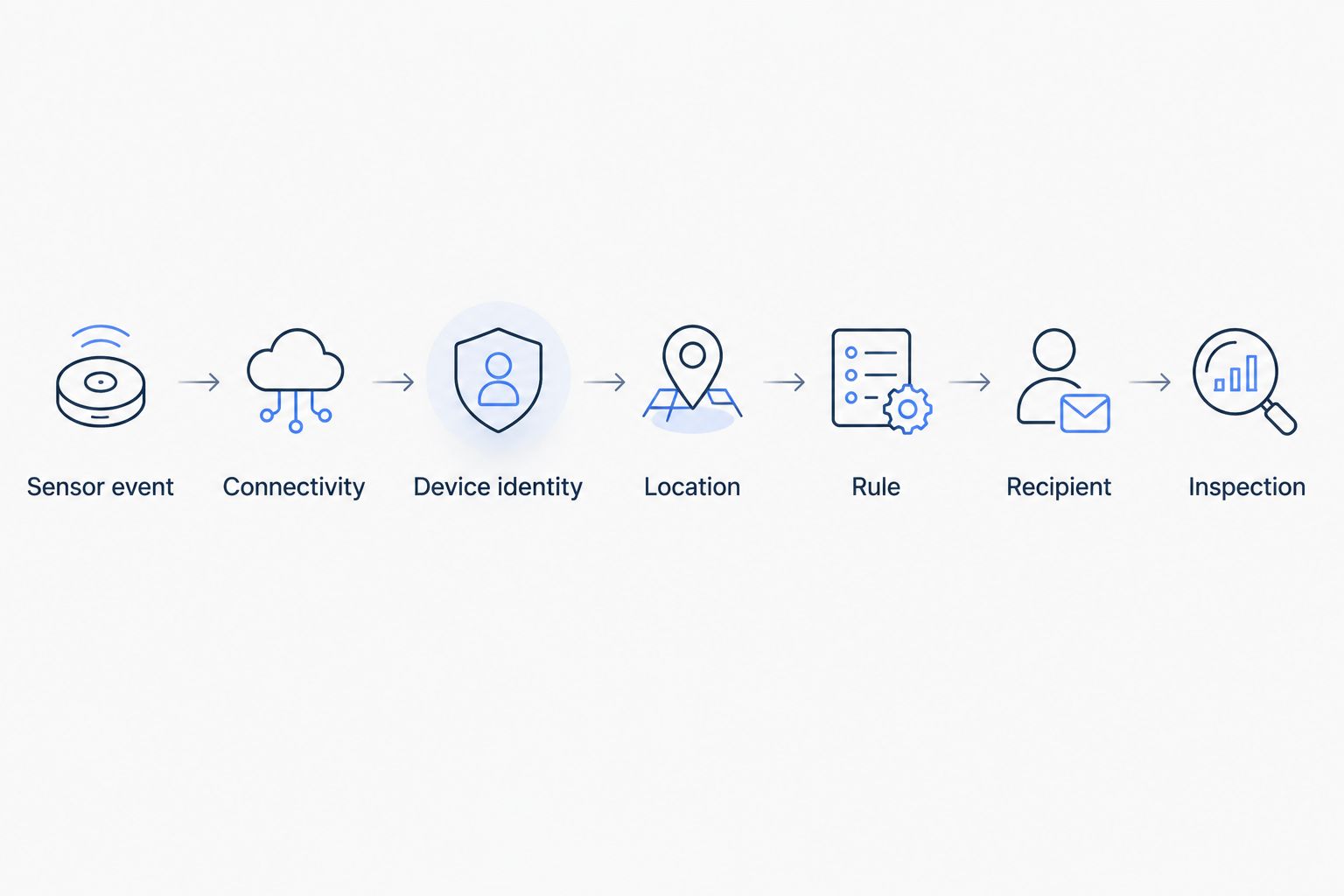
For compatible sensors, Kilo can apply a rule to reported data and create alarms with 5 severity tiers. Its escalation options include email, SMS, and push, with quiet hours and a centralized inbox. Configure the severity and recipients to match the building's actual response procedure; the presence of channels does not establish that someone received or acted on an alert.
Test the installed path by triggering a safe, controlled sensor event according to the device manufacturer's instructions. Confirm the device reports, the dashboard identifies the right location, the rule fires, and the intended recipient sees the alarm. Also test loss of reporting: a sensor that remains silent must not be mistaken for a dry area. Record the test result and fix the failed handoff before expanding coverage.
If hardware is needed, Kilo Electronics is the separate sister company through which IoT devices can be purchased. Select devices against the site plan and verify the actual sensor, gateway, and integration requirements rather than assuming every water detector uses the same protocol.
How do water leak detection system alarms avoid false confidence?
Use an alarm message that states what was observed. Water contact at a named sensor is different from flow above a configured condition on a named branch. Neither statement alone proves the source of a leak. Attach the site, room, asset, and response instruction so the recipient can act without first searching a device list.
Separate acknowledgment from resolution. Acknowledgment establishes that someone has taken responsibility for investigating. Resolution requires an inspection and a check that the triggering condition has cleared. If an authorized operator issues a configured command to connected equipment, an accepted or delivered status still does not prove that equipment changed state; check device feedback or subsequent telemetry where supported.
The Kilo IoT Platform provides rules, alarms, and an execution history for configured device commands. Its built-in assistant operates within the signed-in user's permissions and confirms before consequential actions. Those controls support a governed workflow, but they do not replace a site-specific water response plan or a physical inspection.
How were these water leak detection system approaches ranked?
The ranking follows the criteria above: fit to the exposure, clarity of the measurement, location detail, communications path, and ease of turning an event into an assigned response. The hybrid approach leads for a multi-zone building because no single listed measurement covers both local water contact and supply flow. That is a design judgment, not a claim that every building needs every sensor type.
In 2026, reject a proposal that lists hardware without showing its coverage on a floor plan. Also ask what happens when a device stops reporting and who checks that condition. A clear answer to those questions is more useful than an alarm screenshot without a location or response owner.
FAQ: water leak detection systems for commercial buildings
What's the best water leak detection system for a commercial building?
A hybrid system is the best fit for a multi-zone building when it assigns point sensing, cable sensing, and flow monitoring to the risks each can observe. Map coverage and alarm ownership before selecting devices.
Is a flow meter better than a water-contact sensor?
No; they measure different conditions. A flow meter reports movement through a measured supply, while a contact sensor reports conditions at its installed location.
Where should commercial water leak sensors be installed?
Install them where escaping water is likely to reach them, based on an on-site inspection. Check equipment footprints, low spots, pipe routes, drains, and areas below exposed water-fed assets.
Can a water leak detection system automatically shut off the supply?
Detection and shut-off are separate design decisions. Do not assume an alarm provides valve control; verify the installed control equipment and check device feedback or subsequent telemetry after any command.
Can LoRaWAN, mioty, and MQTT devices appear in one monitoring platform?
Compatible devices can be brought into the Kilo IoT Platform through its built-in LoRaWAN and mioty network servers and MQTT connector. Confirm each device's reporting format and connectivity before installation.
How do facilities teams know a leak alarm was handled?
Assign an owner, acknowledge the alarm, inspect the reported location, and confirm the triggering condition has cleared. A delivered notification alone does not establish that anyone inspected the site.
What should you test before a water leak detection rollout?
Test the sensor event, reporting path, mapped location, alarm rule, and recipient response. Test loss of device reporting separately so silence is not interpreted as a dry floor.
Which water leak detection system should you choose in 2026?
Choose a hybrid system for a multi-zone building with different exposure types; choose cable, flow, or point sensing when the risk is narrower and clearly mapped. Begin with one inspected area and prove the reporting and response path before extending it to the rest of the site. Kilo is best used where the team needs to organize compatible devices, rules, and alarms across that wider deployment.
The easily missed requirement is a location record that stays accurate after installation. If a technician moves a point sensor or reroutes cable, update the map and repeat the event test. An alarm tied to yesterday's location sends the next responder to the wrong place.