
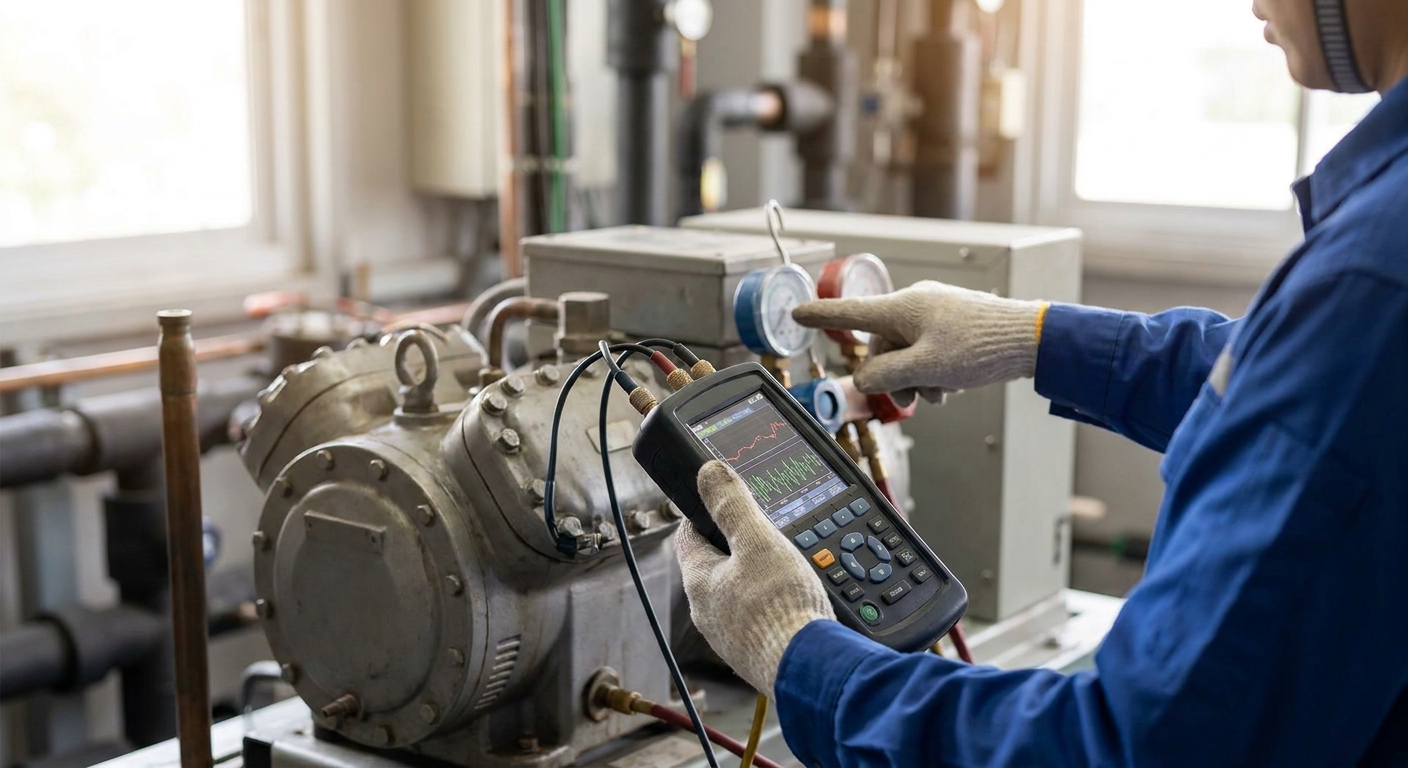
A refrigeration compressor rarely dies without warning: discharge temperature creeps up, amp draw climbs above nameplate, and the unit starts short-cycling days or weeks before it seizes for good.
- Learning how to detect refrigeration compressor failure means tracking discharge temperature, amp draw, vibration, and cycling frequency together, not separately.
- Discharge line temperature above 225F (107C) signals an overheating compressor close to a thermal overload trip.
- Short cycling more than 6 times an hour usually means a failing start capacitor or a low refrigerant charge.
- Amp draw 10% or more over nameplate RLA for 15+ minutes points to a failing winding or a worn bearing.
- A rules engine that fires threshold alarms on these signals catches compressor failure days before a breakdown.
What causes refrigeration compressor failure
Compressor failure comes from four places: electrical, mechanical, thermal, and lubrication. Electrical failure starts with a weak start or run capacitor, or a start winding that draws high locked-rotor amps and eventually opens. Mechanical failure shows up as worn valve plates, scored cylinder walls, or a seized bearing - the kind of wear you catch first as a change in vibration monitoring for chiller plants data, not a sound a technician happens to notice on a walk-through.
Thermal failure follows low refrigerant charge, a dirty condenser coil, or a failed condenser fan - the compressor works harder, discharge temperature climbs, and the motor windings cook. Lubrication failure comes from refrigerant floodback washing oil out of the crankcase, or oil breaking down after years of high discharge temperatures.
ASHRAE Standard 15 requires refrigerant detectors in machinery rooms for systems above a certain charge, because a slow leak that nobody catches becomes both a safety issue and a compressor-killer - low charge starves the compressor of the refrigerant it uses to cool its own motor. EPA Section 608 sets its own trigger: systems holding 50 pounds or more of refrigerant that leak more than 20% of their charge in a year (30% for industrial process refrigeration) must be repaired. Neither rule tells you the compressor is dying today, but both point at the same leading indicator: charge and temperature drift before hard failure.
What you need to monitor a refrigeration compressor before it fails
You don't need a full retrofit to catch compressor failure early. Retrofitting a compressor room in 2026 doesn't require ripping out existing controls - you need four data points, in one place, checked against baselines:
- A discharge line temperature probe rated for the compressor's operating range
- A clamp-on current sensor logging amp draw against the nameplate RLA and LRA figures
- A suction and head pressure transducer pair, or the equivalent readout from the unit's controller
- A vibration sensor on the compressor housing or mounting feet
- A wireless sensor network - LoRaWAN or mioty - that gets readings off the equipment without running new low-voltage wiring through a mechanical room
- A dashboard and rules engine that compares live readings against the compressor's own nameplate and manufacturer limits, not generic defaults
The Kilo IoT Platform runs on a built-in LoRaWAN and mioty network server, so a compressor retrofit doesn't need a separate network server standing between the sensors and the dashboard. Where the compressor already reports through a controller or BMS, an MQTT connector pulls that data in alongside the wireless sensors instead of replacing it.
How to detect refrigeration compressor failure step by step
1. Track discharge line temperature continuously
Discharge temperature is the earliest hard number you get on a compressor working too hard. Many reciprocating and scroll compressor manufacturers rate maximum discharge line temperature near 225F (107C) before an internal thermal overload trips the unit. Log the reading every few minutes, not once per shift walk-through - a compressor can climb from a normal 180F to a trip-level 225F over two hours on a hot 2026 summer afternoon with a dirty condenser. Plot that temperature next to the trend on a cold storage temperature monitoring dashboard and the climb is obvious hours before the trip. The common mistake: checking discharge temperature only during scheduled PM visits, which means the first time anyone sees the number is the day the compressor already tripped.
2. Log amp draw against nameplate rating
Every compressor nameplate lists Rated Load Amps (RLA) and Locked Rotor Amps (LRA). Amp draw running 10% or more over RLA for 15 minutes or longer usually means a failing start winding, a seized or worn bearing adding mechanical drag, or a refrigerant overcharge. A compressor drawing LRA-level current on every start, instead of just the moment of startup, is a start capacitor on its way out. Compare live draw to nameplate RLA, not to what the compressor drew last year - a compressor that's already degraded 8% won't trip an alarm set against its own recent history.
3. Watch for short cycling
Short cycling - starting and stopping more than 6 times an hour - is hard on start windings and start capacitors, and it's usually a symptom, not the root cause. Low refrigerant charge, a stuck expansion valve, or an oversized compressor for the load will all short-cycle a system. Count cycles over a rolling hour, not a single event: one extra start during a defrost cycle is normal, six an hour for three days straight is not.
4. Monitor vibration signature changes
A healthy compressor has a vibration signature; a compressor with a wearing bearing or a loosening mount develops a different one, usually before it makes a sound a person can hear over ambient noise. A vibration sensor bolted to the compressor housing catches an amplitude shift or a new frequency component that a walk-through inspection won't. Set the alarm against the compressor's own baseline reading taken when it was healthy, not a generic vibration limit pulled from a different make and model.
5. Trend suction and head pressure together
Head pressure climbing while suction pressure holds steady points at the condenser side - a dirty coil, a failed fan, or an overcharge. Suction pressure dropping while head pressure holds points at the evaporator side or a restriction. Watching only one pressure hides which half of the system is failing; watching both together, on the same chart, over the same time window, narrows the diagnosis before a technician opens a panel.
6. Check oil condition and refrigerant charge
Refrigerant floodback washes oil out of the crankcase and starves the bearings; the compressor can run for weeks on marginal lubrication before it seizes. A sight glass or an oil level sensor catches the trend; a technician checking oil level once a quarter does not. Pair oil level data with the EPA Section 608 leak-rate math - a system losing charge faster than expected is also a system at risk of floodback on the next call for cooling.
7. Turn thresholds into escalating alarms
A dashboard full of numbers doesn't stop a compressor from failing - someone has to see the alarm and act on it before the shift ends. A rules engine that fires on discharge temperature, amp draw, and cycling frequency together, and escalates from a text to a facilities manager to a push alert to the on-call technician if nobody acknowledges it, closes that gap. In 2026, alarm fatigue is still the top complaint from facilities teams running wireless monitoring, which is exactly why the escalation chain matters as much as the threshold itself. Kilo's rules engine runs on BPMN workflows with CEL expressions, version control, and a one-click rollback if a new rule fires too often - you can test a threshold against a sample payload before it goes live on the floor. Alarms carry five severity tiers and multi-step escalation chains, with quiet hours so a low-severity alert doesn't page someone at 3 a.m. Building that kind of chain is covered step by step in how to build automated alarms for equipment vibration anomalies.
Common refrigeration compressor problems and how to fix them
| Symptom | Likely cause | Fix |
|---|---|---|
| Discharge temp above 225F (107C) | Low charge, dirty condenser, failed condenser fan | Check charge against EPA 608 leak math, clean coil, verify fan run |
| Amp draw 10%+ over RLA | Failing start winding, worn bearing, overcharge | Megohm test the winding, check bearing play, verify charge |
| Short cycling 6+ times/hour | Weak start capacitor, low charge, stuck expansion valve | Capacitance test against nameplate rating, leak check, valve inspection |
| High head pressure, steady suction | Dirty condenser coil, failed condenser fan, overcharge | Clean coil, test fan motor, verify charge |
| Low suction pressure, steady head | Restriction, undercharge, iced evaporator coil | Check filter drier, leak check, inspect defrost cycle |
| Vibration amplitude rising over baseline | Bearing wear, loose mounting bolts, misalignment | Torque mounts to spec, schedule bearing inspection |
Tools and sensors for refrigeration compressor monitoring
A compressor monitoring setup needs sensors that survive a mechanical room or a walk-in machine room - temperature swings, condensation, and vibration from other running equipment. Look for:
- Discharge and suction line temperature probes rated for line temperature, not just ambient air
- A clamp-on current sensor or CT that reports amp draw continuously, not on a manual meter reading
- A vibration sensor with a sample rate high enough to catch bearing-frequency changes, not just gross imbalance
- Pressure transducers on suction and discharge lines, or an integration that pulls readings the compressor's own controller already has
Compressor monitoring setups deployed in 2026 typically pair wireless sensors with an existing controller rather than replacing it outright. The Kilo IoT Platform connects these over LoRaWAN or mioty for battery-powered sensors, or over MQTT for anything already reporting through a PLC, energy meter, or BMS. Each compressor gets its own digital twin in the platform, and readings can sit on a live 3D building twin alongside the rest of the mechanical room, which matters when a facilities team runs more than one compressor per site. An AI assistant built into Kilo can walk a new sensor through onboarding and draft the discharge-temperature and amp-draw rules in plain language, scoped to your permissions and confirming before anything goes live - it doesn't predict failure on its own, it turns the thresholds you already know into a working alarm chain faster.
See compressor alarms built on real thresholds
Set up discharge temp, amp draw, and vibration alarms on the Kilo IoT Platform.
What to do after you catch a compressor problem early
Catching a discharge temperature spike or a run of short cycles doesn't fix anything by itself - it buys a maintenance team a window to act before an unplanned shutdown. Use that window to pull the compressor's service history, check the last measured refrigerant charge against the EPA Section 608 leak-rate threshold, and confirm the alarm against a second signal (amp draw plus temperature, not temperature alone) before dispatching a technician. In 2026, that decision window is usually what separates a scheduled repair from an emergency call and an overtime bill. A false alarm dispatched at 2 a.m. costs credibility with the on-call team faster than almost anything else in a monitoring program, and tightening that signal-to-noise ratio matters as much as catching the failure in the first place.
FAQ
What's the first sign of refrigeration compressor failure?
Rising discharge line temperature is usually the first hard number, often climbing toward 225F (107C) before the internal thermal overload trips. Amp draw and short-cycling frequency typically follow within days, not months.
Is high amp draw always a sign of compressor failure?
Not always - amp draw 10% or more over the nameplate RLA for 15+ minutes points at a problem, but it could be a failing start winding, a worn bearing, or a refrigerant overcharge. Check draw against pressure readings before assuming the compressor itself is failing.
How many short cycles per hour is too many for a compressor?
More than 6 starts an hour is generally considered short cycling and stresses the start winding and capacitor on every cycle. A weak start capacitor, low refrigerant charge, or a stuck expansion valve are the usual causes.
Can vibration monitoring predict compressor bearing failure?
Vibration monitoring doesn't predict failure, but it flags an amplitude or frequency shift away from a compressor's healthy baseline before the wear becomes audible or the bearing seizes. Comparing live readings against the unit's own baseline works better than a generic vibration limit.
What refrigerant leak rate requires repair under EPA rules?
EPA Section 608 requires repair when a system holding 50 pounds or more of refrigerant leaks more than 20% of its charge in a year, or 30% for industrial process refrigeration. A slower leak still starves the compressor of the refrigerant it needs to cool its own motor.
How often should a refrigeration compressor be inspected?
Manual inspections are typically scheduled quarterly or at each PM visit, but discharge temperature, amp draw, and vibration can all drift toward failure in days between those visits. Continuous monitoring closes that gap without adding technician visits.
Does a rules engine replace predictive maintenance software?
A rules engine doesn't predict failure with machine learning - it fires an alarm when a value like discharge temperature or amp draw crosses a threshold you set, and escalates until someone acknowledges it. That threshold-based approach catches the same drift a predictive model would flag, without needing a training data set specific to your compressor.
What's the difference between head pressure and discharge temperature?
Head pressure measures the pressure on the high side of the system; discharge temperature measures how hot the refrigerant gas is leaving the compressor. The two usually move together, but a high discharge temperature with normal head pressure can mean a low charge or a return-gas superheat problem instead of a condenser issue.
What most technicians miss when compressor alarms start firing
Most facilities set a single alarm - usually discharge temperature - and stop there, which means the first alert doubles as the last warning. A compressor that's failing mechanically often shows amp draw and vibration drift days before discharge temperature crosses a threshold, because the motor keeps compensating for wear until it can't anymore. Stacking two signals - amp draw plus vibration, or discharge temperature plus cycling frequency - before an alarm escalates to a phone call cuts false dispatches without losing the early warning, which is the trade every facilities team is actually trying to make in 2026.