
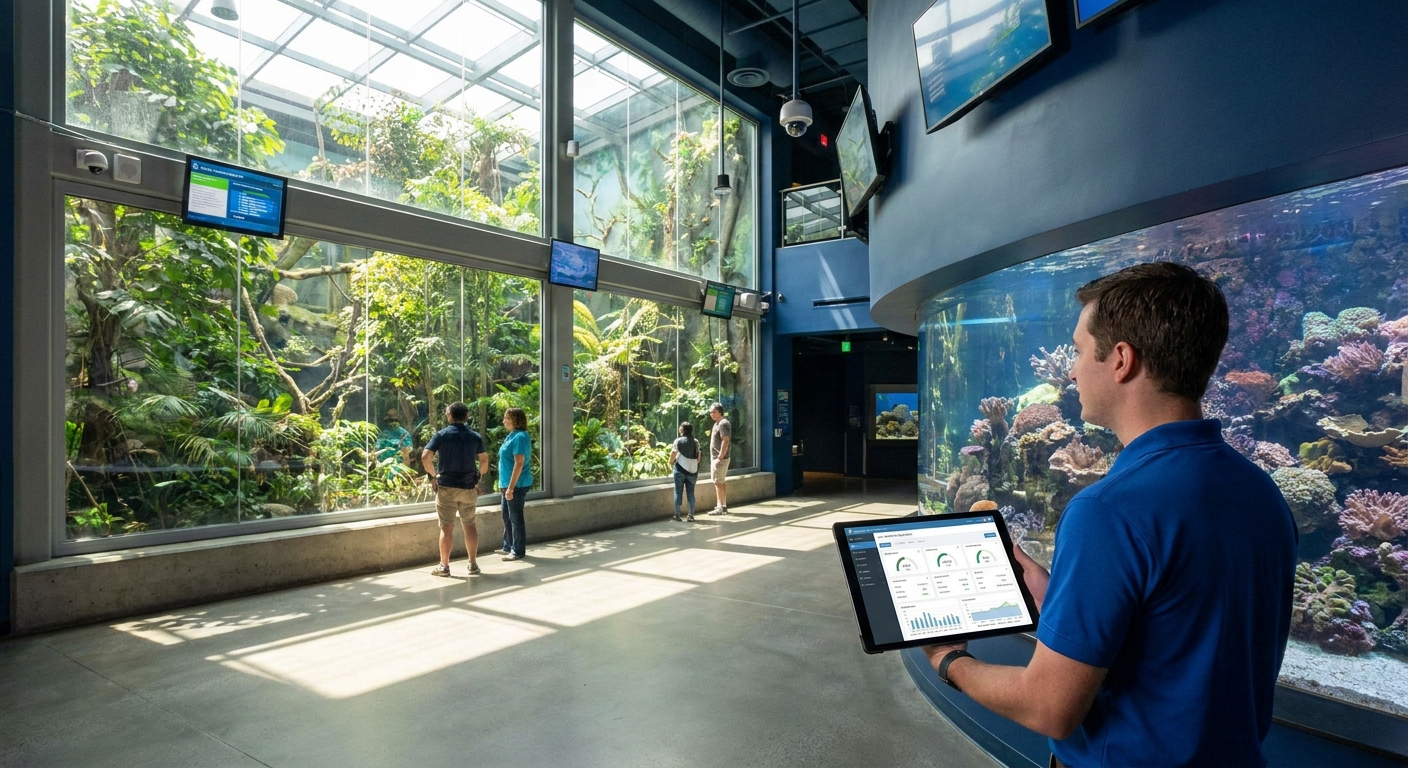
A facility monitoring system for aquariums and zoos has to watch water chemistry, tank temperature, humidity, and backup power at the same time — because a single sensor blind spot can mean a dead exhibit before staff notice.
Kilo Cloud, Kilo IoT's AI-first IoT platform, pulls LoRaWAN, mioty, and MQTT sensor data into one dashboard with a rules engine and alarms built for exactly this kind of multi-system site.
- A facility monitoring system for aquariums and zoos needs 24/7 water, temperature, and power coverage — Kilo Cloud's rules engine and alarms fit this. Buy it.
- Tropical tanks drift outside the 24-27°C range fast once life support fails, and a 0.2 pH swing signals trouble before fish do.
- Reptile and bird exhibits need 50-70% humidity monitoring separate from tank water sensors.
- Skip any system without offline buffering — a Wi-Fi drop in 2026 shouldn't blind you to a chiller failure.
- Multi-site zoo and aquarium networks need one dashboard, not five separate exhibit logins.
Why this matters
An aquarium or zoo runs dozens of independent life-support systems in parallel: tank chillers, aerators, humidifiers, UV filters, backup generators. Each one fails differently, and each failure has a different clock.
A chiller failure in a tropical reef tank can push water past 27°C within hours, stressing coral before a keeper's morning rounds. A generator that doesn't kick in during a power cut can knock out aeration in an overstocked holding tank, and dissolved oxygen can drop to dangerous levels in under 30 minutes.
Manual rounds — walking tanks with a clipboard every few hours — miss the gap between checks. A facility monitoring system for aquariums and zoos closes that gap by watching continuously and alerting the right person the moment a threshold is crossed, not the next time someone walks by.
Who this is for
This guide is for facilities and operations leads at aquariums, zoos, and aquaria-adjacent sites — public attractions, research collections, and aquaculture-linked exhibits — who are responsible for animal welfare compliance, utility costs, and after-hours incident response across multiple buildings or exhibit halls. If you're managing more than a handful of tanks or enclosures and still relying on paper logs or a single building automation system that doesn't reach outdoor exhibits, this is written for your situation.
What to look for in a facility monitoring system for aquariums and zoos
Water chemistry and level sensing, not just temperature
Temperature alone misses slow failures. A filter clog or dead pump can hold temperature steady while pH and dissolved oxygen drift for hours. Look for a platform that ingests multiple water-quality inputs into one rules engine, not a standalone temperature logger bolted onto an existing panel.
Wireless connectivity that reaches outdoor and off-grid enclosures
Zoos have exhibits spread across acres, often with concrete, water, and metal enclosures that kill Wi-Fi signal. LoRaWAN and mioty sensors are built for exactly this — long range, low power, and no dependency on a facility's existing network wiring. This matters more here than in a typical office building.
Alarm escalation that reaches the on-call keeper, not just a dashboard
A threshold breach at 2 a.m. is worthless if it sits unread in an inbox until 8 a.m. The rules engine needs to escalate — text, call, or push — to whoever's actually on call that night, with a clear chain if the first person doesn't respond.
Offline buffering for connectivity gaps
Aquarium buildings have concrete and glass everywhere, and outdoor zoo enclosures sit far from routers. A sensor that drops data during a signal gap and never backfills it leaves a blind window exactly when something might have gone wrong. Buffering and backfill on reconnect is non-negotiable.
A single dashboard across every building and exhibit
A zoo with a reptile house, an aviary, and an aquarium wing shouldn't need three separate monitoring logins. One digital twin view across the whole site — with per-zone drill-down — is what actually gets used daily instead of ignored.
Humidity and air quality for non-aquatic exhibits
Reptile and amphibian enclosures typically need 50-70% relative humidity, and it's a different sensor class from water probes. A monitoring system that treats humidity as a first-class input, not an afterthought, covers more of the facility with the same platform.
Top picks
Pick 1: Tank-level and life-support monitoring — the non-negotiable
Water level and pump-flow sensing catches the failure mode that kills fastest: a clogged intake or a burst line draining a holding tank overnight. Pairing level sensors with rules-based alarms means a drop below a set threshold triggers an alert within minutes, not after a morning walkthrough.
The tank-level monitoring approach built for aquaculture and fish farms applies directly to aquarium holding systems and quarantine tanks. Verdict: Buy. Any site with live animals in water needs this covered before anything else.
Pick 2: Environmental monitoring for exhibit halls and collections — the archivist's approach
Zoos and aquariums often share a building type with museums: enclosed spaces where humidity and temperature swings damage something valuable, whether that's a coral colony or a taxidermy collection in an attached education wing. The same discipline applies.
The facility monitoring system built for museums and archives covers the tight humidity bands and slow-drift detection that exhibit halls need, even outside a strict water-quality context. Verdict: Consider for any site with mixed exhibit types beyond tanks — reptile houses, insectariums, aviaries.
Pick 3: Leak detection before it reaches the public floor — the quiet risk
A cracked seal or overflow on a tank above a public walkway is a liability problem, not just a maintenance one. Water sensors placed at floor level and behind tank housings catch a leak before it spreads, not after a visitor reports wet carpet.
The approach to catching water leaks in commercial buildings before damage spreads applies directly to tank rooms and mechanical spaces behind exhibits. Verdict: Buy for any facility with tanks above finished flooring or electrical equipment.
Pick 4: One dashboard across every building on site — the multi-site fix
A zoo campus with a reptile house, an aquarium wing, and an outdoor safari section is really three or four separate facilities under one name. Running separate monitoring tools per building means someone has to check four dashboards instead of one.
The multi-location facility monitoring dashboard setup consolidates every zone into one digital twin view, with alarms routed by building rather than dumped into one undifferentiated feed. Verdict: Buy for any campus with more than two distinct buildings or exhibit types.
What to avoid
- Generic building sensors not rated for water or salt exposure. A standard office temperature probe corrodes fast near saltwater tanks or humid reptile enclosures — look for IP-rated hardware built for wet environments.
- Systems without alarm escalation logic. A dashboard that shows red without paging anyone is a reporting tool, not a monitoring system. It doesn't help at 2 a.m.
- Platforms that require a dedicated BMS integration to add a single new exhibit. Zoos and aquariums add and reconfigure exhibits often; a system that needs an integrator visit for every new tank doesn't scale with the collection.
See Kilo Cloud on your exhibits
Map out sensor coverage for tanks, enclosures, and mechanical rooms.
Verdict comparison
| Criteria | Tank-level monitoring | Museum-style environmental | Leak detection | Multi-site dashboard |
|---|---|---|---|---|
| Best for | Holding tanks, quarantine | Exhibit halls, mixed collections | Tank rooms, mechanical spaces | Multi-building campuses |
| Core sensor type | Water level, flow | Humidity, temperature | Floor-level moisture | Aggregated across zones |
| Response window | Minutes | Hours (slow drift) | Minutes | Depends on zone rules |
| 2026 verdict | Buy | Consider | Buy | Buy for 2+ buildings |
FAQ
What's the best facility monitoring system for aquariums and zoos in 2026?
A platform combining LoRaWAN or mioty water and environmental sensors with a rules engine and alarm escalation, like Kilo Cloud, covers tank chemistry, temperature, humidity, and leak detection in one dashboard. Standalone temperature loggers alone don't cover the full failure surface.
Is LoRaWAN better than Wi-Fi for zoo exhibit monitoring?
LoRaWAN and mioty reach outdoor and concrete-heavy enclosures that kill Wi-Fi signal, and sensors typically run years on a battery instead of needing constant power. For spread-out zoo campuses, wireless long-range protocols are the more practical choice.
How much does an IoT monitoring system for an aquarium cost?
Costs vary by tank count, sensor type, and site size, so check current sensor and platform pricing directly. Budget scales with the number of monitored zones, not a flat per-facility rate.
Can one dashboard cover both aquarium tanks and reptile enclosures?
Yes, a single facility monitoring system can ingest water sensors from tanks alongside humidity and temperature sensors from reptile or bird enclosures, as long as the platform supports mixed sensor types in one rules engine. That consolidation is the main advantage over running separate point solutions per exhibit type.
What temperature range should a tropical aquarium tank stay in?
Most tropical fish tanks are kept between 24 and 27°C, with alarms typically set a few degrees inside that band to catch drift before it becomes stressful. The exact range depends on species, so check husbandry guidelines for the specific collection.
How fast can dissolved oxygen become dangerous if aeration fails?
In an overstocked holding tank, dissolved oxygen can reach critical levels in under 30 minutes after aeration stops. That's why alarm response time, not just detection, matters for water-quality sensors.
Do zoos need separate systems for indoor and outdoor exhibits?
No, a wireless sensor network built for outdoor industrial deployments can extend the same monitoring platform to outdoor enclosures without a separate system. The connectivity protocol, not the software, is what needs to handle the outdoor environment.
What humidity level do reptile enclosures need monitored?
Most reptile and amphibian enclosures need humidity held between 50 and 70%, monitored separately from water tank sensors. Drift outside that band for even a few hours can stress animals before visual symptoms appear.
One last thing
The failure that actually closes exhibits isn't usually the dramatic one — it's a clogged intake screen nobody checked for three days, slowly starving a tank of flow until oxygen drops overnight. A facility monitoring system for aquariums and zoos earns its cost on that boring, slow-moving failure, not the dramatic power outage everyone already has a generator for. Set the pH and level alarms tight in 2026, and the expensive incidents mostly stop happening.