
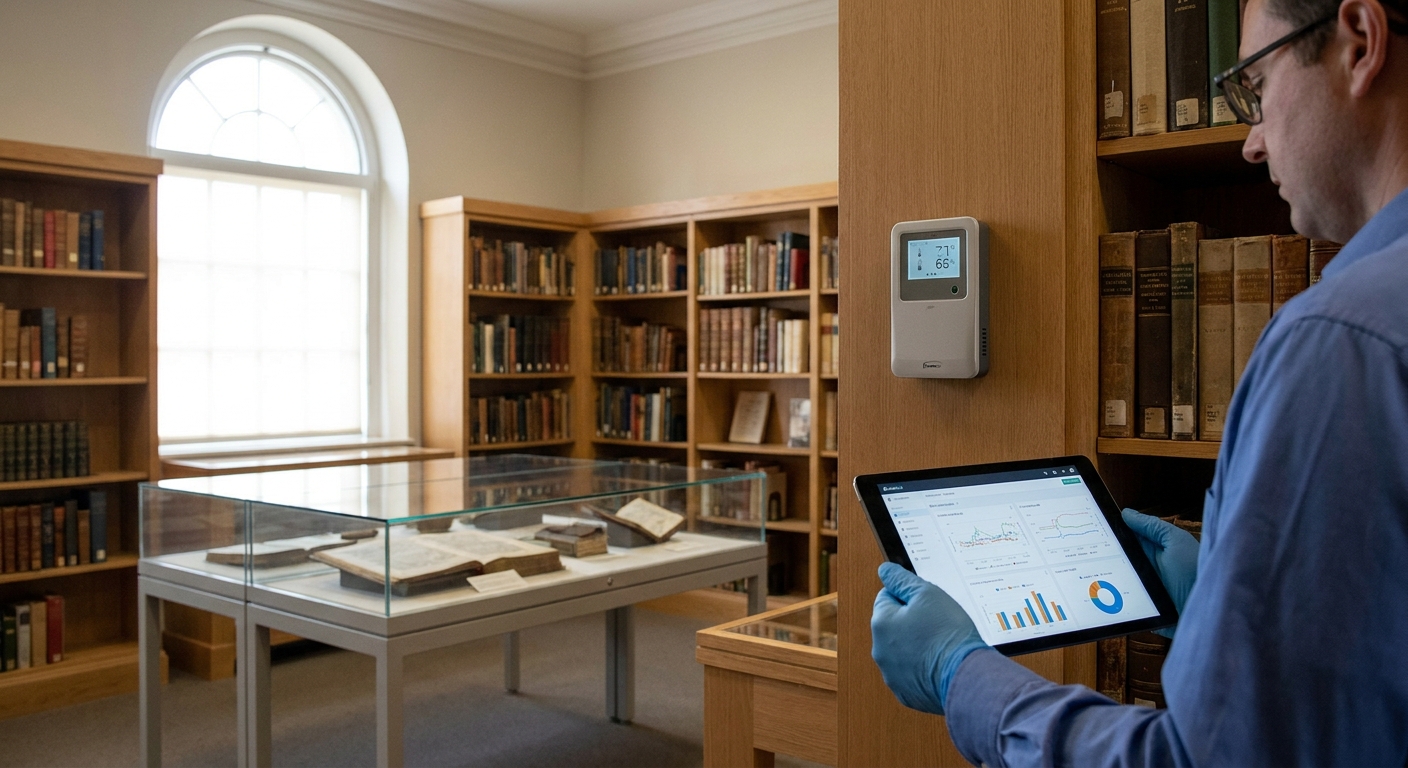
Museums and archives don't lose collections to catastrophic HVAC failures — they lose them to slow humidity drift nobody catches until the vellum cockles or the mold blooms. A facility monitoring system for museums and archives closes that gap with continuous temperature, humidity, and leak alerts across every gallery, vault, and off-site storage unit, and by 2026 most institutions running paper, textile, or photographic collections can't justify manual walkthroughs as the only check.
- Kilo Cloud's facility monitoring system for museums and archives flags RH drift past 5%/24hr — Buy for collections storage.
- Water leak sensors under HVAC condensate lines catch moisture same-day, before it reaches archival boxes — Buy.
- Skip consumer smart-home sensors: no audit trail, no multi-year battery life, no compliance record for insurers.
- Multi-site dashboards map every gallery, vault, and reading room from one login across 2026 renovation projects.
Why this matters
Conservation guidance used across the field calls for 68-72°F and 45-55% relative humidity in collections storage, with daily RH swings held under 5%. Miss that window for a few hours and vellum cockles, canvas expands and contracts, and mold spores dormant at 50% RH start germinating past 65%. A facility monitoring system for museums and archives exists to catch that drift before a conservator finds the damage already done, not after.
Kilo Cloud runs on LoRaWAN and mioty sensors that report temperature and humidity every few minutes without new wiring through a century-old wall. That matters in 2026 more than it did a decade ago — insurers now ask for logged environmental data, not a logbook entry from the last building walkthrough, and grant applications for collections care increasingly require it too.
Who this is for
This is for facilities managers, registrars, and conservators running climate-controlled storage in museums, historical societies, and archival repositories — anyone accountable for a room where a two-degree temperature swing or a burst pipe turns into a six-figure conservation bill. It's built for institutions with multiple storage areas, off-site annexes, or a mix of historic and modern buildings where running new conduit isn't an option.
What to look for in a facility monitoring system for museums and archives
Temperature and humidity precision with drift alarms
A sensor that reports once an hour misses the 3 AM HVAC cycling that pushes RH from 48% to 58% overnight. Look for reporting intervals under 15 minutes and alarms that trigger on rate of change, not just fixed thresholds — a system that only alerts at 65% RH already let the drift happen.
Leak detection near storage and archival stacks
Condensate lines, roof penetrations, and aging plumbing sit above or beside collections in most historic buildings. A leak sensor under an HVAC drip pan or against a baseboard catches moisture within minutes, not weeks after a stain shows up on a box lid.
Multi-site and multi-room mapping
Institutions with a main building, an off-site archive, and a loaned-collection annex need one dashboard, not three logins. A digital twin view that maps sensors to actual rooms lets a registrar spot which gallery is drifting without cross-referencing a spreadsheet.
Wireless sensors that don't require rewiring historic structures
Masonry walls, plaster ceilings, and landmark-status restrictions rule out running new cable. Battery-powered LoRaWAN or mioty sensors mount with adhesive pads and report through walls that would kill a Wi-Fi signal.
Alarm escalation and an audit trail
Insurers and grant auditors want a timestamped record: what the temperature was, when it crossed threshold, and who got notified. A system without exportable logs leaves the registrar guessing during a claim.
Long-range connectivity for thick-walled buildings
LoRaWAN and mioty both punch through stone and plaster better than Wi-Fi or Bluetooth. mioty in particular holds up in dense sensor deployments — useful once a facility has 40+ sensors across multiple floors.
Top picks for museum and archive facility monitoring
The climate backbone. Temperature and humidity dashboards built for tight tolerance environments carry over directly to collections storage — the same alarm logic that flags a cold-chain breach at 8°C for 10 minutes flags an archive room drifting past a 5%-per-24-hour RH swing. Verdict: Buy for any room holding paper, photographic, or textile collections.
The insurance policy. A water leak detection sensor placed under HVAC condensate lines and near roof penetrations catches moisture the same day it starts, instead of weeks later when a box lid shows a stain. One sensor covers roughly a 10-foot radius on a flat floor. Verdict: Buy — the cost of one flooded flat-file cabinet outweighs a season of sensor coverage.
The campus view. For institutions running a main building plus an off-site annex, a multi-site dashboard maps every room to its own alarm profile instead of one blended threshold for the whole campus. A reading room can run at 70°F for visitor comfort while the vault next door holds 68°F and 45% RH. Verdict: Consider if you operate more than one storage location; Skip if everything sits in a single climate-controlled room already.
The quiet installer. Battery-powered wireless sensors avoid the permitting headache of running new electrical or data cable through a landmark-status building. Most LoRaWAN sensors report for years on a single battery, not months, which matters when the sensor sits behind a locked vault door nobody opens weekly. Verdict: Buy for any historic structure where rewiring isn't an option.
The audit trail. Alarm escalation with exportable logs gives a registrar a timestamped record for insurers and grant reporting — when the temperature crossed 74°F, when the alert fired, who acknowledged it. Verdict: Buy for any collection under a loan agreement or insurance policy requiring logged environmental data.
Map your rooms to one dashboard
See how a multi-location setup looks before you commit sensors to a building.
What to avoid
- Consumer smart-home sensors. They look right — cheap, Wi-Fi based, an app with a nice graph — but they lack exportable logs for insurance claims and typically run on Wi-Fi that a thick masonry wall kills at 30 feet.
- Industrial-grade rugged sensors built for factory floors. Overkill for a reading room, and the alarm thresholds are usually tuned for equipment tolerances, not the tighter 45-55% RH band collections need.
- Systems requiring hardwired power at every sensor point. Fine for a new-build facility office; a non-starter for a landmarked structure where an electrician can't touch the plaster.
“If your archive's humidity swings more than 5 percent in a day, the paper moves before the alarm does.”
Verdict comparison
| Capability | Best for | Verdict |
|---|---|---|
| Temperature/humidity dashboards | Any collections storage room | Buy |
| Water leak detection | Rooms below HVAC or roof lines | Buy |
| Multi-site dashboard | Multi-building institutions | Consider |
| Wireless battery sensors | Historic, landmarked structures | Buy |
| Alarm escalation + audit trail | Loaned or insured collections | Buy |
FAQ
What is the best facility monitoring system for museums and archives in 2026?
A system built on wireless LoRaWAN or mioty sensors with temperature, humidity, and leak alarms tied to a multi-site dashboard covers the core needs for museums and archives in 2026. Prioritize drift-rate alarms over fixed thresholds since slow RH swings cause more collection damage than sudden spikes.
How much humidity fluctuation can archival collections tolerate?
Most conservation guidance holds daily relative humidity swings under 5% within a 45-55% target band. Swings beyond that stress paper, vellum, and canvas even when the average reading looks fine.
Do museum climate sensors need Wi-Fi?
No. LoRaWAN and mioty sensors transmit through masonry and plaster walls that block Wi-Fi, and they run for years on battery power without a data cable.
How fast does a leak sensor detect water damage?
A properly placed leak sensor under an HVAC line or near a roof penetration detects moisture within minutes and sends an alert the same day, well before a visible stain appears on stored material.
Is a facility monitoring system worth it for a single-room archive?
Yes if the room holds paper, photographic, or textile collections under an insurance policy or loan agreement — the audit trail alone often justifies the sensor cost. A single climate-controlled room needs the temperature and humidity dashboard more than the multi-site mapping feature.
Can one dashboard cover a main building and an off-site annex?
Yes. A multi-site facility monitoring dashboard maps sensors by room and building so a registrar checks a vault, a reading room, and an off-site annex from one login instead of three separate systems.
What causes most undetected humidity damage in archives?
Overnight HVAC cycling causes most undetected humidity swings, since RH can move 8-10 points between a facility closing and reopening with nobody present to notice. Continuous sensor logging catches this; a daily walkthrough does not.
One last thing
Most archive damage traced back to environmental causes happens overnight, when the HVAC system cycles down and nobody's walking the floor to notice a 10-point RH swing before staff arrive at 9 AM. A facility monitoring system for museums and archives earns its cost on that single 3 AM alert, not on the daily readings that confirm everything's fine.