
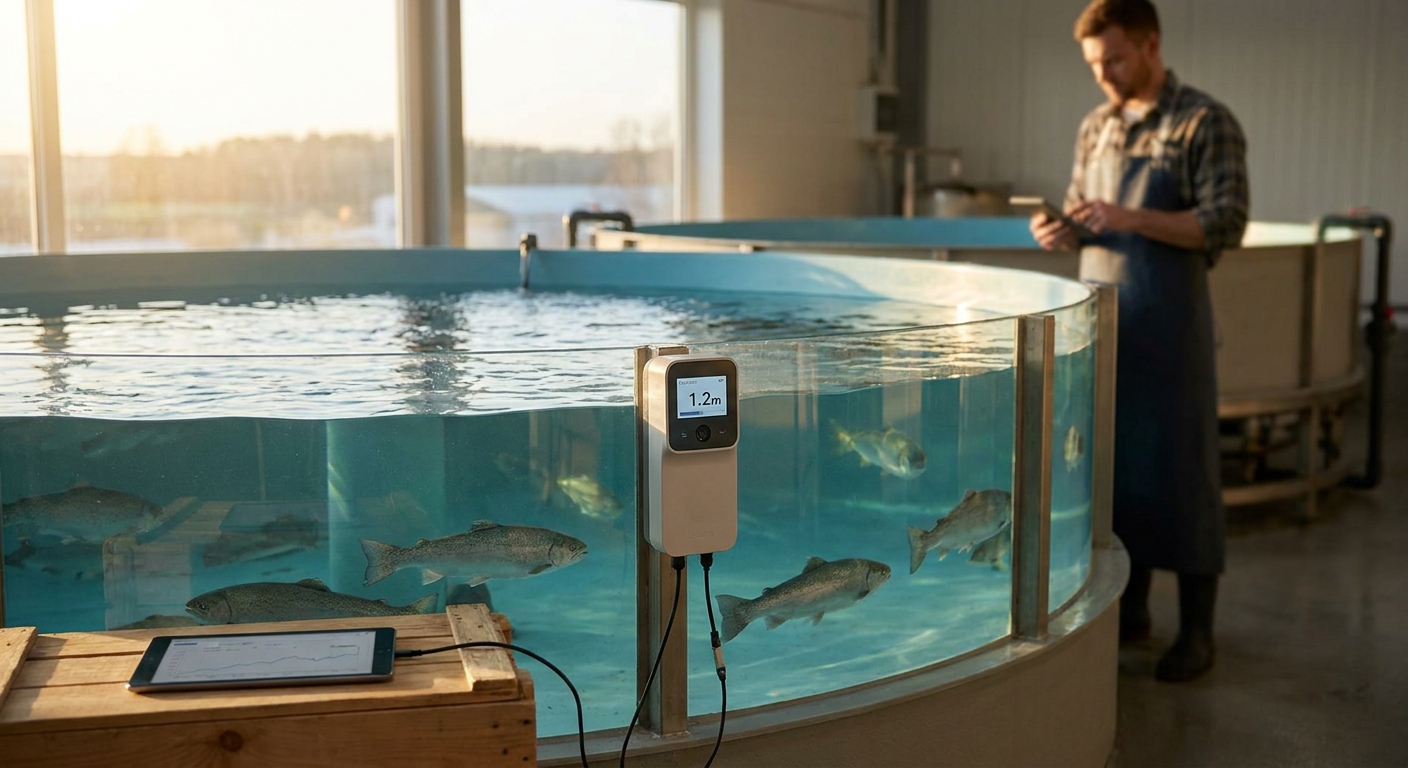
A fish tank that drops two centimeters below its aeration inlet can crash oxygen levels before anyone on shift notices. Tank level monitoring for aquaculture puts a sensor, a rule, and an alert between that drop and a mortality event.
- Kilo IoT's tank level monitoring for aquaculture pairs non-contact sensors with automated low-level and overflow alarms. Buy for multi-tank hatcheries.
- Non-contact ultrasonic sensors handle saltwater and biofouling better than float switches for aquaculture tank level monitoring in 2026.
- Remote cellular tank monitoring covers coastal pens with no LoRaWAN gateway nearby. Consider for isolated grow-out sites.
- Skip uncoated float switches in brackish or marine water; they corrode and stick within months.
Why this matters
Most fish kills tied to level or oxygen problems aren't caused by equipment failure. They're caused by nobody knowing the equipment failed until hours later.
A sump pump that trips at 2 a.m. doesn't announce itself. A header tank feeding gravity-fed raceways can drain in under 30 minutes once a valve sticks, and dissolved oxygen in a crowded grow-out tank can fall to a dangerous range faster than that once circulation stops. Tank level monitoring for aquaculture closes that gap by watching the number that actually predicts the loss — water level — and firing an alert before staff would otherwise catch it on a walk-through.
The same monitoring logic Kilo IoT (https://kiloiot.io/) applies to cold storage and industrial tanks works directly for fish tanks, raceways, and sumps: a sensor reports level on an interval, a rules engine compares it against a threshold, and an alarm reaches a phone before the tank empties or overflows.
Who this is for
This guide is for hatchery managers, RAS (recirculating aquaculture system) operators, and farm techs running multiple tanks, raceways, or sumps who currently rely on visual checks, float switches without alerting, or nothing at all between shifts. If your team is walking tank rows at set intervals to eyeball water level, or finding out about a pump failure from dead stock instead of a phone alert, this is your buyer profile.
What to look for in tank level monitoring for aquaculture
Sensor type built for wet, saline, biofouling-prone tanks
Contact float switches stick and corrode in saltwater and brackish RAS water within months, especially with biofilm buildup. Non-contact ultrasonic or radar level sensors mounted above the water line avoid both problems and hold calibration longer in 2026-era aquaculture deployments.
Report interval fast enough to catch fast drops
A sensor that reports once an hour is useless against a valve failure that drains a header tank in 20-30 minutes. Look for report intervals down to 5-15 minutes on critical tanks, with faster polling available when a threshold is approached.
Connectivity that survives coastal and rural sites
Coastal hatcheries and inland fish farms often sit outside reliable cellular coverage. LoRaWAN covers a single site well with gateway range up to several kilometers line of sight; mioty handles denser steel-and-concrete hatchery buildings with better wall penetration; cellular fills gaps at remote grow-out ponds with no gateway installed.
Automated rules and alarms, not just a dashboard
A dashboard that shows a red number after the fact doesn't prevent a loss. The rules engine has to compare live level readings against thresholds and fire an SMS, call, or app alert to an on-call tech automatically, day or night.
Multi-tank, multi-site view for hatchery scale
A single-tank display doesn't scale past a handful of units. Hatcheries running 20, 50, or 200 tanks need one dashboard showing every tank's level, trend, and alarm state at once, not 50 separate apps.
Battery life that survives cold, wet, submerged-adjacent conditions
Sensors mounted near tank water deal with condensation and cold-water cooling year-round. Battery life rated in years, not months, keeps maintenance visits to a minimum on hard-to-reach raceway tanks.
Top picks for aquaculture tank level monitoring
Non-contact ultrasonic LoRaWAN sensors — the safe pick. Report interval as low as 5 minutes, non-contact mount avoids biofouling entirely, and LoRaWAN range covers a full hatchery building or outdoor raceway row from a single gateway. Buy for standard indoor RAS and hatchery tanks in 2026.
mioty-based sensors for large multi-building hatcheries — the long-range pick. Better signal penetration through steel tanks, concrete walls, and dense equipment rooms than standard LoRaWAN, useful once a hatchery spans multiple buildings on one site. Consider if a single-gateway LoRaWAN layout is already showing dead zones.
Remote cellular tank monitoring for coastal or off-grid pens — the off-grid pick. No gateway to install or maintain; the sensor reports directly over cellular, which matters for grow-out ponds or net pens too far from a hatchery's LoRaWAN footprint. Detailed setup guidance for remote tank monitoring without cellular signal covers the fallback case when even cellular coverage is thin. Buy for isolated or seasonal sites.
Automated overflow and low-level alarms via a rules engine — the compliance pick. This is the layer that actually prevents loss: a threshold rule tied to a sensor reading, firing an alert the moment level crosses a safe range in either direction. Automated level alerts that prevent tank overflow walk through building that rule once sensors are live. Buy — this is the layer most farms skip and regret.
Multi-site dashboard for hatchery groups — the scale pick. One view across every tank and every site matters once a hatchery group runs more than a few locations, with alarm state visible without opening 10 separate logins. Consider once tank count crosses into the dozens.
What to avoid
- Uncoated float switches in saline or brackish water. They corrode, stick, or get fouled by biofilm within a few months and stop reporting accurate state without anyone noticing.
- Cellular-only sensors with no offline buffering near coastal pens. A dead cell tower during a storm means zero visibility exactly when a level event is most likely.
- Manual spreadsheet logging on a fixed schedule. A tech walking the tank room every two hours misses everything that happens in the gap, and a valve failure at minute 20 of a 2-hour gap is already a loss by the time it's logged.
“If the tank drops out of range before the alert fires, the alert is decoration, not monitoring.”
Verdict comparison
| Pick | Sensor type | Best connectivity | Report speed | Verdict |
|---|---|---|---|---|
| Non-contact ultrasonic LoRaWAN | Non-contact | LoRaWAN, single site | Down to 5 min | Buy |
| mioty-based sensors | Non-contact | mioty, multi-building | Down to 5 min | Consider |
| Remote cellular monitoring | Non-contact or contact | Cellular, no gateway | 5-15 min | Buy |
| Automated overflow alarms | Rules layer | Any connectivity | Real-time on threshold | Buy |
| Multi-site dashboard | Software layer | Any connectivity | Real-time | Consider |
Set up automated tank level alerts
See how Kilo IoT connects sensors, rules, and alarms for tank monitoring.
FAQ
What is tank level monitoring for aquaculture?
It's a sensor-and-alert system that tracks water level in fish tanks, raceways, or sumps and fires an automated alarm when level crosses a safe threshold. In 2026 most setups use non-contact ultrasonic sensors reporting over LoRaWAN, mioty, or cellular.
How fast can a fish tank drop to a dangerous level?
A header tank or sump can drain in 20-30 minutes once a valve or pump fails, faster than a typical hourly walk-through would catch. That's why report intervals of 5-15 minutes matter more than dashboard polish.
Are float switches good enough for aquaculture tank monitoring?
Uncoated float switches corrode and stick in saline or brackish water within a few months. Non-contact ultrasonic sensors avoid the contact-and-biofouling problem entirely and hold calibration longer.
Does tank level monitoring work without cellular signal at remote fish farms?
Yes — LoRaWAN or mioty gateways cover a site without cellular reliance, and cellular-connected sensors work directly at sites too remote for a gateway. Pick based on whether the site has one building or several spread-out ponds.
How much does tank level monitoring cost for a small hatchery?
Cost scales with tank count and sensor type; non-contact ultrasonic sensors plus a gateway cover a full building for less than per-tank contact systems with local alarms only. Get a quote based on actual tank count and site layout.
Can one dashboard show level across multiple hatchery buildings?
Yes, a multi-site dashboard shows every tank's level, trend, and alarm state in one view instead of separate logins per building. This matters once tank count crosses into the dozens across more than one site.
What triggers a tank level alarm?
A rules engine compares live sensor readings against a set threshold — high or low — and fires an SMS, call, or app alert the moment the reading crosses it. The alert reaches an on-call tech automatically, without anyone watching a dashboard.
Is mioty better than LoRaWAN for aquaculture buildings?
mioty handles denser steel-and-concrete hatchery buildings with better wall penetration than standard LoRaWAN. LoRaWAN is the simpler, cheaper choice for a single open building or outdoor raceway row.
One last thing
The single most common failure mode in aquaculture tank monitoring isn't a bad sensor — it's an alarm rule set once in 2024 or 2025 and never revisited as tank counts or seasonal flow rates changed. A threshold tuned for winter flow will false-alarm or under-alarm by summer; check the rule against current conditions at least once a season, not just at install.