A facility monitoring system for dairy and livestock operations has to work across acres of barns, parlors, and pasture where cellular signal drops out and WiFi never reaches. This guide breaks down what actually matters for dairy and livestock sites and which monitoring setups from Kilo IoT solve for it.
- Kilo IoT's LoRaWAN and mioty connectivity covers barns and pastures with no cellular signal in 2026 -- Buy for rural sites.
- Remote tank monitoring without cellular replaces manual trough and lagoon checks -- Consider for water-scarce regions.
- Multi-site dashboards matter once you run more than one barn or farm location -- Skip single-site tools if you're scaling.
- Generator fuel monitoring catches backup power failures before a milking parlor loses refrigeration.
Why this matters
A dairy operation loses milk quality the moment a bulk tank drifts above 4°C for more than a few minutes, and a livestock barn loses animals when ventilation fans fail overnight and nobody's there to notice. Kilo IoT runs its AI-first platform on LoRaWAN, mioty, and MQTT specifically because rural sites can't rely on cellular or WiFi reaching every corner of a property.
Most "smart farm" tools sold in 2026 are built for indoor commercial buildings, not 200-acre dairy operations with barns spread across the property. The connectivity layer, not the dashboard, is where these products actually fail on a farm.
Who this is for
This guide is for operations managers and farm owners running dairy or livestock facilities who need to monitor cold storage, barn climate, water systems, and backup power without hiring someone to walk the property twice a day. If you're managing more than one barn, more than one farm site, or equipment that fails quietly (a stuck ventilation fan, a dead well pump), a facility monitoring system for dairy and livestock operations replaces a manual checklist with automated alarms.
What to look for in a facility monitoring system for dairy and livestock operations
Long-range connectivity that doesn't need cellular
A dairy barn a quarter-mile from the farmhouse and a pasture trough half a mile past that both need a sensor signal to reach a gateway. LoRaWAN networks typically cover several miles line-of-sight in open rural terrain, which is why platforms built for warehouses and offices fall apart on farm acreage. mioty adds density for sites running hundreds of sensors -- ear tags, tank probes, feed bin sensors -- without network congestion.
Cold chain accuracy for milk storage
Bulk tank temperature has a narrow tolerance window, and a short excursion still counts. An alarm rule set to flag anything above 4°C for 10 minutes catches a failing compressor before a full tank of milk gets dumped. A system that only logs temperature without threshold-based alarms is a data logger, not a monitoring system.
Water and tank level visibility
Troughs, wells, irrigation tanks, and manure lagoons all need level checks that used to mean someone driving out to look. Automated level alerts catch a stuck float valve or a leaking line before it becomes a flooded pen or a dry trough in July.
Automated alarms for equipment that fails silently
A ventilation fan that stops in a closed barn overnight, a well pump that trips a breaker, a milking system pump that loses pressure -- none of these send a text message on their own. Rules and alarms built into the platform turn a sensor reading into a phone alert the moment a threshold is crossed.
Backup power monitoring
Dairy operations run refrigeration and milking equipment on generators when grid power fails, and a generator that's low on diesel or that fails to start is worse than no plan at all. Fuel level and runtime monitoring on backup generators closes that gap.
Multi-site dashboards
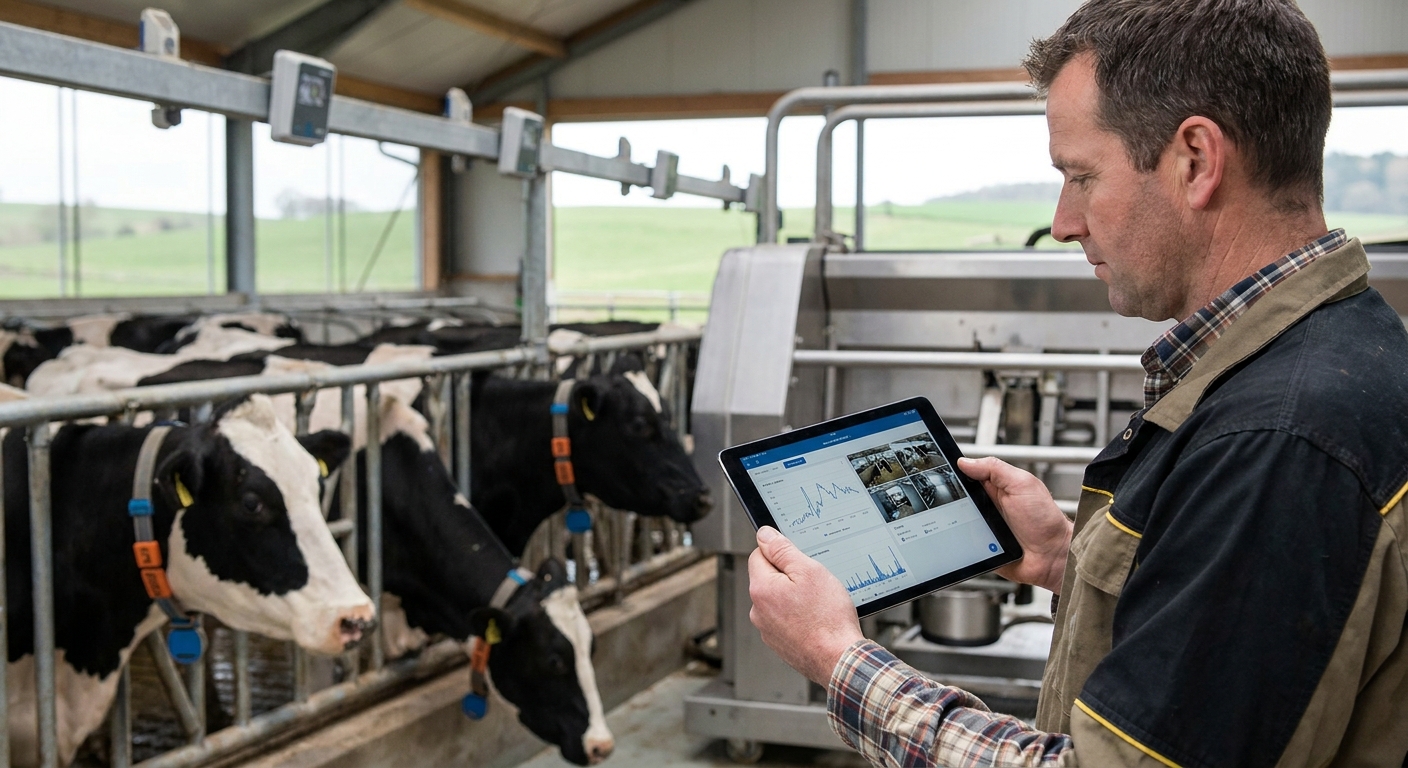
One barn is manageable from memory. Three barns across two farm properties are not. A single dashboard showing every site's temperature, tank levels, and alarm status side by side is the difference between reactive and proactive management.
Top picks for dairy and livestock facility monitoring
The remote-connectivity pick: remote tank monitoring without cellular signal Rural water troughs and manure lagoons sit in the dead zones where cellular coverage maps show bars that don't actually exist on the ground. This setup runs on LoRaWAN gateways instead of cell modems, which matters when the nearest tower is 6 miles out. Buy if any tank or trough on your property has no reliable cell signal.
The barn climate pick: humidity monitoring across multiple zones Barns and feed storage buildings each hold different humidity risk -- feed molds above 65% relative humidity, and livestock respiratory issues climb in poorly ventilated, high-humidity barns. Zone-by-zone monitoring flags the one barn drifting out of range instead of averaging the whole property into a false sense of security. Buy for any operation storing feed or grain on-site.
The backup power pick: fuel monitoring for diesel generators Generator failure during a power outage is the scenario that costs a dairy operation an entire tank of milk in under two hours. Fuel level tracking plus runtime alerts means you know a generator is low before it shuts off mid-outage. Consider for any site with refrigeration or milking equipment on backup power.
The multi-farm pick: facility monitoring dashboard for multiple locations Operations running more than one farm site need one screen, not four separate logins. A shared dashboard puts every barn's temperature, tank level, and alarm status in one view, which is what makes a two-person team able to manage a five-site operation in 2026. Buy once you're past a single-site setup.
Map your dairy or livestock site
See how Kilo IoT covers barns, tanks, and generators on one dashboard.
What to avoid
- Consumer smart home sensors. WiFi-based temperature or humidity sensors sold for houses top out well short of barn-to-barn range and have no offline buffering when the router drops.
- Platforms without store-and-forward buffering. Rural connectivity is intermittent by nature. A system that loses data every time a gateway briefly drops signal isn't giving you a real audit trail for cold chain compliance.
- Single-site dashboards sold as "facility monitoring." A tool built for one building will not scale cleanly to a second barn or a second property without a rebuild -- confirm multi-site support before you commit.
Verdict comparison
| Criteria | Remote Tank Monitoring | Barn Humidity Monitoring | Generator Fuel Monitoring | Multi-Site Dashboard |
|---|---|---|---|---|
| Works without cellular | Yes | Yes | Yes | Yes |
| Solves | Trough/lagoon levels | Feed & barn air quality | Backup power failure | Cross-farm visibility |
| Best for | Rural dead zones | Feed storage sites | Sites on backup power | 2+ farm locations |
| Verdict | Buy | Buy | Consider | Buy |
FAQ
What is a facility monitoring system for dairy and livestock operations?
It's a sensor and software setup that tracks temperature, humidity, tank levels, and equipment status across barns and pastures, sending automated alarms instead of requiring manual checks. Kilo IoT builds this on LoRaWAN and mioty connectivity so it works where cellular signal doesn't reach.
Does LoRaWAN work on a farm with no cell signal?
Yes -- LoRaWAN networks typically cover several miles in open rural terrain using a local gateway instead of a cellular connection. This is the main reason farm monitoring differs from warehouse or office monitoring in 2026.
How much does farm IoT monitoring cost in 2026?
Cost varies by number of sensors, connectivity type, and whether hardware is purchased or pre-configured, so check current options directly on the platform for a specific quote.
What temperature threshold should a dairy bulk tank alarm use?
Most dairy operators set an alarm around 4°C sustained for 10 minutes or more, since a brief spike above that threshold signals a compressor problem before the whole tank is compromised. Exact thresholds should match your local dairy quality standards.
Can one dashboard monitor multiple barns and farm sites?
Yes, a multi-site facility monitoring dashboard shows every location's sensor data and alarm status on one screen. This replaces separate logins per site and is standard for operations running more than one farm property in 2026.
Is mioty better than LoRaWAN for livestock ear tags?
mioty handles higher sensor density better than standard LoRaWAN, which matters when hundreds of ear tags or feed sensors report on one network. LoRaWAN remains the more common choice for lower-density farm deployments.
How do I monitor a generator's fuel level remotely?
A fuel level sensor paired with a monitoring platform sends alerts when diesel drops below a set threshold, which prevents a backup generator from failing silently during a power outage. This matters most for sites running refrigeration or milking equipment on backup power.
What happens if a water trough sensor loses connectivity?
A system with store-and-forward buffering holds readings locally and syncs once connectivity returns, so no data is lost during a brief signal drop. Confirm this capability before choosing a platform for a rural site.
One last thing
The alarm that matters most on a dairy operation isn't the one that fires when a tank is already too warm -- it's the one that fires on the trend line before the threshold is crossed, giving someone time to drive out and fix a compressor instead of dumping a tank. Set your rules on rate-of-change, not just fixed thresholds, and 2026's monitoring setup earns its cost the first time it catches a slow drift instead of a sudden failure.