
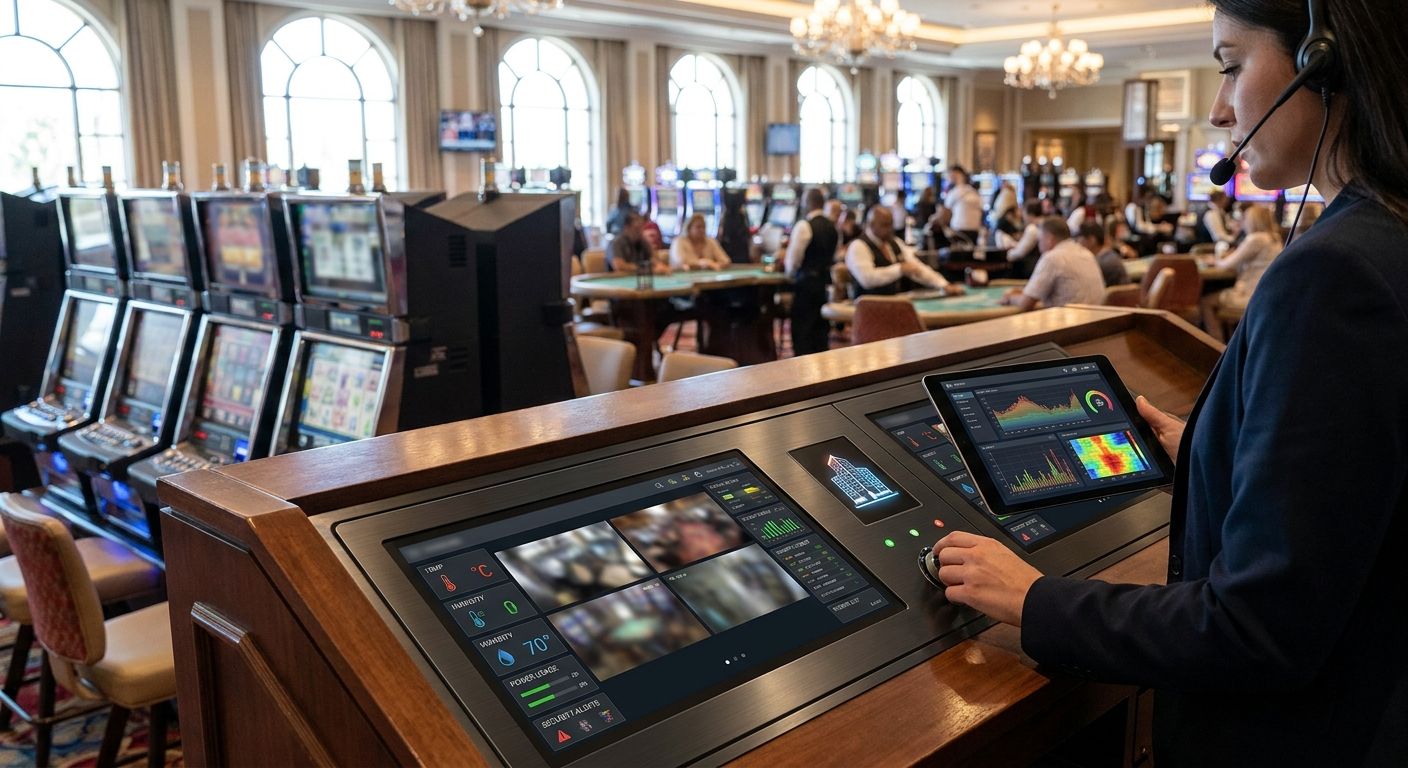
A facility monitoring system for casinos and gaming floors is a network of wireless sensors and a dashboard that tracks temperature, humidity, water, air quality and equipment condition across a property that never closes, with the aim of keeping the floor open and the compliance paperwork clean. A gaming floor runs 24 hours a day, 365 days a year, mixes high foot traffic with cash and currency storage, and has zones — the cage, the vault, the surveillance room, the slot bank — that a hotel wing or an office building never has to account for.
- A facility monitoring system for casinos tracks temperature, humidity, water and equipment across gaming floors around the clock.
- LoRaWAN and mioty sensors report zone conditions without rewiring a live casino floor mid-shift.
- Escalation chains and five alarm severity tiers get the right person paged before a floor-level outage.
- A digital twin maps the cage, vault and gaming floor zones onto one dashboard for facilities and compliance teams.
Why do casinos need a facility monitoring system?
A casino floor doesn't get a maintenance window. Slot cabinets, LED signage, and the HVAC plant that dilutes crowd heat all run continuously, and a five-degree HVAC drift at 3 a.m. is invisible to a day-shift facilities team until a guest complains or a machine faults out.
Humidity control matters more here than in a typical commercial building. ASHRAE Standard 55 recommends indoor relative humidity between 30% and 60% for occupied spaces, and gaming floors that drift outside that band see card and dice stock warp and slot machine electronics run hotter than they're rated for. Cash cages and vaults add a second layer: currency storage has its own tolerance for temperature and moisture, and it's rarely on anyone's dashboard.
Noise is the third pressure point. OSHA's permissible exposure limit under 29 CFR 1910.95 is 90 dBA averaged over an 8-hour shift, and slot banks, table games and PA systems can push ambient noise close to that line for employees working a full shift near the machines.
How to build a facility monitoring system for a casino gaming floor
Map every zone that can't go dark
Start by listing the zones that have different tolerances and different consequences if they fail — this becomes your sensor placement plan before you buy anything.
- Gaming floor and slot banks
- Cash cage and vault
- Surveillance and server rooms
- HVAC mechanical rooms and air handlers
- Back-of-house kitchens, bars and walk-in coolers
- Valet and parking structure
Set humidity and temperature thresholds for the gaming floor
A handheld thermo-hygrometer and a logging sheet checked every shift is the free starting point, and it's how most floors have tracked conditions for years. The gap is what happens between checks.
- Target 30-60% RH per ASHRAE 55 for the main floor
- Set a tighter humidity band for card and dice storage
- Flag slot cabinet intake temperature separately from ambient floor temperature
- Set a currency-appropriate temperature and humidity range for the cage and vault
- Map each threshold to a severity level before you turn on alerts
Keep HVAC and ventilation running without surprises
Manual gauge checks on air handlers catch obvious failures but miss slow drift. A rules engine watching the same feed continuously catches both.
- Pull existing BMS and energy meter data in over MQTT instead of ripping out wiring
- Alarm on supply air temperature drift before it reaches the floor
- Track runtime hours against expected cycles for each air handler
- Compare zone-by-zone temperature to catch one dead unit hiding inside an average
The HVAC energy management platform approach applies directly here: a casino floor with uneven cooling wastes energy in the zones that are overcooled to compensate for the ones that aren't.
Watch for water before it shuts down a bank of machines
A routine walk-through near fountains, restrooms, bars and kitchen lines is the manual baseline, and it's fine until the leak happens between rounds.
- Place point leak sensors under bar lines and near fountain plumbing
- Set a rope or cable sensor along kitchen floor drains
- Alarm on any moisture reading near a slot bank's power distribution
- Escalate floor-level water alarms above general maintenance alarms
Track vibration on escalators, elevators and back-of-house equipment
A maintenance log tied to the vendor's service schedule is the default, and it catches problems on the vendor's timeline, not the floor's.
- Set a vibration threshold on escalator drive units carrying continuous foot traffic
- Watch elevator motor vibration between scheduled service visits
- Track chiller and compressor vibration in the mechanical room
- Fire an alarm when a reading crosses the threshold instead of waiting for the next visit
A CEL rule firing on a threshold isn't a prediction of failure — it's a confirmation that a reading crossed a line you set, and that's the honest description of what a rules engine does.
Build escalation chains before the 3 a.m. call happens
A shift supervisor's phone tree works until the supervisor is on the floor and doesn't hear the ping.
- Route floor-critical alarms through five severity tiers instead of one flat alert
- Set multi-step escalation so an unanswered alarm reaches the next person automatically
- Use quiet hours for non-critical alerts and skip them for floor-critical ones
- Centralize every alarm in one inbox instead of scattered texts and emails
The SMS and email alert setup for critical thresholds covers exactly this pattern: threshold, escalation, confirmation, with nothing waiting on one person's phone.
Track high-value assets that move around the property
Sign-out sheets for valet keys, chip carts and AV gear are the manual system most floors already run. It works for accountability, not for real-time location.
- Tag valet vehicles and shuttle fleet with tracker templates instead of building custom firmware
- Tag chip carts and cash transport carts moving between the cage and the floor
- Track portable AV and event equipment used across convention space
- Log location history instead of relying on staff memory during an audit
A vehicle and tracker connector with 2,000+ preconfigured tracker templates covers most of this without a custom integration project.
Turn sensor data into an audit-ready dashboard
Spreadsheet exports pulled together the night before an audit are the common fallback, and they're the reason audits take longer than they should.
- Build one dashboard combining map, chart, gauge and floor-plan pin widgets
- Bind sensors to a live 3D digital twin of the floor, cage and vault
- Pull an immutable audit trail instead of reconstructing history from memory
- Export via API for whatever reporting format the gaming commission wants
Sensors for any of these zones ship worldwide through Kilo Electronics, the hardware side of the platform, when a property needs pre-configured devices rather than sourcing its own.
Casino facility monitoring options compared
| Option | Best for | Key limitation |
|---|---|---|
| Paper logs and shift rounds | Single-site floors testing the idea before buying anything | No real-time alert between rounds, gaps up to a full shift |
| Point sensors with local buzzer alarms | One critical zone, like a single walk-in cooler | No central dashboard, no escalation past an audible alarm |
| Legacy wired BMS | Buildings with existing wired infrastructure | Expensive and slow to extend to new zones like the cage or a new bar |
| Cloud IoT platform with LoRaWAN/mioty and a rules engine | Multi-zone floors that need escalation and an audit trail | Needs gateway placement planning across a floor spanning tens of thousands of square feet |
The Kilo IoT Platform sits in the last row: it doesn't replace an existing BMS outright, it connects to one over MQTT and adds the rules, alarms and escalation that most legacy systems were never built with.
Common facility monitoring mistakes on casino gaming floors
- Treating humidity as a comfort setting, not a threshold — cards warp and slot boards run hot outside the 30-60% RH band ASHRAE 55 recommends.
- No escalation path after midnight — facilities teams staff day shifts, but the floor runs 24/7, every day of 2026.
- The cage and vault treated as someone else's problem — currency storage rarely gets its own temperature or humidity alarm.
- No shared dashboard between engineering, surveillance and compliance — each team pulls a separate spreadsheet during an audit.
- Sensors installed once and never recalibrated — drift goes unnoticed until an inspector flags it.
See the floor on one dashboard
Map gaming floor, cage and vault zones onto a live digital twin.
What's the one alarm most gaming floors skip?
Ambient noise. OSHA's 90 dBA over an 8-hour shift (29 CFR 1910.95) applies to employees working slot banks and table games all day, and almost no property tracks it continuously — most rely on a one-time survey done years ago. A threshold alarm on a sound level sensor costs less to run than the survey did, and it flags drift the moment a new bank of machines or a PA change pushes a section over the line.
FAQ
What is a facility monitoring system for casinos and gaming floors?
It's a network of wireless sensors feeding a cloud dashboard that tracks temperature, humidity, water, noise and equipment condition across a gaming floor, cage, vault and back-of-house zones. It runs continuously because the floor does, unlike a periodic manual inspection.
How does IoT monitoring help with casino HVAC and air quality?
Sensors report supply air temperature and zone-by-zone conditions continuously, and a rules engine alarms on drift before it reaches the floor. That catches uneven cooling that a manual gauge check on a fixed schedule would miss.
What sensors do gaming floors need for compliance reporting?
Temperature and humidity sensors on the main floor and cage, water leak sensors near plumbing and kitchen lines, and vibration sensors on escalators and mechanical equipment cover the core zones. An immutable audit trail on top of those readings is what turns raw data into a compliance record.
Is a cloud IoT platform better than a traditional BMS for a casino?
A cloud IoT platform is faster to extend to new zones like a renovated cage or a new bar, since it doesn't require new wiring. A legacy wired BMS still works well for buildings that already have the infrastructure in place.
How do casinos get alerted when gaming floor cooling fails at 3 a.m.?
A multi-step escalation chain routes the alarm through email, SMS or push, and if the first person doesn't confirm it, it escalates to the next. Five severity tiers keep a minor HVAC blip from paging the same person as a floor-critical water leak.
Can one platform track cash cage humidity and vault temperature together with the gaming floor?
Yes — a single dashboard with a digital twin can bind sensors from the cage, vault and floor to the same map, each with its own threshold and severity tier. That's the point of centralizing zones instead of running separate point sensors per area.
Does a casino need Wi-Fi to run wireless facility sensors?
No. LoRaWAN and mioty sensors report over long-range radio rather than the building's Wi-Fi network, which matters on a floor where Wi-Fi is already saturated by point-of-sale and guest devices.