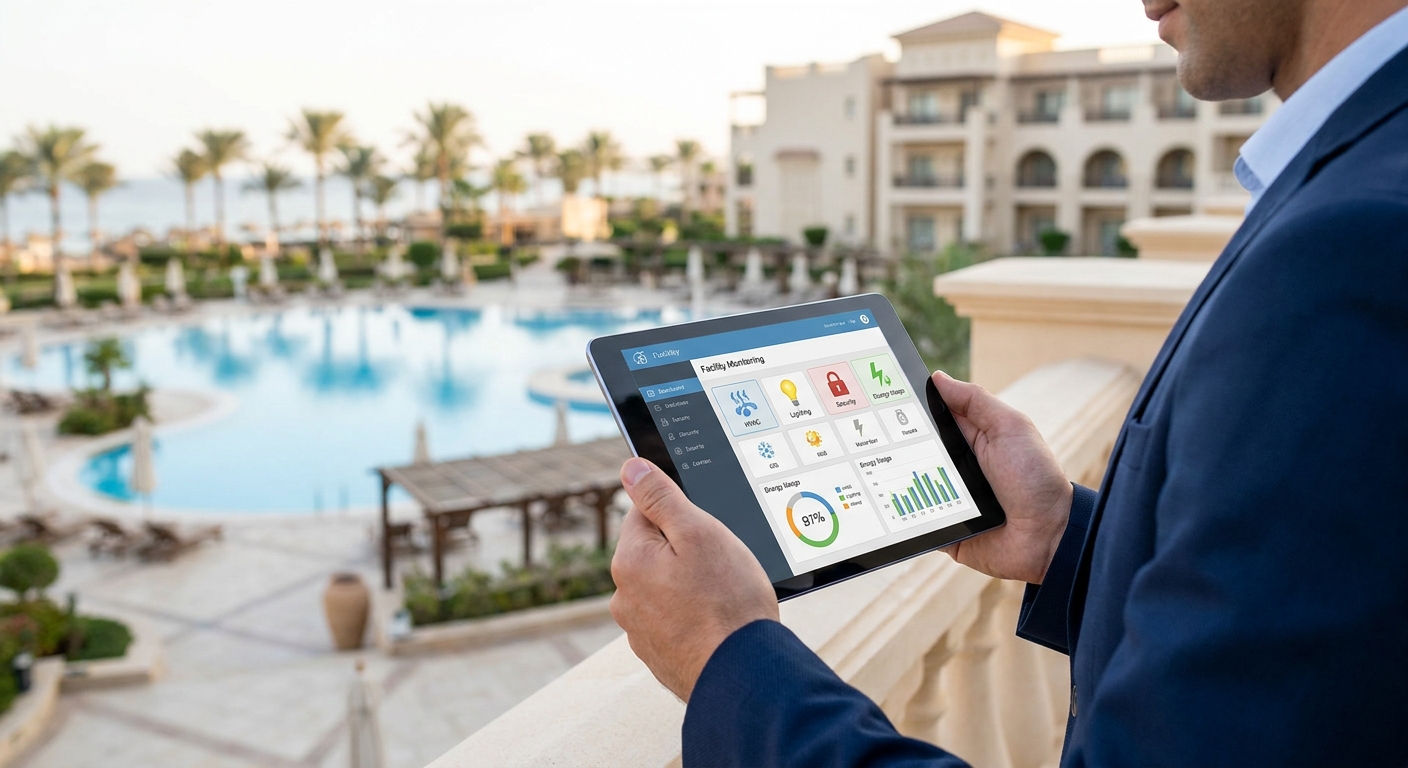
Hotels and resorts run mechanical rooms, guest floors, kitchens, laundries, and pool equipment on a 24-hour clock, and a facility monitoring system for hotels and resorts gives the engineering team one dashboard for temperature, water, and equipment health instead of six separate vendor apps.
- Kilo IoT's facility monitoring system for hotels and resorts runs on LoRaWAN and mioty, not Wi-Fi cameras — Buy for properties over 50 rooms.
- Water sensors on mechanical rooms and ice machines cut response time to under 60 seconds when tied to rules-based alarms.
- HVAC and energy dashboards matter more for 2026 budgets than a guest-facing app nobody in engineering opens.
- Skip any system that needs a separate app per building — resort groups need one dashboard across every property.
- A digital twin lets an engineer check three towers from one screen instead of walking each floor.
Why this matters
A hotel rarely loses money to a missed filter change. It loses money to a walk-in freezer that holds 8°C for ten minutes and spoils a banquet order, a burst supply line on the fourth floor that soaks three guest rooms before housekeeping notices, or a chiller that trips at 2 a.m. with nobody watching a screen.
Staff turnover in hotel engineering runs high, and manual rounds only catch what the person on shift happens to check that hour. A facility monitoring system for hotels and resorts replaces the walkthrough with sensors on LoRaWAN or mioty, a rules engine that fires the alarm the moment a threshold breaks, and a dashboard the general manager can glance at without calling engineering first.
“If a walk-in freezer holds 8°C for ten minutes, the kitchen finds out before the thermostat does.”
Who this is for
This is written for a director of engineering, facilities manager, or ops lead running one property or a small portfolio of hotels and resorts — someone tired of a maintenance team that finds out about a leak from a guest complaint instead of a sensor. If you manage a single 40-room boutique property with one mechanical room, your needs are lighter than a 400-room resort with three towers, a spa, and a commercial kitchen, but the underlying criteria below hold for both. Kilo IoT builds toward the second case: multi-building, multi-zone, and multi-team.
What to look for in a facility monitoring system for hotels and resorts
Connectivity that reaches every basement and mechanical room
Hotels are built with concrete, steel, and elevator shafts — the exact conditions that kill Wi-Fi and Bluetooth range. LoRaWAN and mioty sensors run for years on battery and punch through those walls from a single gateway per building, which matters when your boiler room sits two floors below the lobby and your Wi-Fi mesh doesn't reach the sub-basement.
Alarms your engineering team can build without a developer
A rules engine that only your integrator can touch turns into a system nobody updates after the person who set it up leaves. Look for plain-language rule building — "alert the on-shift engineer if the walk-in holds above 4°C for more than 10 minutes" — so a facilities manager can adjust thresholds in 2026 without opening a ticket.
Water leak detection tied to a shutoff-worthy alarm
Guest room bathrooms, laundry rooms, and mechanical spaces are where hotels take on water damage costs that dwarf the sensor budget. A facility monitoring system for hotels and resorts needs leak sensors that escalate to a phone alert within seconds, not a dashboard entry someone checks the next morning.
HVAC and energy visibility across every building
Energy is one of the largest controllable line items on a resort's P&L, and a best iot platform for hvac energy management view lets you spot a chiller running outside its normal band or a zone heating and cooling at the same time. That's a maintenance ticket today instead of a utility bill surprise next month.
One dashboard for multi-property portfolios
If you run more than one property, per-building logins don't scale. A regional ops director needs a single view across every resort in the portfolio, with alarms grouped by property so a spike at one location doesn't get lost in the noise from four others.
See a hotel monitoring setup
Walk through how Kilo Cloud maps sensors, alarms, and buildings for one property.
Top picks
The overnight leak catcher. Water sensors placed under ice machines, in laundry rooms, and behind guest bathroom vanities report moisture in seconds, not during the next housekeeping round. Tied to a rules-based alarm, a leak that would otherwise run for 6-8 hours overnight gets flagged to the on-call engineer inside a minute. Buy for any property with more than one floor above a mechanical space.
The energy control tower. An HVAC and energy dashboard across every tower gives one engineer visibility into chillers, boilers, and zone setpoints instead of walking each mechanical room with a clipboard. For a resort running three buildings on separate systems, this is the difference between reacting to a utility bill and catching the fault that caused it. Buy for multi-building resorts with centralized engineering.
The cold kitchen guard. Walk-in freezers, banquet kitchen coolers, and minibar compressors all fail quietly — the compressor keeps running while the temperature climbs. Temperature sensors on a 10-minute alarm threshold catch spoilage risk before a chef finds out the hard way. Consider this for properties with in-house food and beverage operations; skip it if the property outsources catering entirely.
The multi-tower dashboard. A digital twin view that maps sensors to a floor plan lets an engineer check three towers and a spa building from one screen instead of physically walking each one. It's most useful once a resort passes roughly three buildings on one site — below that, a standard list-view dashboard does the job just as well. Consider for resorts with 3+ buildings; wait if you're running a single low-rise property.
What to avoid
- Wi-Fi-only "smart hotel" thermostats. They look modern in a sales deck but lose signal in concrete stairwells and rarely tie into a central alarm system engineering actually watches.
- Standalone leak pucks with app-only notifications. Without an escalation path into a ticketing or on-call system, an alert sits unread on a phone that changed hands three staff turnovers ago.
- Dashboards that only show a snapshot, not a history. If you can't see the trend line on a chiller over the last 30 days, you can't tell a slow drift from a one-off spike, and every alarm reads the same.
Verdict comparison
| Pick | Best for | Response threshold | Verdict |
|---|---|---|---|
| Overnight leak catcher | Guest rooms, laundry, mechanical rooms | Under 60 seconds | Buy |
| Energy control tower | Multi-building resorts | Real-time, trend-based | Buy |
| Cold kitchen guard | In-house F&B operations | 10-minute threshold | Consider |
| Multi-tower dashboard | 3+ building sites | Live, per-building | Consider |
FAQ
What is a facility monitoring system for hotels and resorts?
It's a sensor and software setup that tracks temperature, humidity, water, and equipment status across a hotel property and sends alarms when something goes out of range. In 2026, most systems run on LoRaWAN or mioty sensors feeding a central dashboard rather than isolated per-device apps.
Is LoRaWAN better than Wi-Fi for hotel monitoring?
For basements, mechanical rooms, and multi-floor buildings, yes — LoRaWAN sensors run for years on battery and reach through concrete and steel where Wi-Fi signal drops off. Wi-Fi still works fine for guest-facing devices near an access point.
How fast should a leak alarm reach an engineer?
Under 60 seconds from detection to notification is the standard to aim for in 2026 — anything slower and a leak in a mechanical room or guest bathroom has time to spread before someone responds.
Do small boutique hotels need the same system as large resorts?
No. A 40-room boutique property with one mechanical room needs fewer sensors and a simpler dashboard than a 400-room resort with three towers and a commercial kitchen, though the same connectivity and alarm criteria apply to both.
What should a hotel monitor besides temperature?
Water leaks in mechanical rooms and guest bathrooms, HVAC and chiller performance, energy use by zone, and equipment vibration on major mechanical assets are the next priorities after basic temperature monitoring.
Can one dashboard cover multiple hotel properties?
Yes — a multi-site facility dashboard groups alarms and sensor data by property so a regional ops director sees every location without logging into separate systems per building.
Why do hotels need alarms instead of just a dashboard?
A dashboard only helps if someone is actively watching it. Alarms push the alert to the person on shift the moment a threshold breaks, which matters overnight when engineering staffing is thinnest.
One last thing
Most hotels that install sensors still lose the alert somewhere between the sensor and the person who could act on it — the alarm goes to a shared inbox nobody checks after midnight. The fix isn't more sensors, it's routing: point the rules engine at the on-shift engineer's phone, not a distribution list, and reset that routing every time the shift schedule changes.