
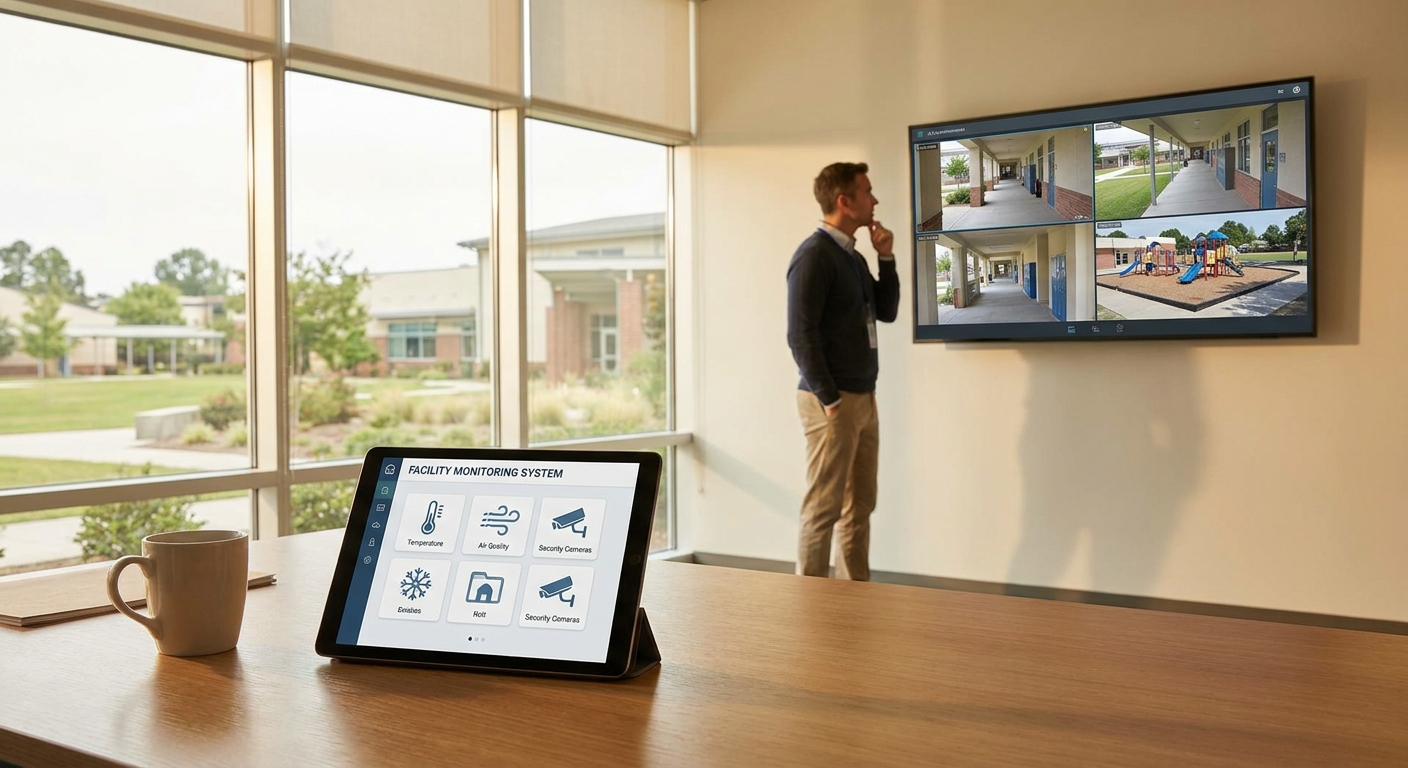
A facility monitoring system for schools puts temperature sensors, water sensors, door/equipment sensors, and energy meters from every building on one dashboard, so a cafeteria freezer failure or a boiler trip gets caught at 2 AM instead of at 7 AM when the buses arrive.
- Kilo IoT's facility monitoring system for schools centralizes cold storage, HVAC, and multi-site alarms in one dashboard — Buy for districts running 3+ buildings.
- A cafeteria freezer failure over a 72-hour holiday weekend can spoil an entire food service budget line before Monday's inspection.
- District-wide digital twin dashboards flag wasted HVAC runtime in empty wings before the 2026 energy audit lands on your desk.
- Skip single-building point sensors once your district passes two campuses — multi-site dashboards win on total cost and staff time.
Why this matters
School facilities teams run buildings built across four or five decades, with HVAC controls, cafeteria refrigeration, and water systems that were never meant to talk to each other. A district with six elementary schools, two middle schools, and a high school is effectively running nine separate mechanical operations with one facilities director and a handful of custodians.
The USDA cold-holding standard requires food kept at 41°F or below, and a walk-in that drifts above that line for even a few hours during a long weekend becomes a health department finding, not just a maintenance ticket. A facility monitoring system for schools exists to catch that drift before Monday morning, and to do it across every campus in the district from a single screen, not nine separate building logs.
Who this is for
This guide is for facilities directors, operations managers, and business officials at K-12 districts who are responsible for buildings they cannot physically walk every night — food service refrigeration, HVAC plants, water systems, and portable classrooms scattered across a campus or a district. If your maintenance team finds out about a failed freezer compressor because a teacher smells something in the morning, this is written for your job.
It is not written for a single-building charter school with one custodian who checks the boiler room daily — that operation can often run on a simpler point solution. Once you cross two or three sites, the math changes.
What to look for in a facility monitoring system for K-12 campuses
Multi-site dashboard, not per-building logins
A district office needs one view across every campus, not nine separate portals with nine separate passwords. If your facilities director has to log into a different system for each school to check overnight freezer temperatures, the monitoring system is adding work instead of removing it. Kilo IoT runs cold storage, HVAC, and water sensors from every building through one dashboard, which is the baseline requirement for any district past a single campus.
Alarms that reach a person, not just a chart
A temperature chart that nobody looks at over a three-day weekend is a data log, not a monitoring system. The alarm has to text or call a real person — the night custodian, the facilities director, an on-call vendor — within minutes of a threshold breach, and it has to escalate if the first person doesn't respond.
Connectivity that survives concrete and steel
School buildings built in the 1960s and 1970s have cinder block walls, steel lockers, and basement mechanical rooms that eat Wi-Fi signal for lunch. LoRaWAN and mioty sensors are built to push a signal through that kind of construction from a single gateway per building, which matters more in a school than in a modern glass office.
Cold storage and food service coverage
Cafeteria walk-ins and reach-in coolers are the single highest-stakes assets in most districts because a failure directly threatens food safety compliance and student meal service. A system that only monitors HVAC and skips food service refrigeration is solving half the problem.
Energy visibility, not just alarms
Unoccupied wings running full HVAC over a three-day weekend or an empty summer month are the quiet cost that never shows up as an emergency ticket but shows up every month on the utility bill. A digital twin view of building energy use turns that waste into a line item someone can actually cut.
API access for existing facilities software
Most districts already run a work-order or facilities management system, and a monitoring platform that can't push alarm data into it just creates a second inbox nobody checks. Look for a platform with an open API rather than a closed dashboard that only lives in its own app.
Top picks for K-12 facility monitoring
The district-wide dashboard pick. A multi-site facility dashboard puts every building's sensor feed on one screen instead of nine logins, which is the single biggest time saver for a facilities director covering more than two campuses. One spec that matters: a single dashboard view across unlimited sites means the facilities office stops toggling between building-specific portals during a Sunday-night alarm. Buy if your district runs three or more buildings.
The food-safety pick. Cold storage temperature monitoring tracks cafeteria walk-ins and reach-ins against the 41°F cold-holding threshold and alarms before a drift becomes a health inspection finding. The concrete number here: a freezer that climbs from 0°F to 20°F over four unmonitored hours during a holiday break can spoil a week's worth of meal service inventory. Buy for any district with on-site food service.
The energy-savings pick. A building energy optimization digital twin maps HVAC runtime against occupancy schedules and flags wings that are heating or cooling empty classrooms. This is the pick that pays for itself out of the utility budget rather than the maintenance budget, which makes it easier to get approved in a 2026 capital planning cycle. Consider it if your district hasn't run an energy audit in the last two years.
The scale pick. Choosing device management for multi-site operations matters once a district gets past roughly a dozen buildings and hundreds of sensors, because provisioning and firmware updates by hand across every campus stops being realistic. Consider this pick specifically at the point where one facilities coordinator can no longer track sensor health building by building.
See the platform across your campuses
One dashboard for cold storage, HVAC, and district-wide alarms.
What to avoid
Single-building point sensors sold as a district solution. A $50 Wi-Fi temperature puck works fine for one classroom fridge, but stitching together nine separate apps across nine buildings is more manual work than the monitoring system was supposed to remove.
Dashboards without escalation logic. A platform that sends one text and stops is useless at 3 AM on a Saturday when the first person on the list doesn't see their phone. Confirm the alarm rules support a second and third contact before you sign anything.
Confusing environmental monitoring with building security. Temperature and equipment alarms tell you a freezer failed; they don't tell you who opened a side door at 11 PM. Districts running both environmental monitoring and cloud-based access control on separate systems still get full coverage, but the two should be scoped and budgeted as distinct line items, not bundled into one RFP by mistake.
Verdict comparison
| Pick | Multi-site dashboard | Alarm escalation | Food service coverage | Energy visibility | Verdict |
|---|---|---|---|---|---|
| District-wide dashboard | Yes | Yes | Partial | Partial | Buy for 3+ buildings |
| Cold storage monitoring | Yes | Yes | Yes | No | Buy for food service districts |
| Energy digital twin | Yes | Partial | No | Yes | Consider before next audit |
| Device management for scale | Yes | N/A | N/A | N/A | Consider past 12+ buildings |
FAQ
What does a facility monitoring system for schools actually track?
It tracks cold storage temperature, HVAC performance, water leaks, and equipment status across every building on a district's campuses from one dashboard. Alarms fire when a reading crosses a set threshold, such as a cafeteria freezer climbing above 41°F.
Is a facility monitoring system worth it for a single small school?
A single-building charter school with daily on-site checks can often run on a simpler point sensor without a full multi-site platform. The math shifts once a district manages two or more campuses that can't be walked every night.
How much does facility monitoring cost for a school district in 2026?
Cost scales with sensor count and building count rather than a flat license fee, since most platforms price by connected device. Districts should request a per-building quote rather than assume a single district-wide number.
Does facility monitoring replace access control or security systems?
No. Environmental monitoring catches temperature, equipment, and water failures, while access control manages who enters a building and when. Districts typically budget and scope them as two separate systems.
What connectivity works best in older school buildings?
LoRaWAN and mioty sensors push signal through cinder block walls and basement mechanical rooms better than standard Wi-Fi, using a single gateway per building rather than dozens of access points. That matters most in buildings constructed before the 1980s.
Can a district integrate sensor alarms with its existing work-order system?
Yes, if the monitoring platform exposes an open API rather than locking data inside its own app. That lets an alarm generate a work order automatically instead of requiring someone to re-enter it by hand.
How fast should a cafeteria freezer alarm reach staff?
An alarm should reach a live person within minutes of a threshold breach and escalate to a second contact if the first doesn't respond within a set window. A chart nobody checks over a holiday weekend isn't a monitoring system, it's a log.
“If a freezer alarm doesn't reach a real person within minutes, it's a data log, not a monitoring system.”
One last thing
Most districts lose the food service argument before they ever open an RFP, because the freezer failure that ruins a week of meal service inventory almost always happens over a long weekend when nobody is on campus to notice. The 41°F cold-holding threshold isn't a suggestion in 2026 — it's the number a health inspector will ask about, and it's the number your alarm rules should be built around first, before HVAC or energy dashboards even enter the conversation.