
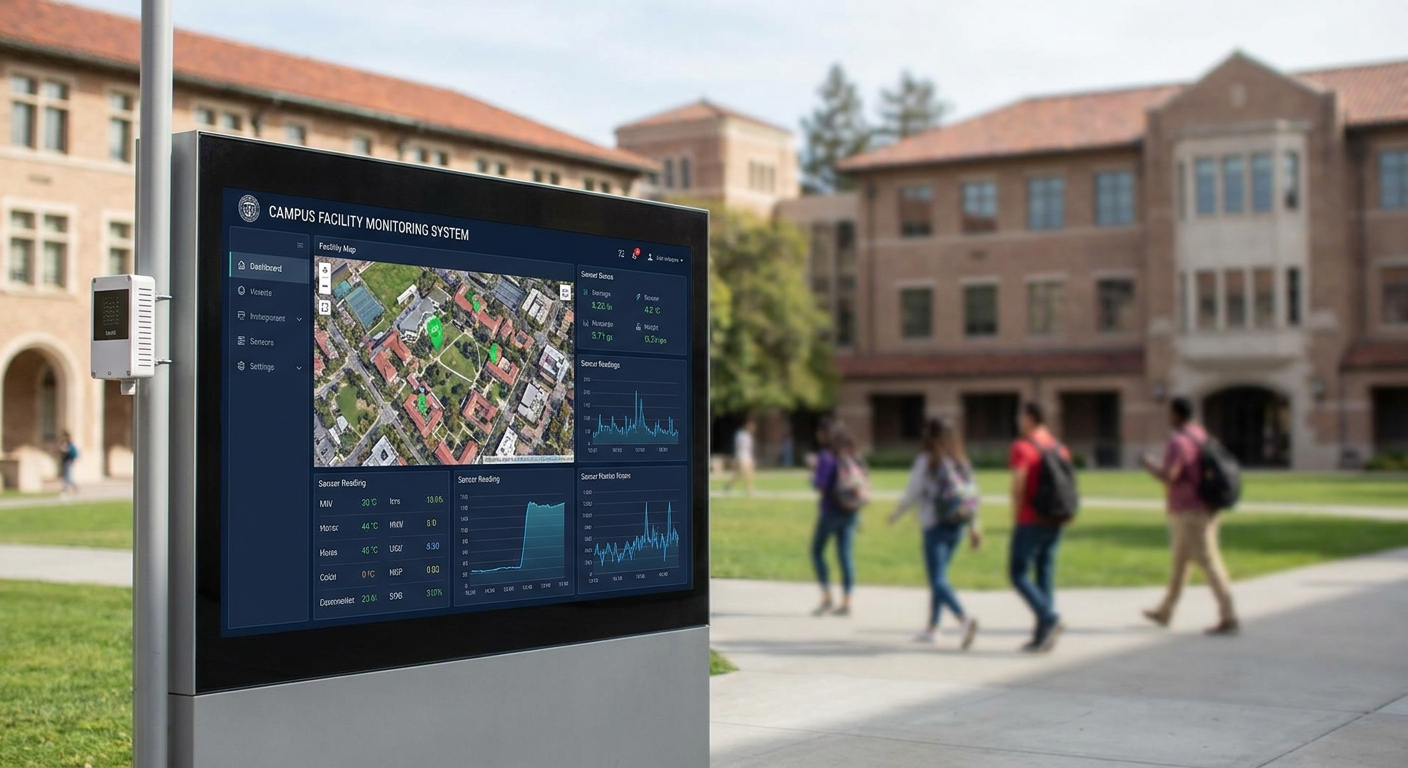
A facility monitoring system for university campuses has to hold up across a few hundred buildings of wildly different ages, wiring, and connectivity — not a single office park with one roof and one HVAC unit. Here's what actually works when you're running dorms, labs, dining halls, and a steam plant on the same dashboard, and what looks good in a demo but falls apart at scale.
- A facility monitoring system for university campuses needs LoRaWAN and mioty side by side for mixed-age buildings — Kilo IoT covers both.
- A live digital twin of energy use across dozens of halls beats a spreadsheet report for facilities directors in 2026.
- Water leak sensors that alarm in under a minute stop a dorm flood before it reaches the floor below — Buy.
- Skip single-building smart-office tools sized for one HVAC unit, not a 200-building campus.
- Role-based multi-site dashboards let a plumber see plumbing alarms only, not every alert on campus.
Why this matters
A university campus is really dozens of small buildings pretending to be one property. A 1920s dorm with plaster walls sits fifty feet from a glass-and-steel lab built in 2019, and both need to report into the same system. Most facility monitoring tools are built for a single building or a single tenant, which is why they stall out the moment a campus tries to scale past one quad.
The Kilo Cloud platform is built around that mismatch: LoRaWAN and mioty connectivity that reach into basements and mechanical rooms WiFi never touches, a rules engine that turns a sensor reading into an actual alarm, and a digital building twin that shows every zone on one screen. That combination is the difference between a facilities team finding out about a burst pipe from a call to campus police and finding out from an alarm at 2:14 a.m.
Who this is for
This guide is for facilities directors, campus energy managers, and operations teams responsible for buildings they didn't design and can't always rewire. If you're managing more than a handful of structures — academic buildings, residence halls, athletic facilities, a central utility plant — and you're still walking floors with a clipboard or waiting on a building automation system that only covers half your inventory, this is written for your situation, not a generic office scenario.
What to look for in a facility monitoring system for university campuses
Connectivity that reaches concrete stairwells and steam tunnels
Campus buildings bury sensors behind cinder block, under raised floors, and inside mechanical rooms with zero WiFi signal. LoRaWAN typically covers 2-5 km in dense urban settings and mioty is built for exactly this kind of high-density, hard-to-reach deployment — thousands of endpoints per base station without a gateway on every floor. A system that only supports WiFi or Bluetooth mesh will leave your boiler room blind.
A digital twin, not a folder of PDFs
A campus energy manager reporting to a provost needs a single view of every building's status, not twelve separate building automation logins. A digital twin that overlays temperature, humidity, occupancy, and energy data onto an actual floor plan turns a walkthrough into a screen you check between meetings.
Alarms that reach a person, not just a dashboard
A sensor reading a spreadsheet doesn't stop a flood. What stops a flood is an alarm that fires within seconds of a threshold breach and routes to the on-call plumber's phone, not a report someone opens Monday morning. This is the single biggest gap between a monitoring tool and an actual facility monitoring system.
Multi-building dashboards with role-based access
A campus has electricians, plumbers, HVAC techs, and a central operations office, and none of them should see every alarm on every building. A system built for multi-site facility teams needs access control down to the building or zone level, so a dorm alarm doesn't land in the lab manager's inbox.
Device management that scales past a few hundred sensors
A mid-size campus can easily run past a thousand sensors once you cover HVAC, water, occupancy, and equipment vibration across every building. Device provisioning, firmware updates, and battery status need to work at that scale without someone manually checking each device page.
API access into your existing systems
Most campuses already run a CMMS or a legacy building automation system for HVAC controls. A monitoring platform that can push alarm data into that system via API saves the facilities team from managing two separate tools for the same building.
Top picks for campus facility monitoring
The energy backbone — HVAC and energy monitoring. Academic buildings and dorms typically account for the largest share of a campus utility bill, and most of that runs through HVAC. A best IoT platform for HVAC energy management setup pairs temperature and runtime sensors with rules that catch a unit running 24 hours a day when the building is empty. Setpoint drift alarms fire within seconds of the threshold breach, not after the next scheduled inspection. Buy — this is the highest-leverage first deployment on any campus.
The reporting fix — a digital twin of every building. Campus sustainability directors spend hours turning building data into slides for the board. A digital twin for building energy optimization puts every zone's live energy and environmental data on one floor-plan view instead of a dozen exported spreadsheets. One screen, updated continuously, replaces the manual report cycle. Buy if your team is still assembling energy reports by hand each month.
The dorm-flood insurance — water leak detection. A burst supply line on the third floor of a residence hall doesn't wait for business hours, and by the time facilities notices water in the hallway, it's already soaked two floors below. Water leak monitoring for commercial buildings catches the leak within minutes of the sensor tripping, before it becomes a multi-floor cleanup and an insurance claim. Buy for any dorm, dining hall, or lab with water lines running through occupied space.
The scale play — a single dashboard across every building on campus. Once you're past three or four buildings, checking each one separately stops working. A multi-location facility dashboard consolidates every alarm, every zone, and every building into one login with role-based views for each team. Consider this once your deployment crosses roughly five buildings — below that, a single building's dashboard may be enough for 2026 budgets.
What to avoid
- Single-building smart-office platforms. Tools built for one commercial building with one HVAC system don't scale device management or alarm routing across a campus with dozens of separate structures.
- Consumer-grade WiFi sensors. They look cheap upfront but drop connectivity in basements and mechanical rooms, exactly where campus infrastructure lives — a facility monitoring system for university campuses fails the moment coverage gaps show up in a steam tunnel.
- Facility tools sized for K-12 school campuses. A single-school deployment tool built for one or two buildings doesn't handle the device count or multi-team access control a university needs across a hundred-plus structures.
See the platform run on your buildings
Walk through LoRaWAN, mioty and alarm setup for a multi-building campus.
Verdict comparison
| Criterion | Why it matters on campus | Verdict |
|---|---|---|
| Connectivity range (LoRaWAN + mioty) | Reaches basements, steam tunnels, concrete stairwells | Buy |
| Digital twin reporting | Replaces manual spreadsheet reports for boards | Buy |
| Water leak alarms | Stops floor-to-floor flooding in dorms | Buy |
| Multi-building dashboard | Needed past roughly 5 buildings | Consider |
| Single-building smart-office tools | Doesn't scale to campus device counts | Skip |
FAQ
What is the best facility monitoring system for university campuses in 2026?
The best facility monitoring system for university campuses in 2026 combines LoRaWAN or mioty connectivity with a digital building twin and automated alarms, since WiFi-only tools fail in basements and mechanical rooms. Kilo IoT covers both connectivity types on one platform.
Is LoRaWAN or mioty better for a university campus?
Mioty handles higher sensor density per base station and performs better in concrete and underground spaces, while LoRaWAN covers open quads and outdoor areas at 2-5 km range in dense settings. Most campuses benefit from running both.
How many sensors does a mid-size university campus need?
A mid-size campus covering HVAC, water, and occupancy across dozens of buildings can easily exceed a thousand sensors once every building is instrumented. Device management needs to handle that count without manual per-device checks.
Can facility monitoring alarms integrate with an existing CMMS?
Yes, a monitoring platform with API access can push alarm data directly into an existing CMMS or building automation system, so facilities teams aren't managing two separate tools for the same building.
How fast do water leak sensors alarm in a dorm?
Water leak sensors typically alarm within minutes of detecting moisture, which is fast enough to stop a burst pipe before it floods the floor below. That speed is the difference between a mop and an insurance claim.
Is a digital twin worth it for a university campus?
A digital twin is worth it once a campus manager is spending hours each month assembling building reports manually, since the twin shows every zone's live data on one floor-plan view instead. It replaces the manual report cycle entirely.
How is a university facility monitoring system different from a K-12 school tool?
University systems need to manage device counts and multi-team access control across a hundred-plus buildings, while K-12 tools are typically sized for one or two school buildings. A K-12-scale tool will hit device management limits fast on a university campus.
What's the biggest mistake campuses make with facility monitoring?
The biggest mistake is deploying sensors without alarm routing, so readings sit in a dashboard nobody checks until the next scheduled walkthrough. An alarm that reaches the on-call tech's phone within seconds is what actually prevents damage.
One last thing
The alarm routing matters more than the sensor count. A campus with 200 sensors and alarms that reach the right phone in under a minute will catch more problems in 2026 than a campus with 2,000 sensors feeding a dashboard nobody watches after 5 p.m.