
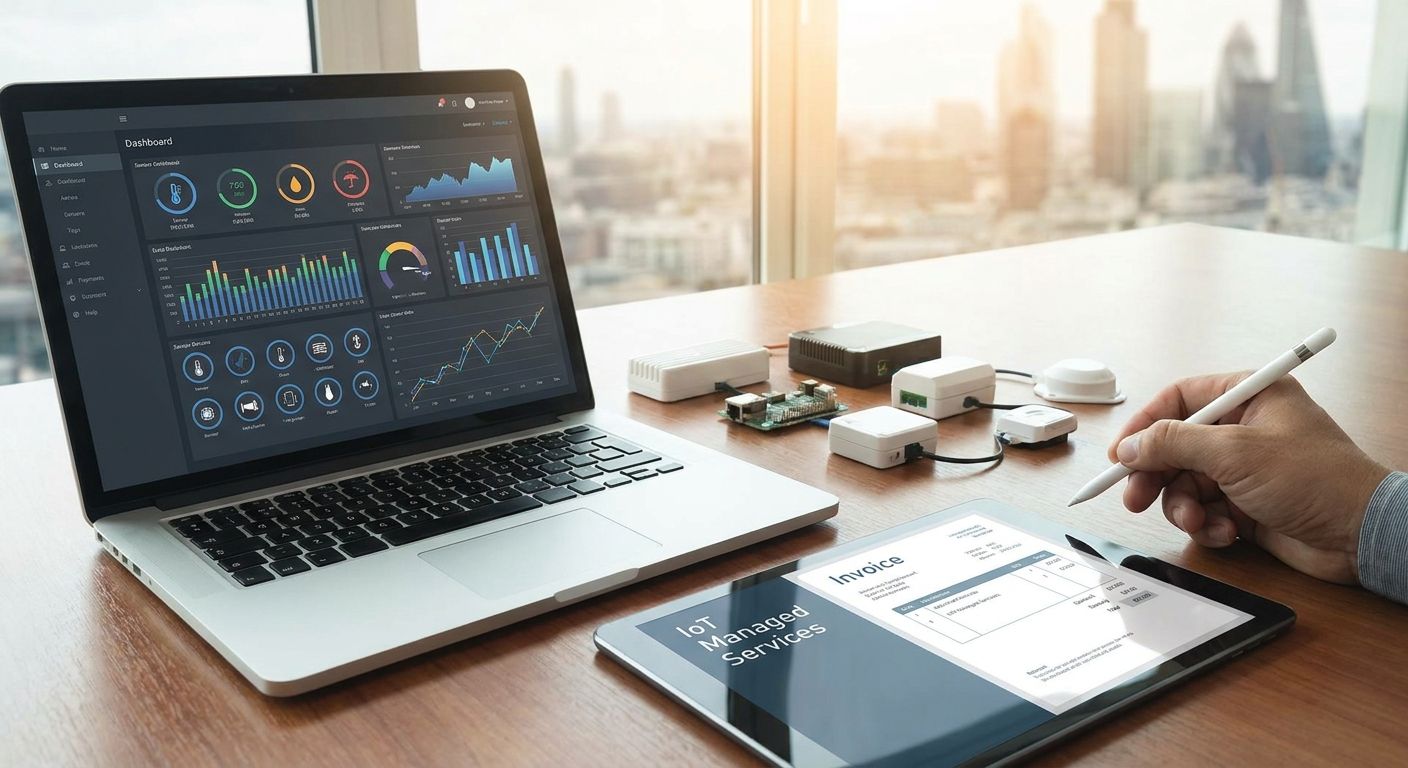
Managed service providers and system integrators reselling IoT monitoring need a billing structure that survives a client adding 40 sensors in year two without a renegotiation fight. This guide breaks down the three billing models that actually hold up, what drives the price up or down, and where the platform cost you pay sets the floor under all of them.
- Per-device billing scales cleanest for large multi-site deployments; per-site flat fees work better when clients add sensors constantly.
- Kilo's own tiers show the cost floor: Free covers 5 devices at 0 EUR, Starter is 25 EUR/month for 25 devices in 2026.
- White-labeling the dashboard lets you bill a branded reporting layer separately from the raw monitoring fee.
- Bill hardware and installation apart from the monitoring subscription — sensor cost and truck rolls don't scale like software does.
- Multi-tenant device management and role-based permissions are what make per-client billing operationally possible.
Bill IoT monitoring as a managed service: three models that work
Most MSPs land on one of three structures. Each one calculates differently, and each one breaks in a specific way if you scope it wrong.
| Model | How it's priced | Best for | Where it breaks |
|---|---|---|---|
| Per-device monthly fee | Flat rate multiplied by active device count | Multi-site rollouts with a stable, known device count | Margin erodes if sensor count grows and the rate isn't revisited |
| Per-site flat retainer | One fee covers unlimited devices at a location | Facilities teams that keep adding sensors after go-live | A site that sprawls past what you scoped starts losing money |
| Tiered SLA pricing | Base fee plus a tier for alarm response time and escalation depth | Clients needing guaranteed response, like cold storage or cleanrooms | You have to actually staff the response time you sold |
A device management platform built for system integrators is what makes any of these three models operationally workable — without a way to group devices by client account, per-device or per-site billing turns into a manual spreadsheet exercise every renewal cycle.
Per-device billing for IoT monitoring services
Per-device billing is the default in industrial IoT because it maps directly to what you're actually paying for underneath. Kilo's own platform tiers illustrate the mechanics: the Free tier covers up to 5 devices at 0 EUR with 1 dashboard and 1 rule, and Starter runs 25 EUR per month for up to 25 devices in 2026. That works out to a real cost floor near 1 EUR per device at the Starter tier, before you add your own margin, support hours, and any hardware markup.
The model scales cleanly because adding a client's 26th device is a predictable, quotable event. It breaks when you quote a rate at signing and the client doubles their device count eighteen months later without a rate conversation — build a review clause into the contract, not an assumption that volume growth is free margin for you.
Per-site flat-fee billing for IoT monitoring as a service
A flat per-site retainer covers unlimited devices at one location for one price. Clients that keep adding sensors — a warehouse installing humidity sensors zone by zone, a hospital adding equipment trackers ward by ward — prefer this model because their invoice doesn't change every time facilities adds a sensor.
The risk sits on your side. If you scope a retainer around 30 devices and the client grows to 150 without a floor-raise clause, you're covering the platform cost increase out of your own margin. Gateways are unlimited on every Kilo tier and never count toward the device cap, which removes one variable, but device count itself still needs a stated ceiling in the contract.
Tiered SLA billing tied to alarm escalation
Tiered pricing charges more for a faster, deeper alarm response — not for more devices. A cold storage client on a 15-minute escalation tier pays more than one on a next-business-day tier, because you're staffing differently for each.
This only works if the escalation chain is actually configured to match what you sold. Kilo's rules engine supports multi-step escalation chains across five severity tiers with email, SMS, and push, plus quiet hours and a centralized inbox — the tier you bill for should map to a specific escalation chain, not a verbal promise.
“If you're still billing every client the same flat rate regardless of alarm response time, you're pricing the easy client and the cold-storage client identically.”
What changes the price of IoT monitoring as a service
A handful of factors move the number up or down, regardless of which model you pick:
- Number of sites and devices per site — the platform cost floor scales with device count, so your price should too.
- Alarm escalation complexity — a five-tier severity chain with SMS and on-call rotation costs more to staff than a single email alert.
- White-label reporting requirements — a client-facing branded dashboard is a separate deliverable from raw monitoring.
- Hardware markup expectations — clients buying sensors through you expect that cost itemized apart from the software fee.
- Multi-tenant access control — role-based permissions per client account add setup time that a single-tenant deployment doesn't.
- On-premise vs. cloud requirements — an on-premise deployment changes your support model and should change your price.
Set up per-client roles with granular permissions before you quote a multi-tenant contract — ABAC access control is what keeps one client from seeing another client's dashboard.
Should you bill per device or per site for IoT monitoring?
Bill per device when the client's device count is stable and known at signing — it's the most predictable model for both sides. Bill per site instead when the client will keep adding sensors, since a flat retainer avoids a monthly renegotiation and keeps their invoice stable while your platform cost per device stays roughly fixed.
Do you need a reseller agreement to bill IoT monitoring as a service?
You need a written service agreement that states what's included — monitoring, alarm response, dashboard access, hardware — separate from any reseller or partner terms with the platform vendor. The agreement should specify the device ceiling, the escalation tier, and who owns the sensor hardware if the contract ends.
How do you price alarm escalation and SLA response time?
Price escalation and SLA response as a tier on top of the base monitoring fee, scaled to how fast and how deep the response chain runs — a 15-minute, multi-contact escalation costs more to staff than a next-business-day email. The tier only holds up if the escalation chain in the platform is actually configured to match it, not just promised in the contract.
A client-facing branded dashboard is worth billing as its own line item. Learn how to white-label an IoT dashboard for client reporting so the client never sees they're running on borrowed software — that's a distinct deliverable from the underlying monitoring fee, and it's usually where MSPs leave money unbilled.
Running more than one client account on the same platform instance requires multi-tenant device management built for sensor networks — without it, every new client is a manual setup instead of a repeatable billing unit.
Start billing clients on Kilo
Free tier covers 5 devices, no card required, in 2026.
FAQ
What's the best way to bill IoT monitoring as a managed service?
Per-device monthly billing is the most common structure in 2026 because it maps directly to platform cost, which scales with device count. Per-site flat fees work better for clients who add sensors constantly, since their invoice stays stable regardless of growth.
Should you charge per device or per site for IoT monitoring?
Charge per device when the client's device count is stable and known upfront, and per site when the client will keep adding sensors after go-live. A per-site retainer needs a stated device ceiling so growth past that point triggers a rate conversation.
Is IoT monitoring typically billed monthly or annually?
Monthly billing is standard for IoT monitoring subscriptions, matching how most cloud platforms including Kilo structure their own tiers. Annual contracts are common for the service agreement layer on top, even when the underlying platform bills monthly.
Do you need a reseller agreement to resell an IoT platform?
You need a client-facing service agreement stating what's included, plus separate partner or reseller terms with the platform vendor if one applies. The client agreement should specify device ceilings, escalation tiers, and hardware ownership if the contract ends.
How do you price alarm escalation and SLA response time?
Price escalation as a tier above the base monitoring fee, scaled to response speed and contact depth, since a 15-minute multi-contact chain costs more to staff than a next-business-day alert. The tier should map to an actual configured escalation chain, not a verbal promise.
Should hardware be billed separately from the monitoring subscription?
Yes, hardware and installation should be itemized apart from the monthly monitoring fee, since sensor cost and truck rolls don't scale the same way a software subscription does. Sensors are sourced through Kilo Electronics, the hardware side of the business, and billed as their own line item.
What is a fair markup on IoT sensor hardware?
Markup on hardware is a business decision specific to each MSP's margin structure, not something set by the platform. What's fixed is the platform's own device-based pricing floor, which you build your monitoring fee on top of separately from any hardware markup.
How do you white-label an IoT dashboard for client billing?
White-labeling means the client-facing dashboard carries your branding instead of the underlying platform's, and it's billed as a distinct deliverable from the raw monitoring subscription. Configurable dashboard widgets, including maps, charts, and floor-plan pins, are what make a branded client report possible without building a dashboard from scratch.
What to put on the invoice for IoT monitoring services
The line item clients question least is the one they can see working: alarm history, escalation logs, and a dashboard with their own name on it. Separate the invoice into platform/monitoring fee, hardware (sourced through Kilo Electronics with worldwide shipping), and any SLA tier — three lines, not one bundled number, is what survives a renewal conversation in 2026 without a client asking what exactly they're paying for.