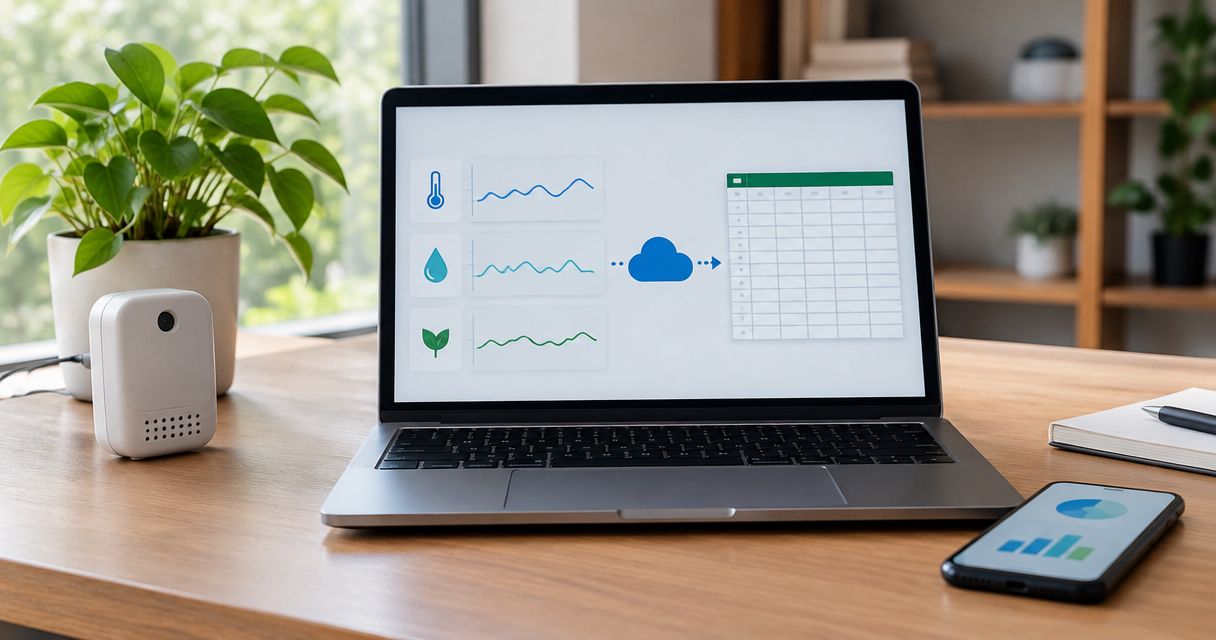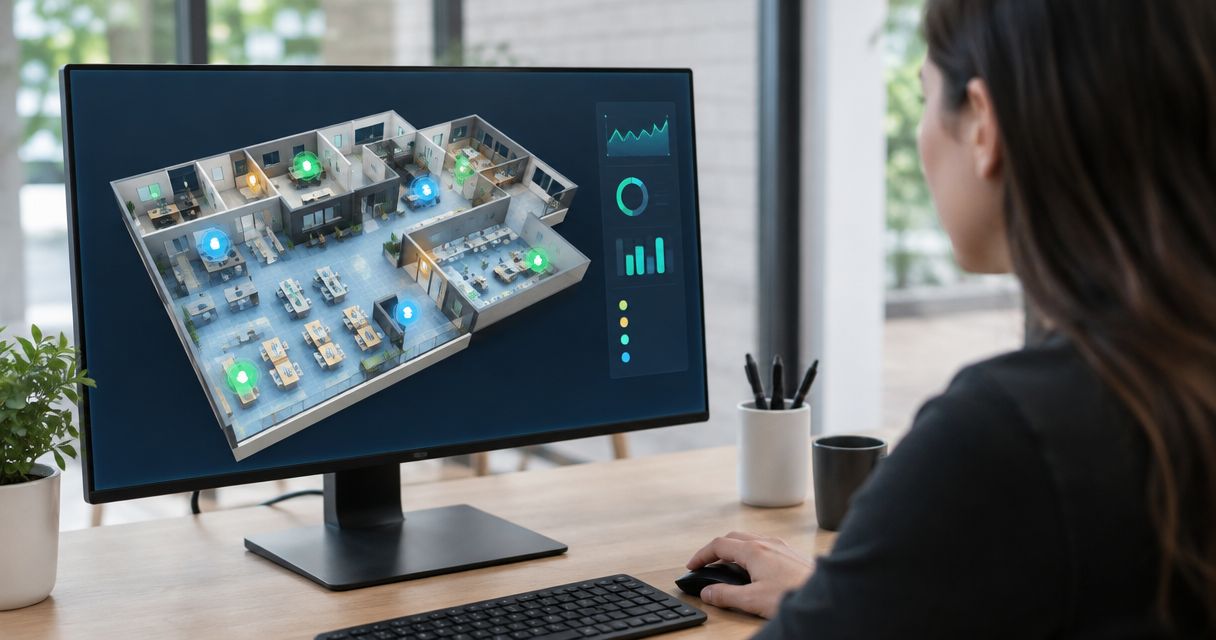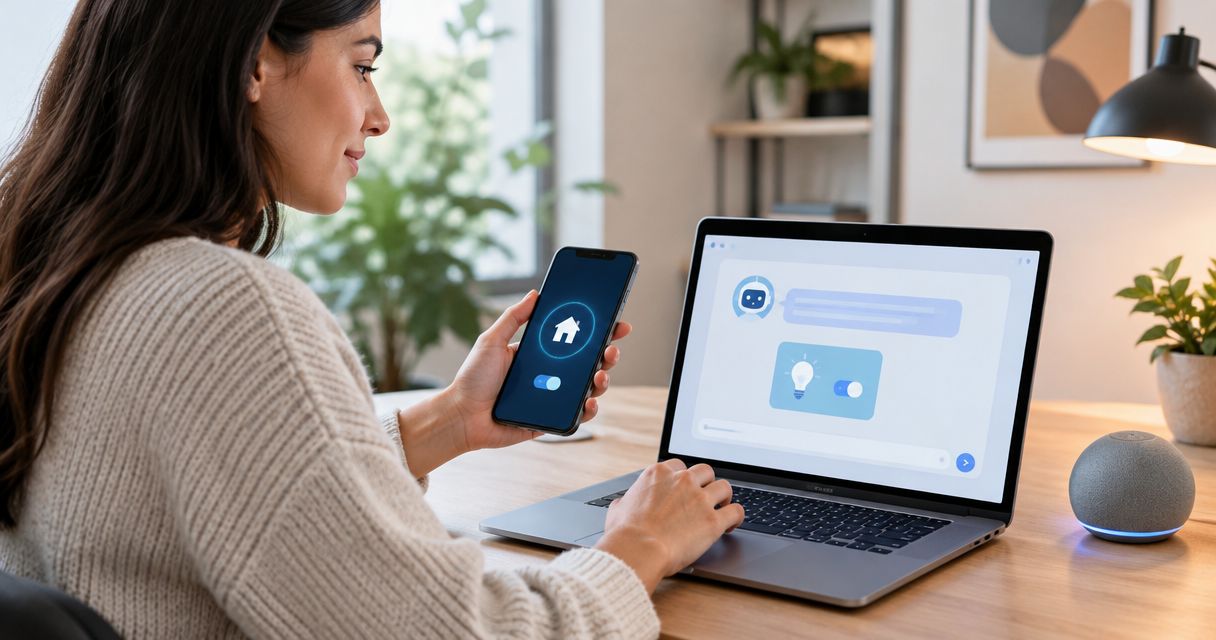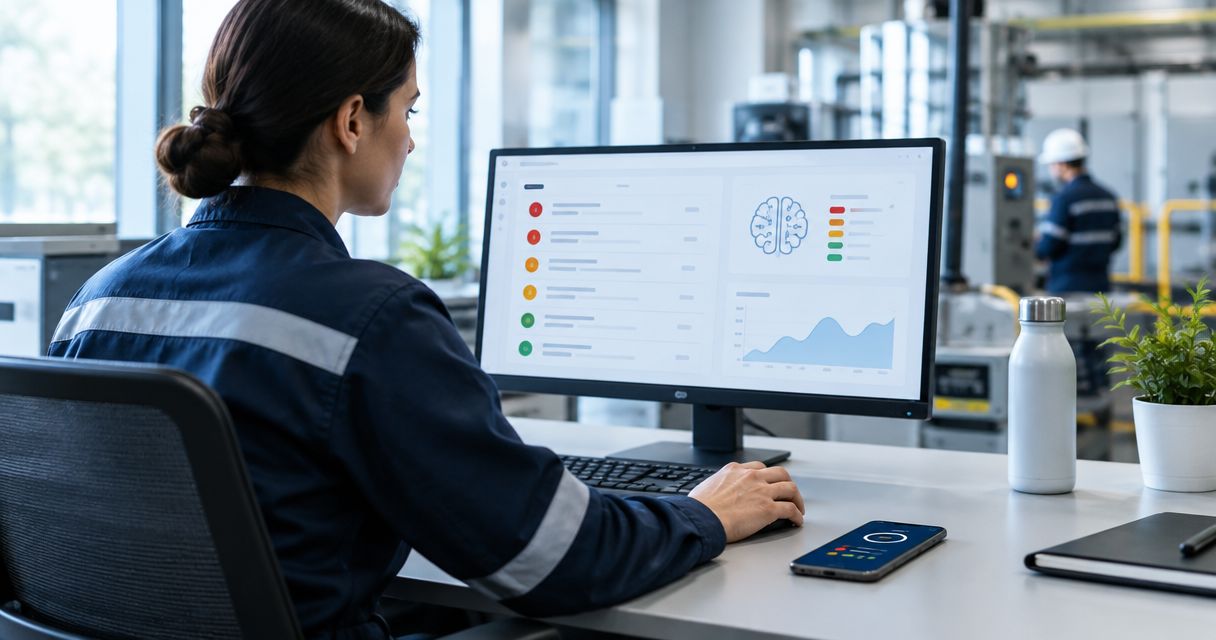
AI severity scoring for maintenance alerts assigns each alarm one of a fixed set of severity tiers so operators know which alert to act on first instead of treating every notification as equally urgent. On the Kilo IoT Platform, alarms carry five severity tiers, each mapped to its own escalation chain, notification channels, and quiet-hours behavior. The scoring itself runs on the CEL expressions and thresholds you define inside a rule, with Kilo's built-in AI assistant helping write and deploy those rules in plain language rather than guessing severity from a black-box model. The cost most teams miss: a severity tier is only as good as the escalation chain behind it — a "critical" alert that pages nobody at 2 a.m. isn't actually prioritized, it's just labeled loudly.
- AI severity scoring for maintenance alerts sorts alarms into tiers so the right person reacts first, not last, in 2026.
- Kilo's alarms use five severity tiers, each with its own escalation chain and notification channel.
- Severity is set through CEL rule logic and thresholds, not a black-box machine learning score.
- The built-in AI assistant helps build and deploy severity rules in plain language, confirming before changes go live.
- Escalation chains and quiet hours decide whether a high-severity alert actually reaches someone.
Why do maintenance teams need ai severity scoring on alerts?
Without tiers, every alarm competes for the same attention, and the Kilo IoT Platform exists partly to stop that flattening from happening. ISA-18.2, the ANSI/ISA alarm management standard used across industrial process control, warns explicitly against "alarm floods" — conditions where operators receive so many undifferentiated alarms that the whole system gets treated as noise and gets ignored, tier or no tier.
Severity scoring is the fix, but only if the scoring logic is visible and testable rather than a guess. A rule that fires because a temperature sensor crossed a defined threshold is auditable; a model that silently decides an alert is urgent is not. That distinction matters more in cold storage, substations, and process plants in 2026 than it did five years ago, because the number of connected sensors per site has grown faster than the headcount reading the alerts.
What does ai severity scoring for maintenance alerts actually do?
In practice, severity scoring is a short sequence you configure once per alert type:
- Define the condition. Write the CEL expression against live telemetry — a walk-in cooler above 8°C for more than 10 minutes, a vibration reading past a set threshold, a tank level below a set percentage.
- Assign a severity tier. Pick from the five tiers based on how much the breach matters to the business, not just how far past the limit the reading is.
- Attach an escalation chain. Decide who gets notified first, how long they have to acknowledge, and who the alert escalates to if they don't.
- Set notification channels per tier. Email for low-severity, SMS or push for anything that needs a person to move.
- Configure quiet hours. Lower tiers can wait until morning; higher tiers should be exempt from quiet hours entirely.
- Test on a sample payload before deploying. Kilo's rules engine supports step-through debugging against a test payload plus one-click deploy and rollback, so a misconfigured tier doesn't reach production untested.
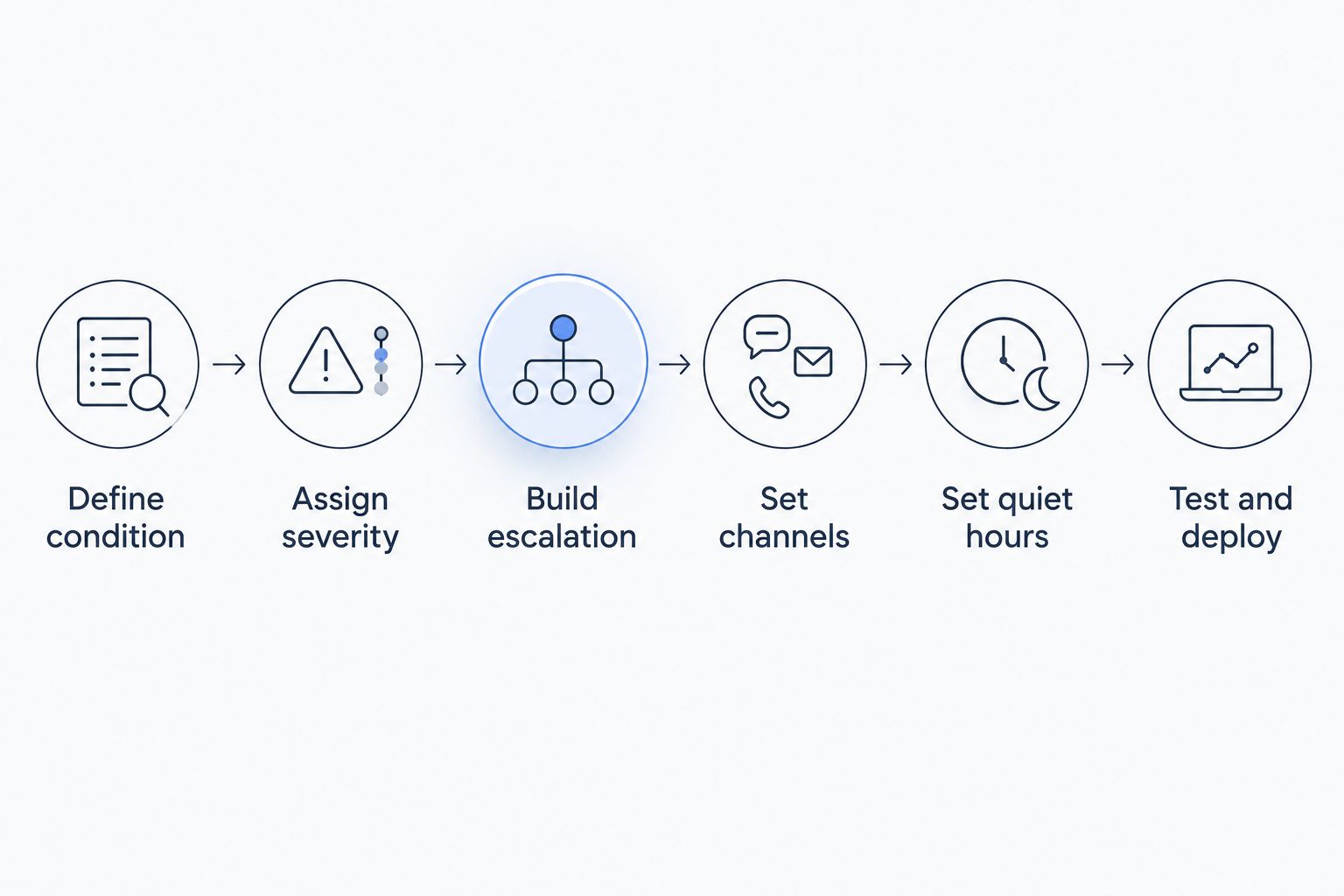
That six-step sequence is the whole mechanism. Nothing in it involves a model forecasting a failure — it involves a threshold, a tier, and a chain of people who get told about it in order.
How do you build severity tiers into a maintenance alert rule?
Each of the five severity tiers on Kilo carries its own escalation chain, its own notification channels (email, SMS, push), and its own centralized inbox entry, all logged to an immutable audit trail. Version control on the rule itself means a bad tier assignment can be rolled back to the previous working version rather than patched live while alerts are firing.
Worth stating plainly: Kilo doesn't try to predict when a compressor or a motor will fail. A rule fires when a threshold or condition in the CEL expression is actually breached, and the severity tier decides how loud and how fast the response is — not a machine-learning model guessing at remaining useful life. If you're wiring in new sensors to feed these rules, Kilo Electronics (kiloelectronics.com) ships LoRaWAN and mioty hardware worldwide, but the severity logic itself lives in the Kilo Cloud platform regardless of which sensor brand reports the breach.
For the rule-building side of this, teams comparing options generally want to see how a rules engine for industrial alarms handles version control and rollback before committing severity logic to production.
See how alert setup works end to end
Walk through building a rule, a tier, and an escalation chain in Kilo Cloud.
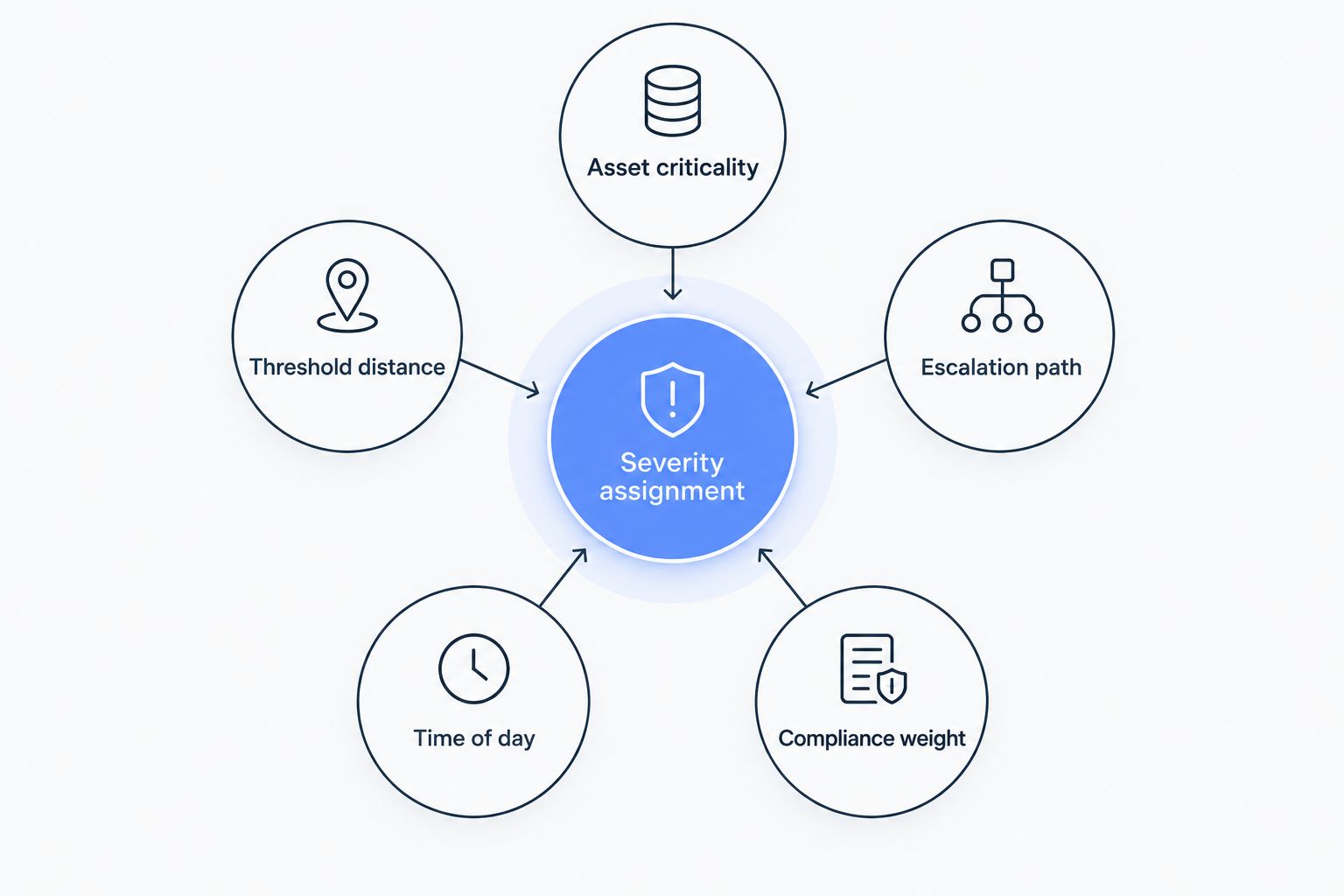
Why does the severity score on a maintenance alert vary?
Same sensor, same threshold, different severity — that's normal, not a bug, and it usually comes down to one of these:
- Asset criticality. A compressor feeding one freezer isn't the same severity as one feeding an entire cold storage floor.
- Distance from the hard limit. A reading 1°C over spec and a reading 10°C over spec shouldn't page the same way, even under the same threshold rule.
- Escalation path already engaged. If an on-call tech is already working that site, a related alert can sit a tier lower without getting lost.
- Time of day and quiet hours. Whether the tier is exempt from quiet hours changes who actually sees it and when.
- Compliance weight. An excursion that needs to be logged for an audit trail carries more severity than one that doesn't, even if the physical breach looks identical.
Can AI automatically assign severity to a maintenance alert?
AI can build the rule that assigns severity, but Kilo's built-in assistant confirms before consequential changes go live and works only within the signed-in user's own permissions. It's a plain-language way to write the same CEL threshold logic an engineer would otherwise write by hand — not a model scoring alerts on its own without a human-approved rule behind it.
Is ai severity scoring the same as predictive maintenance?
No — severity scoring ranks alerts that already fired; predictive maintenance tries to forecast a failure before any threshold gets breached. Kilo's alarms fire on a rule or CEL condition, then severity and escalation decide how the alert gets handled, not a forecast of remaining equipment life.
Should every high-severity maintenance alert page someone by SMS?
Not automatically — the top tier should map to whichever channel actually reaches the right person fastest, and escalation chains exist precisely so that's a multi-step decision, not one blanket rule. Routing every tier through SMS just trains people to silence their phone, which defeats the point of having tiers in 2026 at all.
FAQ
What is ai severity scoring for maintenance alerts?
AI severity scoring for maintenance alerts is the process of assigning each triggered alarm one of a fixed set of severity tiers so responders know what to act on first. On Kilo, five tiers each carry their own escalation chain and notification channels.
How many severity tiers does a maintenance alert system need?
Kilo's alarm system uses five severity tiers. Fewer tiers tend to collapse into "everything is urgent," and more than five tiers usually gets too fine-grained for a human to triage quickly.
Does severity scoring replace predictive maintenance?
No, severity scoring ranks alerts that already fired against a threshold; predictive maintenance is a separate approach that tries to forecast failure before a threshold is crossed. Kilo's alarms are threshold and CEL-rule based, not failure-prediction based.
Can severity tiers be changed after an alert rule is deployed?
Yes, rules on Kilo carry version control, so a severity tier can be edited and redeployed, or rolled back to the prior version if the new tier assignment turns out wrong.
What happens if nobody acknowledges a critical severity alert?
The escalation chain attached to that tier moves the alert to the next person or channel in the chain. That's what an escalation chain is for — an unacknowledged alert doesn't just sit in an inbox.
Do quiet hours apply to the highest severity tier?
Quiet hours are configurable per tier, so the highest severity tier can be set to bypass quiet hours entirely while lower tiers wait until morning.
Can I test a severity rule before it goes live?
Yes, Kilo's rules engine supports step-through debugging against a sample payload before you deploy, plus one-click rollback if the deployed rule behaves wrong.
Is there a centralized place to see alerts across all severity tiers?
Yes, Kilo keeps a centralized alarm inbox across all five severity tiers, logged to an immutable audit trail alongside the escalation history for each alert.
What's the biggest mistake teams make with alert severity scoring?
Tier inflation. ISA-18.2's own guidance on alarm management flags the same failure mode across industrial plants: once too many conditions get labeled the top tier, operators stop trusting the top tier and start ignoring it — the exact opposite of what severity scoring is for. The fix isn't a smarter model, it's a quarterly audit of which rules actually sit at the highest tier and whether each one still deserves to be there.
A severity tier is a promise about how someone will respond. If that promise gets broken often enough by false urgency, the whole scoring system quietly stops working, no matter how the AI assistant that built the rule described it.