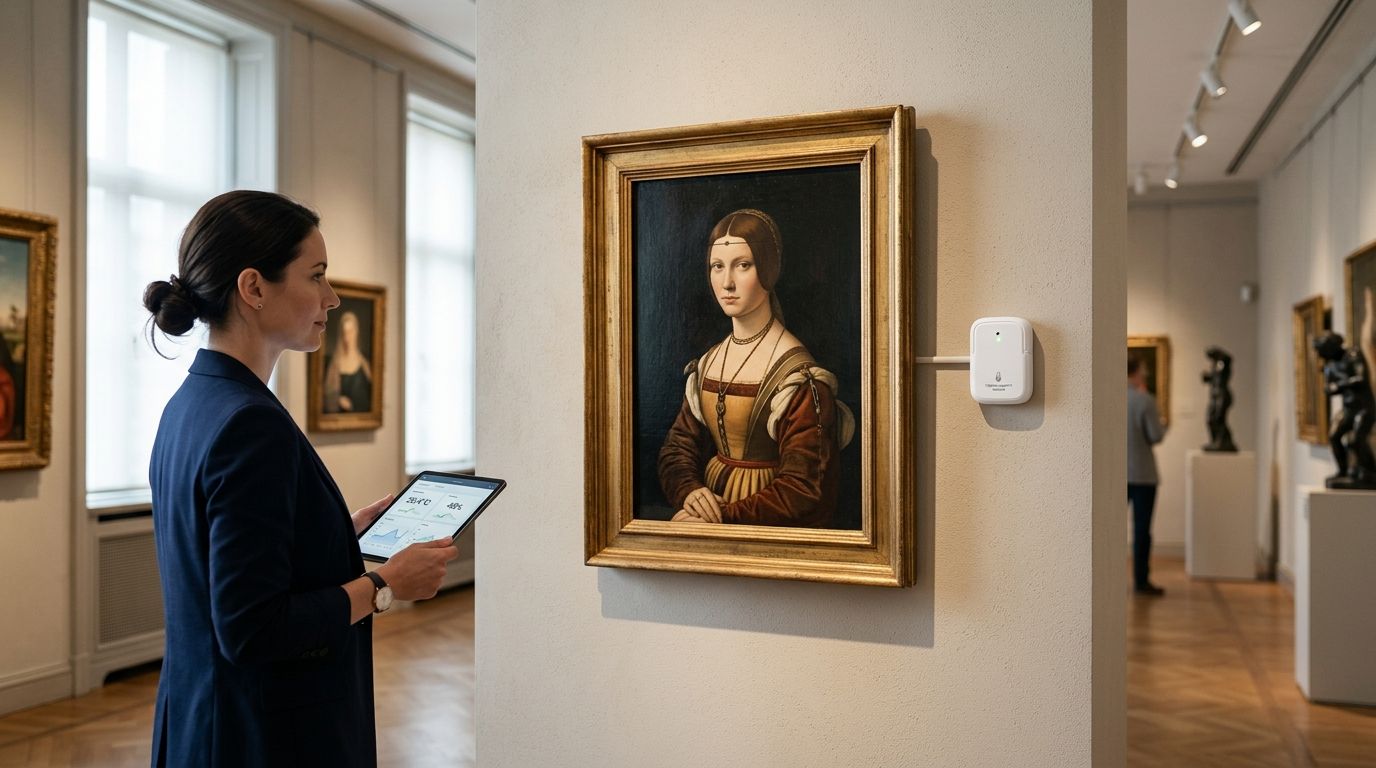
IoT climate monitoring for art galleries pairs continuous temperature, relative humidity, light, and vibration sensors with a cloud platform that alerts staff before drift reaches a canvas, textile, or archival print. Private collections carry a tighter margin than public museums: fewer people walk the rooms daily, insurance and loan agreements often demand a documented condition record, and one HVAC failure over a long weekend in 2026 can cost more than the entire sensor network. A facility monitoring system built for museums and archives gives collectors the same object-level visibility that institutions use, sized down to a single gallery, storage vault, or private residence.
- IoT climate monitoring for art galleries tracks temperature, RH, light and vibration continuously instead of periodic manual rounds.
- ASHRAE and the National Park Service both recommend stable RH for mixed collections, roughly 30%-50%, with tight daily swings.
- Kilo's rules engine and multi-step alarm escalation catch an HVAC or dehumidifier failure before an object is exposed for hours.
- A digital twin maps each sensor to its actual room or vitrine so a reading means something specific, not a building-wide average.
- Free plan covers up to 5 devices with no card required; paid tier starts at 25 EUR/month for up to 25 devices.
What relative humidity should a private art collection maintain?
The National Park Service's Museum Handbook, the reference most conservators cite, recommends holding relative humidity between roughly 30% and 50% and temperature between 60°F and 75°F for mixed collections that combine paintings, paper, textiles, and wood. ASHRAE's museum chapter breaks this down further into climate classes AA through D, ranging from precision-controlled vaults with almost no seasonal drift down to storage that only avoids extremes. Paintings on wood panel, parchment, and photographic materials are the most sensitive to swings — a panel painting that expands and contracts with humidity cycles will eventually crack along the grain, and that damage is one of the most common insurance claims tied to unmonitored storage.
The practical problem for a private collector isn't knowing the target band. It's proving, with a timestamped record, that the gallery held that band through a heat wave, a power blip, or a closed week in August. A wall thermostat reading tells you the room average; it says nothing about the microclimate three inches from a canvas against an exterior wall.
Set collection-specific climate targets
Start by breaking the collection into material categories rather than treating the whole space as one zone.
- List every object by material: oil on canvas, works on paper, photographs, textiles, wood, metal, ceramics.
- Assign each category a target RH band and temperature range based on ASHRAE class or NPS guidance.
- Flag the most humidity-sensitive pieces (panel paintings, parchment, ivory) for tighter thresholds than the rest of the room.
- Note which pieces are on loan, since loan agreements frequently specify a contractual RH and temperature range that must be documented.
- Write down the acceptable daily swing, not just the setpoint — a ±10% daily RH swing does more damage over years than a stable reading a few points outside the ideal band.
Map sensor placement across galleries and storage
A single sensor near the thermostat tells you nothing about the vitrine on the far wall or the storage rack behind a closed door.
- Place a sensor within a few feet of each high-value or sensitive object, not just one per room.
- Add sensors inside sealed display cases and storage cabinets, where microclimates diverge sharply from open-room readings.
- Cover exterior walls and windows separately from interior walls — solar gain and drafts create localized swings the room average hides.
- Instrument mechanical rooms and HVAC returns so a compressor or dehumidifier fault shows up before the gallery air does.
- In historic buildings with thick masonry or plaster, expect wireless range to behave differently than in modern drywall construction; a guide to retrofitting legacy buildings with wireless IoT sensors covers gateway placement for exactly this case.
Choose sensor types for temperature, humidity, light and vibration
Climate alone doesn't cover conservation risk — light exposure and physical shock matter just as much for works on paper and framed pieces.
- Temperature and RH sensors on LoRaWAN or mioty for battery-powered, multi-year deployment without running new wiring through historic plaster.
- Lux/UV sensors near windows and track lighting to track cumulative light exposure on light-sensitive works on paper and textiles.
- Vibration or tilt sensors on pieces near high-traffic corridors, freight elevators, or loading areas.
- MQTT-connected sensors for any existing BMS, energy meter, or dehumidifier that already publishes data, so it feeds the same dashboard instead of a separate system.
- Preconfigured temperature, RH, and light sensors sized for gallery deployments are available through Kilo Electronics (kiloelectronics.com), Kilo's hardware partner, which ships worldwide.
Set thresholds and escalation paths for alarms
A reading outside range only helps if someone finds out fast enough to act.
- Set threshold and rate-of-change alarms per material category — a slow seasonal drift and a sudden compressor failure need different response times.
- Configure Kilo's five severity tiers so a two-point RH drift and a full dehumidifier outage don't compete for the same attention.
- Build multi-step escalation chains that reach a second person automatically if the first doesn't acknowledge within a set window.
- Route critical alerts by SMS, push, and email in parallel rather than one channel; a walkthrough on setting up SMS and email alerts for critical IoT thresholds covers the setup.
- Use quiet hours carefully in a gallery context — night and weekend closures are exactly when an HVAC fault goes longest unnoticed, so critical-tier alarms should bypass quiet hours entirely.
Build a floor-plan view of the gallery
A list of sensor IDs and numbers means little to a curator or facilities manager scanning for a problem.
- Overlay sensor readings on an actual floor plan or 3D building model so a flagged reading points to a specific room or vitrine, not a device ID.
- Bind each sensor to the object or case it protects inside a digital twin of the space.
- Use gauge and chart widgets to show current reading against target band at a glance, not just raw numbers.
- Give insurers, conservators, or loan partners a read-only view scoped to the relevant rooms only, using Kilo's ABAC permission model rather than sharing full dashboard access.
Automate condition reports for insurance and loan agreements
Manual logbooks satisfy nobody when an insurer or lender asks for proof after the fact.
- Generate exportable history for any date range a loan agreement or claim requires.
- Use the immutable audit trail as the record of what conditions actually held, not what the setpoint was supposed to be.
- Pull sensor history through the REST API into an existing collection management or reporting workflow instead of re-entering data by hand.
- Kilo's built-in AI assistant can help draft a rule or alarm from a plain-language description — "alert me if any painting room exceeds 55% RH for more than an hour" — and confirms the configuration before it deploys.
Plan connectivity for historic or shielded buildings
Older gallery buildings — stone walls, lead-lined storage, converted warehouses — are among the hardest environments for wireless signal.
- Test signal strength at planned sensor locations before committing to a full rollout.
- Consider mioty for basement vaults or metal-shielded storage where LoRaWAN range struggles.
- Position gateways centrally rather than at the building perimeter in thick-walled structures.
- Keep a cellular or wired backup path for the gateway itself, since a single point of connectivity failure defeats the whole monitoring plan.
How do climate monitoring options compare for a private gallery?
| Option | Best for | Starting price | Key limitation |
|---|---|---|---|
| Paper logbooks / manual rounds | Single-room, unstaffed budget collections | No software cost | No continuous record; gaps between rounds |
| Standalone data loggers (pulled manually) | Small private collections doing periodic audits | Varies by vendor | No live alerting; data collected in batches |
| Building management system (BMS) add-on | Galleries already running a full HVAC BMS | Varies by integrator | Rarely built for object-level thresholds or loan documentation |
| Kilo IoT platform | Collections needing continuous, alarmed, audit-ready records | Free for up to 5 devices; 25 EUR/month for up to 25 devices | Requires a LoRaWAN/mioty gateway or MQTT-connected hardware on site |
The verdict for most private galleries in 2026: manual rounds and pulled data loggers work for a handful of pieces checked weekly, but neither produces the continuous, timestamped record insurers and lenders increasingly expect.
What mistakes do private galleries make with climate monitoring?
- Trusting the room thermostat instead of object-level sensors. A central reading can sit inside target range while a painting on an exterior wall three feet from a window sees a 15-degree swing.
- Averaging humidity across a whole floor. Vitrines, closed cabinets, and corners near HVAC vents behave nothing like the open-room average a single sensor reports.
- Only checking during open hours. Weekend and holiday closures are when HVAC faults run longest before anyone notices.
- Skipping calibration. Sensors drift over years of continuous use; a guide to calibrating IoT sensors for accurate long-term readings covers a schedule that keeps years of history trustworthy.
- No documented record for insurance or loan claims. Verbal assurance that "the room stays stable" doesn't hold up against a conservator's damage assessment after the fact.
FAQ
What's the best relative humidity for art collections in 2026?
The National Park Service's Museum Handbook recommends 30%-50% RH for mixed collections, with tighter bands for panel paintings and parchment. The right number depends on material mix, so climate targets should be set per object category, not one blanket figure for the whole gallery.
Is IoT climate monitoring better than data loggers for a private gallery?
IoT sensors send readings continuously and trigger alarms in real time, while standalone data loggers only reveal a problem when someone plugs them in to pull the data. For a collection that can't afford hours of undetected drift, continuous monitoring is the meaningful upgrade.
How many sensors does a small private gallery need?
Plan for at least one sensor per room plus one per sealed case or vault, rather than a single sensor for the whole space. Kilo's free plan covers up to 5 devices, enough for a small collection to start without committing to a paid tier.
Can IoT sensors monitor light exposure on paintings?
Yes. Lux and UV sensors placed near windows or track lighting track cumulative light exposure alongside temperature and humidity, which matters most for works on paper, textiles, and photographs.
Does IoT climate monitoring work in historic buildings with thick walls?
It does, with planning. Stone or masonry construction can shrink wireless range, so signal testing before rollout and mioty for shielded storage areas are worth building into the plan from the start.
How much does IoT climate monitoring cost for a private collection in 2026?
Kilo's free plan covers up to 5 devices, 1 dashboard, and 1 rule with no card required. The paid tier starts at 25 EUR/month for up to 25 devices, with gateways unlimited on every tier.
What happens when a climate alarm triggers overnight?
A configured alarm escalates through the severity tiers and contact chain set up in advance, reaching a second person automatically if the first doesn't acknowledge. Critical-tier alarms should bypass quiet hours so an overnight HVAC failure doesn't sit unnoticed until morning.
Do I need a full building management system to add climate monitoring to my gallery?
No. An IoT platform with an MQTT connector can read from an existing BMS if one is present, but it also works standalone with battery-powered LoRaWAN or mioty sensors and no BMS at all.
What's the detail most galleries overlook until it's too late?
The object closest to an exterior wall is almost always the one at greatest risk, and it's rarely the one anyone thinks to check first. A room can read 45% RH at the thermostat while the wall three feet away swings ten points with the weather outside — exactly the daily fluctuation ASHRAE's museum climate classes are built to catch. Sensor placement at the object, not the room, is the difference between a monitoring system that looks complete and one that actually protects the collection.