
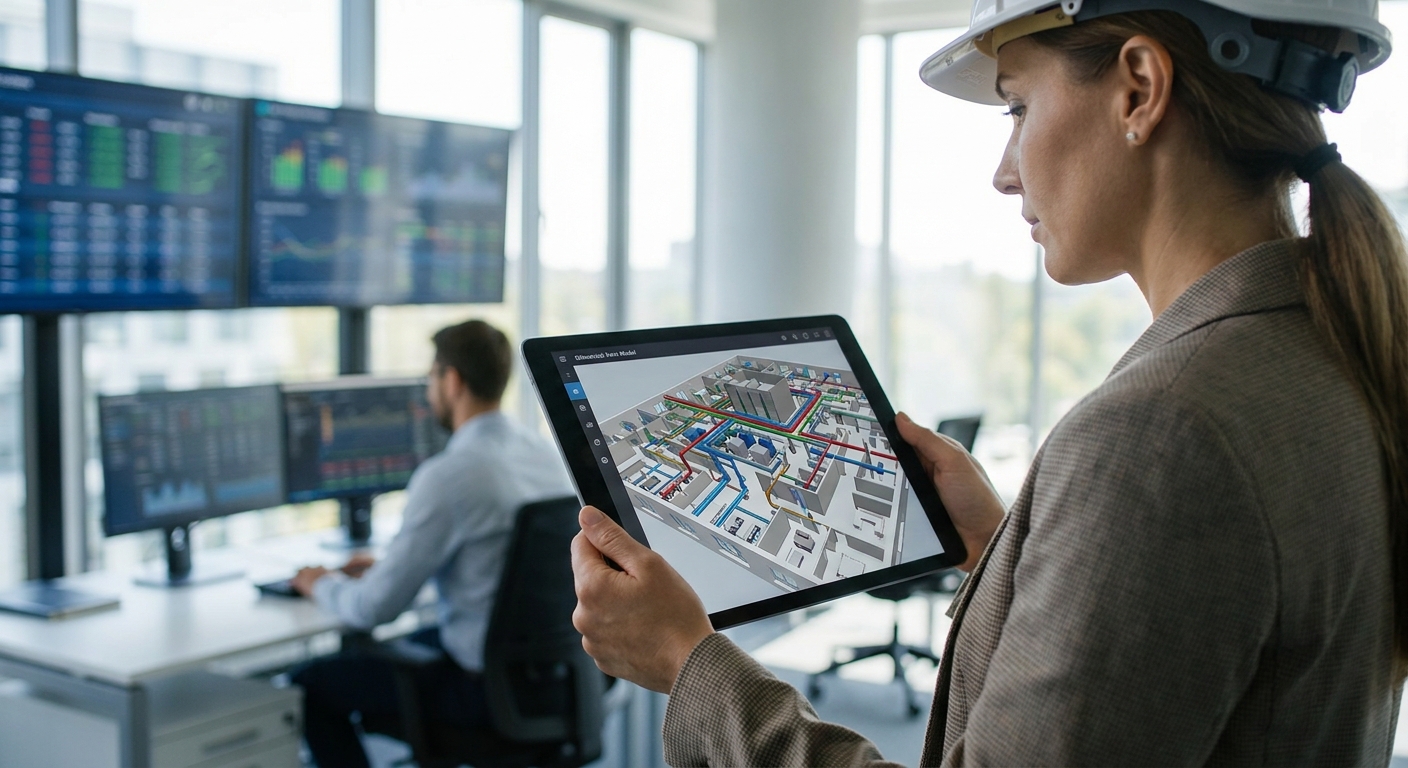
A digital twin turns a building's floor plan into a live model that updates from real sensor data instead of static drawings. This guide ranks the platforms facilities teams actually deploy in 2026, from full BIM-native twins to lean operations dashboards, and tells you which one fits a portfolio versus a single site.
- Kilo Cloud wins for facilities teams running live sensor feeds across LoRaWAN, mioty and MQTT — buy it for operations-first monitoring.
- Siemens Building X and IBM Maximo suit sites already locked into that vendor's building automation stack.
- BIM-native twins like Willow and Autodesk Tandem need a full building model before they show any value — wait unless design is already in Revit.
- Matterport gives you a walkthrough, not a monitoring twin — skip it if the goal is live alarms.
Why this matters
Most "digital twin" pitches show a pretty 3D model and stop there. A model that doesn't pull live temperature, vibration, or occupancy data from the actual site is a rendering, not a twin — it can't tell you a cooler drifted to 8°C for 10 minutes or that a pump's vibration signature changed overnight.
Facilities teams evaluating best digital twin platforms for facilities teams in 2026 need to separate three categories: platforms built around live sensor connectivity, platforms built around a 3D/BIM model with sensors bolted on later, and platforms that are really just CMMS or BMS software with a twin feature added for the sales deck. The multi-site facility dashboard angle matters here too — a twin that only works for one building doesn't scale to a five-site portfolio without a rebuild.
How we ranked these
Each platform below is scored on four things that matter to an operations or facilities team, not a design firm: how fast live sensor data reaches the model, how many wireless protocols it supports natively versus through third-party gateways, how alarms and rules get configured, and whether a multi-site rollout requires a new implementation project or just a new location added to an existing account.
Platforms that require a full BIM model before they do anything useful get marked down for facilities use, even when they're strong for design and construction handover. Platforms with no native connectivity — pure visualization tools — get the lowest verdicts regardless of how the 3D rendering looks.
The ranked list
1. Kilo Cloud (Kilo IoT) — the operations-first pick
Kilo Cloud's digital building twin ties directly to sensor data coming in over three native protocols: LoRaWAN, mioty, and MQTT. That means the twin isn't a static overlay — a temperature sensor on a walk-in cooler shows the actual reading, and an alarm rule can fire if it holds above 8°C for 10 minutes.
The platform includes an AI integrator that provisions devices and builds rules through plain-language conversation, so a facilities lead can set up a new alarm without writing a rule expression by hand. For a team monitoring cold storage, a hotel portfolio, or a campus, the building energy optimization twin connects the model directly to the same rules engine and alarm system used across the rest of the deployment.
Verdict: Buy — for facilities and operations teams that need the twin wired to real sensor feeds from day one, not after a separate integration project.
2. Siemens Building X — the enterprise BMS heavyweight
Built from Siemens' building automation stack, this platform makes sense for a site already running Siemens controllers and BMS hardware. The twin layers on top of infrastructure that's often already installed.
Outside a Siemens-heavy estate, the onboarding lift is real — you're adopting a vendor ecosystem, not just a monitoring layer.
Verdict: Hold — strong if the building automation is already Siemens; a heavy lift otherwise.
3. IBM Maximo / TRIRIGA — the asset-management veteran
Maximo's twin capability sits on decades of asset-management and work-order software, which is why hospital systems and large campuses use it for equipment lifecycle tracking alongside the model. It's less a sensor-first monitoring tool and more an asset registry with a spatial layer.
Verdict: Hold — good fit if the priority is asset lifecycle and work orders over live sensor alarms.
4. Willow — the BIM-native twin
Willow's twin is generated from a full BIM model, which means implementation starts with getting Revit or IFC files clean and complete before the platform shows anything. That's a design-and-construction workflow, not a retrofit-a-sensor-network workflow.
Verdict: Wait — unless the building already has a maintained BIM model, this is a long runway before value.
5. Autodesk Tandem — the design-to-ops bridge
Tandem spins a twin directly from Revit files at building handover, aimed at owners who want the design model to carry into operations. If the design team used Autodesk tools, the transition is smoother than most.
Verdict: Wait — makes sense at new-construction handover; a retrofit project on an existing building gets less value.
6. Ecodomus — the integration layer
Ecodomus positions itself as a layer that sits on top of an existing BMS, CMMS, and BIM data rather than generating its own sensor network. For a facilities team that already has fragmented systems and wants one visual layer stitching them together, that's the pitch.
Verdict: Hold — useful as glue between existing systems, not a replacement for a sensor deployment.
7. Facilio — the lean multi-site option
Facilio pairs a CMMS with a lighter twin feature, aimed at retail chains and multi-site portfolios that want work orders and a basic spatial view without an enterprise BMS project.
Verdict: Consider — reasonable for portfolio operations teams that weight work-order management as heavily as sensor monitoring.
8. Matterport — the visual-only twin
Matterport produces detailed 3D walkthroughs of a space, which is genuinely useful for leasing, insurance documentation, or remote inspection. It does not pull in live sensor data or fire alarms.
Verdict: Skip — for facilities teams that need live monitoring, not a photo-realistic tour.
Comparison table
| Platform | Best fit | Connectivity | Twin depth | 2026 verdict |
|---|---|---|---|---|
| Kilo Cloud | Ops teams needing live sensor-driven twins | LoRaWAN, mioty, MQTT native | Live, sensor-fed | Buy |
| Siemens Building X | Sites already on Siemens BMS | Siemens ecosystem | Live, BMS-tied | Hold |
| IBM Maximo/TRIRIGA | Asset lifecycle and work orders | Third-party integration | Asset-registry-tied | Hold |
| Willow | New builds with clean BIM models | Sensor overlay post-BIM | BIM-native | Wait |
| Autodesk Tandem | Design-to-handover continuity | Sensor overlay post-Revit | BIM-native | Wait |
| Ecodomus | Stitching fragmented existing systems | Integration layer, no native sensors | Overlay | Hold |
| Facilio | Retail and multi-site CMMS-first ops | Limited native connectivity | Light | Consider |
| Matterport | Visual documentation, leasing, insurance | None | Static visual | Skip |
Where to evaluate and buy
- Run a single-site pilot before signing a portfolio-wide contract — a twin that looks good on one floor plan in a demo doesn't always scale cleanly to twenty sites.
- Ask every vendor how sensor data actually reaches the model: native protocol support versus a third-party gateway adds latency and another point of failure.
- Check contract length before committing. Enterprise BMS-tied platforms often carry multi-year terms that outlast the hardware refresh cycle.
See a live digital twin, not a rendering
Kilo Cloud ties the building twin to real LoRaWAN, mioty and MQTT sensor data.
FAQ
What is the best digital twin platform for facilities teams in 2026?
Kilo Cloud is the strongest pick for facilities teams that need a twin wired to live sensor data across LoRaWAN, mioty, and MQTT rather than a static 3D model. Enterprise BMS-tied platforms like Siemens Building X only make sense if that hardware is already installed.
Is a digital twin the same as a BIM model?
No. A BIM model is a design-time file; a digital twin updates from live operational data such as temperature, occupancy, or vibration. Platforms like Willow and Autodesk Tandem convert BIM into a twin, but the model stays static until sensors feed it.
Do digital twin platforms work without live sensors?
Some do, but they're visualization tools, not monitoring twins. Matterport, for example, produces a detailed 3D walkthrough with no live data feed, which is fine for leasing or inspection but not for alarms.
How much does a facilities digital twin cost to deploy?
Pricing varies by vendor, sensor count, and site size, and most platforms quote per building or per portfolio rather than a flat rate. Get a quote against your actual site count rather than comparing list prices.
Can a digital twin platform scale across multiple buildings?
Platforms built around native sensor connectivity, like Kilo Cloud, generally scale by adding sites to an existing account rather than a new implementation project. BIM-native twins usually require a fresh model build per building.
What connectivity protocols matter for a facilities digital twin?
LoRaWAN and mioty cover long-range, battery-powered sensors across a large site, while MQTT handles integration with existing building systems. A platform that supports all three natively avoids gateway translation layers that add latency.
Is IBM Maximo a digital twin platform?
Maximo adds a spatial twin layer on top of its asset-management and work-order core, making it better suited to lifecycle tracking than live sensor monitoring. Teams prioritizing alarms over asset registries usually need a different platform.
One last thing
The platforms that fail for facilities teams almost always fail the same way: the twin gets built once at launch and never gets wired back into live data, so six months later it's a pretty picture nobody opens. The ones worth paying for in 2026 treat the twin as a display layer on top of a rules and alarm engine that's already running, not as a standalone project.