
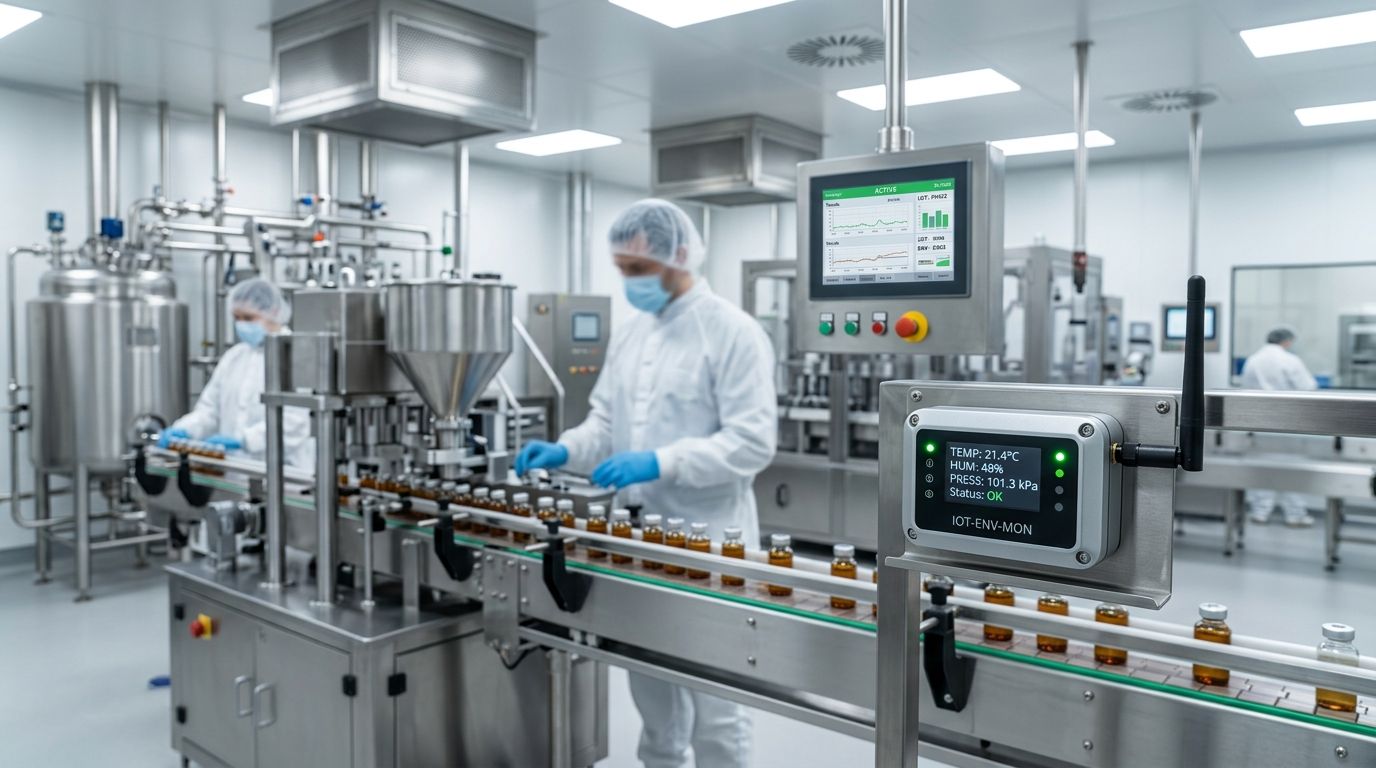
IoT environmental monitoring for pharmaceutical manufacturing plants is the use of networked sensors, a rules engine and automated alarms to track temperature, humidity, differential pressure and particle counts across production, storage and utility zones, with the aim of keeping every batch inside its validated range and producing a defensible electronic record for FDA and EU inspectors. A GMP plant's monitoring needs differ from a warehouse or office building: readings feed batch records, thresholds trace back to a validated range in a Standard Operating Procedure, and a missed excursion can mean a rejected lot or a 483 observation, not just an uncomfortable room.
- IoT environmental monitoring for pharmaceutical manufacturing plants tracks temperature, humidity, pressure and particle data against GMP-validated ranges continuously.
- FDA's aseptic processing guidance recommends at least 0.05 inches water gauge differential pressure between cleanrooms of different classification.
- Biologics and many finished drug products require 2C to 8C storage per WHO cold chain guidance, with 21 CFR Part 11 records for every excursion.
- Kilo runs on LoRaWAN and mioty and logs sensor data into a digital twin with rules-based alarms for cleanroom, cold storage and utility monitoring.
- Manual logbooks and chart recorders still work for narrow scope but leave audit trail gaps that inspectors flag repeatedly.
What is IoT environmental monitoring for pharmaceutical manufacturing plants?
A pharmaceutical manufacturing plant runs several environments at once: aseptic fill lines, API synthesis suites, warehouse cold storage, utility rooms and often a QC lab, each with its own validated range. Paper rounds and chart recorders were the default for decades, and they still show up in FDA warning letters when a gap in the log coincides with a temperature spike nobody caught in time.
EU GMP Annex 1, revised in August 2022, tightened environmental monitoring expectations for sterile manufacture specifically. Continuous monitoring of Grade A and B zones is now the expectation, not an option, and that pushes plants toward networked sensors instead of spot checks. USP <1079> on Good Storage and Distribution Practices sets out the same logic for storage areas: document the range, monitor it continuously, and be able to reconstruct what happened during any excursion.
The job titles driving this work are consistent across plants in 2026: quality assurance managers who own the deviation process, validation engineers who write the IQ/OQ protocols, and EHS or facilities managers who keep the physical sensors running. Facility monitoring for cleanroom environments usually starts as a QA-driven project and only becomes a facilities responsibility once the sensor count grows past what one person can walk and log by hand.
How to set up IoT environmental monitoring in a pharmaceutical manufacturing plant
Map every GMP-critical zone and parameter
Before buying a single sensor, list every room and the parameter that actually matters there. Not every room needs the same four readings.
- Aseptic fill and Grade A/B cleanrooms: differential pressure, particle count, temperature, humidity
- Cold storage for APIs and finished biologics: temperature at 2-8 degrees C or -20 degrees C freezer ranges
- Warehouse and staging areas: temperature and humidity per label claim
- Utility rooms (compressors, chillers, boilers): temperature and vibration as leading indicators
- QC and stability chambers: temperature and humidity against ICH Q1A stability zones
Set monitoring frequency and thresholds per SOP
The threshold is not a guess. It comes from the validated range already written into your batch record or storage SOP, and the monitoring frequency should match how fast that parameter can drift out of range.
- Continuous logging at 1-5 minute intervals for cleanroom pressure and fill-line temperature
- 15-minute intervals acceptable for bulk cold storage with real thermal mass
- Alarm thresholds set inside the validated range, not at the edge of it, to leave reaction time
- Separate warning and critical tiers so a slow drift is not treated like a door left open
- Documented rationale for every threshold, tied back to the SOP number
Install sensors without disrupting production lines
Wired sensors tied into a Building Management System work in rooms that already have BMS coverage, but most plants have gaps. Isolators, incubators and standalone freezers rarely sit on the BMS network. Wireless sensors on LoRaWAN or mioty avoid new conduit runs and go in during a scheduled changeover instead of a shutdown.
- Battery-powered wireless probes for rooms without existing wiring
- MQTT connections to pull data off PLCs, chillers or BMS points that already publish it
- Placement away from HVAC supply vents to avoid skewed temperature and pressure readings
- Redundant sensors in the highest-risk rooms such as fill lines and vaccine cold storage
- A commissioning walk to confirm each sensor matches the room's calibrated reference thermometer
This is where a platform earns its place over a spreadsheet. Once a facility has more than a handful of rooms to cover, monitoring cleanroom pressure differentials with IoT sensors at every doorway, airlock and gowning room becomes a data management problem, not just a sensor-buying one. The Kilo IoT Platform includes a built-in LoRaWAN and mioty network server, so there is no separate network server to stand up before sensors start reporting.
Automate data logging for 21 CFR Part 11 records
21 CFR Part 11 governs electronic records and signatures for FDA-regulated industries. It is the reason a spreadsheet full of manually typed readings does not hold up under audit.
- Immutable, timestamped records for every sensor reading
- Audit trail showing who changed a threshold and when
- Data retention matching your product's shelf life plus the regulatory hold period
- Role-scoped access so contract clients see only their own product's data
- Export format a validation engineer can hand to an auditor without reformatting
Kilo carries an immutable audit trail and ABAC multi-tenant access control, which removes the manual reconciliation step that eats hours during inspection prep week.
Build escalation paths for excursions
An alarm that only reaches an inbox at 2 a.m. is not protecting the batch. Escalation chains route the alert to whoever is on shift, then up the chain if nobody acknowledges it.
- First alert to the on-call operator by SMS or push
- Escalation to a validation engineer or QA manager after a set delay
- Quiet hours configured so low-severity alerts do not wake staff while critical ones always fire
- Multi-tier severity so a humidity drift and a fill-line pressure loss do not compete for attention
- A logged acknowledgment for every alarm, referenced in the deviation record
Kilo's alarm engine covers five severity tiers with multi-step escalation, email, SMS and push, plus a centralized inbox. That matters when a plant runs three shifts and the person who should see a Grade A pressure alarm changes every eight hours.
Validate and calibrate sensors on a schedule
A sensor drifting half a degree over six months without recalibration produces records that look clean and are quietly wrong.
- Calibration against a NIST-traceable reference at the interval in the manufacturer's datasheet
- IQ/OQ documentation for every new sensor before it enters GMP service
- A calibration due date visible on the dashboard, not buried in a spreadsheet
- Cross-checks between redundant sensors in critical rooms to catch drift early
- Replacement criteria defined before a sensor fails, not after a batch is flagged
Generate audit-ready reports
When an FDA investigator or a client audit asks for six months of cold storage history, the answer needs to be a report, not a scramble.
- Excursion reports pulling start time, duration, peak deviation and resolution
- Batch-linked exports tying environmental data to the specific lot affected
- Trend reports showing whether a room is drifting toward its threshold over time
- A standing report format QA does not rebuild every audit cycle
- API or webhook output so the same data lands in your quality system
Which IoT environmental monitoring option fits a pharmaceutical manufacturing plant?
| Option | Best for | Key limitation |
|---|---|---|
| Manual logbooks and paper rounds | Very small labs with minimal GMP scope | No continuous coverage; audit trail gaps are a recurring FDA warning letter finding |
| Standalone chart recorders and data loggers | Single-room compliance archiving | No remote alerts; data retrieval is manual and slow |
| BMS tied to HVAC | Facilities with centralized HVAC controls already installed | Rarely extends to isolators, standalone freezers or non-HVAC utility rooms |
| Wireless IoT sensor platform on LoRaWAN or mioty, such as Kilo | Multi-room, multi-parameter GMP monitoring across cleanrooms, cold storage and utility rooms | Requires upfront network planning and IQ/OQ validation work |
Cold storage and distribution add a layer most manufacturing-only guides skip. Plants shipping finished product need the same discipline applied downstream, which is where IoT platforms for pharmaceutical cold chain distribution centers pick up the monitoring thread from the loading dock onward.
“If a pressure differential alarm does not reach a validation engineer within minutes, it is not monitoring. It is logging.”
See GMP-grade monitoring in Kilo
Free tier covers up to 5 devices, 1 dashboard and 1 rule. No card required.
What mistakes do pharmaceutical manufacturers make with environmental monitoring?
- Treating sensor validation as one-time work. IQ/OQ gets done at install and never revisited, so drift goes uncaught for months and every record in that window becomes questionable.
- Alarm fatigue from over-broad thresholds. When every minor blip pages someone, staff start ignoring the alarms that actually threaten a batch.
- Skipping the electronic records piece. A wireless sensor reporting into a spreadsheet still fails a 21 CFR Part 11 audit. The audit trail has to be built into the platform.
- Sensor placement near HVAC vents or doorways. Readings look fine on the dashboard and do not reflect the room's real profile, which surfaces during an excursion investigation.
- No documented excursion history. When an auditor asks for a trend, teams without a reporting habit reconstruct data from memory. Building the habit early, as in how to build a temperature excursion report for cold chain audits, avoids that scramble in the 2026 inspection cycle.
FAQ
What parameters need environmental monitoring in pharmaceutical manufacturing?
Temperature, humidity, differential pressure and particle counts are the core four for GMP zones. Cold storage rooms typically monitor temperature alone against a 2-8 degrees C or freezer range, while aseptic fill lines add particle counts under ISO 14644-1.
Is IoT environmental monitoring required for FDA compliance?
FDA does not mandate a specific technology, but 21 CFR 211 requires documented environmental control and 21 CFR Part 11 sets standards for electronic records. Continuous IoT monitoring is the practical way most plants meet both in 2026.
How often should cleanroom pressure differentials be checked?
FDA aseptic processing guidance points to continuous monitoring for Grade A and B areas rather than periodic spot checks. A minimum differential of 0.05 inches water gauge between rooms of different classification is the commonly cited benchmark.
What is the difference between LoRaWAN and mioty for pharma facilities?
Both are low-power wireless protocols for battery-run sensors. Mioty uses telegram splitting, which holds up better in high-interference environments like dense manufacturing floors with heavy metal equipment, while LoRaWAN has the broader sensor catalog.
How long should temperature and humidity data be retained?
Retention should match the product shelf life plus any regulatory hold period specified in your quality system. Most plants keep environmental records for the life of the batch plus several years beyond expiry.
Can IoT sensors replace manual environmental monitoring logs entirely?
For continuously monitored parameters like cleanroom pressure and cold storage temperature, yes. Sensors with an immutable audit trail meet the intent of manual logs with fewer transcription errors, though some GMP steps such as visual inspection still need a human check.
What happens during a temperature excursion in a GMP facility?
An alarm fires, the affected time window and peak deviation are logged, and QA opens a deviation investigation to determine whether the batch stayed inside its validated range. A ready-made excursion report shortens that investigation considerably.
What does an IoT environmental monitoring platform cost for a pharma plant?
Cost scales with sensor count. Kilo's Free tier covers up to 5 devices, 1 dashboard and 1 rule with no card required and no expiry, and Starter is 25 EUR per month for up to 25 devices, with gateways unlimited on every tier.
The overlooked zone in pharma environmental monitoring
Most plants get temperature and pressure right inside classified space and miss humidity in the rooms next door: gowning areas, corridors, material staging. No SOP names them as GMP-critical, so no sensor goes in. Humidity swings there do not fail a batch directly, but they affect packaging integrity and can skew particle counts in adjacent cleanrooms, and that link rarely gets mapped until an investigation traces it backward. Put humidity sensors in every room adjacent to a classified space in 2026, not just inside it.
Related guides
- Facility monitoring system for research laboratories
- How to reduce false alarms in industrial IoT alert systems
Sensors for cleanroom, cold storage and utility monitoring are available worldwide through Kilo's sister company, Kilo Electronics, at kiloelectronics.com, for plants that need hardware alongside the platform.