
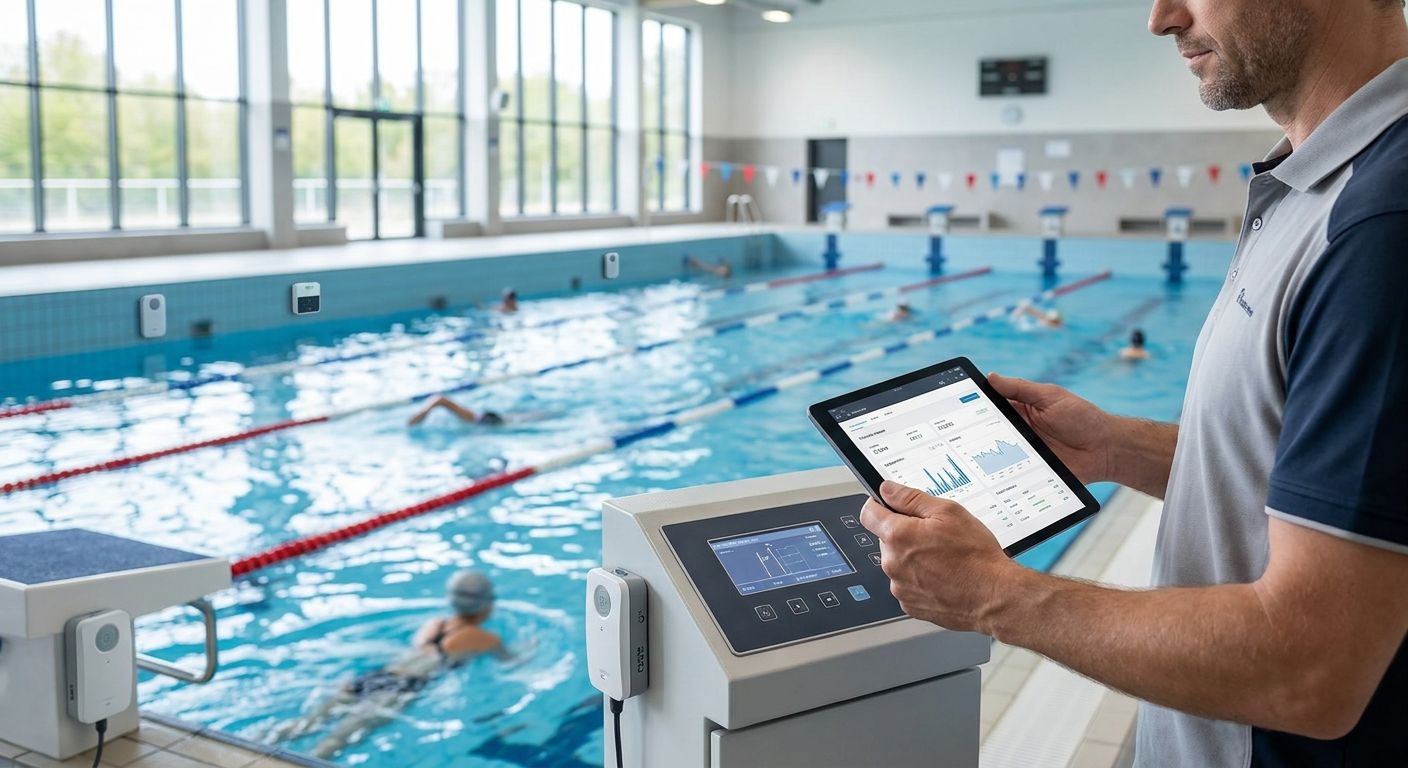
IoT monitoring for commercial swimming pool facilities pairs wireless sensors on chemical feed lines, circulation pumps, and pool-room air handling with a cloud dashboard, so aquatics staff see water chemistry, equipment health, and humidity drift the moment they happen instead of waiting for the next scheduled test. Hotel pools, water parks, gym and club pools, and municipal aquatic centers each run on different staffing schedules, but all of them lose money and risk closures the same way: a chemical excursion or a failed pump that nobody catches until a guest complains or a health inspector shows up.
- IoT monitoring for commercial swimming pool facilities tracks chlorine, pH, pump vibration and humidity between manual tests.
- CDC guidance sets minimum free chlorine at 1 ppm for pools and 3 ppm for hot tubs.
- Kilo's free plan covers 5 devices, 1 dashboard and 1 rule at 0 EUR - enough for a single-pool pilot in 2026.
- ASHRAE recommends 50-60% relative humidity in natatoriums to limit structural corrosion.
- Alarm escalation matters more than sensor count - a chemical excursion with no on-call notification still closes the pool.
Why commercial pool facilities need IoT monitoring
A pool that drifts out of chemical range doesn't fail quietly. Free chlorine below the CDC's recommended 1 ppm minimum for pools (3 ppm for hot tubs) is grounds for closure under most state health codes modeled on the CDC's Model Aquatic Health Code. pH outside 7.2-7.8 wastes chlorine, irritates swimmers, and corrodes equipment faster than the maintenance budget accounts for.
The equipment side is just as unforgiving. A circulation pump that cavitates or a chemical feed pump that runs dry doesn't announce itself - it just stops dosing, and the pool's chemistry drifts on its own timeline, often overnight or before the first shift arrives. Facilities running an IoT platform built for continuous sensor data close that gap: chemistry, pump status, and room humidity all land in one dashboard instead of three separate logbooks.
Aquatic centers attached to hotels, water parks, or gyms carry a second exposure: the natatorium itself. Indoor pool air loaded with chloramine off-gas corrodes structural steel, HVAC coils, and light fixtures over years, which is why ASHRAE's HVAC Applications handbook recommends holding indoor relative humidity between 50% and 60% and air temperature 2-4°F above water temperature. Facilities that only track water chemistry and ignore the air are trading a faster problem for a slower, more expensive one.
How to set up IoT monitoring for a commercial swimming pool facility
Track chlorine, pH and ORP levels in real time
Most facilities start with handheld test kits or benchtop photometers on a fixed schedule - every two to four hours during operating hours, per most state bathing codes. That baseline still matters even after sensors go in; it's the calibration check.
- Free chlorine and combined chlorine, tested against CDC's 1 ppm (pools) / 3 ppm (hot tubs) minimums
- pH, held in the 7.2-7.8 range
- Total alkalinity and cyanuric acid, checked less frequently but tracked over time
- ORP (oxidation-reduction potential) as a secondary chemistry signal
- Water temperature, logged alongside chemistry readings
Monitor chemical feed pump and dosing equipment health
Manual chemistry checks catch problems after they've already happened. A feed pump that stalls at 2 a.m. means chemistry is off by the time staff arrive, not when the pump actually failed. Standalone in-line ORP/pH controllers help on a single pool, but most only alarm locally - nobody gets a text.
This is where wireless sensors on the feed line change the timeline. Kilo's MQTT connector reads existing pump controllers, PLCs, or dosing skids directly, so the equipment stays in place and the data starts flowing to a dashboard instead of a local panel.
- Feed pump run status and cycle count
- Chemical tank or drum level, to catch a dry tank before it becomes a dry pump
- Flow switch state on the dosing line
- Controller fault codes, pulled over MQTT instead of walked to in person
Watch circulation pump and motor performance
Circulation pumps run continuously for years, and a bearing or seal problem shows up as vibration and heat well before it shows up as a chemistry problem. A CEL rule in Kilo's visual rules engine can flag a vibration or temperature reading that crosses a set threshold and fire an alarm before the pump trips offline - it's a threshold check, not a failure prediction, but it buys staff a maintenance window instead of an emergency call.
- Pump vibration amplitude against a baseline reading
- Motor housing or bearing temperature
- Flow rate at the pump discharge
- Run-hours since last service, tracked per pump
Control natatorium humidity and corrosion risk
Dehumidification units are usually sized and scheduled for occupied hours, which leaves early mornings and closed days as the window where humidity creeps outside the ASHRAE-recommended 50-60% band and chloramine off-gas starts working on steel and coils.
- Relative humidity at multiple points in the pool hall, not just at the AHU return
- Air temperature relative to water temperature (ASHRAE's 2-4°F offset)
- Dehumidification unit run status
- CO2 or chloramine indicators where the facility already tracks air quality
Secure the chemical storage room
Chlorine gas exposure is a separate hazard from water chemistry. OSHA's permissible exposure limit for chlorine gas is a 1 ppm ceiling - a completely different measurement than the 1 ppm free-chlorine target in the pool itself, and it's an air-exposure limit, not a water reading.
- Door contact sensors on the chemical storage room
- Gas detection where the facility stores chlorine gas cylinders rather than liquid or tablet chemicals
- Room temperature, since some chemicals degrade or become unstable when overheated
- Ventilation fan run status for the storage room
Track water levels, heaters and boilers
A slow leak or an auto-fill valve stuck open both show up as unexplained water bills long before anyone notices at the pool deck. Heaters and boilers that serve pool water face the same silent-failure problem as circulation pumps.
- Pool water level against the skimmer line
- Auto-fill valve cycle frequency
- Boiler or heater firing status and flue temperature
- Makeup water meter readings, checked against expected evaporation rates
A slow structural leak deserves the same attention water leaks get in any commercial building - see how to monitor water leaks in commercial buildings before damage for sensor placement that applies just as well to a pool mechanical room as an office basement.
Build alarm escalation for critical pool thresholds
A chemical alarm that sits unread in a dashboard overnight is functionally the same as no alarm at all. Kilo's alarms carry five severity tiers and multi-step escalation chains across email, SMS, and push, plus quiet hours so routine alerts don't wake an on-call manager at 3 a.m. while critical ones still get through.
- Chlorine or pH excursion, escalated to the certified pool operator on shift
- Chemical tank low-level, escalated to the operations team before the next delivery cycle
- Pump fault, routed to whoever handles maintenance dispatch
- Storage room door-open event outside scheduled hours, escalated immediately
Centralize monitoring across multiple pools or sites
A hotel group, water park operator, or gym chain running more than one pool needs one dashboard, not one login per property. Kilo's dashboard widgets - map view, gauges, image floor-plan pins - let a regional facilities manager see every pool's chemistry and equipment status on one screen instead of stitching together property-level spreadsheets.
Best IoT monitoring options for commercial swimming pool facilities
| Option | Best for | Starting price | Key limitation |
|---|---|---|---|
| Manual test kits and logbooks | A single small pool with minimal budget | Cost of test strips/reagents only | Readings only during staffed hours, gaps overnight, human error |
| Standalone chemical controllers | A single pool already running an in-line ORP/pH controller | Not publicly disclosed | No pump vibration, humidity, or off-site alerting |
| Building management system (BMS) integration | Large campuses running a full BMS for HVAC and pool room air | Not publicly disclosed | Adding pool-specific sensors usually means a systems integrator project |
| Kilo IoT Platform - Free | A single pool or a pilot deployment testing wireless sensors | 0 EUR for up to 5 devices, 1 dashboard, 1 rule | Device cap makes it tight for anything beyond one pool |
| Kilo IoT Platform - Starter | Multi-pool clubs, hotel aquatic centers, or gyms scaling past a pilot | 25 EUR/month for up to 25 devices | Facilities beyond 25 devices should check current pricing for the next tier |
Gateways are unlimited on every Kilo tier and never count against the device cap, which matters for a natatorium where LoRaWAN range through concrete pool decks can require more than one gateway.
See the Kilo IoT Platform in action
Start free with up to 5 devices - no card required.
Common IoT monitoring mistakes at swimming pool facilities
- Testing only during staffed hours. Many public pools open before the first certified operator arrives - chemistry can drift for hours with nobody watching.
- Treating humidity as an HVAC-only problem. Chloramine off-gas corrodes structural steel and light fixtures regardless of whether the HVAC contract covers it.
- Wiring the main pool and skipping the spa, kiddie pool, or backup circulation loop. A secondary pump can fail silently for days while the main pool dashboard reads fine.
- No escalation path from a chemistry alarm to an actual person. An alarm that lands in an inbox nobody checks overnight closes the pool just as fast as no alarm at all.
- Treating the chemical storage room as part of the water chemistry problem. It's a separate exposure risk (OSHA's 1 ppm chlorine gas ceiling) that needs its own door and gas sensors, not just a water-quality dashboard.
Hardware for chlorine sensors, vibration sensors, and humidity sensors ships worldwide through Kilo's sister company, Kilo Electronics, if the facility needs pre-configured devices rather than sourcing sensors independently.
FAQ
What is the best way to monitor water chemistry in a commercial pool?
Continuous sensors on chlorine, pH, and ORP paired with scheduled manual test-kit checks catch drift faster than manual testing alone. CDC guidance sets minimum free chlorine at 1 ppm for pools and 3 ppm for hot tubs, and pH should stay in the 7.2-7.8 range.
How often should chlorine and pH be checked in a public pool?
Most state bathing codes based on the CDC Model Aquatic Health Code require manual checks every two to four hours during operating hours. Continuous IoT sensors fill the gaps between those checks, including overnight and before opening.
Can IoT sensors monitor a pool's chemical feed pumps?
Yes - an MQTT connector can read run status, cycle counts, and fault codes from existing dosing controllers without replacing the equipment. That data feeds alarms so a stalled pump gets flagged before chemistry drifts.
How much humidity is safe in an indoor pool building?
ASHRAE's HVAC Applications handbook recommends holding natatorium relative humidity between 50% and 60% to limit corrosion of structural steel and equipment. Air temperature is typically kept 2-4°F above water temperature.
Does IoT monitoring replace a certified pool operator?
No - sensors and alarms extend a certified pool operator's coverage to hours when nobody is on deck, but chemical adjustments and compliance decisions still require a trained operator. Monitoring shortens the time between a problem occurring and a person knowing about it.
What sensors track pool pump vibration or failure?
Vibration and temperature sensors mounted on the pump housing or bearing feed a threshold-based rule that alarms when readings cross a set baseline. This flags mechanical wear early without claiming to predict exactly when a pump will fail.
How much does IoT monitoring cost for a swimming pool facility?
Kilo's free plan runs 0 EUR for up to 5 devices, 1 dashboard, and 1 rule - enough for a single-pool pilot in 2026. The Starter plan is 25 EUR per month for up to 25 devices, with gateways unlimited on every tier.
Can one dashboard cover multiple pools or resort locations?
Yes - a multi-site facility monitoring dashboard can show chemistry, pump status, and humidity across every property on one screen instead of separate per-location logins. This matters most for hotel groups, water parks, and gym chains running more than one pool.
What pool facilities overlook after installing IoT sensors
Most facilities wire the pool deck first and the mechanical room second - backwards from where the expensive failures actually happen. A chemistry excursion is usually a same-day fix; a corroded steel truss from three years of unmanaged natatorium humidity is a capital project. Quiet hours on alarms matter more in a natatorium than almost anywhere else, because dehumidification units and feed pumps run on schedules that don't match staffing, and a rules engine with version control lets a facilities team adjust escalation thresholds after the first month of real data instead of guessing at day one.