
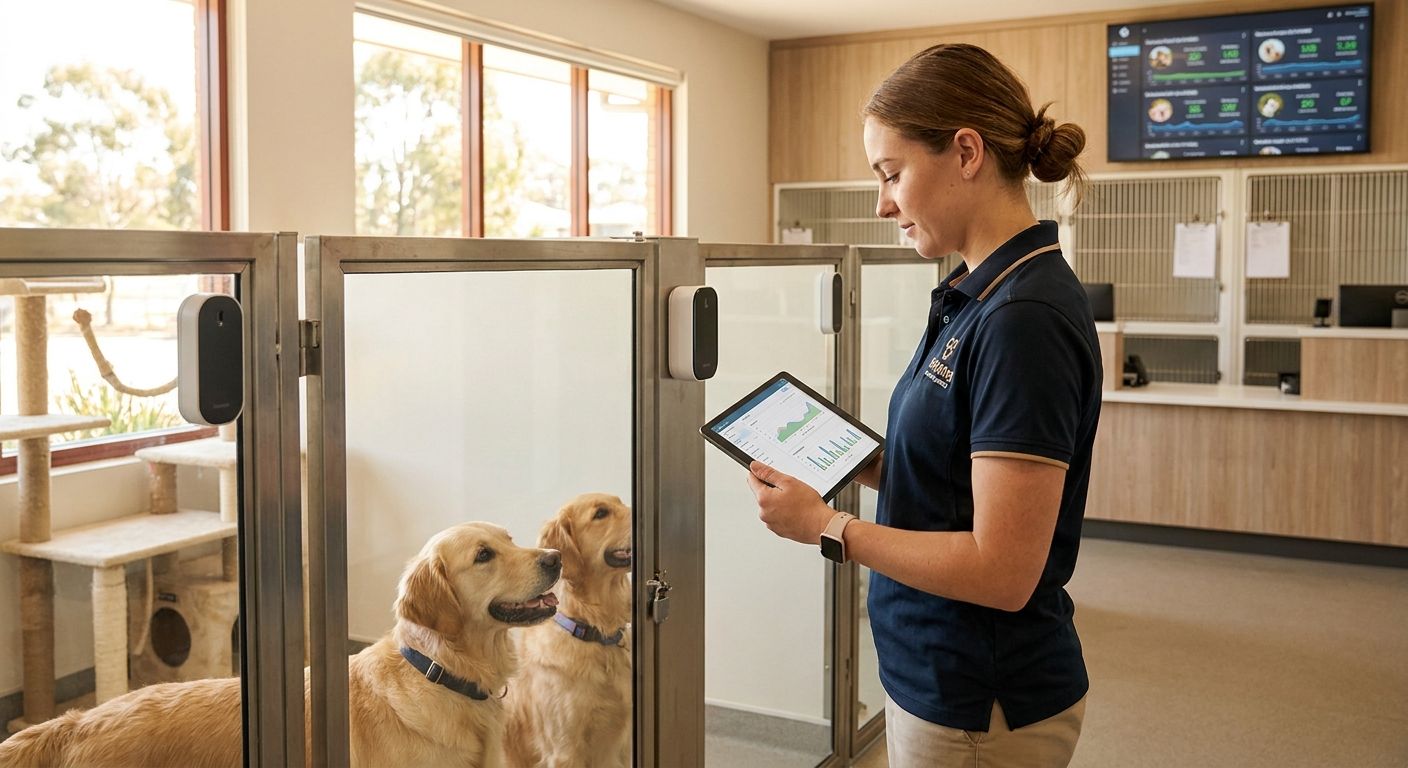
Pet boarding and kennel facility IoT monitoring is continuous sensor-based tracking of kennel temperature, humidity, air quality, and water systems with the aim of catching a heating failure or a flooded wash room before an animal is hurt or a state inspector writes a citation. Boarding kennels run overnight with no engineer on site, which means a stuck thermostat at 2 a.m. has hours to become a welfare incident instead of minutes. That single fact — unattended overnight operation combined with live animals as the asset at risk — is what separates kennel monitoring from a typical office or warehouse deployment.
The Kilo IoT Platform runs this kind of monitoring on LoRaWAN, mioty, or MQTT-connected sensors, and it matters here because a kennel manager checking a phone at midnight needs an alarm that already knows which run is affected, not a raw number to interpret.
- IoT monitoring pet boarding kennel facilities means live temperature, humidity, and water sensors replacing manual overnight rounds.
- USDA's Animal Welfare Act regulations (9 CFR Part 3) cap indoor kennel temperature between 50°F and 85°F for non-acclimated dogs.
- Kilo Cloud routes kennel alarms through five severity tiers with SMS, email, and push escalation, no landline callback required.
- Manual paper logs and standalone data loggers still work for a single-run facility, but they don't scale past a handful of wards.
- Water leak sensors at drain lines catch flooding before it reaches occupied runs, a failure mode paper checklists rarely catch in time.
Why does temperature control matter in pet boarding kennels?
USDA's Animal Welfare Act regulations, specifically 9 CFR Part 3, set the baseline most state kennel licensing codes reference: indoor housing for dogs cannot drop below 50°F or climb above 85°F for more than four consecutive hours unless the animals are acclimated. The same section requires adequate ventilation to control ammonia buildup, moisture condensation, and odor, which is why a kennel HVAC failure is never just a comfort problem — it's a compliance problem the moment an inspector asks for records.
A boarding facility that only checks temperature during closing and opening rounds has, at best, two data points a day. If a rooftop unit fails at 11 p.m., nobody notices until the 7 a.m. walkthrough — eight hours outside the regulated range, with no log showing when it started. That gap is exactly what continuous kennel monitoring closes, and it's the same gap veterinary clinics deal with around vaccine refrigeration; the mechanics of the veterinary clinic monitoring guide apply almost directly to a boarding ward.
How do you set up IoT monitoring for a kennel or boarding facility?
Map your kennel zones and failure points before buying anything
Walk every ward, run, and holding area and note where heat, cold, moisture, and noise actually concentrate — not where you assume they do.
- Indoor runs versus outdoor or semi-outdoor runs (different exposure, different alarm thresholds)
- Wash rooms and drain lines (leak risk)
- HVAC rooftop units and backup generator status
- Food storage and any refrigerated treats or medications
- Isolation or quarantine wards, which often need tighter thresholds
Monitor temperature and humidity in every run and ward, not just the lobby
A thermostat in the front office tells you nothing about the back kennel wing. Start with the manual baseline, then move to continuous coverage.
- Log temperature by hand at open and close for at least two weeks to find your real swing range
- Place a sensor in the warmest and coldest corner of each ward, not just the center
- Track relative humidity alongside temperature — ammonia off-gassing worsens above roughly 60% RH
- Once you know your baseline, wireless temperature and humidity sensors on LoRaWAN give continuous readings without running new wiring through kennel walls, which is the point where most facilities move off paper logs
- Set alert thresholds tighter than the USDA range so staff get a warning before a violation, not after one
Track ammonia and air quality, not just temperature
Ammonia from urine and waste is the most common air quality complaint in boarding facilities, and it's also a staff health issue under general OSHA indoor air quality guidance.
- Portable ammonia meters for a manual spot-check baseline
- Continuous air quality sensors tied to ventilation run cycles
- Correlate air quality spikes with cleaning schedule gaps rather than treating each spike as isolated
- Feed readings into a rules engine so a sustained spike, not a momentary one, triggers a ticket
Watch water lines and drain float switches for leaks
Wash rooms, grooming stations, and drain backups are the most common water-damage source in a kennel, and they usually happen overnight when nobody's watching a floor drain.
- Manual daily drain checks as the free baseline
- Float or contact leak sensors at floor drains and under wash sinks
- Line pressure sensors on any automated watering systems
- The mechanics here mirror general commercial water leak monitoring, just applied to kennel plumbing instead of office risers
Set escalation alarms that reach the overnight tech, not just the front desk
An alarm that only emails the front desk during business hours is useless at 3 a.m. This is where Kilo Cloud's alarm structure — five severity tiers, multi-step escalation chains, and a centralized inbox — replaces a paper on-call list.
- Route low-severity alerts (a run 2 degrees off target) to a daytime queue
- Route high-severity alerts (sustained out-of-range or a leak sensor tripping) through SMS and push with escalation to a second contact if unacknowledged
- Use quiet hours only for genuinely low-priority alerts, never for temperature or leak thresholds
- Setting this up correctly is covered step by step in the guide on SMS and email alert setup
Monitor HVAC run status and backup power
A rooftop unit that's still running but not cooling is a different failure than a unit that's off entirely — you want to know which one you're dealing with before you drive to the facility.
- Runtime and duty-cycle tracking on HVAC compressors
- Contact sensors or current sensors confirming a unit is actually cycling, not just powered
- Generator status monitoring if the facility has backup power for life-support systems
- A rules engine that distinguishes "unit off" from "unit running but temperature still climbing" so staff know whether to check a breaker or call a technician
Address noise levels for both animal welfare and neighbor complaints
Boarding kennels near residential zoning frequently deal with noise ordinance complaints, and sustained barking is also a stress indicator worth tracking on its own.
- Manual decibel spot checks during peak hours
- Continuous noise sensors logging sustained dB levels for compliance documentation
- The same sensor logic used for regulatory reporting in the industrial noise monitoring guide applies directly to kennel noise ordinance disputes
Keep records ready for licensing inspections and insurance claims
Most state kennel licenses require records on demand, and insurers ask for the same data after a claim.
- Export temperature and humidity history covering the inspection window
- Keep an audit trail of who acknowledged which alarm and when
- Store data long enough to cover your state's kennel license renewal cycle, which varies by jurisdiction
See kennel monitoring in your dashboard
Set up temperature, humidity, and leak alarms across every ward.
What's the best IoT monitoring option for pet boarding facilities?
| Option | Best for | Key limitation |
|---|---|---|
| Manual paper logs | A single-ward facility with staff on-site most hours | No overnight coverage, no alarm, easy to falsify or forget |
| Standalone data loggers (USB/Bluetooth) | Facilities wanting a cheap compliance record without live alerts | No live alarm — you find the failure on the next manual download |
| Single-protocol Wi-Fi temperature sensors | Small facilities with strong Wi-Fi coverage throughout | Wi-Fi range and battery life struggle in concrete kennel wings; no unified alarm routing across sensor types |
| Kilo Cloud (LoRaWAN/mioty/MQTT) | Multi-ward facilities needing unified temperature, humidity, leak, and HVAC alarms in one dashboard | Requires gateway placement for LoRaWAN/mioty range; best value once you're past a handful of sensors |
Kilo Cloud is built for facilities running more than one ward or building, since its rules engine and centralized alarm inbox handle cross-zone escalation that standalone loggers and single-protocol Wi-Fi sensors can't do on their own.
What mistakes do kennels make with facility monitoring?
- Relying on closing-round checks only — an 8-hour overnight gap is exactly when HVAC and refrigeration failures happen
- Routing every alarm to one person's phone — a missed call at 3 a.m. means the next check is the morning walkthrough
- Treating a 2-degree drift the same as a full HVAC outage — undifferentiated alarms train staff to ignore all of them
- Skipping water leak sensors because "we mop every day" — daily mopping doesn't catch a drain backup that starts at midnight
- Not keeping enough history for license renewal — inspectors ask for records covering the full review period, not just the last week
Kilo does not predict equipment failure before it happens and does not push automatic shut-off commands — a threshold or CEL rule fires an alarm, escalates it through the chain you configure, and lets staff decide the fix. That's a meaningful distinction from predictive maintenance marketing claims you'll see elsewhere, and it's the honest version of what a rules-and-alarms platform does in 2026.
Sensor hardware for a kennel deployment — wireless temperature and humidity probes, leak sensors, and gateways — is available worldwide through Kilo Electronics, the hardware side of the business; the platform itself doesn't manufacture or ship devices.
FAQ
What's the best IoT monitoring platform for pet boarding kennels?
Kilo Cloud works well for multi-ward facilities because it unifies temperature, humidity, water leak, and HVAC alarms in one dashboard with tiered escalation. A single-run facility with staff on-site most hours may not need more than a data logger.
How do you monitor kennel temperature without a dedicated BMS?
Wireless LoRaWAN or mioty temperature and humidity sensors report directly into a cloud dashboard without new wiring, which is how most kennels add monitoring without installing a full building management system.
What temperature does USDA require for boarding kennels?
USDA's Animal Welfare Act regulations, 9 CFR Part 3, require indoor housing temperature to stay between 50°F and 85°F for non-acclimated dogs, with a 4-hour maximum outside that range. Many state kennel licensing codes reference this same standard.
Can IoT sensors detect water leaks in kennel wash rooms?
Yes, float or contact leak sensors placed at floor drains and under wash sinks trigger an alarm as soon as water is detected, well before it reaches an occupied run.
How does the Kilo IoT Platform send alarms for kennel temperature spikes?
Kilo Cloud's rules engine evaluates sensor thresholds and fires alarms across five severity tiers, escalating through email, SMS, and push to a chain of contacts if the first person doesn't acknowledge it.
Do you need Wi-Fi to run IoT sensors in a kennel?
No. LoRaWAN and mioty sensors connect over a gateway rather than facility Wi-Fi, which avoids the range and battery drain issues Wi-Fi sensors run into inside concrete kennel wings.
How much does IoT monitoring cost for a small boarding facility?
Cost scales with the number of sensors, dashboards, and rules you run rather than a flat facility fee. Check current plan details on the platform's pricing page before budgeting a rollout.
What's one thing most kennel operators don't know about IoT monitoring?
Most kennel operators assume they need a full building management system to get alarms — they don't. A handful of wireless temperature, humidity, and leak sensors on a rules engine covers the actual USDA-relevant risk in a boarding facility: overnight temperature excursions and undetected water damage. The building-wide digital twin and dashboard layer that data centers and hospitals use is available in Kilo Cloud too, but a single-site kennel rarely needs more than the sensors and the alarm chain to close the real gap.