
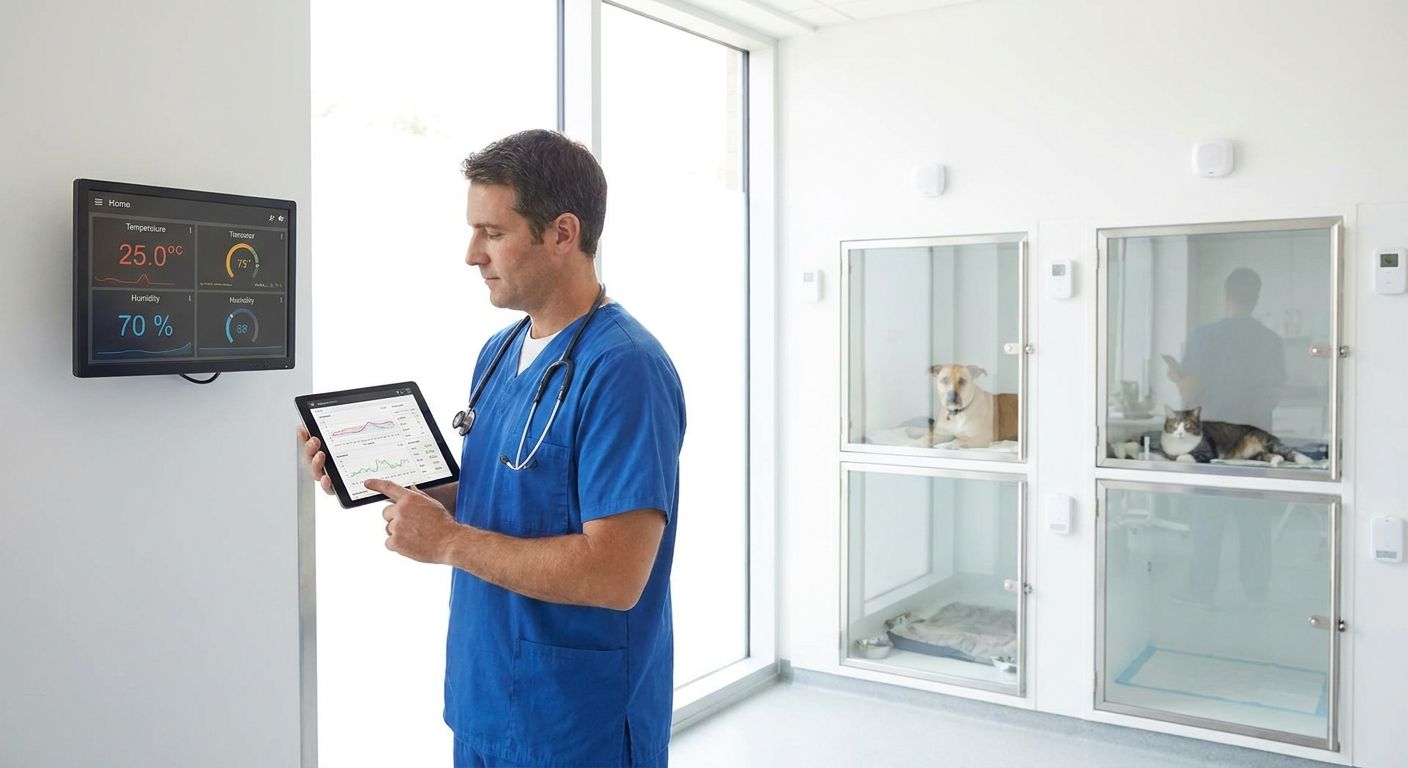
A facility monitoring system for veterinary clinics puts refrigerator and freezer temperature, surgical suite humidity, and water leak detection on one dashboard, so a technician gets an alarm before a vaccine fridge drifts out of range instead of finding out during the morning inventory count. Clinics carry a different risk profile than a warehouse or a hotel: a single power blip overnight can void a full shelf of modified-live vaccines, and the person who discovers it is usually the same tech who has to explain the loss to the practice owner.
- A facility monitoring system for veterinary clinics tracks vaccine fridge temperature, surgical humidity, and water leaks on one dashboard instead of a paper logbook.
- USDA Center for Veterinary Biologics guidance puts most refrigerated animal vaccines at 2°C to 8°C — a drift outside that band for even a few hours can void the batch.
- AAHA accreditation standards call for documented temperature logs on every vaccine and medication refrigerator, which manual twice-daily checks satisfy but automated logging does better.
- Kilo Cloud runs free for up to 5 devices and 1 dashboard with no card required, which covers a single-location clinic's fridge, freezer, and one alarm rule.
Why does a veterinary clinic need a facility monitoring system?
A veterinary clinic runs cold-chain storage, live surgical suites, and often boarding or dental equipment on the same floor plan as a retail lobby. That mix means one monitoring problem covers three different failure modes: a compressor that fails quietly overnight, an HVAC unit that lets a surgical suite drift above the range a sterile field needs, and a slow leak under an autoclave or imaging unit that nobody notices until the floor is wet.
AAHA accreditation standards require documented temperature checks on refrigerators and freezers holding vaccines and injectable medications. Most clinics still do this with a clipboard taped to the fridge door, checked once in the morning and once at close. That leaves 20+ hours a day with no visibility, which is exactly the window a bad compressor picks to fail. An iot vaccine storage monitoring platform replaces the clipboard with a sensor reading every few minutes and an alarm the moment the fridge crosses its threshold, not the next time someone walks past with a pen.
How do you set up a facility monitoring system in a veterinary clinic?
Map every asset that needs a sensor
Start with a walkthrough, not a spec sheet. List every refrigerator, freezer, incubator, and equipment closet that would cost money or put an animal at risk if it failed.
- Vaccine and medication refrigerators and freezers
- Surgical suite temperature and humidity
- Server or IT closet running practice management software
- Water heaters and the floor space under imaging or dental units
- Boarding or ward area temperature, if the clinic houses animals overnight
Set temperature thresholds for vaccine and medication storage
Pull the storage range off each product's package insert rather than guessing at one number for the whole fridge — some biologics tolerate a wider band than others. USDA Center for Veterinary Biologics guidance puts most refrigerated animal vaccines at 2°C to 8°C, with frozen products held well below zero.
- Set a warning threshold a couple of degrees inside the label range, not at the edge
- Set a critical threshold at the label limit itself
- Log every excursion with a timestamp, not just the current reading
- Separate refrigerator and freezer thresholds — they fail differently
iot dashboards for cold storage temperature monitoring turns each threshold into a rule that fires the moment a reading crosses it, which is the manual clipboard's biggest weakness solved in one step.
Track surgical suite humidity and HVAC drift
A surgical suite that runs too humid slows drying time and raises infection risk; too dry and static becomes an issue around electronics. Neither shows up on a wall thermostat tuned for the lobby.
- Place a dedicated temperature and humidity sensor inside the suite, not the hallway
- Alert on humidity swings, not just absolute temperature
- Cross-check readings against HVAC run cycles to catch a failing unit early
- Flag suites that drift during off-hours when nobody is watching the thermostat
Route alarms to the technician on shift, not a shared inbox
An alarm that lands in a shared inbox at 2 a.m. gets read at 8 a.m. — six hours after the fridge crossed its threshold.
- Build an escalation chain: on-call tech first, practice manager second
- Use SMS or push for critical alarms, email for warnings
- Set quiet hours only for non-critical alerts, never for vaccine or freezer thresholds
- Keep a centralized alarm inbox so nothing gets missed between shift changes
how to set up sms and email alerts for critical iot sensor thresholds covers building that escalation chain step by step, including how quiet hours should and shouldn't apply.
Watch for water leaks around imaging and surgical equipment
A slow leak under an ultrasound cart or an autoclave line rarely announces itself — it shows up as warped flooring or a soaked equipment room weeks later.
- Place a leak sensor under any unit with a water line: autoclaves, imaging chillers, ice machines
- Set the alarm to fire on first contact with moisture, not after a puddle forms
- Include water heater closets and any floor drain area prone to backup
- Pair leak alerts with the same escalation chain used for fridge alarms
Centralize multiple clinic locations on one dashboard
A practice running three or four locations usually ends up with three or four separate clipboards and no way to compare them. That's a management blind spot, not just an inconvenience.
- Put every location's fridge, freezer, and leak sensors on one dashboard
- Standardize thresholds across locations so a tech transferring sites sees the same rules
- Use role-based access so front desk staff see status, not configuration
- Review excursion history across all sites monthly, not per-clinic
Keep a compliance-ready log for inspections
AAHA accreditation visits and state board inspections ask for temperature logs, sometimes going back months. A dashboard that only shows the current reading doesn't answer that question.
- Keep automated logs with timestamps for every sensor, not spot checks
- Export excursion history in a format an inspector can read without explanation
- Retain data long enough to cover the accreditation review cycle
- Document who was alerted and when for every critical excursion
Set up your first fridge and leak sensors
Start free for up to 5 devices and 1 dashboard — no card required.
What are the best facility monitoring options for veterinary clinics?
| Option | Best for | Starting price | Key limitation |
|---|---|---|---|
| Paper clipboard log | A single-fridge clinic with tight budget | Free | No alerting between manual checks; easy to falsify or skip |
| Standalone USB temperature logger | A clinic that only needs one fridge tracked | Varies by unit | No live alerting, no multi-site view, data pulled manually |
| Legacy building management system (BMS) | A large hospital already wired for HVAC control | Installation-dependent | Expensive to extend to fridges and leak points; rarely mobile-friendly |
| Kilo Cloud IoT platform | Single clinics and multi-location practices needing live alerts and logs | 0 EUR for up to 5 devices; 25 EUR/month for up to 25 devices | Sensors and gateways are purchased separately through Kilo Electronics |
A clipboard tells you what happened yesterday morning; a facility monitoring system tells you the moment it happens. That's the practical difference that matters when a vaccine batch is on the line.
“If the fridge alarm doesn't reach a person, it isn't an alarm — it's a light nobody's watching.”
What mistakes do veterinary clinics make with facility monitoring?
- Checking temperature only twice a day. A compressor failure at 11 p.m. goes unnoticed until the 8 a.m. check, well past the window most vaccines tolerate.
- Setting one threshold for the whole clinic. Vaccine fridges, surgical suites, and boarding areas each need their own range — a single blanket rule misses all of them accurately.
- Sending every alarm to a shared email. Critical alerts get buried next to appointment reminders and vendor newsletters.
- Skipping the freezer because "it's just backup storage." Frozen biologics and reference samples are often more expensive to replace than the refrigerated stock next to them.
- Treating multi-location monitoring as multiple separate projects. Each clinic ends up with different thresholds and no way to compare excursion history across the practice.
FAQ
What is a facility monitoring system for veterinary clinics?
A facility monitoring system for veterinary clinics is a sensor network and dashboard that tracks refrigerator and freezer temperature, surgical suite humidity, and water leaks in real time, replacing manual clipboard checks with automated alerts.
What temperature should a veterinary vaccine refrigerator hold?
Most refrigerated animal vaccines need 2°C to 8°C per USDA Center for Veterinary Biologics guidance, though the exact range varies by product label and should always be confirmed against the package insert.
Do AAHA accreditation standards require temperature logging?
Yes, AAHA accreditation standards require documented temperature checks for refrigerators and freezers storing vaccines and medications. Automated sensor logging satisfies this requirement and adds a continuous record beyond twice-daily manual checks.
Is an IoT monitoring platform better than a standalone temperature logger?
A standalone logger records temperature but doesn't alert anyone in real time, so a failure between manual downloads goes unnoticed. A platform like Kilo Cloud sends an alarm the moment a threshold is crossed, which matters most overnight and on weekends.
How much does facility monitoring cost for a small veterinary clinic?
Kilo Cloud runs free for up to 5 devices and 1 dashboard with no card required, which covers a single fridge, freezer, and one alarm rule. Larger clinics needing up to 25 devices move to the 25 EUR/month Starter tier.
Can one dashboard cover multiple veterinary clinic locations?
Yes, a facility monitoring platform can put every location's fridge, freezer, and leak sensors on one dashboard with standardized thresholds, rather than a separate clipboard or logger per site.
What sensors does a veterinary clinic need first?
Start with temperature sensors in every vaccine and medication refrigerator and freezer, a humidity sensor in the surgical suite, and a leak sensor under any equipment with a water line.
Does automated monitoring replace manual temperature checks entirely?
Automated monitoring covers the hours between checks that a clipboard can't, but most accreditation bodies still expect a documented process — the sensor data becomes the record instead of a handwritten log.
Does a facility monitoring system catch freezer door events too?
A fridge that reads within range can still lose product if the door gets left ajar for twenty minutes during a busy shift — the compressor never trips an alarm because the average temperature stays close enough, even while the contents near the door warm past the label limit. Clinics that only monitor the compressor's set point miss this failure mode entirely; the fix is watching for open-door duration alongside the temperature reading, not instead of it. That's the gap most twice-daily clipboard checks never catch, since the door is always closed by the time someone walks over to look.