Industrial noise compliance runs on documented decibel readings, not a spot check with a handheld meter, and an IoT sensor network gives you the continuous, audit-ready log that OSHA and local noise ordinances actually require in 2026.
- Kilo Cloud's rules engine wins for threshold alarms tied to OSHA's 90 dBA exposure limit — buy it.
- Skip standalone SPL data loggers with no cloud sync; auditors want a timestamped trail, not a USB stick.
- Correlating noise spikes with equipment vibration cuts false alarms from nearby pumps and motors.
- IoT noise monitoring for industrial compliance needs continuous logging, not periodic manual checks, to survive an audit.
Why this matters
OSHA's permissible exposure limit is 90 dBA averaged over an 8-hour shift, and the hearing conservation action level kicks in at 85 dBA. Cross either one and you're documenting exposure, not guessing at it.
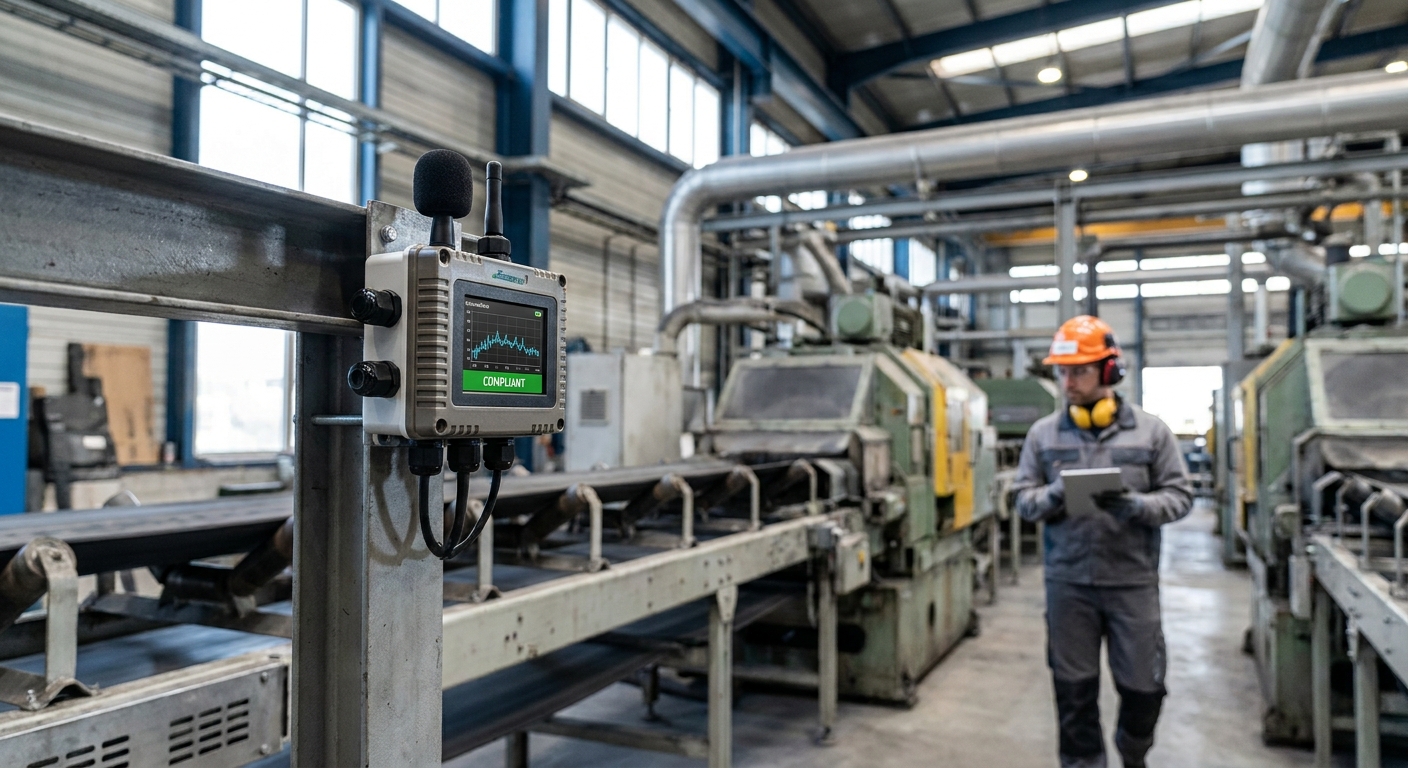
Manual spot-checks with a handheld meter fail audits for a simple reason: they capture one moment, and inspectors ask for a continuous record across shifts, zones, and equipment cycles. A Kilo IoT sensor network logs every reading automatically, so the compliance file writes itself instead of getting reconstructed after the fact.
Local noise ordinances add a second layer on top of OSHA — many municipalities cap ambient noise at property lines during night hours, and that's a separate dataset from occupational exposure. A platform built for iot noise monitoring for industrial compliance has to handle both without turning into two separate spreadsheets.
Who this is for
This guide is for EHS managers, facilities leads, and plant operations teams responsible for documented noise compliance across manufacturing floors, ports, processing plants, or any site with rotating equipment, compressors, or heavy machinery running multiple shifts. If you're currently relying on an annual third-party noise survey and nothing in between, you're the target reader.
What to look for in a noise compliance platform
Continuous decibel logging, not spot sampling
A single annual noise survey tells you what the floor sounded like on one Tuesday. Continuous logging tells you what happened during the 2 a.m. shift when the compressor cycled hard — and that's the record an auditor actually wants.
Threshold-based alarm logic tied to regulatory limits
Alarms need to fire at 85 dBA (action level) and again at 90 dBA (PEL), not just at one arbitrary number. Rules that escalate by severity keep the safety team focused on the readings that matter.
Zone-level sensor placement, mapped to the site
One sensor per building doesn't tell you which line, bay, or dock exceeded the limit. A digital twin view that maps each sensor to a physical zone turns a raw reading into an actionable location.
Connectivity that survives industrial RF and distance
LoRaWAN sensors typically run 10+ km outdoors and cut through the metal, concrete, and electrical noise that kills Wi-Fi in a plant. mioty adds resilience in dense RF environments where LoRaWAN gateways get crowded.
False-alarm handling
A forklift horn or a compressor kicking on shouldn't trigger the same alert as a sustained 92 dBA reading. Rules that require consecutive over-threshold readings — not a single spike — cut noise (pun intended) in the alert queue.
Audit-ready export and retention
When an inspector asks for six months of readings at a specific dock door, you need an export in minutes, not a request to IT. Retention and reporting have to be built in, not bolted on.
Top picks for industrial noise compliance monitoring
The compliance backbone. Kilo Cloud's rules engine for industrial IoT alarms lets you set tiered thresholds at 85 dBA and 90 dBA with different escalation paths for each. One spec that matters: alarms can require multiple consecutive readings before firing, which is the difference between a real exceedance and a passing truck horn. Verdict: Buy.
The audit trail. A facility monitoring dashboard built for compliance reporting turns raw sensor logs into exportable records by zone and date range. If your last audit took three days of pulling data from spreadsheets, this closes that gap. Verdict: Buy.
The false-alarm fix. Correlating noise readings against equipment vibration data separates a real compliance issue from a bearing that's about to fail and rattling louder than usual. It's not a standalone tool — it's a second data layer on the same platform that keeps the alert list credible. Verdict: Consider.
The one to skip. Standalone battery-powered SPL data loggers with no cloud connection still show up in facilities budgets. They store readings locally until someone walks the floor to pull a card, which means gaps exactly when you need continuity most. Verdict: Skip.
Map your noise compliance zones
See how Kilo Cloud logs decibel data site-wide with automated alarms.
What to avoid
- Consumer SPL apps on a phone. They're fine for a rough check, not for a documented compliance record an inspector will ask to see the calibration history of.
- One sensor covering an entire floor. Noise varies wildly by zone in a plant — a single reading averaged across 20,000 square feet hides the exceedance that actually happened at one press line.
- Vendors with no calibration certification trail. ISO 17025-traceable calibration matters when a reading gets challenged in an audit; a sensor with no documented calibration history is a liability, not a data source.
Verdict comparison
| Pick | Alarm logic | Audit trail | False-alarm handling | Verdict |
|---|---|---|---|---|
| Kilo Cloud rules engine | Tiered 85/90 dBA thresholds | Exportable via dashboard | Consecutive-reading requirement | Buy |
| Compliance reporting dashboard | Inherits rules engine | Built-in export by zone/date | N/A | Buy |
| Vibration correlation layer | Secondary trigger logic | Feeds same dashboard | Cuts equipment-driven false alarms | Consider |
| Standalone SPL data logger | None (manual review) | Local card pull only | None | Skip |
FAQ
What is IoT noise monitoring for industrial compliance?
It's a network of connected decibel sensors that log sound levels continuously and feed alarms and reports tied to OSHA and local noise limits. In 2026, most audits expect a continuous digital record rather than a single annual survey.
What decibel level triggers OSHA hearing conservation requirements?
85 dBA averaged over an 8-hour shift triggers OSHA's hearing conservation action level. The permissible exposure limit sits at 90 dBA over the same period, per 29 CFR 1910.95.
Is LoRaWAN good for noise sensors in a plant?
Yes — LoRaWAN sensors typically transmit 10 or more kilometers outdoors and hold up against the metal and electrical interference common on industrial floors. mioty is a strong alternative in sites with dense RF traffic.
How do you reduce false noise alarms from equipment?
Require multiple consecutive over-threshold readings before an alarm fires, and correlate noise spikes with vibration data from the same equipment. A single spike from a horn or a door shouldn't trigger the same alert as a sustained exceedance.
How often should industrial noise levels be logged?
Continuously, not periodically — a shift-based or annual survey misses the readings that happen when equipment is running hardest. Continuous IoT logging captures every reading and timestamps it for audit purposes.
Can one sensor cover a whole facility?
No — noise varies significantly by zone, and one sensor averaged across a large floor hides localized exceedances. Map sensors to specific bays, lines, or dock doors instead.
What should a noise compliance report include?
Timestamped readings by zone, alarm history with thresholds crossed, and an exportable date range an inspector can request on the spot. Reports built into a dashboard save the multi-day scramble of pulling data manually.
One last thing
Most noise complaints in industrial settings come from low-frequency hum below 100 Hz, not peak dB spikes — a compressor humming at 82 dBA all shift generates more complaints than a 95 dBA horn that lasts two seconds. If your iot noise monitoring for industrial compliance setup only tracks peak readings, you're missing the sound that actually drives the complaint calls.