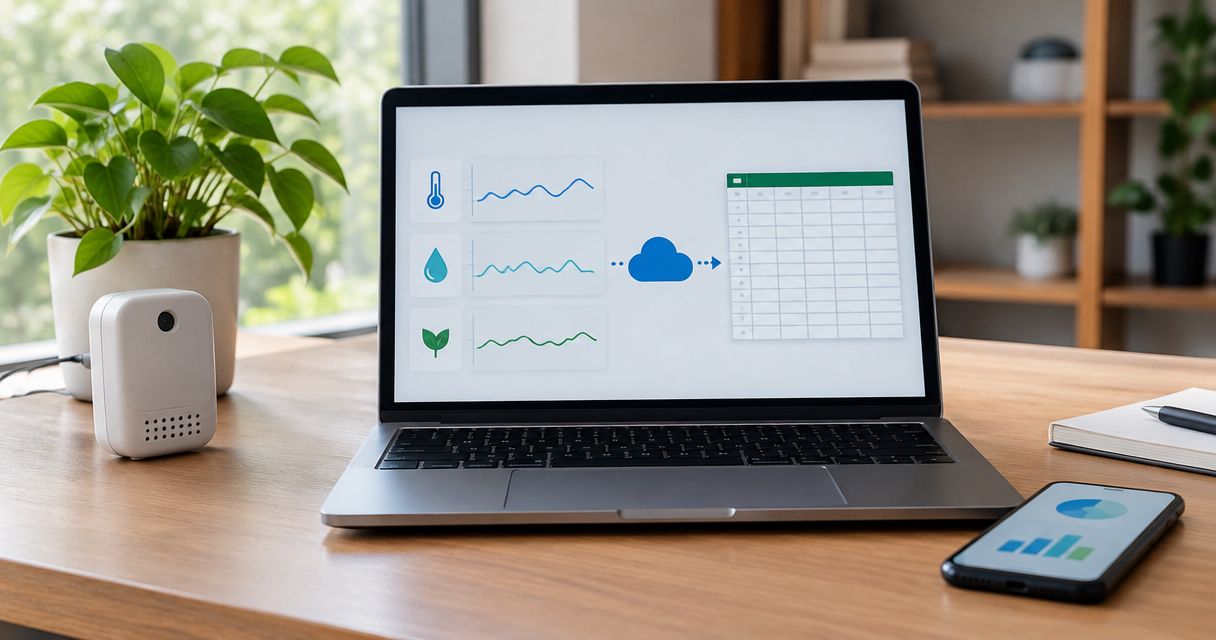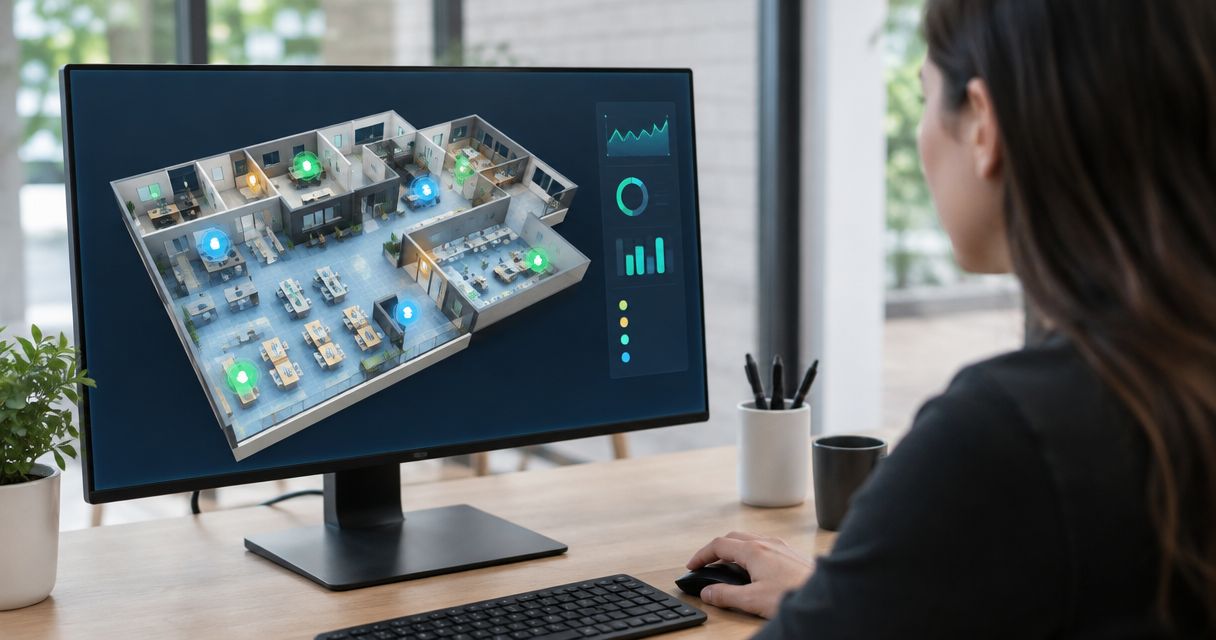
Specialty chemical blending facility IoT monitoring is the wireless sensor and alarm layer that tracks tank levels, temperatures, gas concentrations and pump vibration across a blending line, with the aim of catching an excursion before it becomes a spill, a fire, or an OSHA citation. Blending plants stack hazardous-area classification, batch-by-batch temperature swings and pressurized reactors into one site — a generic building sensor kit doesn't cover Class I Division 1 zones or feed data into a PLC-driven batch record the way a chemical line needs.
- IoT monitoring for chemical blending facilities catches tank overflow, gas leaks and pump wear before an incident report gets written.
- The Kilo IoT Platform combines LoRaWAN and mioty wireless sensors with MQTT-connected PLCs and tiered alarm escalation in one system.
- Kilo's Free plan covers 5 devices; Starter runs 25 EUR per month for up to 25 devices in 2026.
- NFPA 30 and OSHA's Process Safety Management standard (29 CFR 1910.119) set the compliance bar this monitoring has to clear.
Why IoT monitoring matters for chemical blending facilities in 2026
A blending line runs multiple hazards at once: flammable solvents in a storage tank, a heated reactor jacket, an agitator drawing current, and a discharge line that can overflow if a level switch sticks. Chemical storage tank level monitoring exists specifically because a stuck float switch or a missed manual round is how tank overflows happen — not because the operator wasn't paying attention, but because a paper log only gets checked once an hour.
OSHA's Process Safety Management standard (29 CFR 1910.119) already requires documented process safety information and operating procedures for facilities handling threshold quantities of highly hazardous chemicals. EPA's Risk Management Program (40 CFR 68) adds a parallel requirement for accidental release prevention. Neither regulation mandates a specific sensor brand, but both expect a paper trail that shows a facility knew about a condition and acted on it — and a manual clipboard round every two hours doesn't produce that trail between rounds.
NFPA 30, the Flammable and Combustible Liquids Code, governs how those tanks and rooms are built and vented in the first place. IoT monitoring doesn't replace any of these standards. It gives a facility a continuous record instead of a spot-check record, which is the gap auditors and insurers actually flag.
What should a chemical blending facility monitor first?
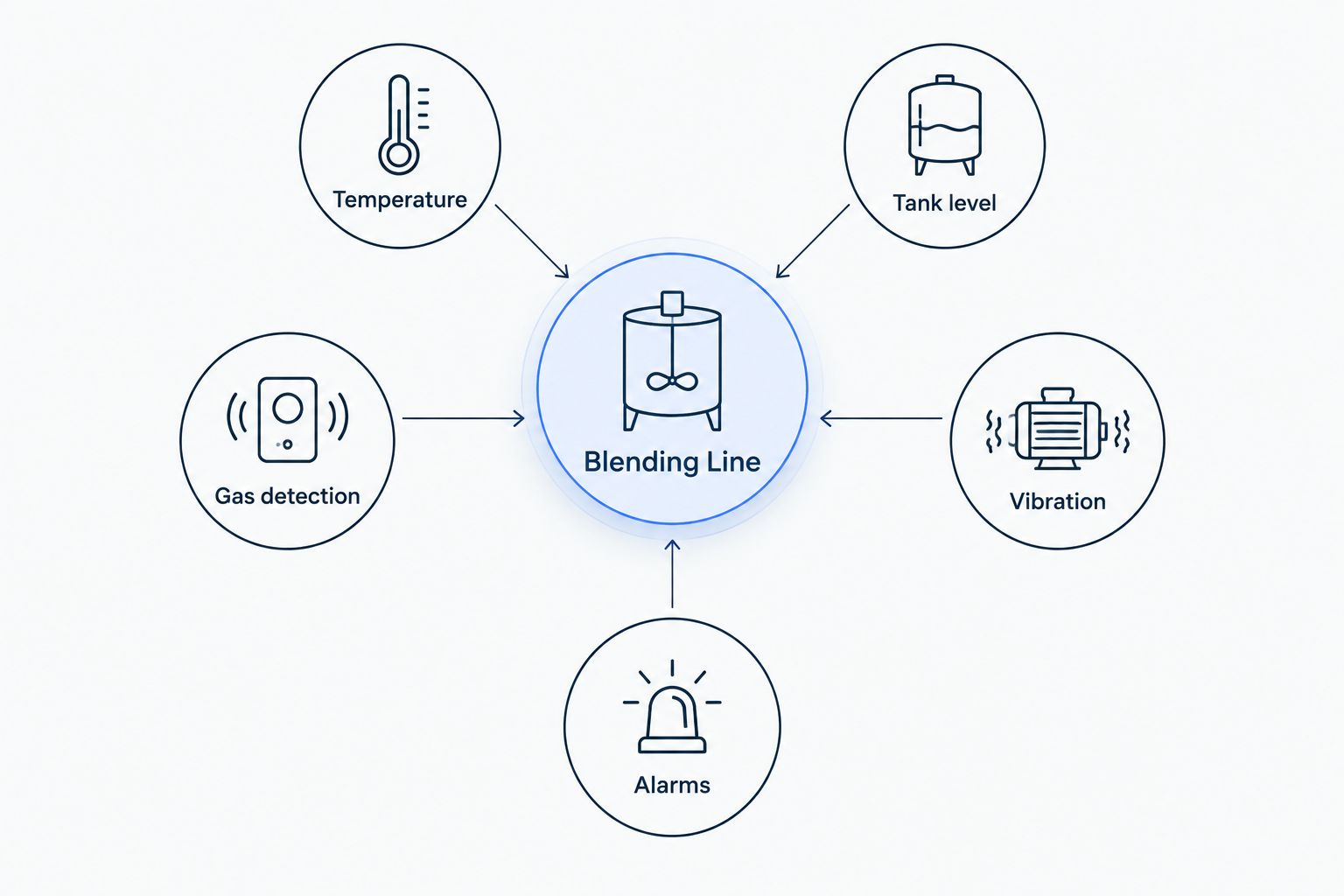
Start where an excursion does the most damage fastest: tank level, then hazardous-area gas concentration, then temperature on jacketed reactors, then vibration on pumps and mixers. Everything else — humidity in a dry-goods room, ambient temperature in an office — can wait.
Map temperature and pressure zones across every blending vessel
Most blending plants already track batch temperature by hand or through a local PLC screen that nobody checks between batches. The manual version works, slowly:
- Calibrated bimetal or digital thermocouples read manually each shift
- Pressure gauges on jacketed reactors logged on a paper batch sheet
- Thermal imaging camera sweeps at shift change to catch hot spots
- Wall-mounted analog gauges at each discharge nozzle
- A signed clipboard round every two to four hours
The gap is the time between rounds. A jacket that runs hot for 40 minutes before the next check doesn't show up until the batch is already off-spec.
Track tank levels to stop overflow and pump dry-running
Dipsticks and sight glasses tell you where the level is right now, not where it's headed. A high-level float switch wired to a local horn helps, but only if someone is in the building to hear it.
- Sight glass checks during rounds
- Float switches wired to a local horn or beacon
- Dipstick measurements logged by hand
- Radar or ultrasonic level transmitters feeding a local PLC screen
Wireless tank-level sensors reporting over LoRaWAN close the gap between manual checks without running new wiring to every tank — the sensor reports on a schedule and on a threshold breach, not only when someone looks. Automated tank overflow alerts cover the mechanics of setting that threshold correctly, which matters more than the sensor choice itself.
Add gas and VOC detection in hazardous-area zones
Any room with Class I Division 1 or Division 2 classification under NFPA 70 needs sensors and enclosures rated for that environment — a standard consumer wireless sensor is not an option here, regardless of price.
- Fixed catalytic or infrared gas detectors at known leak points
- Portable multi-gas monitors carried during rounds
- Local horn-and-strobe alarms tied to a fixed detector
- Wireless explosion-proof IoT sensors rated for the zone, reporting over mioty or LoRaWAN into a central dashboard
This is where a platform earns its place instead of a point sensor: one dashboard showing gas readings from every hazardous zone across the facility, rather than five separate vendor apps that don't talk to each other.
Watch pump and mixer vibration for early bearing wear
A mixer bearing going out doesn't announce itself on a batch sheet. It shows up as a vibration signature change weeks before it fails outright.
- Handheld vibration pen readings during rounds
- Scheduled oil analysis on gearboxes
- Listening for audible bearing noise during walkthroughs
- Fixed vibration sensors reporting continuously, with a threshold rule that fires an alarm on a sustained change
A threshold rule here is not predictive maintenance in the machine-learning sense — it's a documented limit that, when crossed, triggers an alarm and an escalation. That's a meaningfully different (and more auditable) claim than "the system predicted the failure."
Connect PLCs, flow meters and SCADA into one feed
Most blending lines already run a PLC or a small SCADA system for the batching sequence itself. The mistake is treating that system as a separate island from the wireless sensor layer.
- Modbus taps read manually into a spreadsheet
- PLC historian exports reviewed weekly
- A dedicated SCADA screen watched by one operator
- An MQTT connector that pulls PLC, flow meter and energy meter data into the same dashboard as the wireless sensors
The Kilo IoT Platform's MQTT connector accepts data from any publishing device, PLC, energy meter or building management system, which means flow meter totals and wireless tank-level readings land in the same rules engine instead of two disconnected screens. Securing MQTT connections for industrial IoT covers the authentication and network segmentation steps that matter before that connector goes live on a production line.
Build escalation-based alarms instead of a single horn
A horn that only sounds in an empty control room at 2 a.m. isn't an alarm — it's a delayed incident report.
“If a level alarm only sounds in an empty control room at 2 a.m., it isn't an alarm — it's a delayed incident report.”
Kilo's alarm system runs five severity tiers with multi-step escalation chains across email, SMS and push, plus quiet hours so low-severity notices don't page an on-call supervisor at 3 a.m. while high-severity gas or overflow alarms still escalate immediately. Every alarm lands in a centralized inbox instead of a local horn that only the person standing next to it hears.
Keep an audit trail for OSHA PSM and EPA RMP records
When an auditor asks what the reactor jacket temperature was during a specific batch six months ago, "we think it was fine" is not an answer. A continuous, timestamped record is.
- Paper batch sheets filed by date
- PLC historian logs pulled on request
- Spreadsheet exports maintained by a compliance coordinator
- An immutable digital record with REST and gRPC API export for audit and insurance requests
Kilo keeps an immutable audit trail alongside role-based (ABAC) access control, so a compliance coordinator can pull exactly what an auditor asks for without giving that auditor edit access to live alarm thresholds.
Best IoT monitoring options for chemical blending facilities
| Option | Best for | Starting price | Key limitation |
|---|---|---|---|
| Manual logbooks and spot checks | A single-line shop with a handful of tanks | No software cost | No alarm speed; excursions between rounds go unrecorded |
| Standalone SCADA/DCS retrofit | A large single-site plant already running a control system | Quoted by integrator | Expensive to extend to a second site; no built-in wireless sensor onboarding |
| Point sensor kits with a vendor app | A one-off compliance project on a single tank or gas point | Quoted by vendor | Locked to one sensor brand; no cross-site dashboard |
| Kilo IoT Platform | Multi-line facilities needing wireless sensors, PLC data and alarms in one system | Free for up to 5 devices; 25 EUR/month Starter for up to 25 devices | Larger deployments need a higher device tier; check current plan limits on the site |
Wireless sensors themselves — gas detectors, level transmitters, vibration sensors rated for hazardous areas — are sourced through Kilo Electronics (kiloelectronics.com), the hardware side of the business, with worldwide shipping. The platform is protocol-agnostic, so sensors from different manufacturers still land on one dashboard.
Common IoT monitoring mistakes chemical blending facilities make
- Covering only the minimum required gas detection points and missing intermittent leak sources near valve packing and mixer seals
- Setting tank-level alerts as info-only with no escalation chain, so a 2 a.m. overflow alarm sits unread until the morning shift
- Installing non-rated sensors or gateways in Class I Division 1 zones because a wireless kit was cheaper, then failing an electrical classification review
- Running one gateway with no failover, so a single hardware fault takes every wireless sensor in the building offline at once
- Skipping calibration schedules on pressure and level transmitters, which lets drift creep in until false alarms get ignored — including the real one
See the platform behind the alarms
Start free with up to 5 devices, no card required, on the Kilo IoT Platform.
FAQ
What is IoT monitoring for chemical blending facilities?
It's a wireless sensor and alarm system that tracks tank levels, temperatures, gas concentrations and pump vibration across a blending line continuously, instead of relying on scheduled manual rounds. It typically feeds into the same dashboard as existing PLC or SCADA data.
How much does IoT monitoring cost for a chemical blending plant?
On the Kilo IoT Platform, the Free plan covers up to 5 devices with no card required, and Starter runs 25 EUR per month for up to 25 devices in 2026. Gateways don't count against either device limit. Hardware sensor cost depends on the sensor type and is sourced separately through Kilo Electronics.
Do chemical blending sensors need to be explosion-proof?
Any sensor or gateway installed in a room classified Class I Division 1 or 2 under NFPA 70 needs an enclosure and rating suited to that zone. Areas outside the hazardous classification can use standard wireless sensors.
Can IoT sensors connect to an existing PLC or SCADA system?
Yes, through an MQTT connector that accepts data from any publishing PLC, energy meter or building management system. That lets flow meter and PLC data sit in the same dashboard and rules engine as wireless sensor readings.
How does IoT monitoring help with OSHA PSM and EPA RMP compliance?
OSHA's Process Safety Management standard (29 CFR 1910.119) and EPA's Risk Management Program (40 CFR 68) both expect documented process safety records. A continuous, timestamped sensor record with an immutable audit trail gives auditors exactly that, instead of a paper log with gaps between rounds.
What's the difference between LoRaWAN and mioty for a chemical plant?
Both are low-power wireless protocols for battery-run sensors; mioty uses telegram splitting, which holds up well in dense metal or shielded environments common in process plants, while LoRaWAN has a larger existing sensor ecosystem. Kilo runs a built-in network server for both, so the choice depends on the specific building's RF environment rather than the platform.
How fast do IoT alarms reach a shift supervisor?
With a configured escalation chain, an alarm can reach email, SMS and push notification targets in sequence based on severity tier, rather than waiting for someone to notice a local horn. Quiet hours can suppress low-severity notices while high-severity alarms still escalate.
Can one platform monitor tank level, gas and vibration together?
Yes — a protocol-agnostic platform like the Kilo IoT Platform can bring wireless level, gas and vibration sensors, plus PLC data over MQTT, into one dashboard and one rules engine instead of separate vendor apps for each sensor type.
The one record most blending facilities install too late
The audit trail is usually the last thing a facility sets up and the first thing an insurer or OSHA inspector asks for. A rules engine with version control and one-click rollback means a threshold change during a busy quarter doesn't quietly become the new normal — the previous version is still there to restore. Facilities that add the audit and permissions layer on day one, rather than after the first near-miss, spend a lot less time reconstructing what happened during a specific batch six months later.