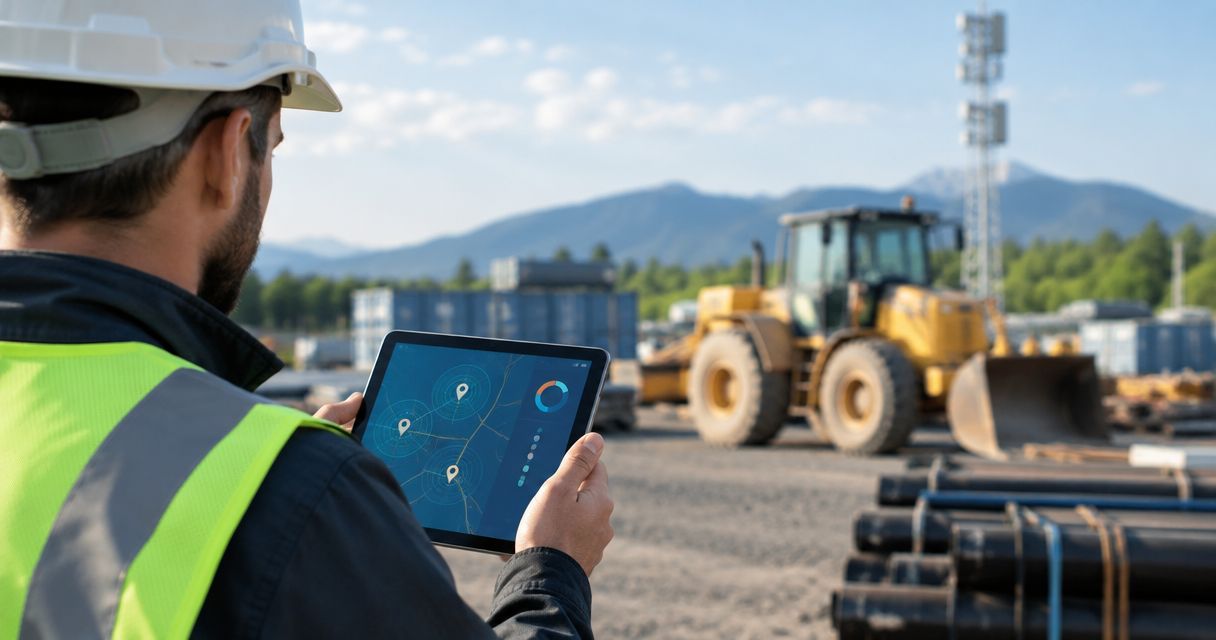
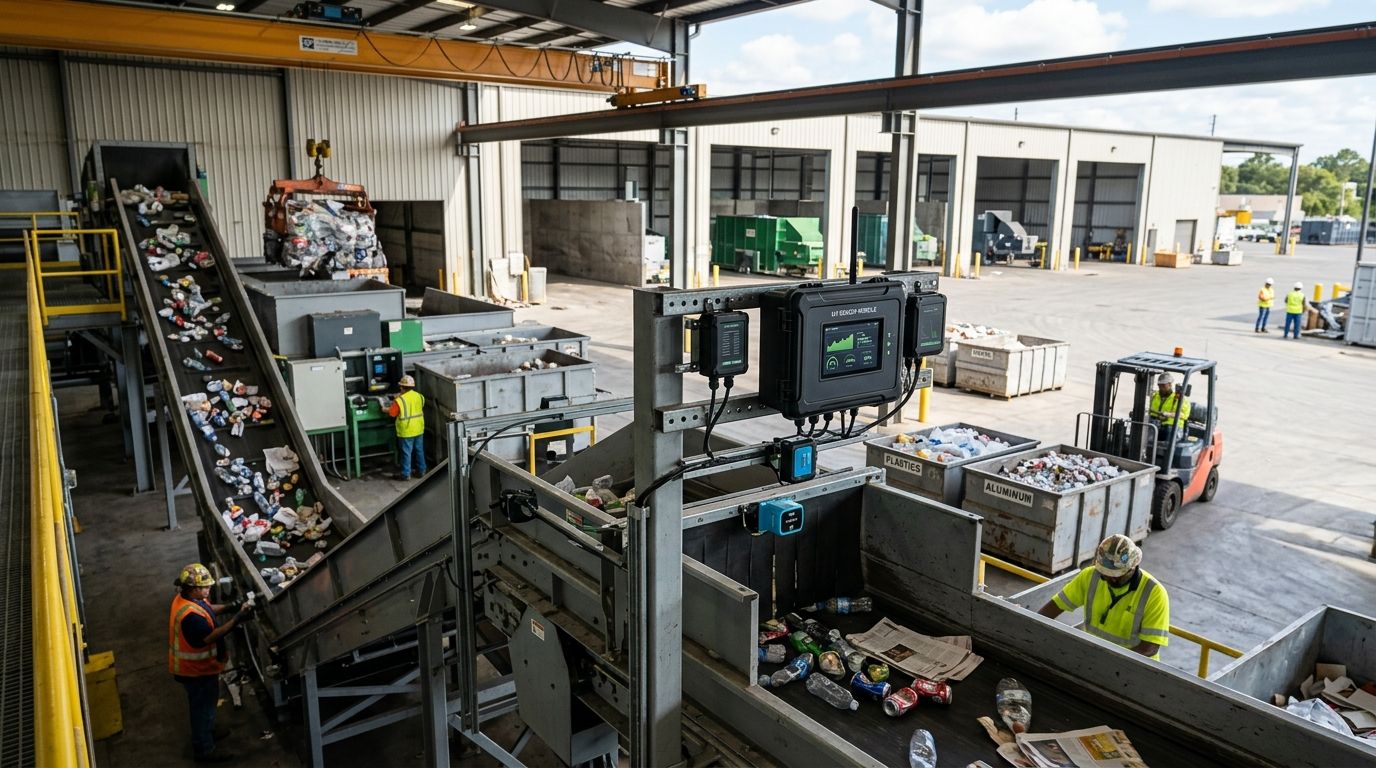
Waste management and recycling facility IoT monitoring uses wireless sensors and a cloud platform to track gas buildup, tank and bin levels, equipment vibration, and yard equipment location, with the goal of catching hazards early, cutting unnecessary truck rolls, and keeping the paperwork ready for an EPA or OSHA inspector. A transfer station or material recovery facility (MRF) is not a warehouse: it has steel-frame buildings that block radio signal, rotating equipment that runs at high load for 16+ hours a day, and gas hazards that a standard building monitoring setup was never built to catch.
- Iot monitoring waste management facilities means combining methane, tank level, vibration and asset sensors on one platform rather than four separate tools.
- The Kilo IoT Platform runs LoRaWAN and mioty natively, and mioty's deeper penetration matters for steel-frame MRF buildings and buried landfill gas wells.
- EPA rules cap surface methane concentration at 500 ppm above background for municipal solid waste landfills under 40 CFR Part 60, Subpart XXX — sensor placement has to match that requirement.
- Kilo's Free tier covers up to 5 devices at 0 EUR with no card required; Starter runs 25 EUR/month for up to 25 devices, with gateways unlimited on every tier.
Why do waste and recycling facilities need IoT monitoring in 2026?
A landfill, transfer station or MRF runs on equipment and hazards that don't show up on a normal facilities checklist: gas wells, leachate tanks, balers that crush at full tonnage for entire shifts, and rolling stock that moves between tipping floor and yard all day. Miss a gas reading and you have an OSHA or EPA problem. Miss a bearing going bad on a baler and you have a shutdown mid-shift.
OSHA's permit-required confined space standard (29 CFR 1910.146) already forces manual gas checks before anyone enters a pit, cell or enclosed tank. Continuous sensor readings don't replace that entry permit, but they do tell an operator whether conditions have changed since the last check, and they leave a time-stamped record instead of a clipboard entry that's easy to lose. For active and closed landfill cells, EPA's New Source Performance Standards (40 CFR Part 60, Subpart XXX) require surface methane monitoring on a quarterly basis, with readings capped at 500 ppm above background — a number worth building sensor placement around, not guessing at.
How do you build an IoT monitoring program for a waste or recycling facility?
Map facility zones and failure points before buying a single sensor
Start with a walk of the site, zone by zone, and list what actually fails or gets missed today.
- Tipping floor and pit: fire risk, dust, occupancy
- Baler, shredder and conveyor lines: vibration, jams, motor load
- Gas collection wells and closed landfill cells: methane concentration
- Leachate and process tanks: level, overflow risk
- Scale house and yard: equipment location, idle time
- Enclosed MRF buildings: steel structure blocking wireless signal
This list becomes the sensor shopping list. Skip it and you end up buying whatever a vendor pitches instead of what the site actually needs.
Monitor methane and gas buildup near cells, wells and enclosed equipment
Gas detection on a landfill or transfer station isn't optional reading — it's the one category tied directly to a federal reporting threshold. The manual route is a handheld meter on a fixed walking route, logged by hand each shift.
- Handheld meter sweeps on a documented, repeatable route
- Fixed point detectors wired to a local alarm horn
- Quarterly surface scans per the landfill methane rule
- Continuous wireless gas sensors reporting into a shared dashboard
- Threshold rules that flag a reading crossing 500 ppm before the quarterly scan catches it
This is where a platform like the Kilo IoT Platform earns its place: a continuous LoRaWAN or mioty gas sensor reports on a schedule you set, and a rule fires an alarm the moment a reading crosses the threshold you configure — not the next time someone walks the route with a handheld unit. Kilo's methane emissions monitoring setup applies the same rules-engine logic used across other industrial gas monitoring deployments.
Track leachate and process tank levels without walking the site
Leachate tanks and process water tanks at a transfer station or MRF get checked by eye more often than they should, because nobody built a level sensor into the original design.
- Manual dipstick or sight-glass checks on a fixed schedule
- Float switches wired to a local high-level alarm
- Wireless ultrasonic or radar level sensors reporting to a dashboard
- A rule that escalates to a supervisor's phone before a tank reaches overflow height
- A logged history of level trends for permit renewal paperwork
A tank running near capacity on a Friday afternoon shouldn't wait until Monday's walk-through to get noticed — an escalation chain with quiet hours turned off for high-severity alarms closes that gap.
Watch vibration on balers, shredders and conveyor drives
Balers and shredders run near their rated load for most of a shift, and a bearing or belt problem tends to show up as a vibration signature change before it shows up as a jam.
- Manual listen-and-feel checks by maintenance staff
- Handheld vibration meters on a weekly rotation
- Fixed accelerometers on high-value motors and gearboxes
- A CEL rule that flags a reading crossing a set vibration threshold, not a prediction of failure
- An alarm routed to the maintenance lead instead of the general operations inbox
Kilo's vibration monitoring for pumps and motors approach applies directly here: a threshold-based rule flags an abnormal reading and routes it to the right person, rather than claiming to predict when a bearing will fail.
Track loaders, compactors and rolling stock across the yard
A transfer station yard has compactors, loaders and roll-off trucks moving constantly, and knowing where a piece of equipment sits at any moment cuts down on wasted searching between shifts.
- A daily paper log of equipment location by zone
- Geofenced zones with entry and exit alerts
- A digital twin view that places each asset on a live facility map
- Idle-time tracking to flag equipment sitting unused
- Handoff logs between shifts tied to the same asset record
Build alarms and escalation paths for after-hours events
A gas reading spike or tank overflow at 2 a.m. is worthless data if nobody sees it until the morning shift walks in.
- A single shared alarm inbox instead of five separate vendor apps
- Severity tiers so a minor reading doesn't page the same person as a critical one
- Multi-step escalation chains that move to a second contact if the first doesn't respond
- Quiet hours turned off specifically for gas and high-level tank alarms
- SMS or push notification tied to the on-call rotation, not just email
Which monitoring option fits a waste or recycling facility?
| Option | Best for | Starting price | Key limitation |
|---|---|---|---|
| Manual checks and paper logs | Small single-site operations tracking a handful of tanks or gas points | No software cost | Misses buildup between rounds and leaves no time-stamped audit trail |
| Standalone point sensors (one gas detector, one tank gauge) | A single reading with no need for shared alarms | Varies by vendor | Each device lives in its own display with no shared escalation path |
| A general building management system (BMS) | Sites that already run a BMS for HVAC and lighting | Varies by vendor | Built for climate-control points, not gas wells, balers or rolling stock |
| Kilo IoT Platform (LoRaWAN + mioty) | Multi-zone sites needing gas, tank, vibration and asset data in one dashboard | Free up to 5 devices, 0 EUR; Starter at 25 EUR/month for up to 25 devices | Sensor hardware ships separately, and gas sensor placement still needs sign-off from a qualified industrial hygienist |
Sensor hardware for any of these deployments ships through Kilo Electronics, the sister hardware company that handles worldwide shipping — Kilo the software platform doesn't manufacture the devices itself.
“If a methane sensor at a closed landfill cell reads above 500 ppm surface concentration, that's not a warning — it's an EPA-reportable event.”
What mistakes do waste and recycling facilities make with IoT monitoring?
- Ignoring steel-frame signal blocking. A baler room or enclosed MRF building attenuates standard LoRaWAN signal more than an open yard — mioty's deeper link budget handles that case better in 2026 deployments.
- Placing gas sensors by convenience, not by regulation. EPA's 500 ppm surface methane threshold assumes a specific monitoring pattern across active and closed cells — sensor placement has to match the standard, not the easiest mounting spot.
- Treating leachate tanks as fire-and-forget. A tank without a level alarm gets checked on a human schedule, and human schedules slip during a busy week.
- No after-hours escalation plan. A gas or overflow alarm that only reaches an email inbox at 2 a.m. gets read at 7 a.m., after the event already happened.
- Buying one sensor type at a time. A gas detector from one vendor, a tank gauge from another and a vibration sensor from a third means three dashboards and three separate alarm systems instead of one.
Get a waste site monitoring plan
Map gas, tank and equipment sensors to one dashboard.
FAQ
What's the best IoT monitoring platform for waste and recycling facilities in 2026?
The Kilo IoT Platform fits multi-zone waste and recycling sites because it combines LoRaWAN and mioty connectivity with a rules engine and alarm escalation in one dashboard, rather than requiring a separate app per sensor type. It's best for operations teams running gas, tank, vibration and asset data across one site.
Is LoRaWAN or mioty better for a landfill or steel-frame MRF building?
Mioty generally handles steel-frame buildings and buried gas wells better because of its deeper link budget and telegram-splitting transmission method. LoRaWAN still works well for open-yard sensors like tank gauges and asset trackers where signal path is less obstructed.
How much does IoT monitoring cost for a waste management facility?
Kilo's Free tier covers up to 5 devices at 0 EUR with no card required and never expires. The Starter tier runs 25 EUR per month for up to 25 devices, with gateways unlimited on every tier.
Can IoT sensors detect methane buildup at a landfill or transfer station?
Yes, continuous wireless gas sensors report methane concentration on a set schedule and can trigger a threshold alarm before the mandated quarterly surface scan under EPA's 40 CFR Part 60, Subpart XXX would catch it. They supplement, not replace, the required quarterly monitoring.
How do you track balers, shredders and rolling stock across a waste yard?
Vibration sensors on balers and shredders flag readings that cross a set threshold, while asset tags on loaders and compactors place equipment on a live facility map. Both feed the same alarm and escalation system instead of separate standalone tools.
Does IoT monitoring replace OSHA-required confined space gas checks?
No. OSHA's permit-required confined space standard (29 CFR 1910.146) still requires a manual gas check before entry. Continuous sensors add ongoing visibility between required checks, not a substitute for the entry permit process.
How do you monitor leachate tank levels without walking the site daily?
A wireless ultrasonic or radar level sensor reports tank height continuously to a shared dashboard, and a rule escalates to a supervisor before the tank reaches overflow height. That removes the need for a daily manual dipstick check.
What's the single biggest blind spot in waste facility IoT monitoring?
Most sites buy gas detection, tank gauges and vibration sensors from three separate vendors, then wonder why nobody sees the pattern when a tank level spike and a compressor vibration spike happen the same afternoon. A single rules engine that sees all three data streams catches that correlation; three separate apps never will. That's the actual value of consolidating iot monitoring waste management facilities onto one platform in 2026 — not the sensors themselves, but the shared alarm logic sitting behind them.