
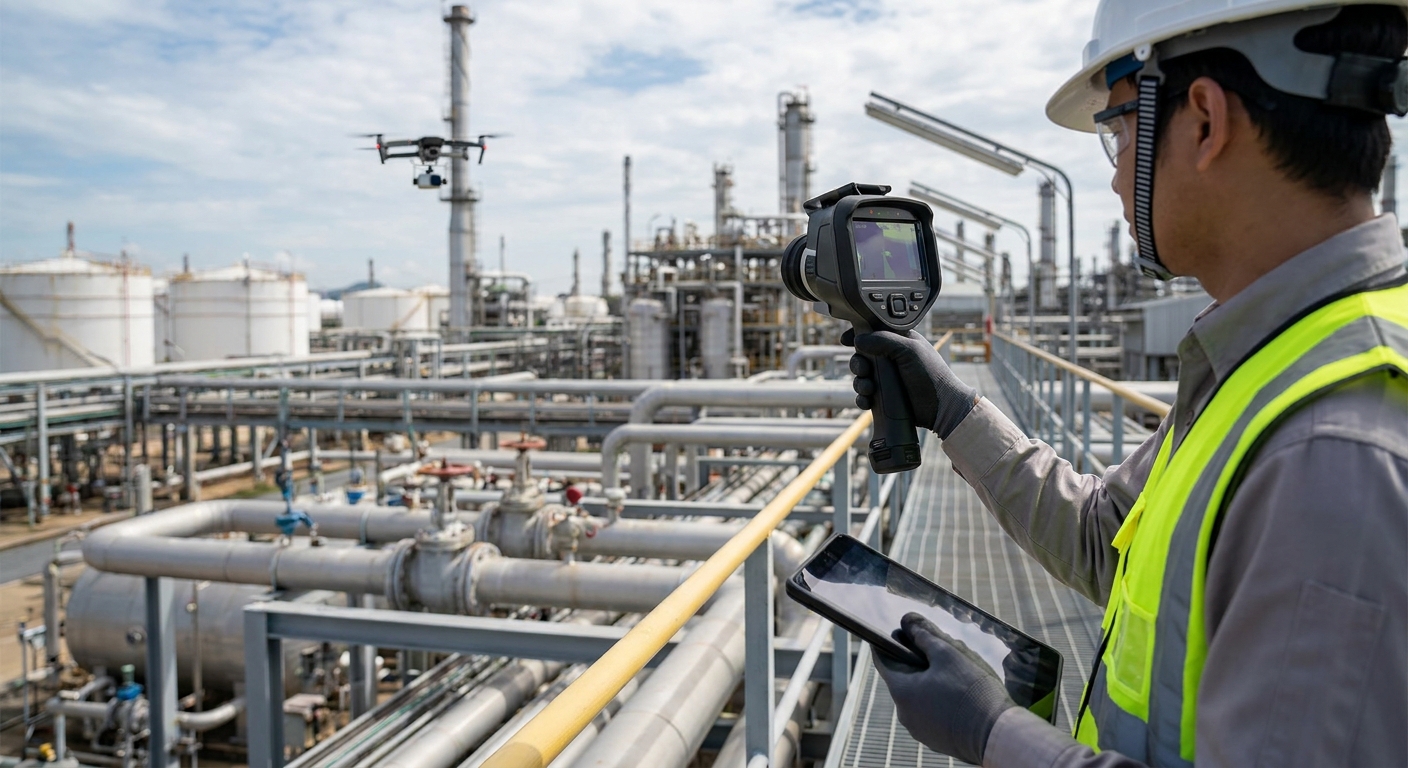
Methane is colorless, and in its raw state it's odorless too — the smell you associate with a gas leak is an additive called mercaptan, and plenty of industrial methane sources (compressor seals, pneumatic controllers, tank hatches) release it without any warning odor at all. It ignites at concentrations as low as 5% by volume in air, according to the NIOSH Pocket Guide to Chemical Hazards, so a monitoring program that relies on an annual optical gas imaging (OGI) survey finds leaks months after they started venting. This guide covers how to build continuous methane monitoring across an industrial facility in 2026: sensor selection, network setup, alarm thresholds, and how to turn raw ppm readings into a compliance record that survives an audit.
- Continuous LEL-rated methane sensors at compressor seals, flanges and tank hatches catch leaks that annual OGI surveys miss between visits.
- Methane's lower explosive limit is 5% by volume, or 50,000 ppm, per the NIOSH Pocket Guide — alarm well below that.
- EPA's Subpart W (40 CFR Part 98) requires facilities emitting over 25,000 metric tons CO2e per year to report methane annually.
- Staged alarm severity beats one flat threshold when you monitor methane emissions in industrial facilities with multiple emission points.
- A continuous data log plus a timestamped alarm history is the fastest path to a defensible 2026 compliance filing.
Why Continuous Methane Monitoring Beats an Annual Leak Survey
Most industrial sites still run leak detection and repair (LDAR) as a periodic exercise: a technician walks the site with an OGI camera or a Method 21 organic vapor analyzer, logs readings, and comes back next quarter or next year. That approach satisfies a checkbox but misses the leak that started the week after the last survey. A compressor seal that starts venting in March sits unmonitored until the next scheduled pass, and by then it has already cost you gas volume and put you outside the intent of EPA's General Duty Clause obligations under the Clean Air Act. Continuous sensors close that gap — they don't replace a Method 21 baseline, they extend it between visits.
What You Need to Monitor Methane Emissions in an Industrial Facility
- A baseline leak survey (Method 21 organic vapor analyzer or OGI camera pass) to identify known high-emitting components before you place sensors
- Hazardous area classification per NFPA 497 for every zone where a sensor will be mounted (Class I Division 1 or Division 2)
- Point-source methane sensors rated for the classified zone — catalytic bead, NDIR, or semiconductor, depending on the environment
- Wireless connectivity that doesn't require running conduit to every compressor pad or tank farm corner — this is where methane leak detection sensor networks over LoRaWAN or mioty earn their keep
- A rules engine capable of staged thresholds tied to alarm severity, not a single flat trigger
- An escalation chain that reaches an on-call EHS manager or process safety engineer by SMS or push, not just an inbox that sits unread overnight
How to Set Up Methane Emissions Monitoring in an Industrial Facility
Step 1: Map every emission point and classify the hazard zone
Walk the site with your Method 21 analyzer or OGI camera and log every compressor seal, flange, valve, pneumatic controller, dehydrator vent, tank hatch, and relief valve as a discrete point. Rank them by emission factor from your last LDAR pass, then classify the surrounding zone per NFPA 497. This tells you which sensors need intrinsically safe housings and which don't.
Common mistake: skipping low-bleed pneumatic controllers because they don't look like a leak. They vent methane continuously by design, and across a site with dozens of them, the cumulative volume is larger than most single equipment failures.
Step 2: Match sensor technology to each point
Catalytic bead sensors work well in oxygen-rich, confined spaces but degrade fast when exposed to silicone or sulfur compounds common near compressor stations — that's sensor poisoning, not a false reading. NDIR sensors don't depend on ambient oxygen and hold calibration longer in dirty environments. Open-path laser (TDLAS) units make sense for fenceline or perimeter monitoring across a tank farm.
Methane is lighter than air — 0.716 kg/m³ versus 1.225 kg/m³ for air — so it rises and pools near ceilings and roof vents in enclosed buildings rather than settling at floor level like propane. Mount indoor sensors high, and mount outdoor point sensors directly at the release source.
Common mistake: copying a propane detector layout. Low-mounted sensors miss methane accumulating at the roofline of a compressor building entirely.
Step 3: Get every sensor reporting to one dashboard
A built-in LoRaWAN and mioty network server means you're not deploying a separate network controller just to get point sensors talking; an MQTT connector pulls readings from any BMS or PLC already on site, so a legacy gas detection panel doesn't have to be replaced to join the same dashboard. For a site that spans several hundred meters, plan LoRaWAN network coverage around gateway line-of-sight to compressor pads and tank rows before you mount a single sensor.
Common mistake: assuming one indoor gateway covers an outdoor tank farm larger than 200 meters across. Obstructions from tanks and structural steel cut range fast — walk the site with a coverage plan, not a guess.
Step 4: Bind sensors to a digital twin of the site
A live 3D building or site twin with sensors bound to physical objects means an alarm shows a tank number or compressor ID on a floor plan, not just a device serial number. During an actual release, that difference determines how fast a responder finds the source.
Common mistake: leaving sensors unbound to twin objects. Someone ends up cross-referencing a spreadsheet during the exact moment they should be walking to the leak.
Step 5: Set staged alarm thresholds, not one flat trigger
Build alarm logic in a visual rules engine using CEL expressions, with thresholds set well below the 50,000 ppm LEL — a low-level advisory around 1,000 ppm, a high alert around 10,000 ppm, and a critical tier tied to your site's own safety plan. Five severity tiers let a minor drift and an active release route completely differently. A rules engine for industrial alarms with version control and a rollback option means you can test a threshold change against a recorded high-concentration payload before it goes live on the floor.
Common mistake: one flat threshold that either floods inboxes with nuisance alerts during startup venting or stays silent until the concentration is already dangerous.
Step 6: Route each severity tier to the right person
Multi-step escalation chains across email, SMS, and push mean a critical methane alarm at 2 a.m. reaches the on-call process safety engineer directly, not the shared facilities inbox. Reserve quiet-hour suppression for low-severity advisories only — a critical methane alarm should never be silenced by a schedule.
Common mistake: routing every tier to the same channel and the same person. A low-level advisory and a critical release need different recipients and different urgency.
Step 7: Log everything for compliance reporting
A timestamped alarm history plus sensor history over the API turns continuous sensor data into the record an auditor asks for: when a device saw a reading, what threshold fired, and when the alarm was resolved. Building a compliance reporting dashboard around that data is what makes an EPA Subpart W annual filing or an OGMP 2.0 submission defensible instead of reconstructed from memory after the fact.
Common mistake: relying on OGI survey photos as your only compliance evidence. A photo from one afternoon doesn't answer what happened the other 364 days of the year.
“Set your alarm threshold at a fraction of the LEL, not at it — 50,000 ppm is when methane ignites, not when you want to find out.”
Set up continuous methane monitoring
See how the Kilo IoT Platform handles sensor ingestion, alarms and compliance records.
Why Is My Methane Sensor Giving Bad Readings? Troubleshooting
- Sensor reads zero after a known leak survey confirms a source. Catalytic bead sensors get poisoned by siloxanes and sulfur compounds common near compressor stations. Swap that point to an NDIR sensor and cross-check with an OGI pass.
- Nuisance alarms fire during startup or shutdown venting. Add a sustained-duration condition — require the concentration to hold above threshold for 2 minutes before the alarm fires, rather than triggering on a single spike. This is the core of how to reduce false alarms in a facility with routine pneumatic venting.
- A gateway drops sensors at the edge of the site. Check received signal strength before boosting sensor transmit power — a repeater gateway usually fixes range issues that stronger transmission won't.
- Alarms don't reach staff overnight. Check that quiet-hours settings only apply to low-severity tiers. A critical methane alarm should bypass any scheduled suppression entirely.
- Sensor readings drift over several months. Recalibrate per the manufacturer's datasheet interval — commonly every 6 to 12 months for catalytic bead sensors — and log the calibration date in your maintenance record so it shows up in a compliance review.
- Digital twin location doesn't match the sensor after equipment gets moved. Rebind the sensor to its new object promptly and audit the twin against the site's P&ID on a quarterly cycle.
Tools and Resources for Methane Emissions Compliance
- A Method 21 organic vapor analyzer or OGI camera for the baseline survey and periodic confirmation passes
- NFPA 497 as the reference standard for classifying hazardous areas around emission points
- EPA's Greenhouse Gas Reporting Program guidance (40 CFR Part 98, Subpart W) for facilities above the 25,000 metric ton CO2e/year threshold
- The OGMP 2.0 framework if the facility reports under a voluntary international methane program
- A platform that ingests LoRaWAN, mioty, and MQTT sensor data into one dashboard, applies rules and alarms, and keeps a searchable alarm history for reporting— this is where the Kilo IoT Platform fits for teams monitoring methane emissions in industrial facilities without stitching together separate systems for connectivity, alarms, and compliance logs
FAQ
What's the best way to monitor methane emissions in industrial facilities?
Continuous point sensors at known emission sources — compressor seals, flanges, tank hatches, pneumatic controllers — connected to a rules engine with staged alarm thresholds is the most reliable setup in 2026. Periodic OGI surveys still matter for baseline confirmation, but they miss leaks that start between visits.
Is continuous methane monitoring better than periodic OGI surveys?
Continuous monitoring catches leaks the same day they start, while an annual or quarterly OGI survey only catches what's active during that visit. The two work best together: OGI establishes the baseline, continuous sensors watch the gap between surveys.
What is the lower explosive limit for methane?
Methane's lower explosive limit is 5% by volume in air, or 50,000 ppm, according to the NIOSH Pocket Guide to Chemical Hazards. Alarm thresholds should trigger well below that concentration, not at it.
How much methane can a facility emit before EPA reporting is required?
Under EPA's Greenhouse Gas Reporting Program (40 CFR Part 98, Subpart W), facilities in the petroleum and natural gas sector emitting over 25,000 metric tons of CO2 equivalent per year must report annually. Check the current rule text for sector-specific exceptions.
What sensor type works best for methane leak detection?
NDIR sensors hold calibration longer in dirty industrial air and don't depend on ambient oxygen levels. Catalytic bead sensors work fine in cleaner, oxygen-rich spaces but degrade when exposed to silicone or sulfur compounds common at compressor stations.
How often should methane gas detectors be calibrated?
Most catalytic bead sensors need recalibration every 6 to 12 months per the manufacturer's datasheet, though intervals vary by environment and exposure to contaminants. Log every calibration date so it's available for a compliance review.
Can LoRaWAN sensors monitor methane outdoors at a large industrial site?
Yes, with gateway placement planned around line-of-sight to emission points — a single gateway rarely covers a tank farm or compressor field larger than 200 meters across without obstruction issues.
What is EPA's Subpart W methane reporting rule?
Subpart W (40 CFR Part 98) is EPA's Greenhouse Gas Reporting Program requirement for petroleum and natural gas facilities above a 25,000 metric ton CO2e per year threshold to report methane and other GHG emissions annually.
The detail most facilities get wrong isn't sensor placement — it's alarm design. A site with 40 monitoring points and one flat threshold either drowns the on-call engineer in nuisance alerts within the first month or gets ignored entirely by the second. Staged severity, tested against a recorded payload before deployment, is what makes continuous methane monitoring something a team actually trusts by the time an EPA filing or an insurance audit asks for the data behind it.