
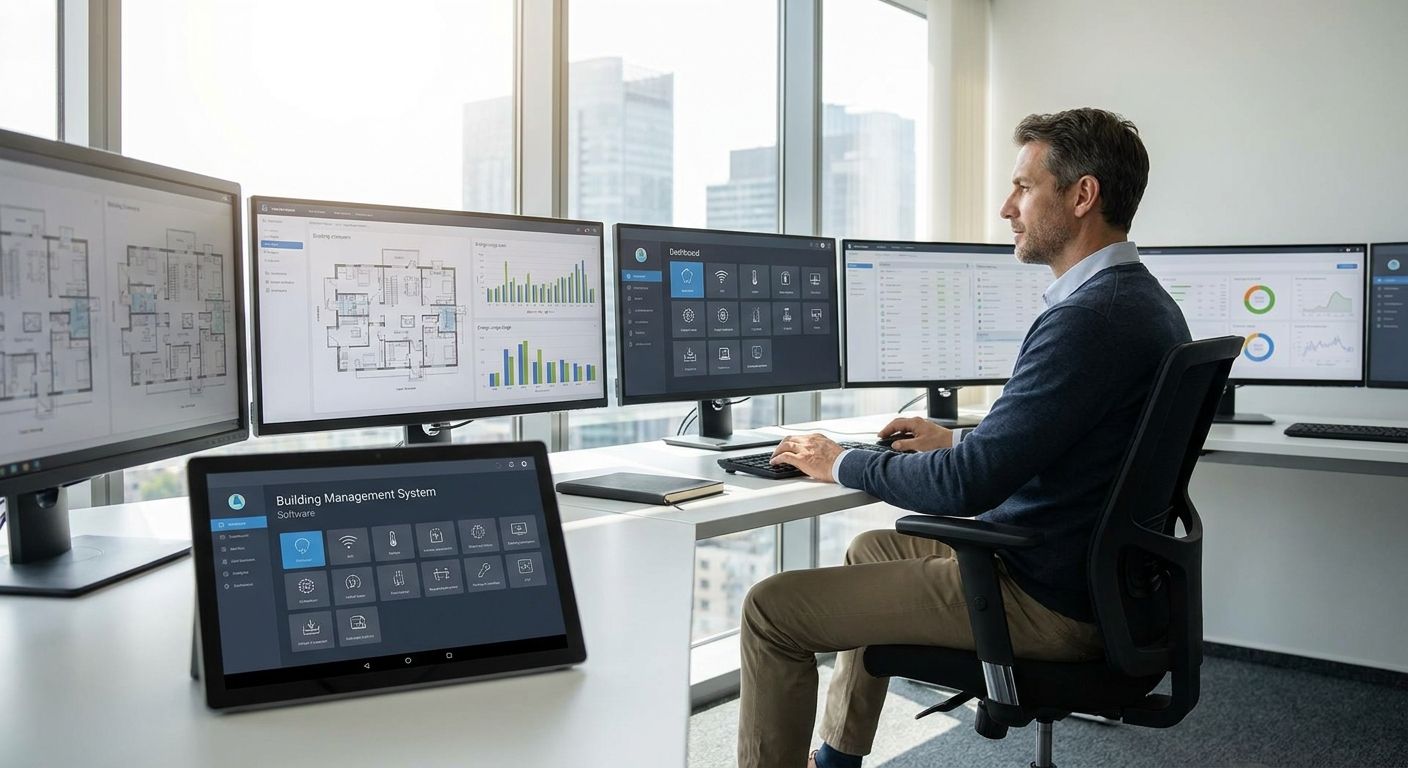
Building management system software brings HVAC, lighting, energy, occupancy, and equipment data into one place so a facilities team can see problems before a tenant complains or a compressor fails. This guide breaks down what actually differs between the software categories on the market in 2026 and where a cloud-native platform like Kilo fits against legacy building automation.
- Building management system software in 2026 splits into five categories: legacy BAS controllers, open-source stacks, point sensor kits, full-service integrators, and cloud-native AIoT platforms.
- Match protocol support to your building first — BACnet and Modbus for existing controls, LoRaWAN or mioty for retrofits without new wiring.
- Alarm escalation chains and digital twin visualization separate a real facilities platform from a dashboard that just plots charts.
- Kilo's free tier runs 0 EUR for up to 5 devices with 1 dashboard and 1 rule, with no card required, so you can test a rule and an alarm before committing budget.
What counts as building management system software
A true building management system pulls sensor and controller data \u2014 temperature, humidity, energy, occupancy, door and equipment status \u2014 into rules that trigger alarms and, in some cases, commands back to equipment. That's different from a single-purpose sensor app or a spreadsheet of meter readings. The Kilo IoT Platform is built around that loop: connect devices over LoRaWAN, mioty or MQTT, build rules against the data, and escalate what breaks.
Most facilities teams inherit at least two systems already: an older building automation controller running BACnet (ASHRAE Standard 135) or Modbus, and a pile of point sensors bought to solve one problem at a time. Building management system software in 2026 either replaces that stack, sits on top of it, or bridges the two.
How to evaluate building management system software for a facilities team
Four or five features decide whether a platform survives past the pilot. Walk through each before you sign anything.
Protocol and network support
Check whether the platform has a built-in network server for the wireless protocols you'll actually deploy, not just a generic "IoT connector." Kilo ships a built-in LoRaWAN and mioty network server, so there's no separate network server to stand up and maintain, plus an MQTT connector for any publishing device, PLC, energy meter or BMS controller already on site.
Alarm and escalation logic
A temperature spike that nobody sees for six hours isn't monitoring, it's a log file. Look for severity tiers, multi-step escalation chains, and quiet hours so 2 a.m. alerts don't wake the wrong person. Kilo runs five severity tiers with multi-step escalation across email, SMS and push, plus a centralized alarm inbox.
Rules engine flexibility
Threshold alarms cover the obvious cases; CEL expressions and a visual rules engine cover the rest \u2014 combining a door sensor with a temperature reading, or suppressing an alarm during a known maintenance window. Kilo's rules engine is BPMN-based with version control, one-click deploy and rollback, and step-through debugging against a test payload before it goes live.
Digital twin and visualization
A floor plan with live pins beats a table of device IDs when you're explaining a problem to a property manager or a board. Kilo builds a digital twin per device plus a live 3D digital building twin with sensors bound to physical objects, alongside configurable dashboard widgets \u2014 maps, charts, image floor-plan pins, gauges and control widgets.
Device management at scale
Onboarding ten sensors by hand is fine; onboarding across a portfolio of buildings is a different job. A platform built for multi-site facility teams needs bulk provisioning, scoped access per site, and an audit trail. That's the exact case covered in this multi-site facility monitoring dashboard breakdown.
API depth and access control
Energy managers want the raw data in their own reporting stack; integrators need scoped keys, not one shared admin login. Kilo exposes REST and gRPC APIs with scoped API keys, ABAC-based multi-tenant access control, an immutable audit trail, and on-premise deployment as an option.
The types of building management system software worth comparing
Here's how the market actually breaks down in 2026, by architecture rather than brand name.
Legacy BAS controllers. Built around BACnet or LonWorks, tied to the HVAC and lighting controls installed when the building was constructed. Deep integration with existing equipment, but adding a wireless retrofit sensor usually means a separate gateway and a separate dashboard. Best fit for buildings that never plan to touch their control wiring again.
Open-source IoT stacks. Free to run, fully customizable, and entirely on you to maintain \u2014 patching, scaling the network server, and building your own alarm logic from scratch. Best fit for a team with in-house engineering time and no urgency.
Point sensor kits. A single app tied to one sensor type \u2014 a leak detector, a temperature logger \u2014 with no rules engine and no cross-device correlation. Fine for a single problem in a single room; it doesn't scale into a portfolio view.
Full-service BMS integrators. A contractor designs, installs, and manages the whole system, often on proprietary hardware with a long implementation timeline. Strong for new construction with a big capital budget; overkill for a retrofit on an existing site.
Cloud-native AIoT platforms. Built for wireless sensors first, with a hosted network server, a rules engine, and an AI assistant layered on top. Kilo falls in this category: it onboards devices, writes and deploys rules, and creates alarms through plain-language conversation, scoped to the signed-in user's permissions and confirming before any consequential action. This is the category to compare when you're retrofitting an existing building without ripping out controls, which is covered in more detail in this guide to retrofitting legacy buildings with wireless IoT sensors.
Building management system software comparison table
| Category | Protocol support | Alarm depth | Digital twin | Best for |
|---|---|---|---|---|
| Legacy BAS controllers | BACnet, LonWorks | Basic thresholds | Rare | Buildings not touching existing wiring |
| Open-source IoT stacks | Varies, self-managed | Build-your-own | Build-your-own | Teams with in-house engineering time |
| Point sensor kits | Single protocol | None or basic | No | One problem, one room |
| Full-service BMS integrators | Proprietary + BACnet | Vendor-defined | Sometimes | New construction, large capital budget |
| Cloud-native AIoT platforms | LoRaWAN, mioty, MQTT | Five-tier escalation | Per-device + 3D building twin | Multi-site retrofits, AI-assisted setup |
Test a rule before you buy
Free tier: 0 EUR, up to 5 devices, 1 dashboard, 1 rule, no card required.
Where to source building management system software and hardware
Three rules cut through most of the noise when you're actually buying in 2026.
- Match protocol to what's already installed. If the building runs BACnet controls, look for a bridge, not a rip-and-replace. If it's a retrofit with no existing low-power network, LoRaWAN or mioty avoids running new cable.
- Separate the software decision from the hardware decision. Kilo doesn't manufacture or ship sensors \u2014 hardware for a Kilo deployment comes through Kilo Electronics, the hardware side of the business, with worldwide shipping, so you're not locked into one sensor SKU for the life of the contract.
- Run the free tier before the multi-site rollout. A platform that can't prove a working rule and alarm on five devices at 0 EUR won't get easier to trust at fifty devices and a monthly bill.
For teams also managing HVAC-specific energy targets alongside general facility monitoring, the criteria shift slightly \u2014 covered in this HVAC energy management platform comparison. For portfolio visualization specifically, see this breakdown of digital twin platforms for facilities teams.
FAQ
What is building management system software?
Building management system software connects HVAC, lighting, energy, occupancy and equipment sensors into one platform with rules and alarms. In 2026 the category ranges from legacy BACnet controllers to cloud-native platforms like Kilo that add a rules engine and digital twin on top of wireless sensor data.
What's the difference between a BMS and a BAS?
A building automation system (BAS) typically refers to the wired controllers running HVAC and lighting, often on BACnet or LonWorks. A building management system (BMS) is the broader software layer that can pull in that data plus wireless sensors, energy meters and occupancy counts.
How much does building management system software cost?
Pricing varies by category: full-service BMS integrators quote per project, while cloud platforms like Kilo publish tiered plans — Kilo's free tier is 0 EUR for up to 5 devices and its Starter plan is 25 EUR per month for up to 25 devices, with no limit on the number of gateways on either tier.
Can building management system software work without replacing existing BACnet controllers?
Yes. Platforms with an MQTT connector, like Kilo, can pull data from an existing BACnet or Modbus-fed BMS controller alongside new wireless sensors, rather than replacing the controller outright.
Is LoRaWAN or mioty better for a building retrofit?
Both are low-power wireless standards designed to avoid running new cable through a retrofit; the right choice depends on building density and battery life needs, and Kilo runs a built-in network server for both so the choice doesn't lock you into a separate infrastructure decision.
Does building management system software include a digital twin?
Not always — point sensor kits and most legacy BAS controllers skip it entirely. Kilo builds a digital twin per device plus a live 3D digital building twin with sensors bound to physical objects on a floor plan.
What alarm features should facilities teams look for in 2026?
Severity tiers, multi-step escalation chains, and quiet hours matter most — a single flat alert list buries the urgent case. Kilo runs five severity tiers with escalation across email, SMS and push into one centralized inbox.
Can an AI assistant set up building management alarms directly?
Kilo's built-in AI assistant can onboard a device, write a rule, and create an alarm through plain-language conversation, but it stays scoped to the signed-in user's permissions and confirms before any consequential action — it doesn't act unsupervised.
What to check before you sign a building management system software contract
The detail most shortlists skip is the network server. If the vendor requires you to stand up a separate LoRaWAN or mioty network server before their software can even see a device, that's a second piece of infrastructure to patch and maintain for the life of the contract. A platform with the network server built in \u2014 Kilo runs both LoRaWAN and mioty natively \u2014 removes that step entirely, which matters more at renewal time in 2026 than it does during the sales demo.