Best overall: wireless LoRaWAN NDIR CO2 sensors on a cloud IoT platform, for any school running more than a classroom or two. Best for steel-frame or interference-heavy campuses: mioty CO2 sensors. Best for a single room with no network in place: a standalone desktop CO2 monitor. This guide ranks the five practical co2 sensor classroom air quality options schools actually deploy in 2026, and tells you exactly where each one falls apart.
- Wireless LoRaWAN NDIR sensors on a cloud platform are the best co2 sensor classroom air quality setup for multi-room schools in 2026.
- ASHRAE Standard 62.1 flags sustained classroom CO2 above roughly 1,000 ppm as a sign of inadequate outdoor air ventilation.
- Mioty CO2 sensors beat LoRaWAN in steel-frame buildings and campuses with heavy RF interference.
- Standalone desktop CO2 monitors work for single-room spot checks but cannot alert facilities staff remotely.
- A rules engine turns a raw CO2 reading into an escalated alarm within minutes instead of a number nobody checks.
How CO2 Buildup Affects Classroom Air Quality and Student Focus
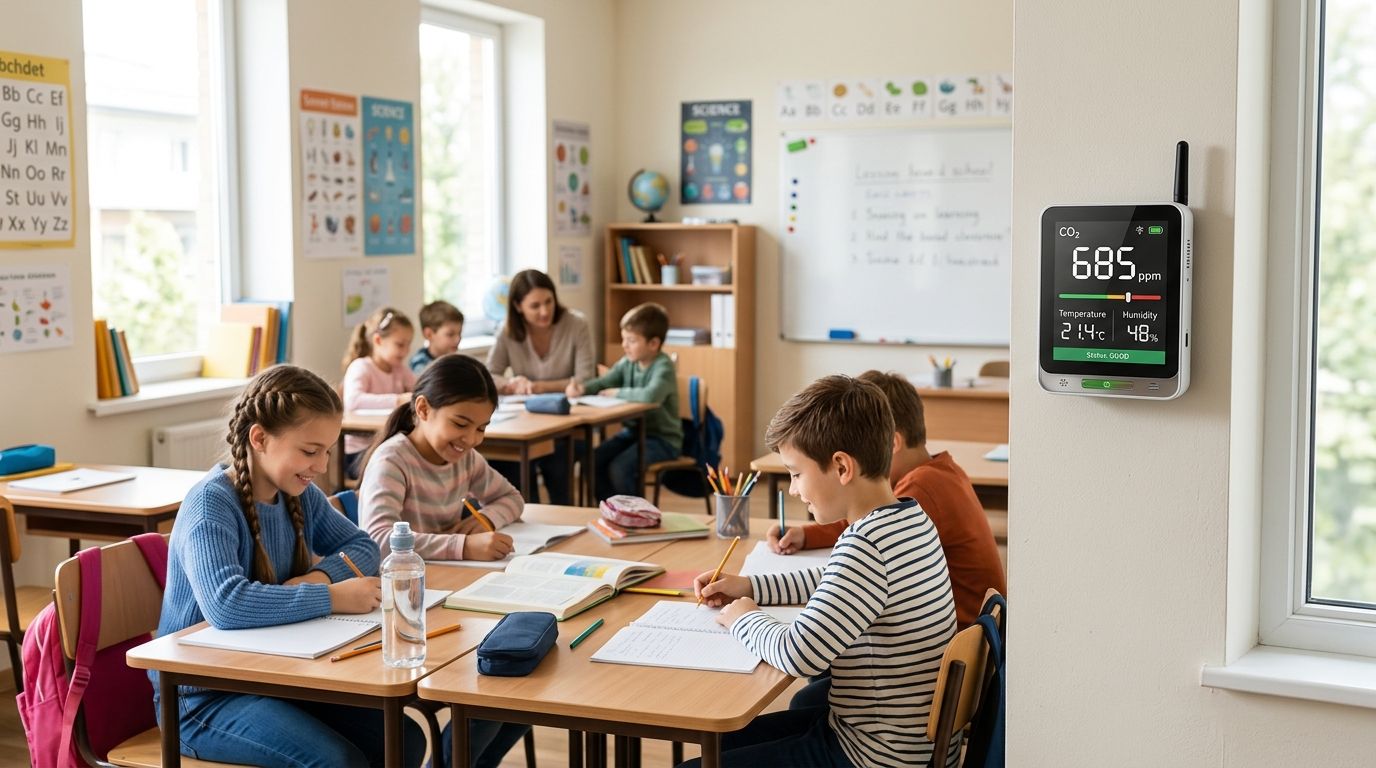
Outdoor ambient CO2 sat near 425 ppm in 2024 measurements from NOAA's Mauna Loa Observatory, so anything a classroom sensor reads well above that baseline came from something inside the room — mostly the students breathing. ASHRAE Standard 62.1 uses CO2 as a proxy for outdoor air ventilation rate, and most school indoor air quality guidance treats sustained readings above 1,000 ppm as a sign the room isn't getting enough fresh air.
The stakes aren't abstract. Harvard T.H. Chan School of Public Health's COGfx research found cognitive test scores dropped as CO2 concentrations climbed from roughly 550 ppm toward 1,400 ppm in controlled office conditions — a range plenty of portable classrooms hit by mid-afternoon with the door shut and 25 kids inside. A CO2 sensor doesn't fix ventilation. It tells a facilities team the room crossed a line, which is the only way anyone finds out before the fourth-period slump sets in.
Running that alert loop is a job for a platform, not a sensor sitting alone on a wall. The Kilo IoT Platform pairs CO2 readings with a rules engine and alarm escalation, so a room that crosses 1,000 ppm can page whoever owns the HVAC schedule as part of K-12 school campus monitoring instead of logging a number nobody opens.
What Makes a Good CO2 Sensor for Classroom Air Quality Monitoring
- Sensing technology: NDIR (non-dispersive infrared) is the standard CO2 sensing method — it doesn't drift with humidity the way older electrochemical designs do.
- Auto-calibration (ABC): automatic baseline correction resets the zero point against known-clean outdoor air, usually overnight, so accuracy holds across multi-year deployments.
- Placement height: ASHRAE guidance puts CO2 sensors in the breathing zone, roughly 3 to 5 feet off the floor, away from doors, windows and supply vents.
- Connectivity and range: the wireless protocol decides how many classrooms one gateway covers and whether a sensor survives inside a steel-stud wall.
- Alarm and escalation logic: a reading is useless without a rule that turns it into a notification, an escalation chain and a record of who acknowledged it.
- Reporting interval and battery life: classrooms need readings every few minutes, not once an hour, without a battery swap every semester.
CO2 Sensor Options for Classroom Air Quality at a Glance
| Option | Best for | Standout feature | Key limitation |
|---|---|---|---|
| Wireless LoRaWAN NDIR sensors | Multi-classroom, multi-building rollouts | Centralized dashboard and alarm escalation | Needs at least one gateway per building wing |
| Mioty NDIR sensors | Steel-frame or interference-heavy campuses | Telegram splitting holds up under RF noise | Fewer sensor models on the market than LoRaWAN |
| BACnet/MQTT BMS-integrated sensors | Schools with an existing building management system | Reads straight into the BMS point database | Locked to whatever protocol the BMS already speaks |
| Standalone desktop CO2 monitors | Single-room spot checks, no network | Works out of the box, no setup | No remote alarm, no cross-building trend |
| Wired analog CO2 sensors | Retrofitting one wing of an older building | No batteries to ever replace | Wiring cost scales with distance from the panel |
1. Wireless LoRaWAN CO2 Sensors: Best for Multi-Classroom Air Quality Monitoring
LoRaWAN NDIR CO2 sensors broadcast a reading every few minutes over a low-power wireless network that one or two gateways cover across an entire school building. Instead of a person walking room to room with a handheld meter, every classroom reports into a single dashboard. Kilo Cloud runs a built-in LoRaWAN network server, so there's no separate network server to stand up before sensors start reporting.
LoRaWAN CO2 sensor pros:
- Covers a whole building from one or two gateways, with battery life measured in years on typical LoRaWAN device datasheets.
- Feeds a rules engine that escalates an alarm by email, SMS or push the moment a room crosses a threshold.
- Scales to a district's worth of buildings without pulling new wire.
LoRaWAN CO2 sensor cons:
- Range drops fast inside buildings with a lot of rebar or metal studs.
- Still needs at least one gateway per wing, which is one more device to maintain.
Kilo Electronics, Kilo's hardware partner, ships pre-configured LoRaWAN CO2 sensors worldwide, and the AI assistant built into Kilo Cloud can walk a facilities team through onboarding each one and wiring a threshold alarm through plain-language conversation, without writing code.
Best for: districts monitoring more than a handful of classrooms who want one dashboard and automated alarms instead of a spreadsheet. Verdict: Buy.
2. Mioty CO2 Sensors: Best for Steel-Frame and Interference-Heavy Campuses
Mioty is a low-power wide-area standard specified under ETSI TS 103 357, built around telegram splitting: each message gets broken into fragments sent across different frequencies and times. That design holds up better than plain LoRaWAN in buildings with heavy RF interference or a lot of steel and concrete. Kilo Cloud runs a built-in mioty network server alongside its LoRaWAN server, so switching protocol doesn't mean switching platforms — the same logic that applies to mioty sensors for shielded environments applies to a gym with a steel roof deck.
Mioty CO2 sensor pros:
- Telegram splitting survives interference and multipath fading that would corrupt a LoRaWAN packet.
- Handles higher sensor density per gateway in steel-frame or industrial-adjacent construction.
- Runs on the same dashboard and rules engine as LoRaWAN sensors.
Mioty CO2 sensor cons:
- Fewer CO2 sensor models ship in mioty than LoRaWAN today, since the standard is newer to education deployments.
- Overkill for a typical wood-and-drywall classroom building — it solves a problem most schools don't have.
Best for: campuses with steel-stud construction or portables clustered near industrial equipment that already showed LoRaWAN dead zones. Verdict: Consider if a gateway survey found dead zones; skip otherwise.
3. BACnet/MQTT BMS-Integrated CO2 Sensors: Best for Schools With an Existing Building Management System
If a school already runs a building management system, a CO2 sensor that speaks BACnet or publishes over MQTT can land directly in the existing point database instead of adding a second dashboard. Kilo Cloud's MQTT connector accepts readings from any publishing device, PLC or BMS point, so the CO2 data can sit next to HVAC setpoints already being watched.
BMS-integrated CO2 sensor pros:
- No new dashboard for facilities staff to learn.
- CO2 readings sit alongside damper position and supply air temperature already on the BMS graphics.
BMS-integrated CO2 sensor cons:
- Locked to whatever protocol and point-naming convention the BMS vendor already uses.
- Adding sensors usually means an integrator visit, not a self-service install.
Best for: schools with a working BMS and an integrator relationship already in place. Verdict: Hold — good if the BMS exists, don't build one just to add CO2.
4. Standalone Desktop CO2 Monitors: Best for Single-Room Spot Checks
A standalone desktop or portable NDIR CO2 monitor reads and displays a number on the unit itself, with no network connection required. It's the fastest way to check one room once.
Standalone monitor pros:
- Works immediately, no setup, no gateway.
- Portable between rooms for a quick audit.
Standalone monitor cons:
- No remote alarm — someone has to be standing in the room to see the reading.
- No historical trend, no cross-building comparison, no escalation if a room spikes overnight.
Best for: a single classroom, a one-time indoor air quality audit, or confirming a wireless sensor's reading. Verdict: Wait on this as the only solution beyond one room; it doesn't scale.
5. Wired Analog CO2 Sensors: Best for Retrofitting Older School Buildings
A wired analog CO2 sensor running 4-20mA or 0-10V back to a panel or PLC has no battery to replace, which matters in a building where nobody wants to climb a ladder every few years. Kilo Cloud's MQTT connector can take that PLC's published data the same way it takes a BMS point.
Wired analog CO2 sensor pros:
- No batteries, ever.
- Reliable in older buildings where wireless coverage is unproven.
Wired analog CO2 sensor cons:
- Wiring cost scales fast with distance from the panel.
- Adding a sensor later means pulling more cable, not just mounting a device.
Best for: retrofitting one wing of an older building where running wire is cheaper than proving wireless coverage. Verdict: Consider for a small, contained retrofit; skip for anything spanning multiple buildings.
How These CO2 Sensors for Classroom Air Quality Were Ranked
Each option was weighed against the criteria above: NDIR accuracy, auto-calibration, breathing-zone placement, connectivity reach, alarm escalation and reporting interval. Wireless LoRaWAN sensors rank first because they clear every criterion for a typical school without added wiring. Mioty, BMS-integrated and wired options rank where they do because they solve a specific building condition rather than the general case, and a standalone monitor ranks last for anything beyond one room because it fails the alarm criterion outright.
Which CO2 Sensor Is Best for Classroom Air Quality Monitoring in 2026?
For most schools in 2026, wireless LoRaWAN NDIR sensors on a cloud platform win — one or two gateways cover a building, sensors run for years on a battery, and a rules engine turns a 1,000 ppm reading into an alarm instead of a log entry. Steel-frame campuses or buildings that already showed LoRaWAN dead zones should default to mioty instead. A standalone desktop monitor only makes sense as a stopgap for a single room or a one-time audit, never as the district's only answer.
Map CO2 coverage across every classroom
See how districts monitor air quality across multiple school buildings.
FAQ
What's the best CO2 sensor for a classroom?
A wireless LoRaWAN NDIR CO2 sensor connected to a cloud platform is the best co2 sensor classroom air quality setup for most schools in 2026, since it covers a whole building from one or two gateways and can trigger an alarm automatically.
How much CO2 is too much in a classroom?
ASHRAE Standard 62.1 guidance treats sustained CO2 above roughly 1,000 ppm as a sign of inadequate ventilation. Ambient outdoor CO2 measured around 425 ppm at NOAA's Mauna Loa Observatory in 2024, so readings well above that baseline point to a room that isn't getting enough fresh air.
Is mioty better than LoRaWAN for CO2 sensors?
Mioty holds up better in steel-frame buildings or campuses with heavy RF interference because of its telegram-splitting design. For a typical wood-and-drywall classroom building, LoRaWAN is simpler and has more CO2 sensor models to choose from.
Do classroom CO2 sensors need calibration?
Yes. NDIR sensors with automatic baseline correction reset their zero point against known-clean outdoor air, usually overnight, and that recalibration is what keeps accuracy stable over a multi-year deployment.
Can a CO2 sensor trigger an automatic alert?
Yes, when it's connected to a platform with a rules engine. A threshold rule can fire an alarm the moment a reading crosses 1,000 ppm and escalate it by email, SMS or push to whoever manages HVAC.
How many CO2 sensors does a school need?
Generally one sensor per occupied classroom, mounted in the breathing zone roughly 3 to 5 feet off the floor and away from doors, windows and supply vents, per ASHRAE placement guidance.
Do classroom CO2 sensors need Wi-Fi?
No. LoRaWAN and mioty sensors run on their own low-power wireless network through a gateway, not the building's Wi-Fi, which avoids adding load to the school's existing network.
One Thing Most Districts Miss About Classroom CO2 Sensors
The sensor that gets mounted next to the door or return air vent reads lower than the actual breathing zone, understating real exposure by the time it's checked. Auto-calibration also assumes the room sees a stretch of outdoor-level clean air overnight — a classroom used for an evening program never gets a true zero point and drifts high over a school year. Either mistake makes the sensor technically online and quietly wrong, which in 2026 is worse than no sensor at all, because it creates false confidence instead of an open question.