
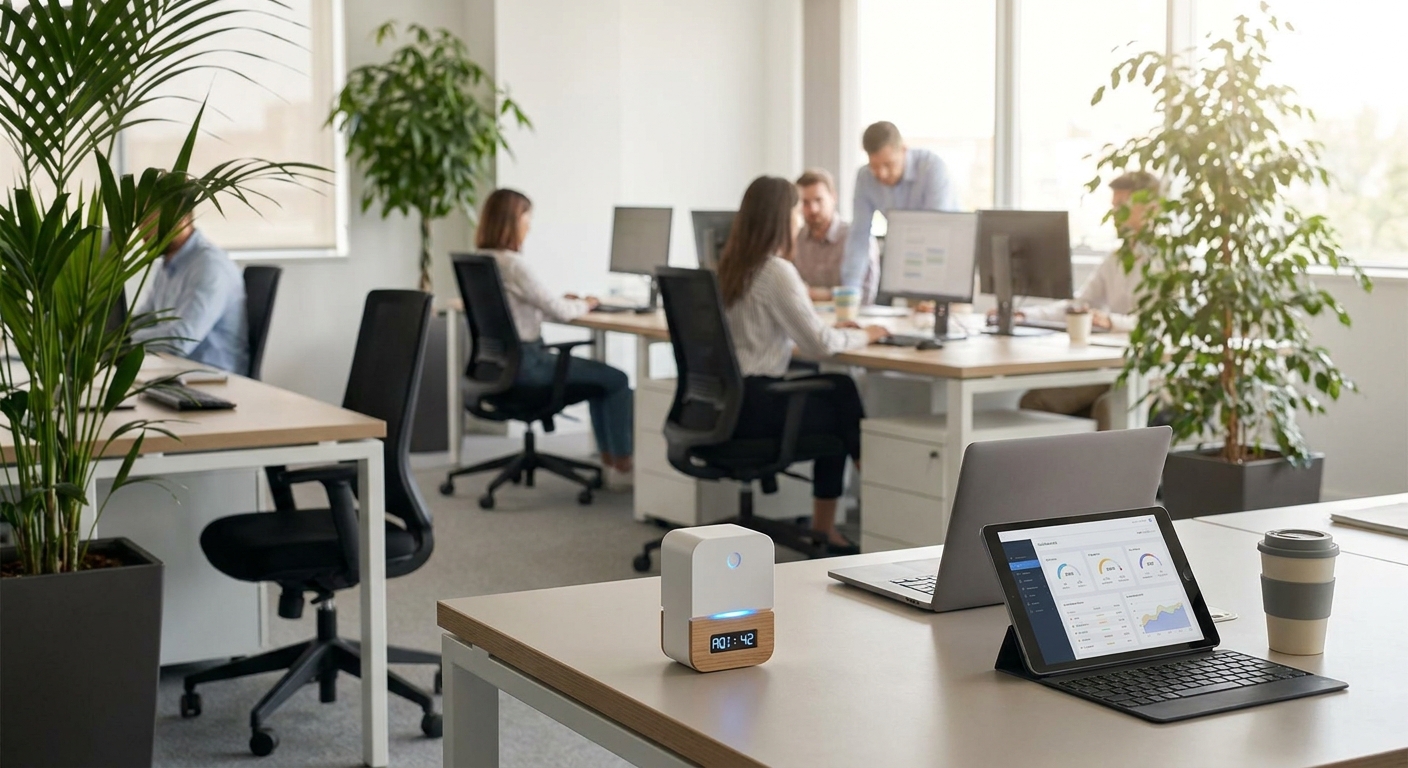
Corporate offices are chasing indoor air quality data for the same reason cold storage sites chase temperature data: a bad reading now costs money or headcount later, and nobody wants to find out about it from an employee complaint. This guide breaks down what actually matters when picking iot indoor air quality monitoring for offices, not the general "smart building" pitch.
- Wireless LoRaWAN sensors beat wired BMS add-ons for leased offices — no rewiring, install in under an hour per zone.
- CO2 above 1,000 ppm (ASHRAE 62.1 guidance) is the trigger point most offices should alarm on, not just log.
- A rules engine that ties CO2 readings to HVAC demand-controlled ventilation cuts wasted airflow, not just reports on it.
- Multi-site dashboards matter the moment you manage more than one floor or building — single-site apps do not scale reporting.
- Kilo Cloud's alarm and rules engine is built for exactly this: threshold-based alerts across CO2, PM2.5, VOC and humidity.
Why this matters
Office air quality complaints used to be anecdotal — someone in conference room 4B says it's stuffy, facilities checks the thermostat, nothing changes. IoT indoor air quality monitoring for offices replaces that with continuous CO2, PM2.5, VOC and humidity data tied to specific rooms and specific timestamps. In 2026, with hybrid schedules packing more people into fewer conference rooms on Tuesday-Thursday, occupancy-driven CO2 spikes are common and mostly invisible without sensors.
The stakes are not dramatic like a cold chain excursion, but they are real: CO2 above 1,000 ppm is linked to measurable drops in cognitive performance in published ASHRAE-referenced studies, and PM2.5 spikes near HVAC intake during wildfire season or nearby construction go unnoticed without a sensor watching for it. Facilities teams that can show a dashboard instead of a shrug win the budget conversation.
Who this is for
This is written for facilities managers and operations leads running one or more corporate office floors — the person who gets the "why is the east conference room always stuffy" email and has no data to answer it. If you manage a single 20,000 sq ft floor or a portfolio across multiple buildings, the buying criteria below apply the same way — only the scale of the rollout changes.
What to look for in IoT indoor air quality monitoring for offices
Zone-level sensor coverage, not one sensor per floor
Open floor plans and enclosed conference rooms behave differently — a single CO2 sensor near the HVAC return will read low even when a packed 12-person meeting room three doors down hits 1,400 ppm. Offices need sensor density mapped to room type, not square footage alone. Budget one sensor per enclosed meeting room and one per 2,000-3,000 sq ft of open floor.
CO2 as the primary occupancy proxy
CO2 is the cheapest, most reliable signal for "this room needs more fresh air" — it correlates directly with occupancy and ventilation rate. Platforms that only report PM2.5 and humidity but skip CO2 are missing the metric that predicts stuffiness complaints before they happen. Look for sensors reporting in ppm with alarm thresholds you can set, not just a color-coded "good/fair/poor" score.
Wireless retrofit capability
Most corporate offices are leased space — you cannot run conduit through a landlord's ceiling for a wired BMS sensor network. Wireless protocols like LoRaWAN solve this because sensors run on battery for years and mount with adhesive pads, no electrician required. This matters more for offices than almost any other building type in this list, since lease terms and tenant improvement rules make wired retrofits expensive or outright disallowed. See how this plays out in practice in this retrofit approach for legacy and leased buildings.
Rules engine that ties air quality to HVAC action
A dashboard that shows CO2 climbing is useful; a rules engine that triggers demand-controlled ventilation or notifies facilities before employees start complaining is what actually changes outcomes. Look for platforms where alarms can chain into HVAC-adjacent workflows, not just push a notification nobody reads until Monday. This is where HVAC energy management platforms intersect with air quality — ventilation and air quality are the same control loop.
Multi-building dashboard and reporting
A single office might get by with a per-floor view. A corporate portfolio with five, ten, or fifty office locations needs a dashboard that rolls data up by building, region, and floor without exporting to spreadsheets. This becomes the deciding factor once you are past two sites.
Alarm tuning to avoid noise fatigue
Air quality sensors that alarm on every minor CO2 fluctuation get muted within a week. The system needs threshold logic with dwell time — for example, alarm only if CO2 stays above 1,000 ppm for 15 minutes, not on a single noisy reading. This single feature determines whether facilities teams keep watching the dashboard or ignore it entirely.
Top picks for IoT indoor air quality monitoring for offices
The retrofit pick. For leased office floors where you cannot touch the ceiling or walls, wireless LoRaWAN CO2/PM2.5/humidity sensors are the only realistic path — install time runs under an hour per room and sensors report on 15-30 minute intervals. Buy if your lease blocks wired infrastructure changes, which is most corporate office space in 2026.
The HVAC-tied pick. Pairing air quality alarms with a platform that already handles HVAC energy management means one rules engine controls both comfort and cost — CO2 spikes trigger ventilation adjustments instead of just alerts. Buy if your office already tracks HVAC energy separately and you want one system instead of two.
The portfolio pick. If you manage more than one building, a dashboard that aggregates air quality across sites by default saves hours of manual reporting every month. Buy for any operations team past two office locations; Consider if you are single-site for now but expanding within the next year.
The property manager pick. Commercial property managers running air quality monitoring as a tenant amenity or lease requirement need reporting built for multi-tenant, multi-building portfolios rather than a single corporate HQ. Consider if you manage buildings for tenants rather than occupying them yourself. Reference: facility monitoring system for property management companies.
The single-sensor-gadget pick. Standalone consumer air quality monitors (the kind sold direct-to-consumer with a mobile app and no rules engine) look tempting because they are cheap and fast to buy. Skip for corporate deployments — they do not alarm to a shared dashboard, do not scale past a handful of units, and give facilities teams no audit trail for compliance conversations.
What to avoid
- Single-point sensors covering an entire floor. A CO2 reading near the HVAC return tells you nothing about the packed conference room across the hall — density matters more than headline sensor count.
- Air quality apps with no alarm engine. A pretty dashboard that requires someone to check it manually every morning is not monitoring — it is a chart nobody looks at after week two.
- Wired-only sensor networks pitched for retrofit. If a vendor's install plan involves running new cabling through a leased office ceiling, get a second quote — wireless exists for exactly this problem.
Verdict comparison
| Criterion | Retrofit pick | HVAC-tied pick | Portfolio pick | Property manager pick |
|---|---|---|---|---|
| Wireless, no rewiring | Yes | Yes | Yes | Yes |
| Ties to HVAC control | No | Yes | Depends on setup | Depends on setup |
| Multi-building rollup | No (single site) | Optional | Yes | Yes |
| Best for | Leased single floor | Energy + comfort combined | 3+ office locations | Multi-tenant portfolios |
| Verdict | Buy for single-site retrofit | Buy for combined energy/IAQ | Buy past 2 sites | Consider for property managers |
See IoT air quality monitoring in action
Check how Kilo Cloud handles CO2, PM2.5 and HVAC-tied alarms for offices.
“If your CO2 sensor cannot tell you which conference room crossed 1,000 ppm, it is decoration, not monitoring.”
FAQ
What's the best IoT platform for indoor air quality monitoring in offices?
The best setup pairs wireless LoRaWAN CO2/PM2.5/humidity sensors with a rules engine that alarms on sustained thresholds, not single readings. Kilo Cloud handles this by combining sensor data with configurable alarm dwell times so facilities teams are not chasing noise.
Is CO2 monitoring enough for office IAQ, or do I need PM2.5 too?
CO2 alone covers occupancy and ventilation demand but misses particulate issues from outdoor air, nearby construction, or wildfire smoke intake. Most 2026 corporate deployments track CO2, PM2.5, humidity and VOC together for a complete picture.
How much does IoT indoor air quality monitoring cost for a corporate office in 2026?
Costs scale with sensor density and site count rather than square footage alone, since enclosed rooms need dedicated sensors. Check current sensor and platform pricing directly since it varies by deployment size and connectivity choice.
Can wireless sensors work in a leased office without rewiring?
Yes — LoRaWAN sensors mount with adhesive pads and run on battery for years, avoiding the cabling changes a wired BMS retrofit would require. This is the standard approach for leased corporate floors where landlords restrict infrastructure changes.
How many sensors does a typical open-plan office need?
Budget roughly one sensor per enclosed conference room and one per 2,000-3,000 sq ft of open floor space. A single sensor per floor near the HVAC return will miss localized CO2 spikes in packed meeting rooms.
Does IAQ monitoring need to integrate with the HVAC system?
It does not have to, but the value multiplies when it does — tying CO2 alarms to demand-controlled ventilation cuts wasted airflow instead of just reporting a problem after the fact. Standalone monitoring still beats no monitoring, but HVAC-tied rules close the loop.
How long do LoRaWAN air quality sensors last on a battery?
Most LoRaWAN CO2 and PM2.5 sensors run 5 or more years on a single battery at typical 15-30 minute reporting intervals. Reporting interval and temperature swings affect battery life more than any other variable.
Is IoT air quality monitoring different for multi-site corporate portfolios?
The sensors and thresholds stay the same, but the dashboard requirement changes — portfolios need rollup views by building and region instead of a single-floor screen. Facilities teams past two or three locations should prioritize platforms built for multi-site reporting from day one.
One last thing
Most offices that install air quality sensors set the alarm threshold and forget the dwell time — the setting that decides whether an alarm fires on one noisy 30-second CO2 reading or only after it stays above 1,000 ppm for 15 minutes straight. Get that one setting wrong and the dashboard either stays silent when it should fire or floods facilities with alerts they mute within a week. Test the dwell time on one conference room for a full week before rolling out across a floor in 2026.