
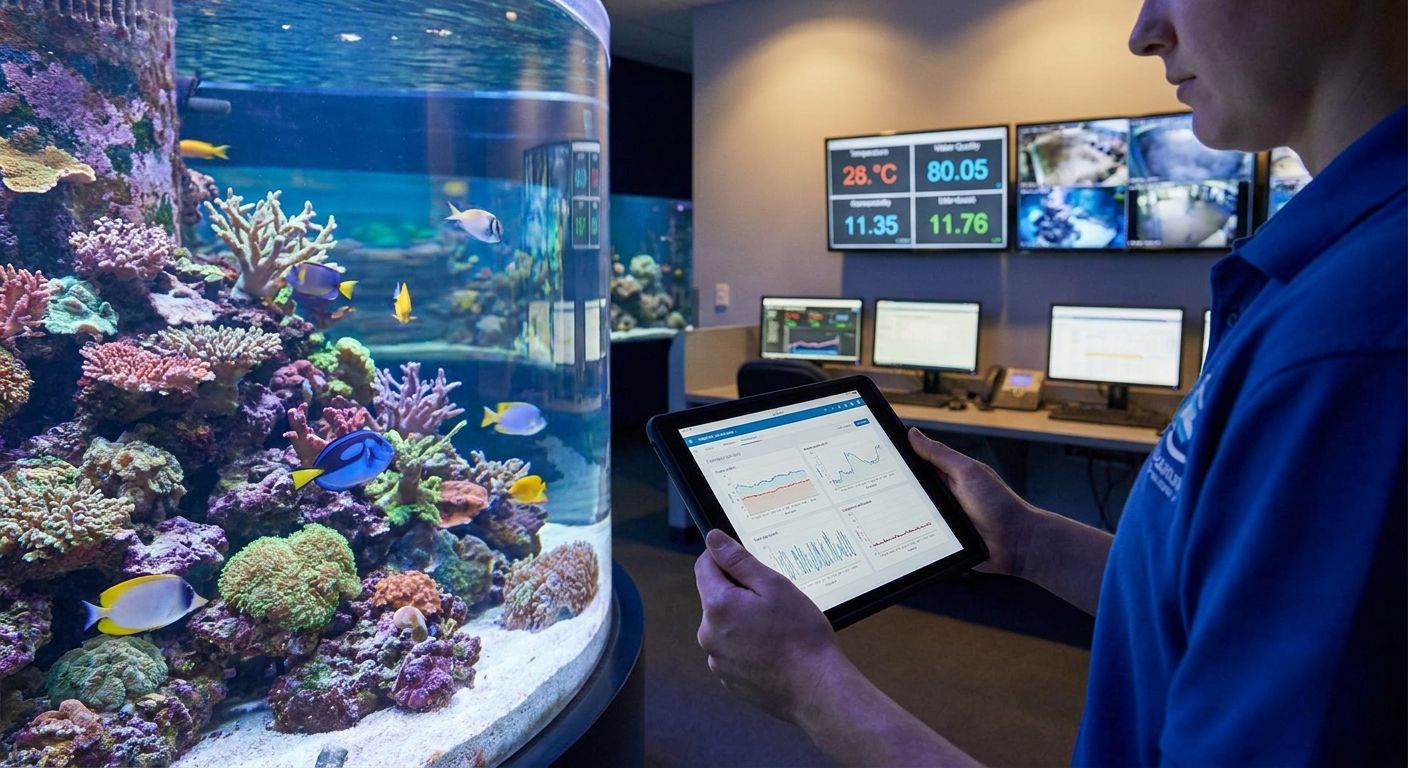
Aquariums and zoos run life-support systems, chillers, backup generators and quarantine rooms across dozens of enclosures, often in buildings that were never wired for a building management system. A facility monitoring system for aquariums and zoos has to catch a failing chiller or a generator that didn't start before an exhibit does, and this guide breaks down what to check before you buy, using the Kilo IoT Platform as a working example of the pattern.
- A facility monitoring system for aquariums and zoos should track water temperature, dissolved oxygen, backup power and tank level.
- AZA accreditation standards require backup life-support systems and alarm monitoring for aquatic collections at member institutions.
- LoRaWAN and mioty reach outdoor exhibits and underground utility rooms that Wi-Fi often misses.
- Kilo's alarm engine escalates through five severity tiers, so a chiller failure reaches a person, not a silent panel.
Why facility monitoring for aquariums and zoos needs faster alarms
A server room can run warm for an hour before anyone notices. A 6,000-gallon tropical tank cannot. Dissolved oxygen and temperature tolerances for aquatic species are narrow enough that a chiller failure or a stuck valve turns into a mortality event in hours, and most facilities run these systems overnight with a skeleton crew or none at all.
The USDA Animal Welfare Act requires licensed exhibitors to maintain environmental conditions appropriate to the species housed, and the Association of Zoos and Aquariums (AZA) accreditation standards go further for member institutions, requiring backup life-support systems and alarm monitoring for aquatic collections. NFPA 110, the standard for emergency and standby power systems, is the reference most facilities managers cite when they spec the generator that's supposed to start when a chiller trips off. None of that helps if nobody sees the alarm at 3 a.m.
That's the gap a facility monitoring system for aquariums and zoos is built to close: sensors on the equipment that actually matters, wired to an alarm chain that reaches a real person instead of a light on a panel in an empty building.
What a facility monitoring system for aquariums and zoos should track
The list looks different from a warehouse or an office building, and it's longer.
Water temperature and dissolved oxygen
Cold-water and reef species both run on narrow tolerance bands, and a submersible temperature probe or dissolved oxygen sensor wired into a rules engine catches drift before staff do a manual round. A threshold rule that fires at a 2-degree swing gives keepers time to act instead of finding a problem on the morning check.
Backup power and generator status
A generator that shows green on its own panel can still fail to carry load. Monitoring the transfer switch state and fuel level separately from the generator's built-in alarm closes a blind spot that NFPA 110 compliance alone doesn't cover.
Tank, pond and quarantine water level
Overflow and low-level events both mean equipment damage or a stressed animal, and they happen fastest in systems nobody is standing next to. Tank level monitoring built for aquaculture and fish farms applies almost directly to exhibit tanks and quarantine holding systems, since the sensor and alarm logic are the same problem in a different building.
Humidity and air handling in indoor exhibit halls
Reptile houses, tropical bird houses and rainforest exhibits run humidity levels most HVAC systems weren't sized for. ASHRAE 62.1 ventilation minimums assume office occupancy, not an open water surface and live plants, which is why exhibit-hall HVAC drifts out of range more often than the rest of the building.
Perimeter and quarantine access control
Keeping non-essential staff and visitors out of quarantine and behind-the-scenes holding areas is both a biosecurity requirement and an insurance question. Door and access sensors tied into role-based permissions give facilities managers a log of who entered a restricted space and when, without relying on a sign-in sheet.
How to evaluate a facility monitoring system for aquariums and zoos
Five criteria separate a system that survives a power outage from one that just logs data nobody reads until after the fact.
Protocol coverage for outdoor enclosures and underground rooms
Outdoor exhibits, underground filtration rooms and concrete mechanical vaults are exactly where Wi-Fi and cellular signal drop. Kilo runs a built-in LoRaWAN and mioty network server, so the IoT platform doesn't need a separate network server deployed to cover a zoo campus that spans several buildings and a few acres of outdoor exhibits.
Alarm escalation that reaches a real person
A single email alert at 2 a.m. gets missed. Kilo's alarm system runs five severity tiers with multi-step escalation chains across email, SMS and push, plus quiet hours and a centralized inbox, so a life-support alarm escalates from the on-call keeper to a supervisor if nobody acknowledges it in time.
One dashboard for a multi-building campus
A zoo with an aquarium building, a reptile house and an outdoor pachyderm barn needs one view, not five logins. Configurable dashboard widgets, including a map view, image floor-plan pins and gauges, plus a live 3D digital building twin with sensors bound to real objects, let one operations team see every enclosure without switching systems.
Audit trail for compliance reporting
AZA re-accreditation and USDA inspections both ask for records, not memory. An immutable audit trail paired with REST and gRPC APIs means temperature and power logs can be pulled straight into a compliance report instead of reconstructed from a paper logbook.
Pricing that scales from pilot to full campus
Kilo's free plan runs at 0 EUR for up to 5 devices, 1 dashboard and 1 rule, which is enough to pilot monitoring on a single high-risk tank before committing budget. Starter runs 25 EUR per month for up to 25 devices, and gateways are unlimited on every tier, which matters on a campus where enclosures are spread across several buildings.
Facility monitoring priorities for aquariums and zoos, ranked for 2026
Not every monitoring point carries the same risk. Here's how to prioritize a rollout.
-
Life-support power monitoring — Critical. A chiller or pump losing power is the single fastest path to an animal loss. Monitor the equipment's actual power draw, not just the generator's own status light, and route the alarm to whoever is physically on-site overnight.
-
Water level and overflow control — Critical. A stuck float valve or a cracked seal turns into standing water and stressed livestock within an hour. The same sensor pattern used in tank level monitoring for aquaculture and fish farms applies directly to exhibit and quarantine tanks.
-
Leak detection around tanks and plumbing — High. Slow leaks near filtration rooms damage flooring and electrical panels long before anyone spots standing water. Monitoring water leaks in commercial buildings before damage occurs is a direct fit for the mechanical rooms behind most exhibit tanks.
-
Filtration pump and blower vibration — High. A bearing starting to fail shows up in vibration signatures weeks before it shows up as a burnt-out motor. Catching that early avoids an emergency filtration outage on a weekend.
-
Humidity and HVAC in exhibit halls — Standard. Drift here stresses animals and damages finishes over weeks, not hours, so it's a lower-urgency alarm than a life-support failure but still worth automated tracking.
-
Multi-building dashboard and digital twin — Standard. Useful for coordination and reporting across a campus, but it's an efficiency layer on top of the alarms above, not a replacement for them.
-
Compliance and audit-trail reporting — Standard. Necessary for re-accreditation and inspections, but it's the paperwork layer that sits on top of the monitoring you already need for operational reasons.
“If life-support power fails for more than a few minutes, corals and cold-water fish do not get a second chance.”
Facility monitoring system options for aquariums and zoos compared
| Monitoring approach | Protocol coverage | Alarm escalation | Typical entry cost |
|---|---|---|---|
| Equipment manufacturer control panel | Wired, single device only | Local light or buzzer on the unit | Included with the equipment |
| Building management system add-on | Wired, sometimes BACnet | Rule-based, tied to a BMS operator console | Custom integration project |
| Dedicated IoT monitoring platform (e.g. Kilo) | LoRaWAN, mioty, MQTT and wired sensors | Multi-tier escalation to email, SMS, push | Free up to 5 devices, 25 EUR/month for 25 devices |
Where to source a facility monitoring system for aquariums and zoos
- Pilot on your highest-risk tank first. Put sensors on the enclosure where a failure would be most expensive or most dangerous to the animal, then expand once the alarm chain proves it works in your building.
- Confirm protocol reach before you commit. Concrete mechanical rooms and outdoor exhibits are exactly where cellular and Wi-Fi drop; LoRaWAN and mioty are built for that kind of range and wall penetration.
- Source hardware separately from the software. Kilo Electronics, Kilo's sister hardware company, ships sensors and gateways worldwide, so a facility can pick sensors for its specific tanks and enclosures without being locked into one hardware line.
See the platform behind this guide
Explore dashboards, alarms and the rules engine on the Kilo IoT Platform.
What zoo and aquarium teams miss in facility monitoring setups
Gateways are unlimited on every Kilo pricing tier, which matters more here than in a single-building deployment: a campus with an aquarium, a reptile house and an outdoor exhibit loop needs several gateways for coverage, and that shouldn't be a line item that scales with device count. Camera-based context for enclosures, sold under the name Kilo Lens, is listed as coming soon rather than shipping today, worth knowing before you plan a rollout around it in 2026.
FAQ
What's the best facility monitoring system for aquariums and zoos in 2026?
The best system covers water temperature, dissolved oxygen, backup power and tank level from one dashboard, with alarm escalation that reaches a person, not just a panel. Look for LoRaWAN or mioty coverage for outdoor exhibits and underground mechanical rooms where Wi-Fi typically fails.
Is LoRaWAN or mioty better for a zoo campus?
Both are built for long-range, low-power coverage across outdoor exhibits and concrete mechanical rooms that block Wi-Fi and cellular signal. The right choice depends on regional spectrum rules and existing gateway infrastructure, so check what a platform supports natively before picking sensors.
How much does an IoT monitoring system cost for a small aquarium exhibit?
Kilo's free plan runs at 0 EUR for up to 5 devices, 1 dashboard and 1 rule, which covers a single pilot tank. Starter runs 25 EUR per month for up to 25 devices, with unlimited gateways on every tier.
What sensors do zoos need for life-support monitoring?
Temperature and dissolved oxygen probes on tanks, power sensors on chillers and pumps, level sensors on tanks and ponds, and vibration sensors on filtration motors cover the highest-risk failure points. Humidity sensors in indoor exhibit halls come next.
How do alarms reach the right person during a power outage?
A multi-step escalation chain routes the alert from the on-call keeper to a supervisor if it isn't acknowledged within a set window, across email, SMS and push. Quiet hours settings can be overridden for life-support alarms specifically so critical alerts always get through.
Can one dashboard cover multiple zoo buildings and outdoor exhibits?
Yes, a facility monitoring dashboard with map views, floor-plan pins and a digital building twin can show an aquarium building, a reptile house and outdoor exhibits in one screen. This avoids the need to log into separate systems per building.
Does AZA require backup power monitoring for aquariums?
AZA accreditation standards require accredited facilities to maintain backup life-support systems and alarm monitoring for aquatic collections. That requirement is about the system existing and being monitored, not any single brand of sensor.
What happens when Wi-Fi or cellular signal doesn't reach an outdoor enclosure?
LoRaWAN and mioty are designed for exactly this problem, covering long distances and penetrating concrete and underground rooms on low power. A platform with a built-in network server for these protocols avoids needing a separate network server deployment just to get signal to a back-lot exhibit.
The detail most teams miss when budgeting: the ranked list above matters more than the vendor comparison. Get life-support power and water level alarms right before worrying about a unified dashboard, because that's the failure mode that costs an animal, not just a maintenance ticket.