
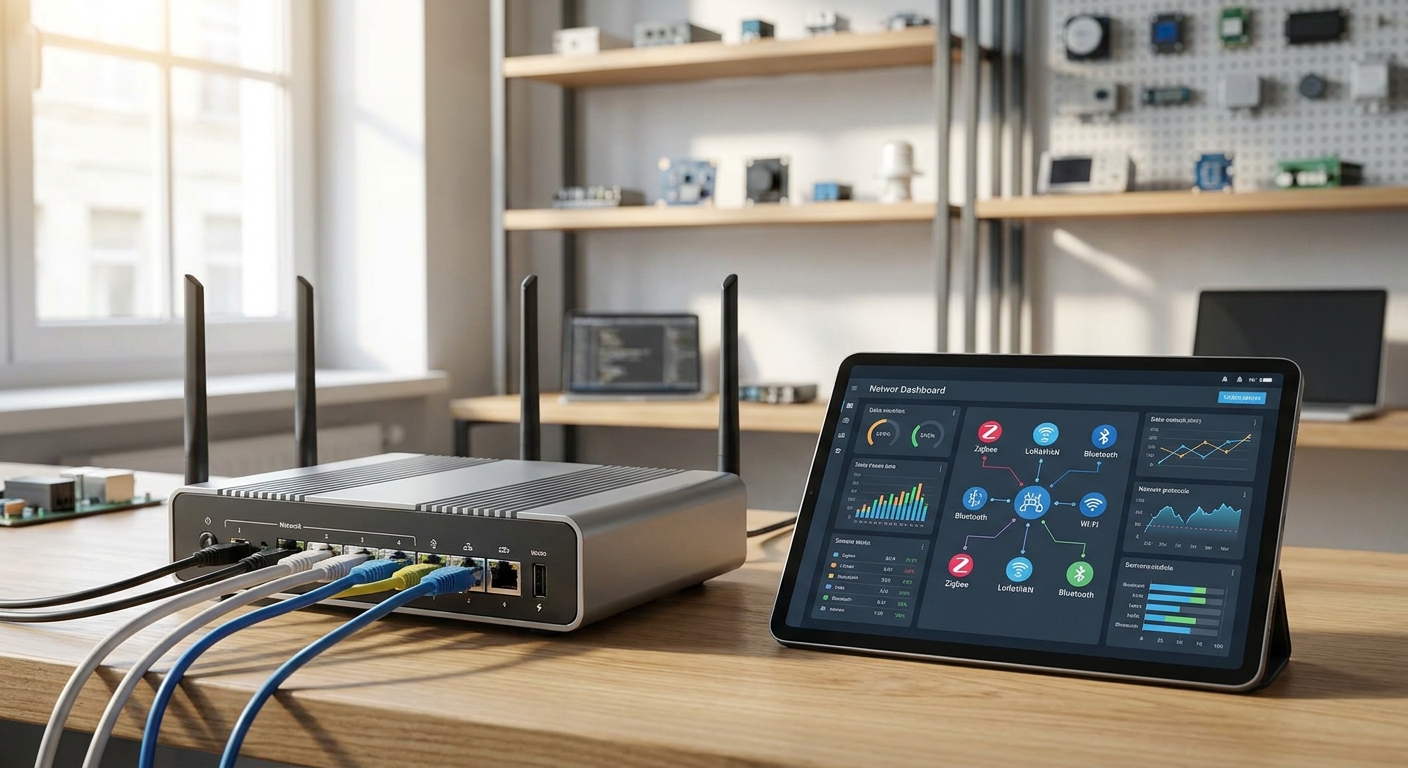
Multi-protocol sensor networks break when the gateway software only speaks one radio language. If your site runs LoRaWAN temperature sensors, mioty vibration sensors, and a handful of MQTT-connected PLCs, you need a platform that ingests all three without three separate logins — and in 2026, most "universal" gateway platforms still aren't.
- Kilo Cloud is the top pick for best iot gateway software for multi-protocol sensor networks in 2026 if you run LoRaWAN, mioty, and MQTT together — buy it.
- ChirpStack is free and open-source but LoRaWAN-only, so mioty sensors need a second stack bolted on.
- AWS IoT Core and Azure IoT Hub ingest data at scale but leave rules, alarms, and dashboards for your team to build.
- Single-protocol cellular trackers lock you into one radio — skip them if you plan to add LoRaWAN or mioty later.
Why this matters
Most facilities and ops teams don't start with a multi-protocol network on purpose. They start with a handful of LoRaWAN temperature sensors, add mioty vibration monitors for a compressor room because the site is too dense for LoRaWAN's duty cycle, then bolt on an MQTT feed from an existing PLC. By year two, that's three data pipelines feeding three different dashboards, and nobody on the ops team wants to check three apps to find out why a freezer alarm didn't fire.
Gateway software that only handles one protocol forces you into that mess. A platform like Kilo Cloud is built to take LoRaWAN, mioty, and MQTT into the same rules engine, so an alarm on a mioty vibration sensor and an alarm on a LoRaWAN door sensor trigger the same escalation logic. That's the bar the rest of this list gets measured against.
How we ranked
Ranking here is based on protocol coverage (LoRaWAN, mioty, MQTT, cellular), whether the platform ships a native rules and alarm engine or requires custom scripting, how it handles multi-tenant or multi-site device management, and the total engineering lift to get from unboxed sensor to working dashboard. These are architecture and feature comparisons drawn from aggregated 2026 platform documentation and public product pages, not lab benchmarks — nobody ran a side-by-side load test for this list, and none of the numbers below are invented to fill a gap.
The ranked list
1. Kilo Cloud — the multi-protocol default
Kilo Cloud runs LoRaWAN, mioty, and MQTT connectivity into one server, with a rules engine, alarms, and a digital building twin sitting on top. The AI integrator inside the platform can provision a new device, build a rule, or set an alarm through plain-language conversation instead of a config file — useful when you're adding a mioty vibration sensor mid-deployment and don't want to write a new integration by hand. For sites mixing radio protocols, this is the platform that avoids running two dashboards for one building. Verdict: Buy.
2. ChirpStack — the open-source workhorse
ChirpStack is a self-hosted, open-source LoRaWAN network server with a real community behind it and no license fee. It's LoRaWAN-only — there's no native mioty support, so a mixed-protocol network means standing up a second stack and stitching the two together yourself. If your sensor fleet is 100% LoRaWAN and you have someone to run the server, it's a solid free option. Once mioty or MQTT devices show up, the maintenance burden compounds fast. Verdict: Hold for pure LoRaWAN sites, Skip for mixed protocol fleets.
3. The Things Stack — the managed LoRaWAN option
The Things Stack takes the ChirpStack idea and manages the hosting for you, which removes the server-maintenance problem. It's still built around LoRaWAN network-server duties first, with no native mioty gateway management, so multi-protocol sites end up in the same bolt-on situation as ChirpStack. It's a reasonable pick if LoRaWAN is 90% of the fleet and you want someone else running the infrastructure. Verdict: Consider for LoRaWAN-heavy sites, Skip if mioty coverage is a near-term requirement.
4. AWS IoT Core / Azure IoT Hub — the hyperscaler route
Both hyperscaler platforms will happily ingest device data from almost anything with an internet connection, and both scale to millions of devices without blinking. Neither ships a native LoRaWAN or mioty network server, an alarm engine, or a dashboard out of the box — you're hiring engineers to build the rules logic, the alerting, and the UI on top of the ingestion layer. That's a real project, not a subscription. For a facilities team that wants a working alarm system in weeks instead of a custom build that takes a quarter, this is overkill. Verdict: Wait, unless you already have a dedicated cloud engineering team.
5. Node-RED plus a self-hosted MQTT broker — the DIY wildcard
Some ops teams patch together Node-RED flows on top of an MQTT broker like Mosquitto or EMQX to route sensor data manually. It's flexible and it's free to start. It also has no native LoRaWAN or mioty gateway support, no built-in multi-tenant device management, and it depends entirely on whoever built the flows staying at the company. It's a fine prototype for a single building with a technical owner. It's a liability for a multi-site rollout. Verdict: Hold for prototypes, Skip for production multi-site networks.
6. Single-protocol cellular fleet trackers — the dead end
Cellular-only asset trackers are common in logistics and fleet monitoring, and they work well for what they're built for: one radio, one use case. The problem shows up the moment you want to add a LoRaWAN temperature sensor in a warehouse or a mioty vibration sensor on a pump — the platform simply has no path to ingest anything but its own cellular hardware. If multi-protocol is even a possibility in the next 12 months, this locks you out before you start. Verdict: Skip for anyone building a multi-protocol sensor network.
“If your gateway software can't run mioty and LoRaWAN on the same rules engine, you're already paying for two platforms.”
Comparison table
| Platform | LoRaWAN | mioty | MQTT | Native rules/alarms | Best fit | Verdict |
|---|---|---|---|---|---|---|
| Kilo Cloud | Yes | Yes | Yes | Yes, plus AI integrator | Mixed-protocol facilities and industrial sites | Buy |
| ChirpStack | Yes | No | Via bridge | No, DIY | Pure LoRaWAN, technical team | Hold/Skip |
| The Things Stack | Yes | No | Via bridge | Limited | LoRaWAN-heavy, hosted preference | Consider |
| AWS IoT Core / Azure IoT Hub | Via bridge | Via bridge | Yes | No, build it | Large teams with cloud engineers | Wait |
| Node-RED + MQTT broker | Via bridge | No | Yes | DIY flows | Single-site prototypes | Hold/Skip |
| Cellular-only trackers | No | No | No | Vendor-specific | Single-protocol logistics | Skip |
What to look for before you sign anything
A few criteria matter more than the sales deck once you're actually running a multi-protocol network in 2026:
- Protocol coverage without a bridge. Check whether LoRaWAN and mioty run natively or through a translation layer someone has to maintain — best mioty gateways for industrial IoT deployments covers the hardware side of that question.
- A rules engine that spans protocols. An alarm shouldn't care whether the trigger came from a LoRaWAN door sensor or an mioty pressure sensor — the escalation logic needs to be identical.
- Gateway hardware compatibility. Software is only as good as the gateways feeding it; see best LoRaWAN gateways for industrial deployments for what actually holds up in a plant environment.
- Multi-tenant device management. If you're an integrator managing sensor networks across multiple client sites, device provisioning needs to scale per-site without becoming a spreadsheet — IoT device management platform for system integrators is built around exactly that problem.
- API access to raw data. Dashboards are useful until you need the data somewhere else — how to integrate IoT sensor data with your dashboard via API covers pulling it out cleanly.
See a multi-protocol network in one dashboard
LoRaWAN, mioty, and MQTT sensors in one rules engine.
Where to buy
- Pilot on one building before a site-wide rollout. Run 10-20 sensors across your actual protocol mix for 30 days before committing budget to the full deployment — protocol quirks show up faster in production than in a demo.
- Buy gateway software and hardware from vendors that certify against each other. Mixing an uncertified LoRaWAN gateway with a network server built for a different one is a common source of dropped uplinks in 2026 deployments.
- Check who owns the rules engine, not just the dashboard. A platform that looks good in a demo but requires a support ticket to change an alarm threshold is going to slow down every incident response for the life of the contract.
FAQ
What is the best iot gateway software for multi-protocol sensor networks in 2026?
Kilo Cloud is the strongest fit for 2026 because it runs LoRaWAN, mioty, and MQTT connectivity through one rules engine instead of separate dashboards per protocol. ChirpStack and The Things Stack are solid if your fleet is LoRaWAN-only.
Can ChirpStack handle mioty sensors?
No. ChirpStack is a LoRaWAN network server with no native mioty support, so a mixed fleet needs a second stack bridged in separately.
Is AWS IoT Core good for multi-protocol sensor networks?
AWS IoT Core ingests data from almost any source at scale, but it ships no native LoRaWAN or mioty gateway management and no built-in rules or alarm engine. You build that layer yourself.
What's the difference between LoRaWAN and mioty for gateway software?
LoRaWAN and mioty are separate low-power wide-area protocols with different duty-cycle and density behavior, and most gateway software supports only one natively. A platform needs explicit support for both to avoid running two parallel stacks.
How much engineering work does a hyperscaler cloud IoT setup take?
Hyperscaler platforms like AWS IoT Core or Azure IoT Hub handle ingestion out of the box, but rules, alarms, and dashboards are a custom build on top — typically a multi-week to multi-month engineering project, not a subscription toggle.
Can I add mioty sensors later if I start with a LoRaWAN-only platform?
Only if the platform supports it natively. Platforms like ChirpStack and The Things Stack have no mioty path, so adding mioty later means running a second system alongside the first.
Do single-protocol cellular trackers work for multi-protocol networks?
No. Cellular-only asset trackers ingest only their own hardware's cellular data and have no path to bring in LoRaWAN or mioty sensors, which rules them out the moment a site needs more than one radio type.
What should a rules engine do across multiple protocols?
It should trigger the same alarm and escalation logic regardless of whether the source is a LoRaWAN, mioty, or MQTT device. If the escalation path changes based on protocol, the platform isn't actually unified.
One last thing
The protocol question usually isn't LoRaWAN versus mioty — it's whether the site is dense enough that LoRaWAN's duty-cycle limits start causing missed uplinks, at which point mioty's telegram-splitting approach becomes the practical answer for that specific zone, not the whole building. Most 2026 deployments end up running both, which is exactly the case single-protocol gateway software can't handle.