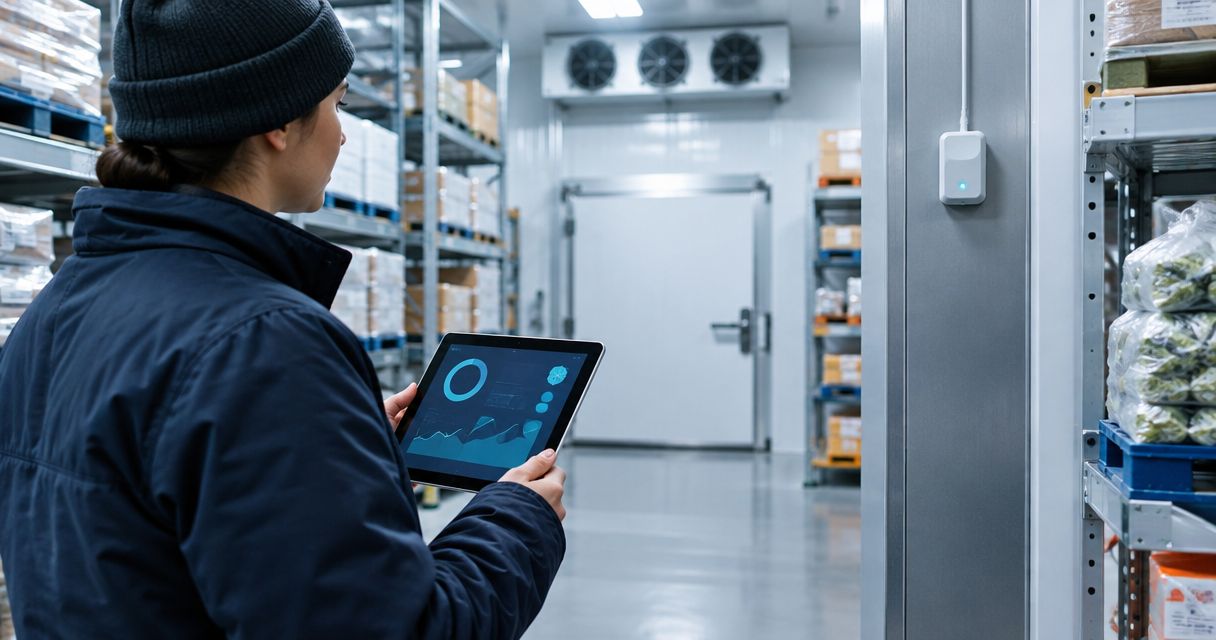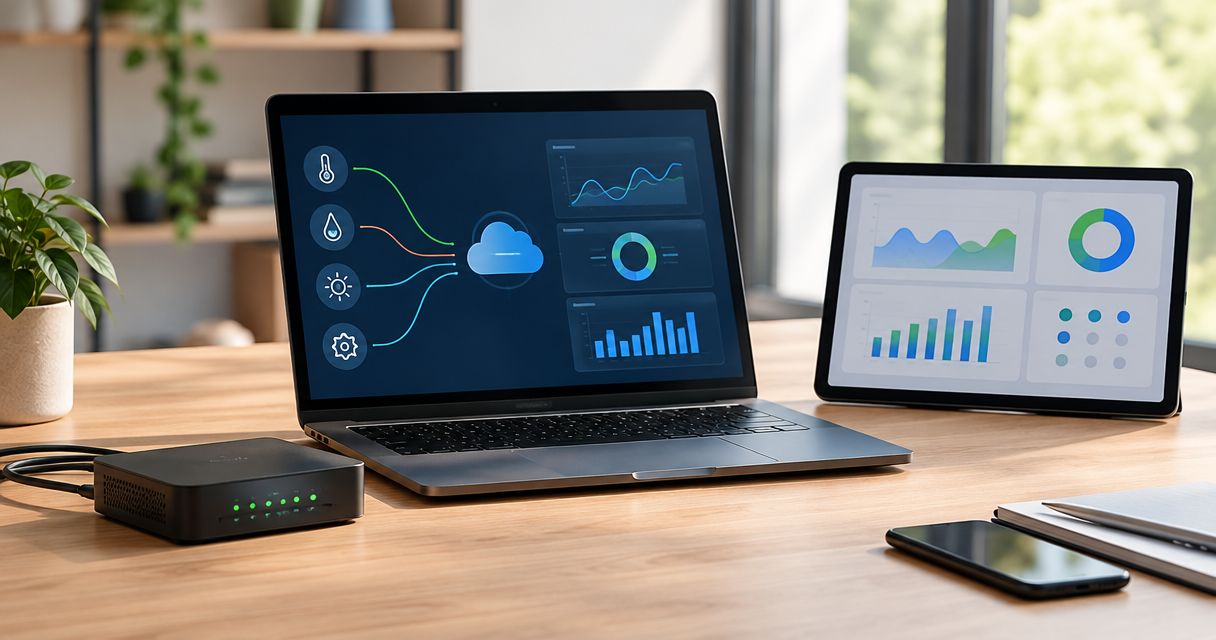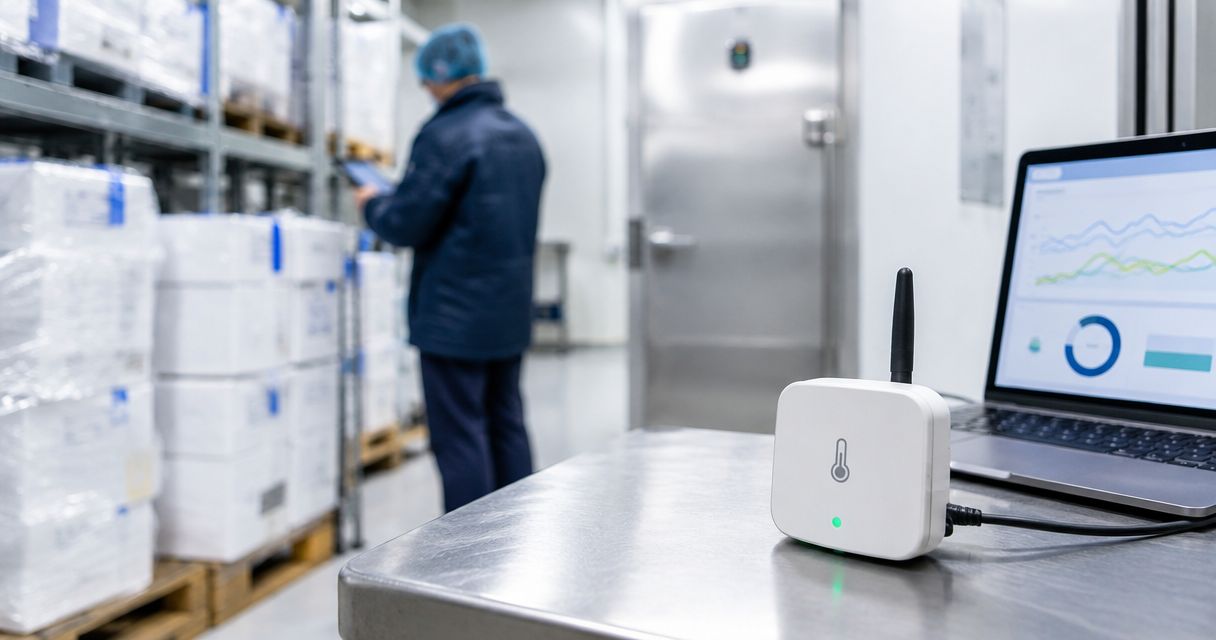
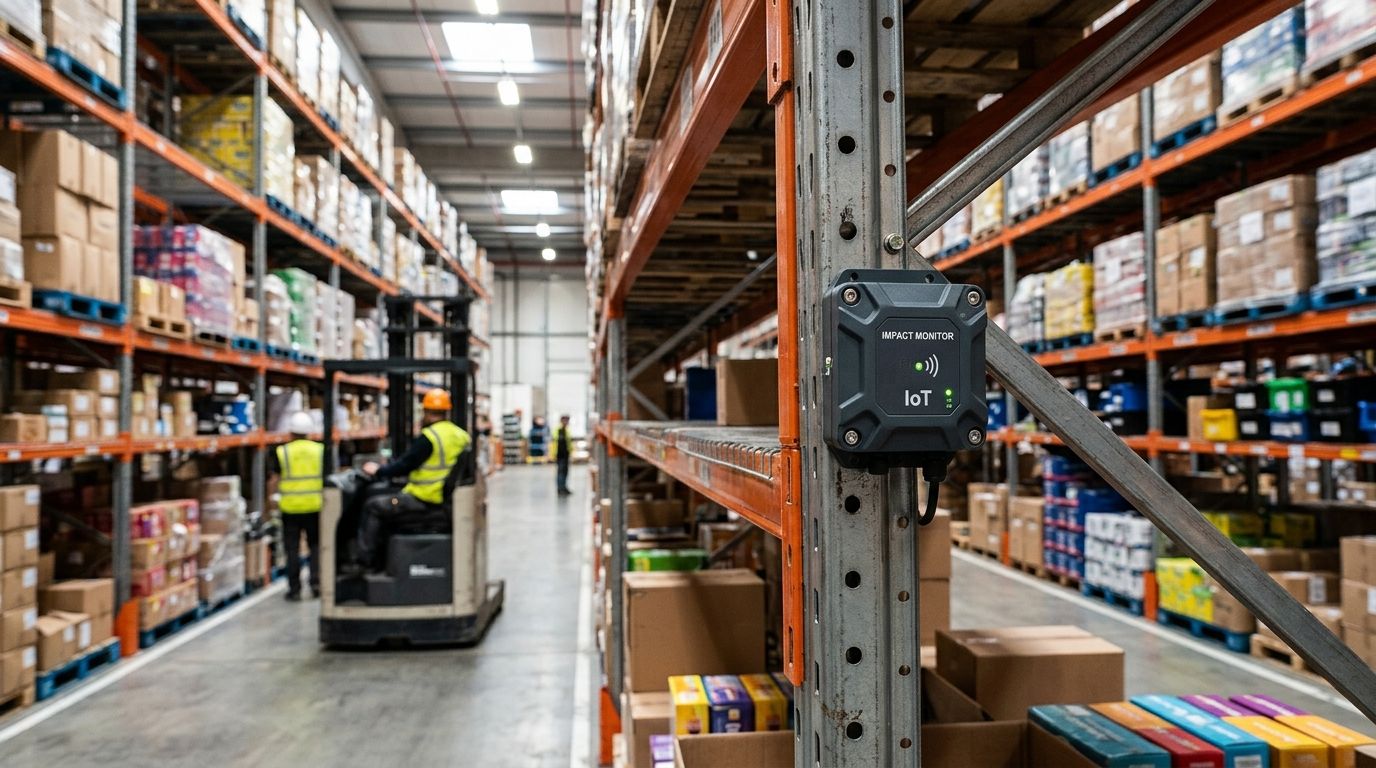
Warehouse racking gets hit more often than anyone logs on paper — a forklift clips an upright, nobody reports it, and the frame stays in service until a beam finally deflects under load. The fastest fix for that blind spot is a wireless impact sensor bolted to the column, wired into an alarm system that fires the moment force crosses a damage threshold. This guide ranks the five sensor approaches that actually detect racking damage in 2026, tells you which one fits which failure mode, and shows how they plug into a platform like the Kilo IoT Platform once they're mounted.
- Piezoelectric impact sensors catch the exact moment of a forklift strike on an upright column.
- Accelerometer-based vibration nodes track cumulative fatigue on high-traffic aisles, not single hits.
- Tilt sensors flag racking that's leaning after a hit even when no single impact looked severe.
- Strain gauges catch overload before impact ever happens, which impact sensors alone miss.
- Combined multi-sensor nodes give safety teams one alarm feed instead of four separate systems.
What counts as an iot impact sensor for warehouse racking damage
An iot impact sensor for warehouse racking is a battery-powered node mounted on an upright frame, beam, or column base that measures a physical event — shock, acceleration, tilt, or strain — and reports it wirelessly, usually over LoRaWAN or mioty, to a cloud dashboard. The category covers four distinct physics: piezoelectric shock detection, MEMS accelerometer vibration sensing, inclinometer tilt sensing, and strain gauge load sensing. Each one catches a different racking failure mode, which is why a single-sensor deployment usually misses something.
The Kilo IoT Platform runs all four sensor types on the same rules engine, so a warehouse doesn't need four separate dashboards to cover impact, vibration, tilt, and load. That matters for safety managers who already juggle OSHA 1910.176 storage requirements and a forklift fleet that racks up thousands of aisle passes a shift.
What makes the best iot impact sensor for warehouse racking
- Trigger latency — how fast the sensor reports an event once it happens, not on the next scheduled uptime
- Threshold configurability — whether you can set separate g-force or angle thresholds per rack bay instead of one global number
- Mounting method — bolt-on vs. adhesive, and whether it survives repeated low-level forklift contact without false triggers
- Battery life in a cold or dusty aisle — LoRaWAN and mioty nodes are built for multi-year battery runs, but dust ingress and cold-dock temperatures shorten that in practice
- Alarm routing — whether a red-tier event reaches a safety manager's phone in minutes or sits in a weekly report
- Documentation trail — whether the event log is admissible for an insurance claim or an ANSI MH16.3 damage assessment
iot impact sensors for warehouse racking damage detection at a glance
| Sensor type | Best for | Standout feature | Key limitation |
|---|---|---|---|
| Piezoelectric impact | Real-time forklift strike detection | Sub-second trigger on shock events | Doesn't catch slow deformation between hits |
| Accelerometer vibration | Cumulative fatigue on high-traffic aisles | Trend data across weeks, not just single spikes | Needs baseline tuning per rack type to avoid noise |
| Tilt / inclination | Detecting leaning racks after impact | Flags structural drift even with no fresh hit | Slow to respond to a single sharp strike |
| Strain gauge load | Overload monitoring on heavily loaded beams | Warns before failure, not after | Higher install cost per beam than a bolt-on node |
| Combined multi-sensor node | Full damage documentation and audits | One alarm feed across impact, tilt, and vibration | More configuration work up front |
1. Piezoelectric impact sensors: best for real-time forklift strike detection on upright columns
A piezoelectric impact sensor mounts at the base of an upright column, where forklift contact is most common and most damaging structurally. It generates a voltage spike proportional to the force of the hit and reports the event the moment it crosses a configured g-force threshold — this is the sensor type that actually earns the name "impact sensor."
Piezoelectric sensor pros:
- Detects the exact moment and rough severity of a strike
- Low false-positive rate once threshold is tuned to the rack's load class
- Works over LoRaWAN with multi-year battery life on a coin cell or AA pack
Piezoelectric sensor cons:
- Reports single events well but says nothing about gradual bowing or corrosion
- Needs a threshold set per bay — a warehouse with mixed rack heights can't use one number everywhere
Best for: distribution centers with heavy forklift traffic near narrow-aisle racking. Verdict: Buy for any facility that has logged repeat forklift-rack contact.
2. Accelerometer-based vibration sensors: best for cumulative fatigue monitoring on high-throughput aisles
MEMS accelerometer nodes read continuous vibration rather than single shock events. They're the right tool when the question isn't "did something hit this rack" but "has this rack been shaking loose over three months of forklift passes." The same accelerometer hardware that flags equipment vibration anomalies on pumps and motors applies directly to racking fatigue.
Accelerometer sensor pros:
- Surfaces slow degradation that a single impact sensor never triggers on
- Trend charts show whether a bay is getting worse month over month
- Same hardware class already used for rotating equipment, so integrators know it
Accelerometer sensor cons:
- Requires a tuning period to establish a normal baseline per rack
- Less useful for pinpointing exactly which forklift pass caused the damage
Best for: high-throughput aisles where racks see hundreds of forklift passes a shift. Verdict: Buy as a companion to impact sensors, not a replacement.
3. Tilt and inclination sensors: best for detecting rack leaning after impact
A tilt sensor measures the angle of a column relative to vertical. Racking damage doesn't always show up as a dramatic spike — sometimes a column bends a few degrees over several impacts and nobody notices until a visual inspection catches it, if one is even scheduled. The Rack Manufacturers Institute's ANSI MH16.3 specification classifies rack damage into three severity tiers — green, yellow, and red — based largely on measured column deformation, which is exactly what a tilt sensor quantifies continuously instead of at inspection intervals.
Tilt sensor pros:
- Catches structural drift that accumulates across multiple sub-threshold hits
- Maps cleanly onto ANSI MH16.3's tiered damage classification
- Low power draw, since it reports on a schedule plus threshold breach
Tilt sensor cons:
- Slower to flag a single sharp impact than a piezoelectric sensor
- Needs precise initial mounting alignment or the baseline reading is wrong from day one
Best for: facilities doing formal ANSI MH16.3-style rack inspections that want continuous data between manual walkthroughs. Verdict: Buy for any site with a documented rack inspection program.
4. Strain gauge load sensors: best for monitoring overloaded beams and shelf load limits
Strain gauges mount directly on a beam and measure deflection under load, which makes them the only sensor on this list that catches overloading before an impact ever happens. Beam overload is one of the most common causes of racking collapse, and it's invisible to impact and tilt sensors until the beam has already failed.
Strain gauge pros:
- Flags overload conditions that have nothing to do with a collision
- Gives a direct load reading in addition to a pass/fail alarm
- Pairs naturally with a digital twin view showing which specific bay is over capacity
Strain gauge cons:
- Costs more per beam to install than a bolt-on impact node
- Retrofitting an existing beam is more involved than mounting a column sensor
Best for: high-density pallet storage where load limits get pushed close to rated capacity. Verdict: Buy for racking near or above rated load, Skip for lightly loaded shelving.
5. Combined multi-sensor nodes: best for full damage documentation and insurance audits
Some nodes combine an accelerometer, tilt sensing, and impact detection in one enclosure, reporting all three event types over a single LoRaWAN or mioty connection. That consolidation matters most when the goal is documentation — a single event log that shows exactly when, how hard, and at what angle a rack was hit gives a safety team or an insurer one clean record instead of three.
Combined node pros:
- One device, one mounting job, one battery to manage instead of three
- Produces a single audit trail useful for reducing insurance premiums with IoT monitoring
- Covers the most failure modes per install
Combined node cons:
- Configuration takes longer since three trigger types need separate thresholds
- A single point of failure — if the node goes offline, all three signals go dark
Best for: facilities that need a defensible damage record for insurance or compliance. Verdict: Buy where documentation matters as much as detection.
How to choose an iot impact sensor for warehouse racking
Match the sensor to the failure mode you're actually worried about, not the one that sounds most technical. A facility with frequent forklift traffic and no formal inspection program should start with piezoelectric impact sensors on the highest-risk bays. A facility already running ANSI MH16.3-style inspections gets more value from tilt sensors that fill the gap between manual walkthroughs. Heavily loaded storage gets strain gauges regardless of impact history, because overload doesn't need a collision to happen.
Once sensors are mounted, the sensor choice matters less than what happens next: does the reading reach the right person in time to act. That's a rules-and-alarm problem, not a sensor problem.
Which iot impact sensor is right for your warehouse racking
For most distribution centers in 2026, the practical starting point is piezoelectric impact sensors on the columns nearest dock doors and narrow-aisle turns, since that's where forklift contact concentrates. Add accelerometer vibration nodes on the same bays within the first year to catch what impact sensors miss between hits. Bring in strain gauges specifically on beams operating near rated capacity, and reserve combined multi-sensor nodes for bays that also need a clean audit trail for insurance or compliance review.
Once the sensors are reporting, the value comes from what the platform does with the data. Kilo's rules engine runs threshold or CEL-expression logic against each sensor feed and can fire a five-tier alarm — from low-severity notice up to a critical escalation chain with SMS, email, and push — the moment a column crosses a configured g-force or angle limit. Quiet hours and a centralized alarm inbox keep low-severity events from paging someone at 2 a.m., while a red-tier hit escalates immediately to whoever owns rack safety on that shift.
Map your racking sensors to one dashboard
See how impact, tilt, and vibration alarms route through one platform.
Sensors themselves — the piezoelectric, accelerometer, tilt, and strain gauge hardware referenced above — ship through Kilo's sister hardware company, Kilo Electronics, with worldwide shipping, while the platform side handles onboarding, thresholds, and alarm routing.
FAQ
What is the best iot impact sensor for warehouse racking in 2026?
Piezoelectric impact sensors mounted at the base of upright columns give the fastest, most direct detection of forklift strikes. Pair them with accelerometer vibration sensors for cumulative fatigue and tilt sensors for slow structural drift.
How does a racking impact sensor detect forklift damage?
A piezoelectric sensor generates a voltage signal proportional to the shock force at the moment of contact and reports the event once it crosses a configured g-force threshold. The alert reaches a dashboard or alarm system within seconds over LoRaWAN or mioty.
Is a tilt sensor better than an impact sensor for racking?
They catch different things. Tilt sensors detect gradual leaning or deformation across multiple minor hits, while impact sensors flag the exact moment of a single sharp collision — most facilities need both.
What damage classification do warehouses use for racking inspections?
The Rack Manufacturers Institute's ANSI MH16.3 specification classifies rack damage into three tiers — green (monitor), yellow (engineering evaluation needed), and red (immediate action) — based on measured column deformation.
Do racking impact sensors need a cellular connection?
No. Most warehouse racking sensors run over LoRaWAN or mioty, which cover a full facility from a small number of gateways without per-device connectivity contracts.
Can one platform handle impact, vibration, tilt, and strain sensors together?
Yes. A platform with a protocol-agnostic device layer and a rules engine can route all four sensor types into the same alarm and dashboard system rather than requiring separate tools per sensor type.
How much does racking damage from forklift strikes typically go unreported?
There's no single published figure, but industry inspection guidance from the Rack Manufacturers Institute exists specifically because visual walkthroughs alone routinely miss damage between scheduled inspections.
What's the difference between a strain gauge and an impact sensor on racking?
An impact sensor detects a collision event after it happens; a strain gauge measures beam deflection continuously, which catches overload conditions that have nothing to do with a forklift strike.
What's the one racking signal most warehouses still miss?
Overload. Every facility worries about forklift strikes because they're dramatic and loud, but a beam bowing under a load that exceeds its rated capacity produces no collision at all — no impact sensor on this list catches it. A strain gauge on the highest-loaded beams closes that gap, and it's the one sensor type warehouses skip most often because it doesn't feel like a "safety" purchase until a beam has already failed.