
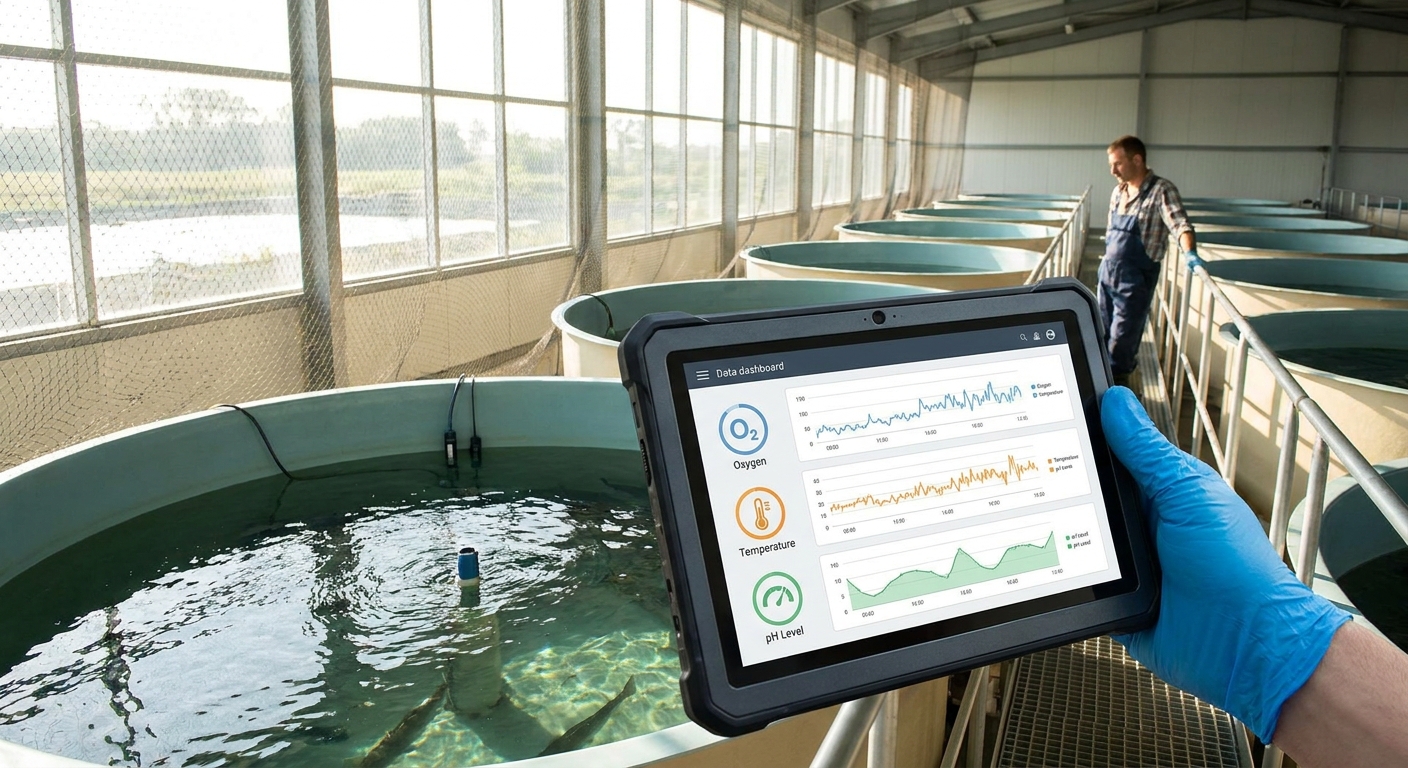
Dissolved oxygen crashes, a pump loses prime, or tank temperature drifts two degrees overnight — the best IoT platform for aquaculture operations catches all three before a mortality event, not after a stocking tank shows up dead at the morning check.
- Kilo is a full IoT platform for aquaculture operations, running LoRaWAN and mioty sensors without a separate network server.
- Alarm escalation chains route a dissolved oxygen drop straight to the on-call tech's phone, not a quiet dashboard nobody opens.
- The free tier covers 5 devices and 1 dashboard at 0 EUR in 2026; Starter scales to 25 devices for 25 EUR per month.
- Gateways are unlimited on every tier, so adding a second pond site does not multiply your monthly cost.
What does IoT monitoring actually track on a fish farm?
A recirculating aquaculture system (RAS) or open pond operation runs on a handful of variables that matter more than any others: dissolved oxygen, water temperature, tank or pond level, and whether the aeration pump is actually running. Ammonia and pH probes usually wire in through a controller rather than broadcasting natively, which is why an MQTT connector matters as much as a wireless sensor does.
A feed silo running low, a chiller cycling too often, or a backup generator kicking on unexpectedly are the second tier of things worth an alarm. None of this needs a machine-learning model to predict a failure — it needs a threshold rule that fires the moment a reading crosses a line you set, and an escalation path that gets a human there fast. That is the actual job the Kilo IoT Platform does for aquaculture sites in 2026: turn sensor data into an alarm chain, not a chart nobody checks until Monday.
What to look for in an IoT platform for aquaculture operations
Connectivity that reaches ponds and raceways without gaps
Most fish farm sites are spread across acreage a Wi-Fi router never covers, and running conduit to every tank isn't realistic. LoRaWAN and mioty both push a battery-powered sensor's signal a kilometer or more outdoors, which is the actual requirement here — not raw bandwidth, since a dissolved oxygen reading every few minutes is a tiny payload.
Alarm escalation that reaches the right person before a mortality event
A single email alert gets missed on a Friday night. What a fish farm needs is a multi-step escalation chain: text the on-call tech first, call a supervisor if nobody acknowledges within a set window, and keep all of it out of a shared inbox where it drowns. Severity tiers matter too — a slow ammonia creep is not the same emergency as a pump that just stopped.
Tank and pond level monitoring that's built in, not bolted on
Level sensors on tanks, sumps and header tanks need the same rules engine as everything else, not a separate app. If your platform treats tank level monitoring for aquaculture and fish farms as a first-class sensor type instead of an afterthought, overflow and dry-run alarms live in the same dashboard as temperature and oxygen.
A dashboard that covers every pond, not just the one you're standing next to
Operations with more than one site need a single screen showing every tank's status, not five logins. A dashboard built from map widgets, gauges and chart panels lets a manager scan twenty tanks in the time it takes to check one paper log.
Device management that scales past the first 20 sensors
Onboarding one sensor by hand is fine. Onboarding 80 across three ponds by hand is a week of work. Onboarding LoRaWAN sensors at scale across multiple sites needs bulk provisioning and a device management view that doesn't fall apart past a couple dozen units.
“If dissolved oxygen drops below 5 mg/L for ten minutes, that's a health problem, not a data problem — the rule has to fire before the fish notice.”
How Kilo's IoT platform handles fish farm and aquaculture monitoring
Kilo runs a built-in LoRaWAN and mioty network server, so there's no separate network server to stand up alongside the platform — sensors join, the platform sees them, and that's the extent of the infrastructure. An MQTT connector picks up anything already publishing from a RAS controller or dosing pump, so a pH probe wired into an existing panel lands in the same dashboard as a wireless tank sensor.
Each sensor gets its own digital twin, and the rules engine runs on CEL expressions with version control — meaning a dissolved oxygen threshold can be tested against a real payload before it ever goes live, rolled back with one click if it misfires, and stepped through during debugging instead of guessed at. Alarms carry five severity tiers with multi-step escalation across email, SMS and push, plus quiet hours so a 3 a.m. low-priority reading doesn't wake anyone who doesn't need waking.
The built-in AI assistant handles the setup conversation directly: describe the rule in plain language — "alarm me if tank 4 dissolved oxygen drops below 5 mg/L for 10 minutes" — and it drafts the rule and confirms before deploying it, scoped to whatever permissions the signed-in user has. None of this predicts a pump failure before it happens; it catches the reading that says the pump already stopped and gets that fact to a person fast.
Aquaculture IoT platform comparison: managed vs DIY vs single-purpose
| Category | Connectivity | Alarm escalation | Multi-site dashboard | Setup effort |
|---|---|---|---|---|
| Kilo IoT Platform | Built-in LoRaWAN and mioty network server, plus MQTT | Five severity tiers, multi-step escalation, quiet hours | Map, gauge and chart widgets across sites | AI assistant drafts rules and onboards devices |
| Open-source self-hosted stacks | Requires standing up your own network server | Depends entirely on what you script yourself | Custom-built, no included widgets | High — someone maintains the whole stack |
| Single-purpose water quality apps | Usually locked to one sensor brand | Limited to that vendor's app notifications | Rarely covers more than one site type | Low upfront, low ceiling |
How much does an IoT platform for aquaculture cost in 2026?
The free tier runs 0 EUR for up to 5 devices, 1 dashboard and 1 rule — no card required, and it's the actual platform rather than a time-limited trial, which is enough to pilot one tank cluster before committing further. Starter runs 25 EUR per month for up to 25 devices, which covers a small farm's full sensor count across oxygen, temperature and level monitoring.
Gateways are unlimited on every tier and never count against the device limit, so a second pond site with its own gateway doesn't push the bill up the way adding sensors does.
Start monitoring your fish farm free
5 devices, 1 dashboard, 0 EUR in 2026 - no card required.
FAQ
What's the best IoT platform for aquaculture operations in 2026?
A platform that combines built-in LoRaWAN or mioty connectivity with a rules engine and multi-step alarm escalation covers the core need: catching a dissolved oxygen or temperature swing before it becomes a mortality event. Kilo runs all three in one dashboard without requiring a separate network server.
Is LoRaWAN or mioty better for monitoring fish farm tanks?
Both push readings a kilometer or more outdoors on battery power, which is what matters across spread-out ponds and raceways. The choice usually comes down to which frequency plan and gateway hardware are already available at the site.
How much does an IoT platform for a fish farm cost per month?
Kilo's free tier is 0 EUR for up to 5 devices and 1 dashboard in 2026, and Starter is 25 EUR per month for up to 25 devices. Gateways don't count toward the device limit on either tier.
Can IoT sensors track dissolved oxygen and water temperature in real time?
Yes — wireless sensors report on an interval you set, and a rule can fire the moment a reading crosses a threshold you define, such as oxygen dropping below a set level for 10 minutes. The reading and the alarm live in the same dashboard.
How do alarms work for water quality thresholds on a fish farm?
A CEL-based rule watches the sensor feed and triggers an alarm at one of five severity tiers when a threshold is crossed. Escalation chains then push that alarm through email, SMS or push notification to the right person, with quiet hours suppressing low-priority alerts overnight.
Do aquaculture IoT platforms need a dedicated network server?
Not if the platform includes one. Kilo runs a built-in LoRaWAN and mioty network server, so there's nothing separate to deploy or maintain alongside the dashboard.
How many sensors can one gateway support on a fish farm?
Gateway capacity depends on hardware and sensor reporting interval rather than the platform itself, but gateways are unlimited on every Kilo plan and never count against the device limit, so scaling sensor count doesn't require a bigger plan just for coverage.
Can one dashboard cover multiple ponds or tanks at different sites?
Yes — a dashboard built from map, gauge and chart widgets can show every tank across every site on one screen. That's the difference between checking twenty logins and checking one.
What's the biggest blind spot in fish farm IoT monitoring?
Most teams set one alarm threshold on dissolved oxygen and stop there — no escalation chain, no quiet hours, no second severity tier for a slower ammonia creep versus a sudden pump failure. The rule fires, an email lands, and it sits unread until someone happens to check.
Step-through debugging on a test payload before deploying a rule catches the other common mistake: a threshold set from memory that turns out to be wrong for the actual tank size or species. Testing against real data in 2026 costs nothing and prevents an alarm that either never fires or fires on every routine reading.