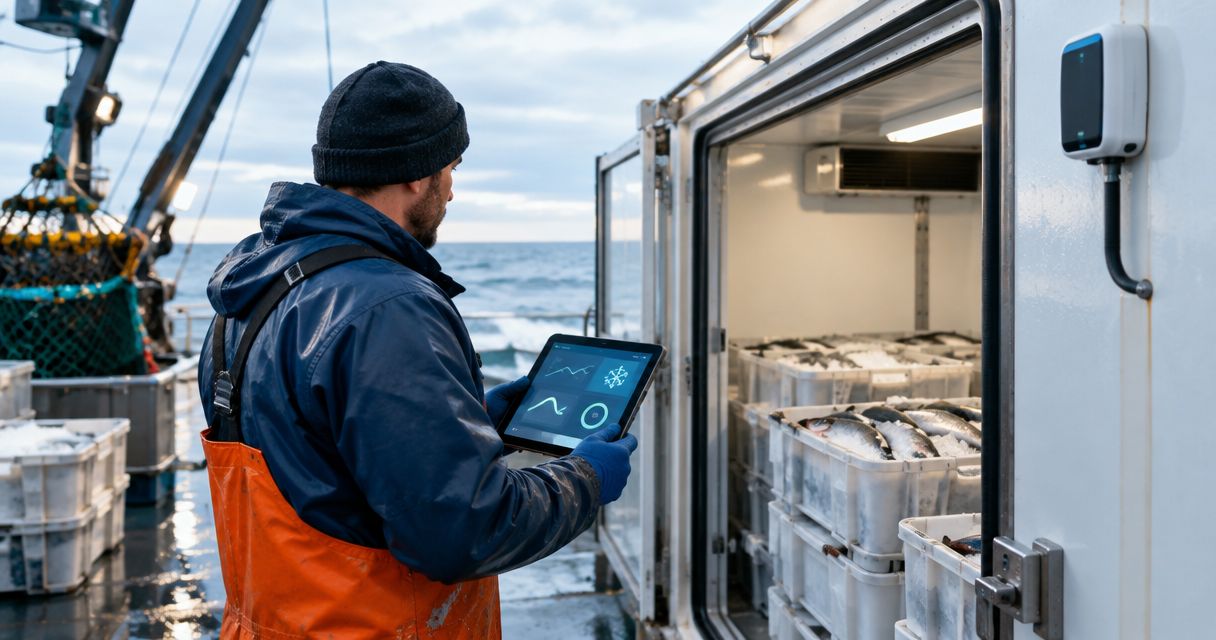
A fishing vessel's cold storage runs for days or weeks with no cellular signal, takes constant saltwater spray and vibration, and still has to produce a temperature record an inspector will accept back at the dock. This guide ranks the deployment approaches that actually hold up at sea in 2026, and where a platform like Kilo fits into each one.
- Satellite-backhauled LoRaWAN is the strongest iot platform for fishing vessel cold storage on offshore, multi-day trips.
- Private mioty networks handle steel-hulled holds better than standard LoRaWAN when signal has to punch through metal and insulation.
- Dockside MQTT sync works for day-boats returning to port daily but gives no live alert while the vessel is still at sea.
- Manual logbooks alone don't meet 2026 documentation expectations and should be phased out before the next inspection.
- Kilo Cloud runs LoRaWAN, mioty and MQTT on one platform with built-in alarm escalation and exportable history.
Why does cold chain monitoring matter for fishing vessels?
Seafood is one of the most perishable cargoes on the water. A hold that climbs from near-freezing to 45°F for even a few hours can turn a full catch into a write-off, and that risk doesn't stop at the dock — it follows the fish through processing and into a distributor's compliance file. The FDA's Fish and Fishery Products Hazards and Controls Guidance recommends holding fresh fish at 40°F (4.4°C) or below from catch to processing, and EU Regulation (EC) No 853/2004 sets -18°C as the ceiling for frozen fishery products moving through the supply chain.
Auditors in 2026 increasingly expect a continuous digital log rather than a clipboard, and that expectation applies to vessel holds just as much as it does to the shoreside storage covered in guides on marine shipping hold monitoring. The gap most fleets hit isn't the sensor — it's connectivity once the vessel is out of range of a phone tower or a dock router.
What makes the best IoT platform for fishing vessel cold storage?
- Works without cellular or dockside Wi-Fi for the length of the trip, not just near shore
- Sensor housing rated for saltwater spray, washdown and constant vibration
- Battery life measured in months, not weeks — nobody is swapping batteries mid-voyage
- Wireless range and penetration through steel hulls and insulated hold walls
- Alarm escalation that reaches a specific crew member, not just a dashboard nobody's watching mid-trip
- Temperature history that exports in a format an FDA or EU inspector will accept
Kilo, for one, runs a built-in LoRaWAN and mioty network server plus an MQTT connector on the same platform, so the connectivity choice below doesn't force a switch to different software once a vessel changes routes or hull type.
IoT platform approaches for fishing vessel cold storage at a glance
| Approach | Best for | Standout feature | Key limitation |
|---|---|---|---|
| Satellite-backhauled LoRaWAN | Offshore, multi-day trips | Full telemetry once synced, works days from shore | Alerts queue until the satellite link connects |
| Private mioty network | Steel-hulled, insulated holds | Stronger signal punch-through than standard LoRaWAN | Narrower hardware ecosystem, needs its own gateway |
| Dockside MQTT sync | Day-boats, near-shore fleets | Uses sensors or PLCs already wired in | No live alert while the vessel is still at sea |
| Manual logbooks | Single-vessel ops not yet investing | No hardware or subscription | Misses excursions between checks |
1. Satellite-backhauled LoRaWAN monitoring: best for offshore, multi-day fishing trips
LoRaWAN sensors inside the fish hold report to an onboard gateway; the gateway backhauls readings over a satellite terminal once the vessel is beyond cellular or dockside range, and everything syncs to the cloud platform when the link is up. Because Kilo Cloud includes its own LoRaWAN network server, there's no separate network server to stand up before layering satellite backhaul on top — the rules engine and alarm inbox just start working once data lands.
Satellite-backhauled LoRaWAN pros:
- Retains full-resolution readings for the whole trip, even days from shore
- Alarm escalation chains fire in full once the link connects, reaching the right crew member by email, SMS or push
- The same dashboards and rules apply whether the vessel is a mile or 200 miles offshore
Satellite-backhauled LoRaWAN cons:
- An excursion isn't flagged in real time until the satellite link syncs, so response time depends on backhaul frequency
- The satellite terminal is additional hardware to install, power and maintain
- It does nothing on its own without a platform behind it to run the rules and alarms
Best for: long-haul trawlers spending days or weeks beyond cellular and dockside Wi-Fi range. Verdict: Adopt for offshore fleets.
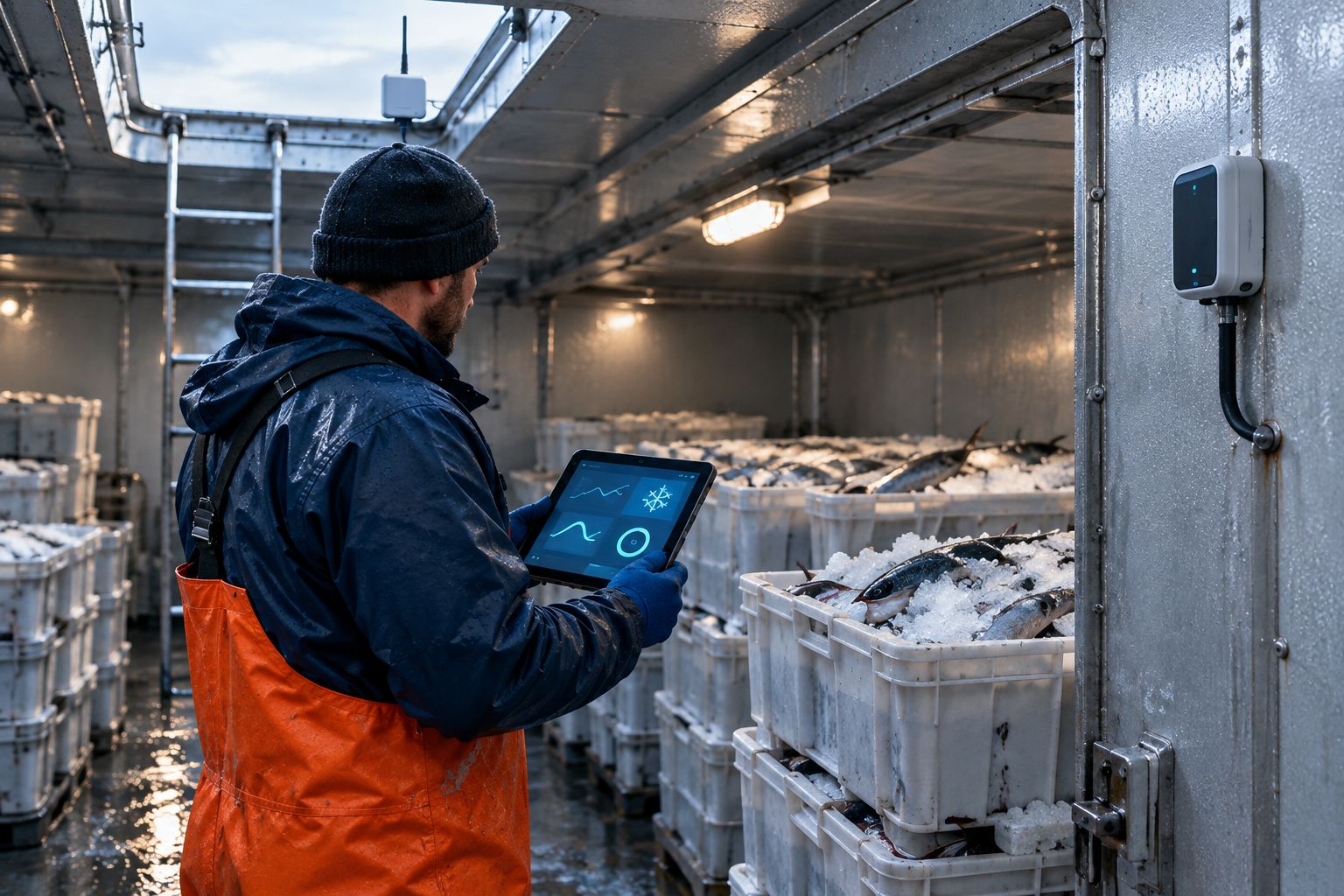
2. Private mioty network in steel hulls: best for deep, insulated fish holds
Mioty's telegram-splitting transmission, standardized as ETSI TS 103 357, gives better link margin than standard LoRaWAN in environments where signal has to punch through steel and insulation — a common condition in deep factory-trawler holds. If a sensor can't reach a gateway from inside a sealed steel hold, the platform behind it doesn't matter. Kilo Cloud runs a built-in mioty network server alongside LoRaWAN, so the same platform handles whichever protocol suits the hull without a separate piece of software.
“If a sensor can't reach a gateway from inside a sealed steel hold, the platform behind it doesn't matter.”
Private mioty pros:
- Better signal penetration through steel and insulation than off-the-shelf LoRaWAN in the same hold
- Long uplink range from a below-deck sensor to a single topside gateway
- Same dashboard, rules engine and alarm inbox as any other Kilo deployment — no separate software to learn
Private mioty cons:
- Fewer mioty-compatible sensor models to choose from than the broader LoRaWAN catalog
- Needs its own gateway even if a LoRaWAN gateway is already installed aboard
- Still depends on what the topside gateway can reach for shoreside backhaul
Best for: steel-hulled vessels with deep, insulated holds where standard wireless signal degrades. Verdict: Adopt for steel-hull, insulated-hold vessels.
3. Dockside MQTT sync with onboard buffering: best for day-boats and near-shore fleets
Sensors or an existing PLC publish to a local MQTT broker onboard; readings buffer through the trip and sync to the cloud platform over vessel or dock Wi-Fi once the boat ties up. Kilo Cloud's MQTT connector accepts any publishing device, PLC or energy meter without requiring LoRaWAN or mioty hardware, which is why the same sync pattern shows up in marina and boat yard monitoring deployments where vessels dock nightly.
Dockside MQTT pros:
- Works with sensors or controllers already wired into an existing onboard system
- Simplest option if the vessel already runs an MQTT-capable controller
- Full trip history lands in the platform the moment it syncs, ready for documentation
Dockside MQTT cons:
- No live visibility while at sea — an excursion isn't flagged until the vessel docks
- Alarm escalation only fires retroactively unless a local buzzer or light is also wired in
- Onboard storage needs enough capacity to buffer a multi-day trip without gaps
Best for: day-boats and near-shore fleets that return to port within a single working shift. Verdict: Adopt for near-shore, single-shift fleets.
4. Manual logbooks with periodic spot checks: best for operations not yet ready to invest
A crew member records a thermometer reading at set intervals in a paper or spreadsheet log — the way many fleets have documented cold storage for decades, and still a legal minimum for some small operators.
Manual logbook pros:
- No hardware or subscription cost
- Already familiar to crew, no training needed
- Meets a bare minimum recordkeeping requirement
Manual logbook cons:
- Gaps between checks miss excursions that continuous sensors would catch immediately
- Inspectors in 2026 increasingly expect continuous digital records rather than handwritten sheets
- No alarm path — by the time a spot check shows an out-of-range reading, the catch has already been sitting warm
Best for: single-vessel operations that haven't yet budgeted for sensors and want a documented baseline before investing. Verdict: Replace before the next inspection cycle.
How were these approaches ranked?
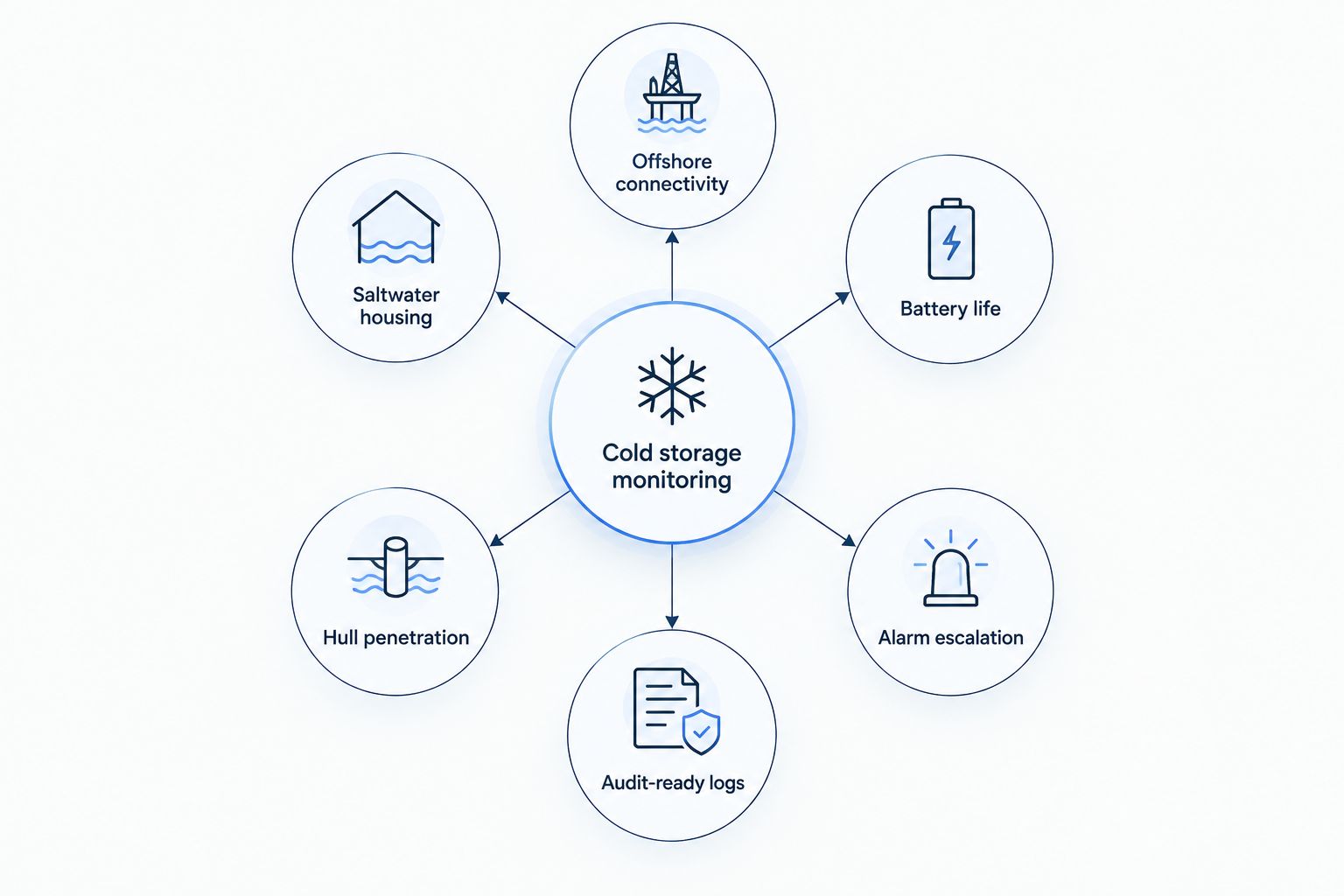
Each approach above was weighed against the same six criteria: offshore connectivity, saltwater housing, battery life, hull penetration, alarm escalation and audit-ready logs. Satellite-backhauled LoRaWAN and private mioty score highest on connectivity and penetration; dockside MQTT sync trades live alerting for simplicity on short trips. Manual logbooks fail the audit-ready and alarm-escalation criteria outright, which is why it's the one approach on this list headed for retirement in 2026 rather than adoption.
Which IoT platform approach fits your fishing vessel?
Trip length decides this more than anything else. A vessel spending more than a day offshore needs satellite-backhauled LoRaWAN monitoring or, in a steel-hulled factory trawler, a private mioty network running under the same platform. A day-boat back at the dock every night doesn't need satellite hardware at all — dockside MQTT sync with onboard buffering covers the documentation requirement without it.
Whichever connectivity fits the trip, running it through one iot platform for fishing vessel cold storage beats stitching together separate dashboards for LoRaWAN sensors, mioty sensors and dockside PLC data. Kilo Cloud's rules engine, alarm escalation and audit trail work the same way regardless of which of the three protocols the hardware speaks, and the built-in AI assistant can walk through onboarding a new sensor type or building a threshold rule in plain language once devices are on the network. Rugged, saltwater-rated sensors for this kind of deployment are also available through Kilo Electronics, the hardware side of the Kilo platform, with worldwide shipping.
See Kilo Cloud handle vessel sensors
Built-in LoRaWAN, mioty and MQTT support on one platform.
FAQ
What's the best IoT platform for fishing vessel cold storage in 2026?
It depends on trip length: satellite-backhauled LoRaWAN suits offshore, multi-day trips, while dockside MQTT sync covers day-boats returning to port nightly. Kilo Cloud supports both connectivity types on one platform with the same rules and alarm system.
Is mioty better than LoRaWAN for steel-hulled fishing vessels?
Mioty's telegram-splitting transmission, standardized as ETSI TS 103 357, generally gives better signal penetration through steel and insulation than standard LoRaWAN. That makes it a better fit for deep, insulated holds on steel-hulled trawlers specifically.
How cold does a fishing vessel's hold need to stay?
The FDA's Fish and Fishery Products Hazards and Controls Guidance recommends 40°F (4.4°C) or below for fresh fish, and EU Regulation (EC) No 853/2004 sets -18°C for frozen fishery products. Both apply from catch through processing.
Does an IoT platform work without cellular signal at sea?
Yes, through satellite backhaul or onboard buffering rather than a cellular connection. Sensors keep logging locally and sync to the cloud platform once a satellite link or dockside network is available.
Can dockside MQTT sync replace continuous monitoring on a fishing vessel?
Only for trips short enough that a delayed alert isn't a problem. It gives no live alarm while the vessel is still at sea, so it fits day-boats better than multi-day offshore trips.
Do fishing vessels need HACCP-compliant temperature logs?
Seafood processors and vessels supplying them generally fall under the FDA's Seafood HACCP regulation, 21 CFR Part 123, which expects documented temperature control through the cold chain. A continuous digital log satisfies that more reliably than a spot-check logbook.
How long do wireless sensor batteries last on a fishing vessel?
It varies by sensor model and how often it reports, so check the specific device's datasheet rather than assuming a fixed number. Low-power LoRaWAN and mioty sensors are built to run for extended periods between swaps rather than days.
What often gets missed with fishing vessel cold storage monitoring?
A sensor mounted on the hold's bulkhead reads air temperature, not product temperature — and air near a hatch or bulkhead swings faster than the fish stacked in the center of the hold. Placing at least one sensor inside the catch itself, not just on a wall, is standard practice in cold chain monitoring generally, and it's the detail that separates a log that passes a 2026 audit from one that gets questioned.