
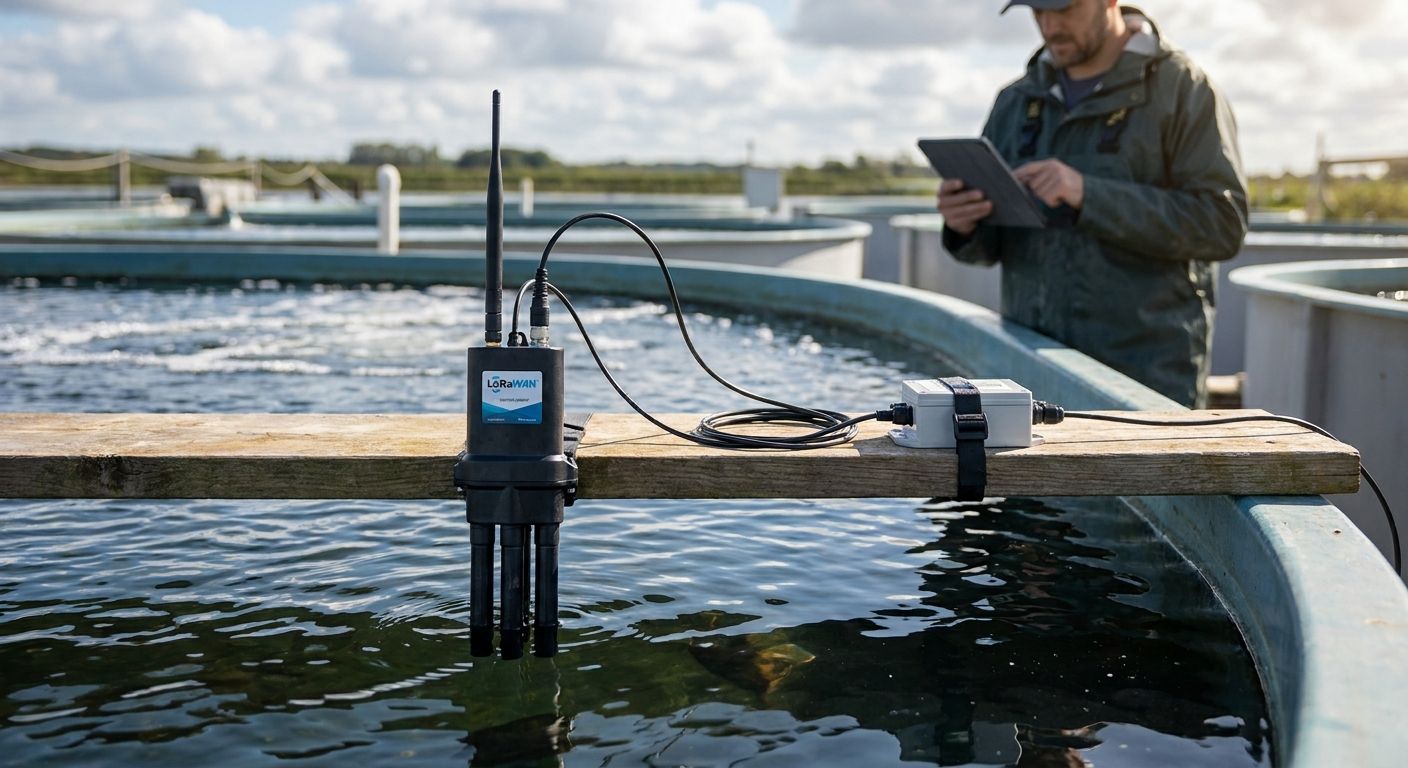
Dissolved oxygen crashes and ammonia spikes kill more farmed fish than any single disease outbreak, and a LoRaWAN sensor network is the cheapest way to catch either one before it turns lethal. This guide ranks which water quality parameters need a probe first, what protocol fits a spread-out pond or cage site, and where the alarm has to land once a reading crosses the line.
- Dissolved oxygen probes top the list of lorawan water quality sensors aquaculture sites need first — DO below 3.0 mg/L stresses warm-water fish within hours, per EPA criteria.
- Ammonia and pH rank second: un-ionized ammonia above roughly 0.05 mg/L turns toxic for many species, per Southern Regional Aquaculture Center guidance.
- LoRaWAN's multi-kilometer link budget fits scattered ponds and cages better than Wi-Fi; mioty adds resilience in RF-noisy hatchery buildings.
- The Kilo IoT Platform runs LoRaWAN and mioty sensors through one rules engine, so a DO alarm and a pH alarm escalate through a single inbox instead of two apps.
- Buy dissolved oxygen, temperature, and level sensors first in 2026; add ammonia and turbidity probes once the core network is proven.
What causes dissolved oxygen crashes on fish farms and ponds?
Warm water holds less dissolved oxygen than cold water, and algae that photosynthesize all day switch to consuming oxygen at night. That combination produces the classic pre-dawn DO crash that has emptied more ponds than any predator or pathogen. The EPA's Ambient Water Quality Criteria for Dissolved Oxygen puts the floor at 5.0 mg/L on a 30-day average for warm-water fisheries, with a 3.0 mg/L instantaneous minimum before acute stress sets in.
A manual dip-test twice a day misses the 3 a.m. crash entirely. That gap is exactly what a LoRaWAN sensor deployment built for aquaculture and fish farm operations is meant to close — a probe reads every few minutes, and a threshold rule fires the moment the number drops, whether anyone is standing at the pond edge or not.
Ammonia works the opposite direction: it climbs as feed and waste decompose, and un-ionized ammonia (NH3) is the toxic fraction. Southern Regional Aquaculture Center publications put a safe ceiling near 0.05 mg/L for sensitive species, with acute toxicity setting in well above that. pH sits between the two — the Food and Agriculture Organization lists 6.5 to 9.0 as the workable range for most farmed finfish, and swings outside that band suppress feed conversion long before fish start dying.
How to prioritize LoRaWAN water quality sensors for aquaculture operations
Ranking below is built on which failure kills fastest, which parameter drifts slowest, and which sensor type has the lowest maintenance burden in submerged or brackish conditions. Fast-killing, fast-drifting parameters go first. Slow-moving parameters that mainly affect growth rate and feed cost go into a second phase once the core network is running.
1. Dissolved oxygen probes
The hook: the parameter that kills in hours, not days. A DO reading below 3.0 mg/L for even 20-30 minutes stresses warm-water species and can trigger a die-off in a stocked pond by morning. Optical DO probes avoid the membrane fouling that plagues older Clark-cell electrodes in ponds thick with algae. Verdict: Buy first, no exceptions.
2. Temperature sensors
The hook: the sensor that makes every other reading meaningful. Oxygen solubility, ammonia toxicity, and pH all shift with temperature, so a DO reading without a paired temperature reading is only half the picture. Submersible temperature strings cost little relative to the rest of the network and report continuously over the same LoRaWAN uplink. Verdict: Buy alongside dissolved oxygen, same deployment.
3. pH sensors
The hook: the slow leak that tanks feed conversion before anyone notices. pH drift outside the FAO's 6.5-9.0 range doesn't usually kill outright, but it depresses appetite and growth for weeks before a farm manager connects the dots. Glass-bulb pH probes need more calibration attention than DO or temperature sensors, which is the trade-off for catching this parameter. Verdict: Buy in phase one for finfish operations; consider for shellfish where pH swings less.
4. Salinity and conductivity sensors
The hook: the parameter that only matters if your water isn't fresh. Brackish and marine operations — shrimp ponds, oyster leases, coastal cages — need conductivity data to catch saltwater intrusion or freshwater dilution after heavy rain. Freshwater tilapia or catfish farms can skip this sensor entirely. Verdict: Buy for brackish/marine sites; skip for closed freshwater ponds.
5. Turbidity sensors
The hook: the early warning for a filtration failure in recirculating systems. Turbidity spikes flag a broken biofilter or a feed overfeed before ammonia even starts climbing in a Recirculating Aquaculture System (RAS). Open pond operations get less value here since turbidity naturally varies with weather and runoff. Verdict: Buy for RAS and hatchery tanks; hold for open ponds.
6. Ammonia and ORP sensors
The hook: the most expensive parameter to measure continuously, and the one worth the cost once density climbs. Ion-selective ammonia probes need more frequent calibration and replacement than DO or temperature sensors, which is why most operations add them in a second phase rather than at initial rollout. Oxidation-reduction potential (ORP) sensors serve as a cheaper proxy signal for water treatment status in some RAS designs. Verdict: Hold for phase two, add once DO and temperature alarms are proven reliable.
7. Water level and tank sensors
The hook: the sensor that prevents the failure that has nothing to do with chemistry — an overflowing tank or a pump that ran dry. Ultrasonic or pressure-based level sensors round out the network for tank-based and RAS operations where a level failure can drain a system in minutes. A dedicated tank level monitoring setup for aquaculture and fish farms covers this separately from the water-chemistry probes above. Verdict: Buy first for tank-based systems, phase two for open ponds.
LoRaWAN vs mioty: which protocol fits fish farm water quality monitoring?
LoRaWAN's link budget supports multi-kilometer range in open, low-interference environments, which fits the spread-out layout of ponds, raceways, and offshore cages better than Wi-Fi or Bluetooth mesh. mioty, built on telegram splitting, holds up better in RF-dense hatchery buildings and processing facilities where LoRaWAN can see more collisions. A comparison of sensors for mioty-based industrial monitoring covers where that trade-off tends to land in practice.
| Parameter | Danger threshold | Sensor type | Best protocol fit | Verdict |
|---|---|---|---|---|
| Dissolved oxygen | Below 3.0 mg/L (EPA) | Optical DO probe | LoRaWAN (open ponds/cages) | Buy |
| Temperature | Species-dependent range | Submersible thermistor | LoRaWAN or mioty | Buy |
| pH | Outside 6.5-9.0 (FAO) | Glass-bulb probe | LoRaWAN | Buy |
| Ammonia (NH3) | Above ~0.05 mg/L (SRAC) | Ion-selective probe | LoRaWAN or mioty (indoor RAS) | Hold |
| Turbidity | Sudden spike vs. baseline | Optical scattering sensor | mioty (indoor hatchery) | Hold |
| Water level | Deviation from setpoint | Ultrasonic/pressure | LoRaWAN | Buy for tanks |
The Kilo IoT Platform runs both LoRaWAN and mioty sensors through one built-in network server, so a farm mixing an outdoor pond network with an indoor hatchery doesn't need two separate stacks to manage alarms. That matters more than which single protocol wins on paper, since most aquaculture sites end up running both.
Where to buy LoRaWAN water quality sensors for aquaculture
Three rules keep this from turning into a pile of incompatible hardware:
- Confirm IP68 or better on anything submerged. A probe rated for splash exposure is not the same as one rated for continuous immersion in pond or tank water.
- Check the reporting interval is configurable, not fixed. Dissolved oxygen needs readings every few minutes during warm months; salinity on a stable brackish pond can report hourly without losing anything useful.
- Prefer sensors with a standard output (SDI-12, Modbus, or a documented LoRaWAN payload) rather than a closed app. That's what lets a platform's MQTT connector or LoRaWAN network server ingest the data directly instead of re-keying numbers by hand.
Kilo Electronics, Kilo's sister hardware company, ships pre-configured sensors worldwide and is one option worth checking against whatever a local aquaculture supplier quotes. Once probes are on-site, a guide to onboarding LoRaWAN sensors at scale across multiple sites walks through provisioning more than a handful of devices without doing each one by hand.
See the platform behind the alarms
Run LoRaWAN and mioty water quality sensors through one dashboard.
FAQ
What is the best LoRaWAN water quality sensor for aquaculture in 2026?
Dissolved oxygen probes are the highest-priority lorawan water quality sensors aquaculture operations should install first in 2026, since DO below the EPA's 3.0 mg/L acute threshold can kill stock within hours. Temperature sensors should go in alongside DO because oxygen solubility shifts with water temperature.
How much dissolved oxygen do farmed fish need?
The EPA's Ambient Water Quality Criteria for Dissolved Oxygen recommends a 5.0 mg/L 30-day average for warm-water fisheries, with a 3.0 mg/L instantaneous floor. Cold-water species like trout typically need levels held closer to the higher end of that range.
Is LoRaWAN reliable for monitoring water over open ponds?
Yes, LoRaWAN's link budget covers multi-kilometer range in open, low-interference settings, which fits scattered ponds and cages better than Wi-Fi. Indoor hatchery buildings with more RF noise often perform better on mioty instead.
What ammonia level is dangerous for fish?
Southern Regional Aquaculture Center guidance puts safe un-ionized ammonia (NH3) below roughly 0.05 mg/L for many sensitive species. Levels above that climb toward acute toxicity, especially when paired with high pH and warm water, which increase the toxic NH3 fraction.
Do I need a pH sensor if I already monitor dissolved oxygen?
Yes, because pH and dissolved oxygen fail differently — pH drift outside the FAO's 6.5-9.0 range suppresses feed conversion for weeks without necessarily causing a die-off. A DO-only network misses that slow-moving loss entirely.
How long do LoRaWAN water sensors last on battery in the field?
Battery life depends heavily on reporting interval and ambient temperature, and cold water or cold climates draw batteries down faster than mild conditions. Configuring a longer interval for stable parameters like salinity, and a shorter one only for volatile parameters like dissolved oxygen, extends field life without losing the data that matters.
Should I choose LoRaWAN or mioty for a fish farm?
Open ponds and offshore cages generally favor LoRaWAN for its range over water, while indoor hatcheries and processing buildings with more RF interference often do better on mioty. Many aquaculture operations end up running both protocols across one site.
What sensors does a recirculating aquaculture system (RAS) need that a pond doesn't?
RAS operations benefit more from turbidity and ammonia sensors than open ponds do, since a biofilter failure shows up as rising turbidity and ammonia before it shows up anywhere else. Open ponds can often defer both sensors to a second monitoring phase.
The water quality reading most aquaculture operators check too late
The pre-dawn dissolved oxygen crash is predictable, not random — it happens because algae stop producing oxygen at night and start consuming it instead, and the effect compounds as pond temperature rises through summer. Most manual testing schedules check water in the morning or afternoon, which is exactly when DO looks fine. A rule that fires on a sustained drop between midnight and sunrise catches the actual failure window instead of a reassuring daytime reading. That's the difference between a sensor network that reports numbers and one that actually prevents a die-off.