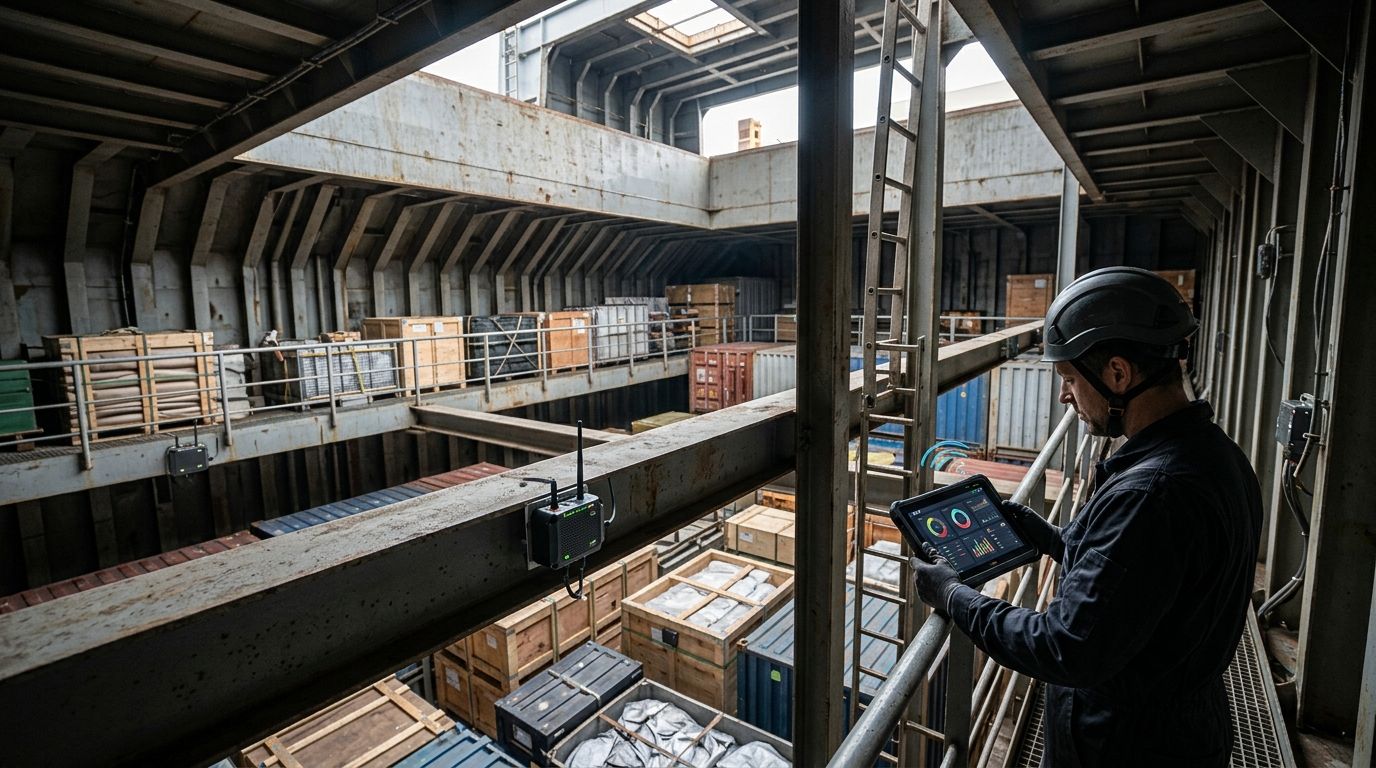
IoT monitoring for cargo vessel holds tracks temperature, humidity, water ingress and hatch status inside a ship's holds using wireless sensors, a marine-rated gateway and a cloud rules engine, so cargo condition is documented from port of loading to discharge instead of estimated from a clipboard round every four hours.
- IoT monitoring for cargo vessel holds pairs LoRaWAN or mioty sensors below deck with a cloud rules engine that alarms on temperature, humidity or bilge water excursions.
- mioty's telegram-splitting design handles steel-hull attenuation better than standard LoRaWAN on multi-deck vessels.
- Kilo Cloud logs every reading to a digital twin per hold, producing an excursion history for cargo claims and customs without a manual logbook.
- Satellite or cellular backhaul is required once a vessel clears port range — confirm coverage before committing to one connectivity path.
Why do cargo vessel holds need IoT monitoring in 2026?
Holds present physical problems most facility monitoring never deals with. Steel bulkheads attenuate wireless signal deck to deck, cellular and Wi-Fi drop out once a vessel clears a few miles of open water, and the cargo itself carries its own paper trail. The same continuous record a port-side cold store or monitoring at seaports and harbor terminals generates is rarely available once cargo moves below deck.
The IMO's International Maritime Solid Bulk Cargoes (IMSBC) Code sets a Transportable Moisture Limit for Group A cargoes — nickel ore and bauxite fines among them — that can liquefy and shift in transit. SOLAS Chapter VI requires the shipper to supply cargo information before loading. A hygrometer checked once per watch doesn't produce the kind of continuous record either framework implies when a claim gets filed in 2026.
Reefer cargo adds a second failure mode. A compressor fault or a bad door seal can turn a full load into a total loss inside hours, not days. IoT monitoring for cargo vessel holds gives the bridge and shore ops the same excursion data a cold warehouse gets, generated automatically instead of walked.
Map your holds and cargo zones before you spec sensors
Start with a walk-through, not a sensor order.
- Mark reefer plug points, hatch covers, bilge wells and any IMDG-classified stowage areas on each hold
- Note steel deck thickness and bulkhead layout between holds — this drives gateway placement later
- Separate holds by cargo type: dry bulk, palletized reefer, bulk liquid, hazmat
- Flag holds with a history of condensation or moisture damage from prior voyages
- Record available power near each hold for sensor and gateway runs
Choose sensors built for a steel hull and salt air
The manual fallback is a handheld thermometer and a logbook. It works for a spot check; it produces nothing usable for a claim.
- Temperature and humidity sensors in corrosion-resistant, IP67-rated enclosures
- Water or leak sensors at bilge wells and low points in dry cargo holds
- Door and hatch contact sensors on reefer units and hold access points
- Vibration or shock sensors on lashings for cargo secured through heavy weather
- Battery-powered units for holds without a reliable AC run
- Sensors compatible with cold chain compliance monitoring if reefer cargo is part of the manifest
Sensors, gateways and battery-powered marine enclosures for this kind of deployment ship worldwide through Kilo Electronics, Kilo's hardware sister company.
Solve connectivity between below-deck holds and shore
A steel hull attenuates a LoRaWAN signal between decks the same way a reinforced concrete floor attenuates it in a warehouse — worse, because there's more steel and it's closer. mioty's telegram-splitting design was built for exactly this kind of high-interference, high-attenuation environment, which is why it tends to hold up better than plain LoRaWAN across multiple steel decks.
An on-vessel gateway aggregates sensor traffic and bridges it out once the vessel is in range of a port network, cellular tower or satellite link. This is where the Kilo IoT Platform enters as the faster path once the manual signal-mapping work is done: Kilo Cloud runs its own built-in LoRaWAN and mioty network server, so there's no separate network server to stand up on top of the gateway hardware, and an MQTT connector lets an existing reefer monitoring system or PLC keep publishing instead of being ripped out.
- Test signal strength between deck levels before finalizing gateway count and placement
- Favor mioty over standard LoRaWAN for multi-deck, steel-hull runs
- Confirm satellite or cellular backhaul coverage on the vessel's actual trade routes, not just its home port
- Bridge legacy reefer or PLC data in over MQTT rather than replacing it outright
- A built-in network server removes one integration step from a vessel retrofit
Set thresholds and escalation rules for cargo alarms
The manual version of this step is a printed range taped to a bulkhead. The faster path is a visual rules engine — Kilo Cloud's uses BPMN with CEL expressions — that fires an alarm the moment a reading crosses a threshold and escalates through severity tiers if nobody acknowledges it.
- Set separate thresholds per cargo type — a bulk grain hold's humidity limit isn't a reefer's temperature limit
- Build a multi-step escalation chain so an unacknowledged alarm reaches shore ops, not just the watch officer
- Route email, SMS or push alerts based on what's actually reachable mid-voyage
- Test a rule against a sample payload before deploying it to a live hold
- Give bilge water alarms their own escalation path, separate from cargo temperature alarms
- Use quiet hours so a minor reading doesn't page the bridge at 3 a.m. mid-crossing
“If a reefer excursion alarm doesn't reach shore ops within minutes of the event, the monitoring system isn't doing its job.”
Build one dashboard for the bridge and shore ops
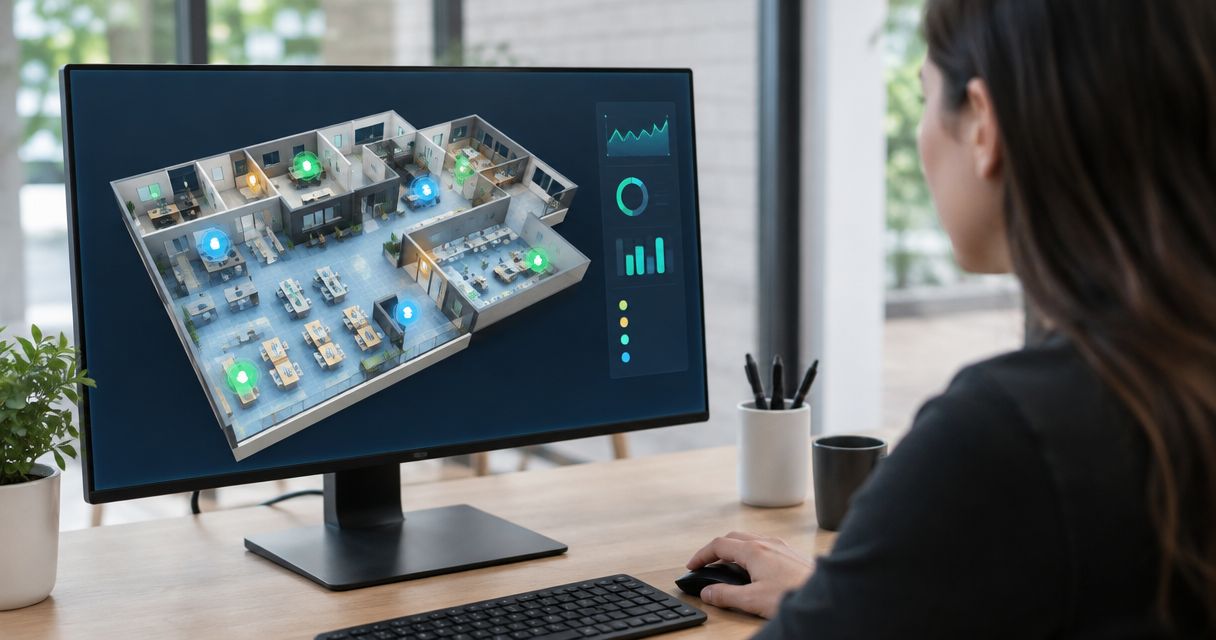
- Map widgets — chart, gauge, image floor-plan pins — to the actual hold layout
- Give shore ops read access to the same live data the bridge sees, not a delayed export
- Track reefer, dry and hazmat holds as separate dashboard views
- Set role-based, organization-scoped permissions so shore ops can view but not adjust vessel-side thresholds
Log condition data for cargo claims and customs
The manual version is a photo of a paper log taken at discharge. The faster path is a digital twin per device that carries continuous history and exports on demand.
- Export full temperature and humidity history per hold at discharge, not a spot reading
- Keep an immutable audit trail of every alarm and acknowledgment for insurance disputes
- Attach hold-level history to a specific voyage and cargo lot, not one aggregate ship record
- Show which specific sensor recorded an excursion, not just which hold
Cargo hold monitoring options compared
| Option | Best for | Key limitation |
|---|---|---|
| Paper log + spot checks | A single vessel on short coastal runs | No continuous record; an excursion can't be reconstructed after the fact |
| Standalone USB/Bluetooth loggers | One-off documentation for a specific cargo lot | Data only readable once the logger is retrieved — no live alarm |
| Cellular-only tracker + app | Vessels that stay in cellular range near shore | Signal drops the moment the vessel clears cell tower range |
| LoRaWAN/mioty + Kilo Cloud | Multi-hold fleets needing live alarms, escalation and a defensible history for claims and customs | Below-deck LoRaWAN runs still need signal testing between steel decks |
Common mistakes in iot monitoring for cargo vessel holds
- Relying on port Wi-Fi or cellular for a mid-voyage alarm, then losing the connection the moment the vessel clears the breakwater
- Applying one threshold set to every hold when a bulk grain hold and a reefer hold fail in different ways
- Skipping a hull-attenuation signal test between decks before finalizing gateway count
- Storing excursion data only on a laptop kept on the bridge, with no backup once the vessel changes hands or goes to drydock
- No backup power plan for reefer alarm sensors during a generator swap
Monitor your vessel's cargo holds
See how Kilo tracks temperature, humidity and hatch status per hold.
FAQ
What is IoT monitoring for cargo vessel holds?
It's the use of wireless sensors and a cloud platform to track temperature, humidity, water ingress and hatch status inside ship holds, with alarms that escalate to the bridge or shore ops when a reading crosses a threshold. It replaces periodic manual checks with a continuous, exportable record.
How does IoT monitoring work below deck on a steel-hulled vessel?
Sensors in each hold report to an on-vessel gateway over LoRaWAN or mioty, which then bridges the data out over cellular or satellite once in range. Steel decks attenuate signal between levels, so gateway placement and a signal test are done before a full rollout.
Is mioty better than LoRaWAN for cargo ship holds?
mioty's telegram-splitting design tends to hold up better across multiple steel decks and in high-interference conditions than standard LoRaWAN. Either protocol can work on a single open hold; multi-deck steel hulls favor mioty.
Can IoT sensors monitor bilge water and hatch status, not just temperature?
Yes. Water/leak sensors at bilge wells and low points, plus door and hatch contact sensors, run on the same network as temperature and humidity sensors and report into the same dashboard and alarm rules.
Does IoT cargo hold monitoring work without cellular signal at sea?
On-vessel sensors and the gateway keep reading and logging locally without cellular signal; the data reaches shore once the gateway has a satellite or cellular backhaul link. Confirm backhaul coverage for the vessel's actual trade route before deployment.
How much does IoT monitoring for cargo vessel holds cost in 2026?
Cost depends on hold count, sensor count and gateway hardware, so check current plan details and hardware pricing directly rather than budgeting from a fixed figure. Sensor and gateway hardware for marine deployments is sold separately through Kilo Electronics.
What sensors do I need for a reefer container hold?
A temperature and humidity sensor plus a door contact sensor covers the core reefer failure modes: compressor fault and door seal failure. Add a water/leak sensor at the base of the unit if condensation drainage is a known issue.
Can an IoT platform integrate with an existing reefer monitoring system?
Yes, if the existing system can publish over MQTT. Kilo Cloud's MQTT connector accepts that traffic without requiring the legacy reefer monitoring hardware to be replaced.
What most cargo hold monitoring setups miss below deck
Most operators wire up the reefer holds and stop there. The bigger regulatory exposure often sits in the dry bulk holds: IMSBC Code Group A cargoes like nickel ore and bauxite fines carry a documented liquefaction risk when moisture content exceeds the Transportable Moisture Limit, and that's a hold most monitoring budgets skip in favor of the more visible reefer alarm. A humidity sensor in a bulk hold costs the same as one in a reefer plug — the gap is usually a planning oversight, not a budget one.