
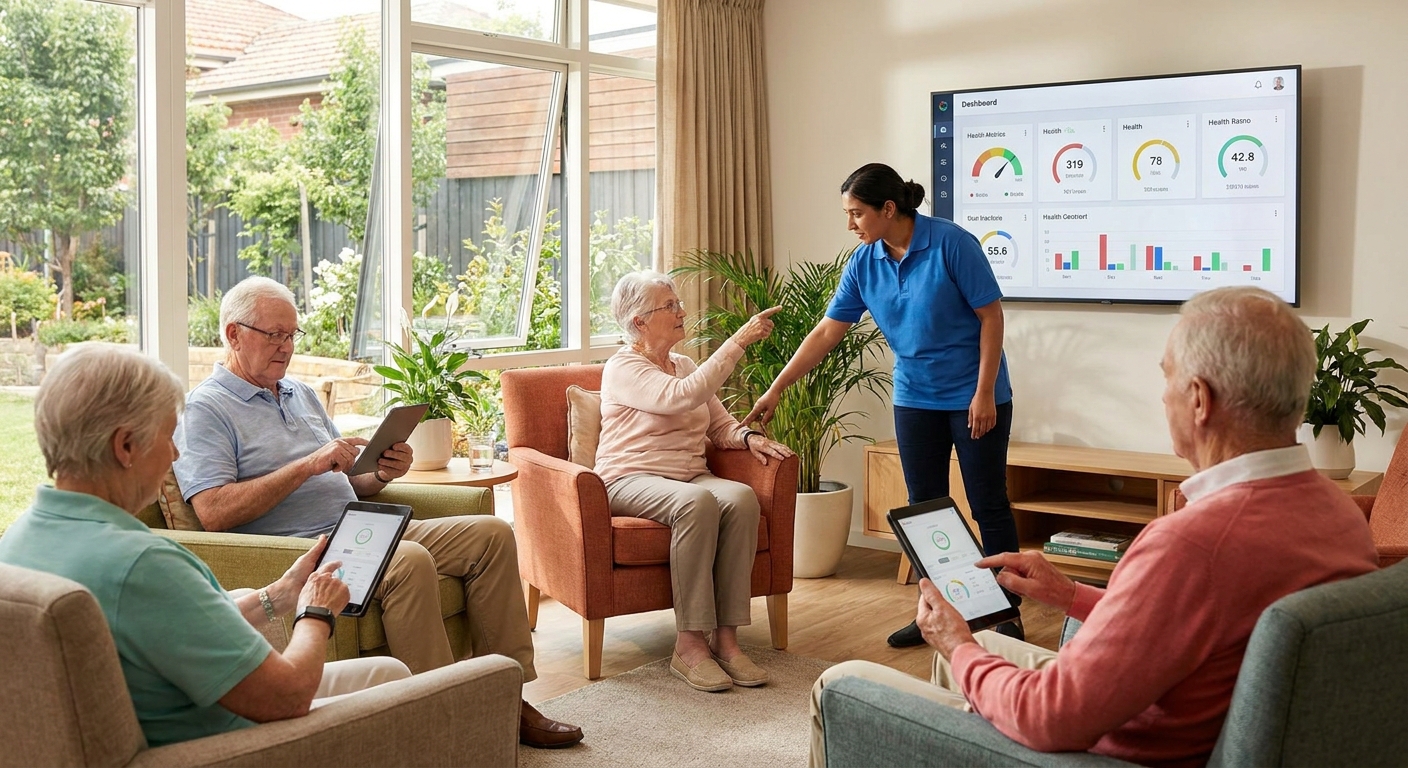
Senior living operators buy IoT platforms to catch a refrigerator drift, a flooded utility closet, or a stuck elevator before it turns into a resident safety incident or a survey finding. This guide covers what a platform actually needs to do for assisted living, memory care, and independent living campuses, and where the Kilo IoT Platform fits as a working example.
- The best IoT platform for senior living facilities tracks resident room temperature, medication refrigeration, water leaks and elevator vibration in one dashboard.
- CMS requires resident rooms and common areas stay between 71°F and 81°F under the State Operations Manual, F584.
- Medication refrigerators need 2°C to 8°C per the CDC Vaccine Storage and Handling Toolkit — a sensor drift alert prevents a wasted batch.
- The Kilo IoT Platform runs LoRaWAN and mioty sensors plus MQTT-connected BMS points on one rules engine, with five alarm severity tiers and multi-step escalation.
- Free tier covers 5 devices and 1 rule at 0 EUR; Starter runs 25 EUR per month for up to 25 devices, and gateways stay unlimited on both.
Why senior living facilities need dedicated IoT monitoring
A nursing home or assisted living campus runs on a handful of failure modes that show up every year without fail: a walk-in cooler compressor quits over a weekend, a med room fridge drifts a few degrees overnight, a supply line leaks behind drywall for three days before anyone notices, or an elevator starts vibrating differently and nobody logs it until it's stuck between floors. None of these need a human doing rounds every hour. They need a sensor, a threshold, and an alarm that reaches the right staff member fast.
The CDC reports that roughly 1 in 4 adults 65 and older falls each year, and falls are the leading cause of injury among that population — which is why life safety, not just energy savings, drives IoT budgets in this sector more than in a typical office building. A facility monitoring system built for senior living communities has to answer to a director of nursing and a maintenance supervisor at the same time, not just a facilities team.
What should a senior living facility look for in an IoT platform?
Four things separate a platform that works for this sector from one that's a general-purpose building dashboard with a senior living label stuck on it.
Resident room temperature and humidity compliance
The CMS State Operations Manual, under F584, requires long-term care facilities to maintain resident rooms and common areas at a comfortable temperature, and many state surveyors enforce a 71°F to 81°F band. ASHRAE Standard 170 sets minimum ventilation rates for health care and long-term care spaces on top of that. A platform needs continuous room-level temperature and humidity logging with an alarm the moment a room drifts out of range — not a monthly spot-check with a handheld thermometer.
Medication and vaccine refrigeration
The med room fridge is the single highest-stakes cold chain point in the building. The CDC Vaccine Storage and Handling Toolkit specifies 2°C to 8°C (36°F to 46°F) for refrigerated vaccines and most medications, and a door left ajar for 20 minutes can push a unit out of range. This is a direct fit for cold chain compliance sensors with door-open logging and an alarm that fires before the batch is compromised, not after.
Water leak and flood detection
Ice machines, laundry rooms, and bathrooms tied to resident units are the most common leak points in senior living buildings, and they're often behind walls or under fixtures where nobody looks daily. A leak sensor at the base of each risk point, wired into a rule that pages the maintenance supervisor immediately, catches damage while it's still a mop-and-fan job instead of a drywall replacement.
Elevator, generator, and life-safety equipment health
NFPA 101, the Life Safety Code, governs health care and residential board-and-care occupancies, and NFPA 110 requires emergency generators serving these facilities to run a monthly test — typically 30 minutes at roughly 30% load. Vibration sensors on elevators and generator monitoring turn a scheduled paper checklist into a continuous data feed, which matters when an inspector asks for records going back a year.
How does the best IoT platform for senior living facilities handle resident room temperature?
A well-built deployment puts a temperature and humidity sensor in every resident wing, not just the mechanical room, because HVAC failures in one zone don't always show up on the central thermostat. The HVAC energy management platform approach pairs zone-level sensors with a rules engine that flags both comfort violations and energy waste — a unit running at full cooling in an empty common area at 2 a.m. is a cost problem, a resident room sitting at 65°F in January is a compliance problem, and the same sensor grid catches both.
On the Kilo IoT Platform specifically, each device gets its own digital twin, so a facilities director can see which room, which sensor, and which reading triggered an alert without digging through a spreadsheet. Rules run on CEL expressions with version control, so a threshold change for one wing doesn't silently change every other wing's alarm behavior.
How much does IoT monitoring cost for a senior living facility in 2026?
Pricing on most platforms scales with device count, not building square footage, which matters for a campus with dozens of small rooms rather than a few large zones. The Kilo IoT Platform's free tier covers up to 5 devices, 1 dashboard, and 1 rule at 0 EUR with no card required, and it never expires — enough to pilot a single wing or one med room fridge before committing to a wider rollout. The Starter tier runs 25 EUR per month for up to 25 devices, and gateways are unlimited on every tier, which matters because a multi-building senior living campus often needs several gateways for coverage before it needs many more sensors.
What sensors does a senior living IoT deployment need?
- Temperature and humidity sensors in resident rooms, common areas, and mechanical rooms
- Refrigerator and freezer probes for medication rooms, kitchens, and any vaccine storage
- Water leak sensors under ice machines, laundry connections, and bathroom fixtures
- Door contact sensors on cold storage and medication cabinets
- Vibration sensors on elevators, chillers, and generators
- CO2 and indoor air quality sensors in common areas and dining rooms
- MQTT-connected points from an existing BMS, PLC, or energy meter where one already exists
Most of these run on LoRaWAN for battery-powered, low-traffic readings across a multi-building campus, with mioty as an option where dense RF environments make LoRaWAN adoption harder. Points already wired into a building management system connect over MQTT instead of adding a second sensor.
How does alarm escalation work in a senior living facility?
A fridge alarm at 3 a.m. is useless if it sits in an inbox nobody checks until 8 a.m. The Kilo IoT Platform runs alarms through five severity tiers with multi-step escalation chains — a low-severity comfort deviation might just log and email, while a medication fridge breach pages the on-call nurse by SMS and escalates to a supervisor if nobody resolves it within a set window. Quiet hours keep low-priority notifications from waking night staff over something that can wait until morning, and a centralized inbox keeps every alarm, acknowledged or not, in one place for a compliance review.
The built-in AI assistant can set up a rule and an escalation chain from a plain-language request — "alert the maintenance supervisor if any med room fridge goes above 8°C for more than 15 minutes" — and it confirms the rule before deploying it, scoped to whatever permissions the signed-in user already has.
See senior living monitoring in Kilo
See how resident room temperature, med fridges and life-safety equipment are monitored on one dashboard.
IoT platform comparison criteria for senior living operators
| Criteria | What to check | Why it matters here |
|---|---|---|
| Room-level temperature coverage | Sensor per wing, not just per HVAC zone | CMS F584 enforces a 71°F–81°F band per occupied space |
| Cold chain accuracy | Probe range and alarm delay on fridges | CDC toolkit specifies 2°C–8°C for medication storage |
| Alarm escalation | Multi-tier severity, SMS/push, quiet hours | Night staff can't monitor a dashboard around the clock |
| Protocol flexibility | LoRaWAN, mioty, and MQTT support | Campuses mix new sensors with existing BMS points |
| Multi-building rollout | Single dashboard across sites | Chains and campuses need one view, not one per building |
| Record keeping | Alarm history, rule version history, API access to records | Surveyors ask for records, not a verbal assurance |
FAQ
What is the best IoT platform for senior living facilities?
There's no single universal answer, but the strongest fit combines room-level temperature and humidity sensors, cold chain monitoring for medication fridges, and a rules engine with multi-tier alarm escalation. The Kilo IoT Platform covers all three on LoRaWAN, mioty, and MQTT in one dashboard.
What temperature do CMS regulations require in a senior living facility?
The CMS State Operations Manual, under F584, generally requires resident rooms and common areas to stay in a comfortable range, and many state surveyors apply a 71°F to 81°F band. Continuous room-level sensors document compliance instead of relying on periodic spot checks.
How cold does a medication refrigerator need to be in assisted living?
The CDC Vaccine Storage and Handling Toolkit specifies 2°C to 8°C (36°F to 46°F) for most refrigerated vaccines and medications. A door-open or temperature-drift alarm on the fridge prevents a wasted batch before it happens.
Is LoRaWAN or mioty better for a senior living campus?
LoRaWAN covers most multi-building senior living campuses well for battery-powered sensors reporting on a low-frequency schedule. mioty is worth considering in dense RF environments or where interference makes LoRaWAN coverage harder to guarantee.
How much does IoT monitoring cost for a senior living facility?
Costs scale with device count on most platforms. Kilo's free tier covers up to 5 devices and 1 rule at 0 EUR, and Starter runs 25 EUR per month for up to 25 devices, with unlimited gateways on both tiers.
Do senior living facilities need generator monitoring?
NFPA 110 requires emergency generators serving health care and residential board-and-care occupancies to run a monthly test, typically 30 minutes at roughly 30% load. Vibration and run-time monitoring turns that requirement into a continuous record instead of a paper log.
Can one IoT platform cover multiple senior living buildings?
Yes, a platform built for multi-site facility monitoring puts every building's sensors, alarms, and rules on one dashboard instead of requiring a separate login per site, which matters for chains and campuses with more than one building.
What sensors matter most for elevator and equipment safety?
Vibration sensors on elevators, chillers, and generators catch mechanical drift before it becomes a breakdown or entrapment. Combined with NFPA 101 life safety compliance records, they give a facilities team a continuous equipment health picture instead of a quarterly inspection snapshot.
What senior living operators get wrong about IoT rollouts
Most pilots start with too many sensor types at once and stall out on setup instead of running. The deployments that stick start with one high-stakes point — the med room fridge, or the wing that keeps failing temperature checks — prove the alarm actually reaches someone in time, and expand from there. A single fridge sensor with a working escalation chain beats fifty sensors nobody trusts yet.