
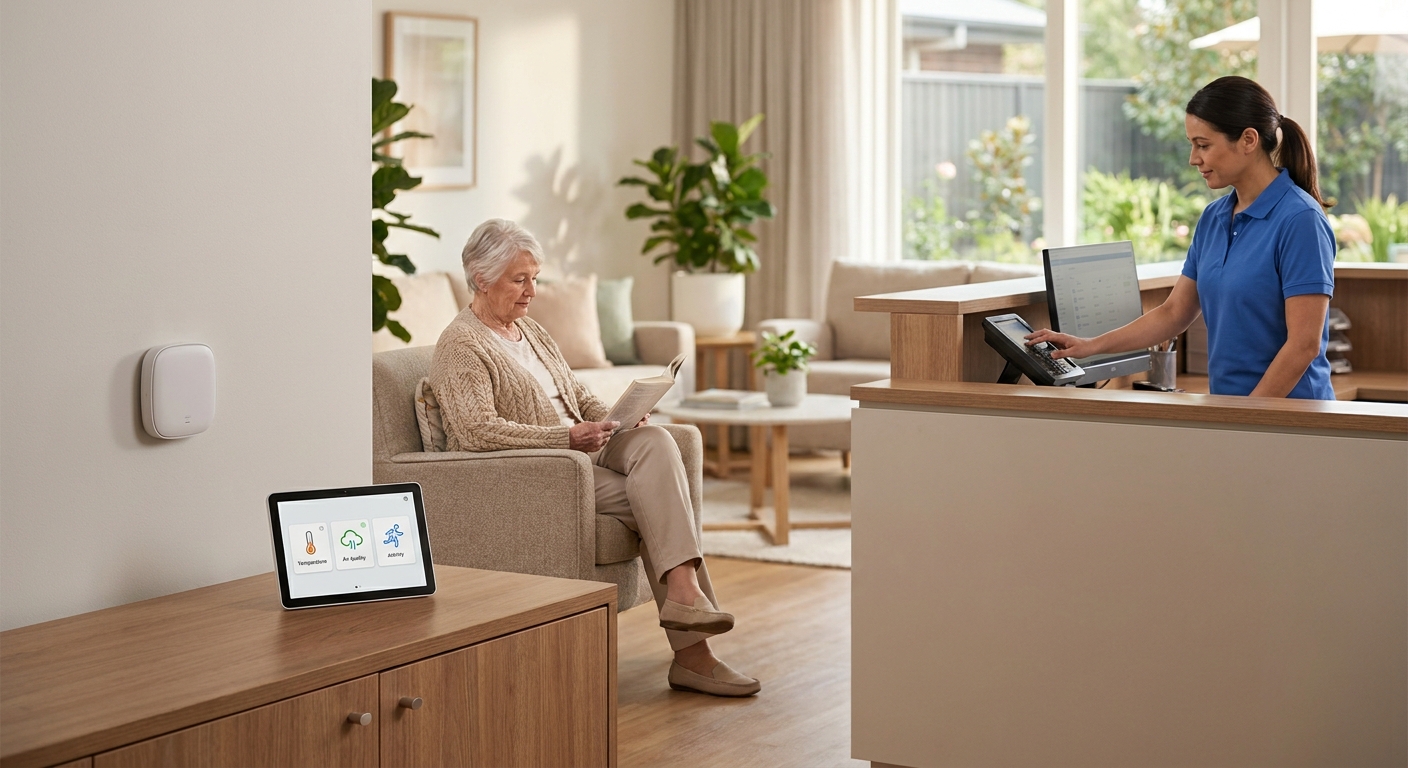
A facility monitoring system for senior living communities has to catch what overnight staff can't watch every hour — a dietary freezer drifting past 40°F, a boiler room climbing toward 95°F, a slow leak under a resident bathroom sink — and route the alert to someone who can act before it becomes an incident report.
- Kilo IoT's wireless retrofit sensors fit senior living buildings from the 1980s and 1990s without opening a wall — buy for older campuses.
- Leak sensors tied to a rules engine catch water damage before it reaches a resident room below — essential for any 2026 deployment.
- Skip hourly polling on walk-in coolers; a compressor failure can spoil a day's dietary inventory before an hourly check notices.
- One dashboard across a multi-site portfolio beats a separate login per community once you pass two buildings.
Why this matters
Senior living operators run buildings with thinner overnight staffing than a hospital and more liability exposure than a typical office. A missed HVAC failure in a memory care wing isn't a comfort complaint — it's a resident safety event, and state surveyors ask for the log afterward. Most communities also occupy buildings put up before the mid-1990s, long before anyone ran conduit for sensors, which is exactly the gap wireless retrofit sensors close without opening a wall or rerouting hallway traffic. In 2026, the communities getting burned aren't the ones without a monitoring system — they're the ones running one that only checks in once an hour.
Who this is for
This guide is for facility directors, regional maintenance managers, and operations VPs running assisted living, independent living, or memory care communities — anywhere from a single campus to a 40-property portfolio. You're the person who gets the 2 a.m. call when a chiller trips, and you're done finding out about a leak from a stained ceiling tile instead of a sensor.
What to look for in a facility monitoring system for senior living communities
Wireless sensors that don't require rewiring
Most senior living buildings weren't built with sensor conduit, and pulling new wire through occupied resident wings means work orders, noise, and disrupted residents. Look for LoRaWAN or mioty sensors that run 5 to 10 years on a single battery and mount with a screw or adhesive pad, not a licensed electrician. A vendor quote that includes rewiring is quoting the wrong system for an occupied building.
“A vendor quote that includes rewiring is quoting the wrong system for an occupied building.”
Temperature and humidity thresholds tuned by room type
Resident rooms and common areas run on a different threshold than a dietary walk-in cooler. Common-area HVAC typically holds 68°F to 74°F, while a cooler alarm needs to fire well before product crosses 40°F. A system with one blanket threshold for the whole building either misses real failures or buries staff in noise until they start ignoring alerts.
Leak detection tied to a maintenance response
A leak sensor that only updates a dashboard nobody's watching at 3 a.m. is decoration. Leak detection built to alert before damage spreads pushes straight to a phone or a text, getting someone standing in front of the leak before it reaches the resident room below.
Escalation rules that reach the right person
An alarm that emails the facilities inbox on a Saturday isn't an alarm — it's a record for the incident report. The rules engine behind the platform needs to escalate step by step: on-call tech first, then the maintenance director, then the administrator on duty, until someone acknowledges it.
Multi-site visibility without adding staff
Run more than one community and you need a single dashboard across all of them, not a separate login per building. Five browser tabs open at 6 a.m. because a freezer alarm fired at Building 3 defeats the point of automating the check.
Monitoring configurations that actually fit senior living
The baseline: resident wings plus mechanical rooms
The safe pick for any community starting from zero. Sensors report on 15-minute intervals across HVAC returns, walk-in coolers, and boiler rooms — the two failure modes behind most incident reports in this setting. Verdict: Buy for any first deployment in 2026.
The retrofit path: buildings older than 2000
The one that skips the electrician entirely. Battery-powered LoRaWAN sensors run 5+ years without opening a wall, which matters when the building predates the sensor-conduit era by two decades. Verdict: Buy if your buildings went up before 2000.
The alarm-first rollout: fix response before adding sensors
The one that fixes response time, not coverage. Kilo IoT's rules engine can route an alert through an on-call tech, then a maintenance director, then an administrator, timed at each step — rules engine logic built for industrial IoT alarms applies the same way to a 90-unit assisted living building. If sensors already exist but nobody reliably acts on the alerts, fix the escalation logic before buying more hardware. Verdict: Buy if alarms exist but response is inconsistent.
The wildcard: digital twin view for capital planning
Not for day-to-day ops — useful for budget season. A building-level digital twin turns a year of temperature and energy data into the kind of chart that gets an HVAC replacement approved by a board instead of argued about. Verdict: Consider once the baseline system has run long enough to produce that data.
Map the monitoring gaps in your community
See how Kilo IoT covers resident wings, kitchens, and mechanical rooms in one dashboard.
What to avoid
- Hourly polling on freezer or cooler sensors — a compressor failure at 2 a.m. can spoil a full day's dietary inventory before an hourly check notices anything.
- Email-only alerts with no phone or text escalation — overnight staff don't monitor a shared inbox.
- A quoted wiring closet or dedicated BMS integration for a community under 100 units — that's infrastructure sized for a hospital, and it triples install cost with no real benefit for a single community.
Verdict comparison
| Configuration | Best for | Install effort | Verdict |
|---|---|---|---|
| Baseline (resident wings + mechanical rooms) | New deployments | Low — mount and go | Buy |
| Retrofit path | Buildings older than 2000 | Low — no wiring | Buy |
| Alarm-first rollout | Existing sensors, slow response | Low — configuration only | Buy |
| Digital twin view | Capital planning, board approval | Low — reporting layer | Consider |
FAQ
What's the best facility monitoring system for senior living communities?
The best facility monitoring system for senior living communities pairs wireless retrofit sensors with fast, tiered escalation, not just a dashboard. As of 2026, Kilo IoT's platform ties LoRaWAN or mioty sensors to a rules engine that routes an alert through an on-call tech, then a maintenance director, until someone acknowledges it — the setup that fits an occupied building without rewiring.
Is wireless sensor monitoring reliable in older senior living buildings?
Yes — LoRaWAN and mioty sensors work through the thick walls and long hallways typical of buildings from the 1980s and 1990s, without running new wire. Battery life on these sensors typically runs 5 to 10 years, so a retrofit install doesn't turn into a maintenance burden of its own.
How fast should a leak alert reach maintenance staff?
A leak alert should reach a phone or a text within minutes of the sensor detecting moisture, not sit in an email inbox until someone checks it. The gap between detection and response determines whether a leak stays a maintenance ticket or becomes a resident room repair.
What temperature range should common areas stay in?
Common areas in senior living communities typically hold between 68°F and 74°F, tighter than a general office building because residents are more sensitive to cold and heat stress. Dietary walk-in coolers need a separate, lower threshold with an alarm set well before product crosses 40°F.
Do senior living communities need a dedicated building management system for monitoring?
No — a dedicated BMS is infrastructure sized for a hospital campus and is overkill for a single community under 100 units. A cloud-based facility monitoring system with wireless sensors covers the same failure points at a fraction of the install cost.
How long do wireless sensor batteries last in a senior living deployment?
Most LoRaWAN and mioty sensors run 5 to 10 years on a single battery, depending on how often they report. A sensor set to check in every 15 minutes runs shorter than one reporting hourly, so the reporting interval is worth setting deliberately per room type.
Can one dashboard cover multiple senior living communities?
Yes — a multi-site facility monitoring system should show every building's alerts in one dashboard instead of a separate login per property. Kilo IoT's dashboard aggregates alerts across a portfolio so a regional manager isn't checking five tabs before breakfast.
What's the difference between LoRaWAN and mioty for facility monitoring?
LoRaWAN and mioty are both long-range, low-power wireless protocols built for battery sensors, and either works for senior living monitoring. mioty handles denser sensor deployments and interference better in busy RF environments, which matters more on a large campus than a single mid-size community.
One last thing
The alarm most first-round deployments skip is humidity in linen closets and medication storage rooms. A spike above 60% relative humidity for a few hours degrades stored medication and feeds mold growth behind cabinets long before anyone smells it — and covering it costs one more sensor, not a redesign.