
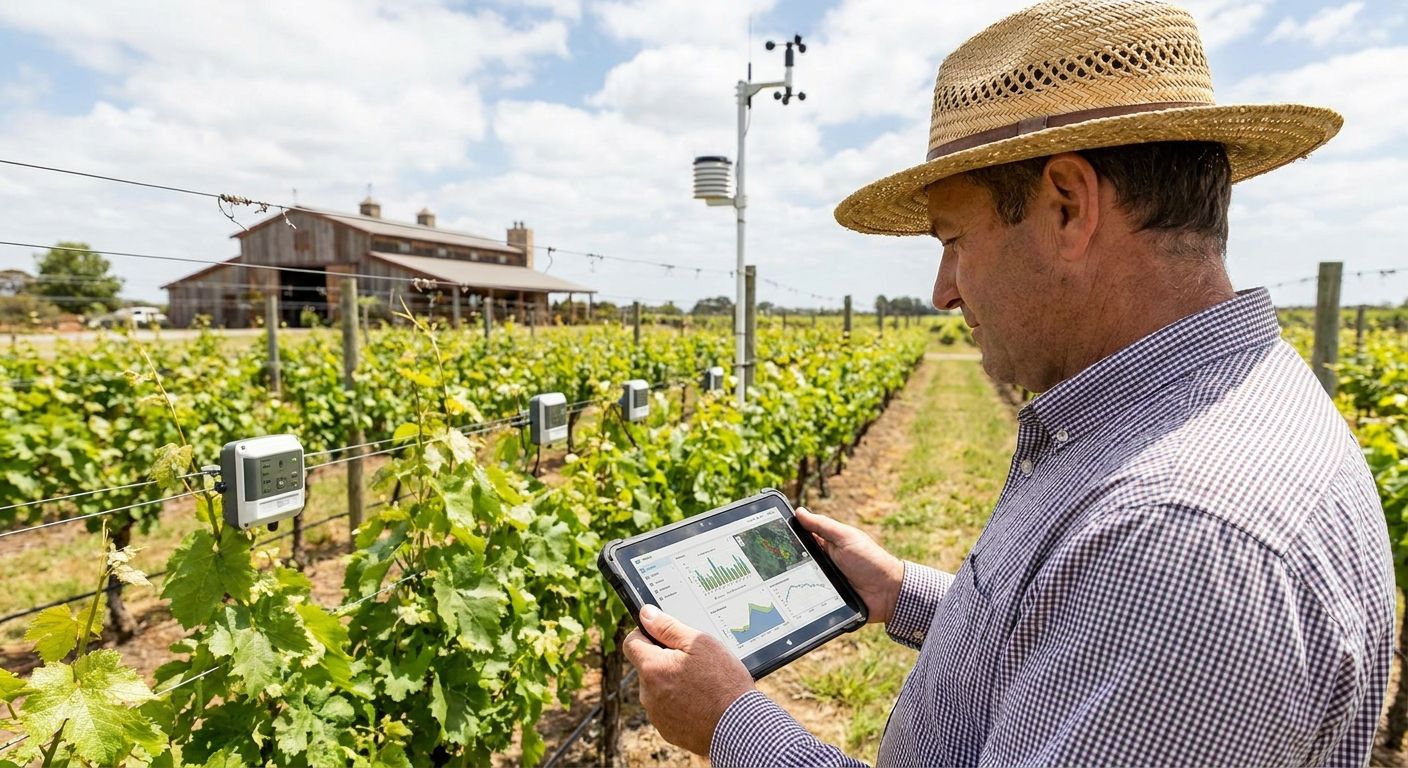
Vineyards and wineries run two different monitoring problems at once: wide-open blocks exposed to frost, heat and drought, and sealed tanks, barrels and cellars that need tight temperature and humidity control. An IoT platform for vineyards has to cover both from one dashboard instead of stitching together a weather app, a tank probe gauge and a clipboard.
- An IoT platform for vineyards needs both long-range outdoor connectivity and a bridge for existing tank or cellar equipment.
- Frost damage risk starts below 0°C (32°F) at bud break, per agricultural extension frost-protection guidance.
- Fermentation runs 75-86°F for reds and 50-65°F for whites, per general university viticulture and enology guidance.
- The Kilo IoT platform runs a built-in LoRaWAN and mioty network server plus an MQTT connector, so field and cellar data share one dashboard.
- A free tier covering 5 devices at 0 EUR is enough to pilot one frost zone or one tank room before scaling in 2026.
Why does vineyard monitoring need a different IoT setup than a warehouse?
A 40-acre block a mile from the nearest building doesn't have Wi-Fi, and trenching mains power to a soil probe at the far end of a row costs more than the probe itself. A tank room, by contrast, sits inside a building that already has a chiller loop or a PLC reporting somewhere.
An IoT platform for vineyards has to handle both cases in the same account: long-range outdoor sensors that run for years on a battery, and a bridge for equipment that's already instrumented. The Kilo IoT platform is built around that split — LoRaWAN and mioty network servers are native to the platform, so there's no separate network server to stand up, and an MQTT connector accepts data from any tank probe, chiller PLC or building management system without a middleware layer in between.
That matters for who's actually reading the dashboard: a vineyard manager checking frost risk before sunrise, a winemaker watching a fermentation curve, and a facilities lead tracking cellar humidity through harvest season. One login, not three.
What should you look for in an IoT platform for vineyards?
- Long-range outdoor connectivity (LoRaWAN or mioty) that reaches sensors across rows without a gateway on every block.
- An MQTT or PLC bridge for tank probes, chillers and building systems already running in the cellar.
- A rules engine that fires on temperature and moisture thresholds without a developer writing custom code.
- Escalation chains so a frost alarm at 2 a.m. reaches a phone, not just an inbox nobody checks overnight.
- A free or low-device tier to pilot one block or one tank room before committing budget across the estate.
- Per-device and floor-plan views that show which row or which tank triggered an alert, not just a device ID.
IoT monitoring needs for vineyards and wineries at a glance
| Monitoring need | Sensor type | Protocol | Alarm trigger |
|---|---|---|---|
| Frost protection at bud break | Ambient temp/humidity probe | LoRaWAN | Below 0°C (32°F) |
| Soil moisture / irrigation | Soil moisture probe | LoRaWAN | Below scheduled deficit-irrigation threshold |
| Fermentation tank temperature | Submersible/contact tank probe | MQTT (existing PLC) or LoRaWAN | Outside 75-86°F red / 50-65°F white |
| Barrel cellar humidity | Ambient temp/RH sensor | LoRaWAN or mioty | Outside 60-70% RH or 55-59°F |
| Remote plot connectivity | Any of the above | mioty or LoRaWAN | Signal loss / gateway offline |
How do you monitor frost risk in a vineyard?
Frost during bud break can wipe out most of a season's crop in a single night once temperatures drop below 0°C (32°F), a threshold documented in agricultural extension frost-protection guidance. Crews running wind machines or overhead sprinklers usually have a narrow window to react, so the alarm has to move faster than a human checking a weather app.
The alarm has to beat the crew to the field, not the other way around. Ambient probes placed at canopy height in the lowest, coldest rows — not just near the equipment shed — feed a rules engine that can fire the moment a threshold is crossed for a set number of minutes, escalating through email, SMS and push until someone acknowledges it. Quiet hours get suspended for the frost season on purpose; a 3 a.m. alert during bud break is the point, not a nuisance.
What sensors track soil moisture for vineyard irrigation scheduling?
Deficit irrigation — deliberately underwatering vines at specific growth stages to concentrate flavor — is standard practice in premium viticulture and depends on knowing soil moisture at multiple depths, not just surface wetness. A single sensor per block misses the variation between a low, wet corner and a sloped, dry one.
LoRaWAN soil probes run for years on a battery because they transmit small packets infrequently, which suits a network of a dozen or more probes spread across acreage where running power isn't practical. The LoRaWAN soil moisture sensors for irrigation guide covers probe depth and placement in more detail. Skip a single-sensor setup for anything over a few acres — it hides the variation that irrigation scheduling depends on.
How do you monitor fermentation tank temperature in a winery?
Red wine typically ferments at 75-86°F (24-30°C) and white wine at 50-65°F (10-18°C), per general enology guidance from university viticulture and enology programs. Drift outside that band during an active ferment can stall yeast activity or push off-flavors, and by the time someone walks the tank room to check, hours have passed.
Tank probes that already report to a chiller controller or PLC don't need replacing — an MQTT connector pulls that existing data into the same dashboard as the field sensors, so a winemaker isn't logging into two systems during crush. The tank level monitoring for wineries and vineyards guide covers level sensing alongside temperature for the same tanks. A tank alarm that fires within the fermentation window, not after the batch is already off-spec, is the actual requirement here.
What temperature and humidity does a wine cellar need?
Barrel aging rooms generally target 55-59°F (13-15°C) and 60-70% relative humidity, figures widely cited in cellar design guidance to limit evaporative loss and keep barrels from drying out. A single sensor near the door reads differently than one at the back of a large cellar, especially after a door-open event or an HVAC cycle.
Multiple ambient temperature and humidity sensors placed across cellar zones, tied to a floor-plan or digital twin view, show which zone drifted and when — useful for catching a failing HVAC unit before a whole barrel run is affected, not just for a compliance log. mioty's deeper penetration through concrete and metal racking makes it a better fit than LoRaWAN in some underground or heavily shielded cellars.
How do you connect sensors in a vineyard with no Wi-Fi or wired network?
Most vineyard acreage has no wired network and no reliable indoor-grade wireless coverage, which rules out anything built for a building. LoRaWAN and mioty both run on unlicensed spectrum through a gateway you control, rather than depending on indoor-grade Wi-Fi reaching the far end of a row.
One gateway typically covers a large block from a central point — mioty's telegram-splitting design in particular is built to tolerate interference and distance better than a standard point-to-point radio link. For estates with multiple non-contiguous blocks, that usually means more than one gateway feeding the same account rather than one platform per block.
How does the Kilo IoT platform fit vineyard and winery monitoring?
The Kilo IoT platform pairs a built-in LoRaWAN and mioty network server with an MQTT connector, so field sensors and cellar equipment land in the same dashboard without a separate network server to deploy. Its rules engine uses BPMN workflows with CEL expressions, version control and one-click deploy, so a frost or fermentation-temperature rule can be tested against a sample payload before it goes live in the field. Alarms carry five severity tiers and multi-step escalation chains across email, SMS and push, with quiet hours you can suspend for frost season specifically. A built-in AI assistant can build that frost rule or set that fermentation alarm from a plain-language request, scoped to what the signed-in user is allowed to touch, and it confirms before anything consequential deploys.
Honest limits: Kilo doesn't manufacture soil probes, tank sensors or gateways — hardware comes through the sister company Kilo Electronics' partner catalog, which ships worldwide, and the AI assistant only recommends devices from that catalog. The platform also doesn't run a multi-day frost forecast model; it reacts to live sensor data against a threshold or CEL rule you set, which is a narrower and more verifiable job than a prediction engine.
How much does an IoT platform for vineyards cost in 2026?
Kilo's free plan runs at 0 EUR for up to 5 devices, 1 dashboard and 1 rule, with no card required and no expiration — enough to pilot frost monitoring on one block or temperature monitoring on one tank room before committing further. Starter runs 25 EUR per month for up to 25 devices, which typically covers a mid-size block plus a tank room together. Gateways are unlimited on every tier and never count against the device limit, which matters once a vineyard spans multiple non-adjacent blocks. Sensor and gateway hardware itself is purchased separately through Kilo Electronics, which ships worldwide.
See vineyard monitoring set up live
Walk through frost, soil and tank alarms on the Kilo IoT platform.
FAQ
What's the best IoT platform for vineyard frost monitoring?
A platform with long-range outdoor connectivity and a fast, escalating rules engine handles frost best, since bud-break damage starts below 0°C (32°F) and crews need minutes, not hours, to react. The Kilo IoT platform builds this on LoRaWAN with CEL-based threshold rules and multi-step alarm escalation.
Is LoRaWAN or mioty better for vineyard sensors?
LoRaWAN suits most open-field vineyard blocks with a single gateway covering the acreage. mioty's telegram-splitting design tolerates interference and shielding better, which helps in underground or heavily built cellars where LoRaWAN signal can degrade.
How much does an IoT platform for vineyards cost in 2026?
Kilo's free plan is 0 EUR for up to 5 devices, 1 dashboard and 1 rule with no card required, and Starter runs 25 EUR per month for up to 25 devices. Gateways don't count against either device limit.
What temperature should wine fermentation tanks be monitored at?
Red wine ferments at roughly 75-86°F (24-30°C) and white wine at 50-65°F (10-18°C), per general university enology guidance. An alarm set just outside those bands catches a stalling or overheating ferment before the batch is affected.
Can one platform monitor both vineyard blocks and cellar tanks?
Yes, when the platform runs both a LoRaWAN/mioty network server for field sensors and an MQTT connector for existing tank or PLC data. That avoids running a separate app for the field and the cellar.
How long do vineyard IoT sensor batteries last?
LoRaWAN soil and ambient sensors are designed to run for years between battery changes because they transmit small, infrequent packets rather than a constant stream. Actual life varies by device and reporting interval, so check the specific sensor's datasheet.
Does an IoT platform for vineyards need cellular coverage?
No. LoRaWAN and mioty both operate over a gateway you control on unlicensed spectrum, which is why they work in vineyard acreage with no reliable network coverage of any kind.
What humidity should a wine cellar maintain?
Barrel aging rooms generally target 60-70% relative humidity and 55-59°F (13-15°C), figures commonly cited in cellar design guidance to limit barrel evaporation. Multiple sensors across a large cellar catch zone-to-zone variance a single sensor misses.
What's the most overlooked sensor placement mistake in vineyard monitoring?
A single ambient sensor mounted near the equipment shed reads nothing like the lowest row in the vineyard, and that low row is usually where frost hits first. The same mistake shows up in cellars: one sensor near the door misses drift at the back of the room after an HVAC cycle or a long door-open event during a barrel move. Placing sensors at the actual failure points — canopy height in known cold pockets, and both ends of a long cellar — matters more in 2026 than which brand of probe you buy.