
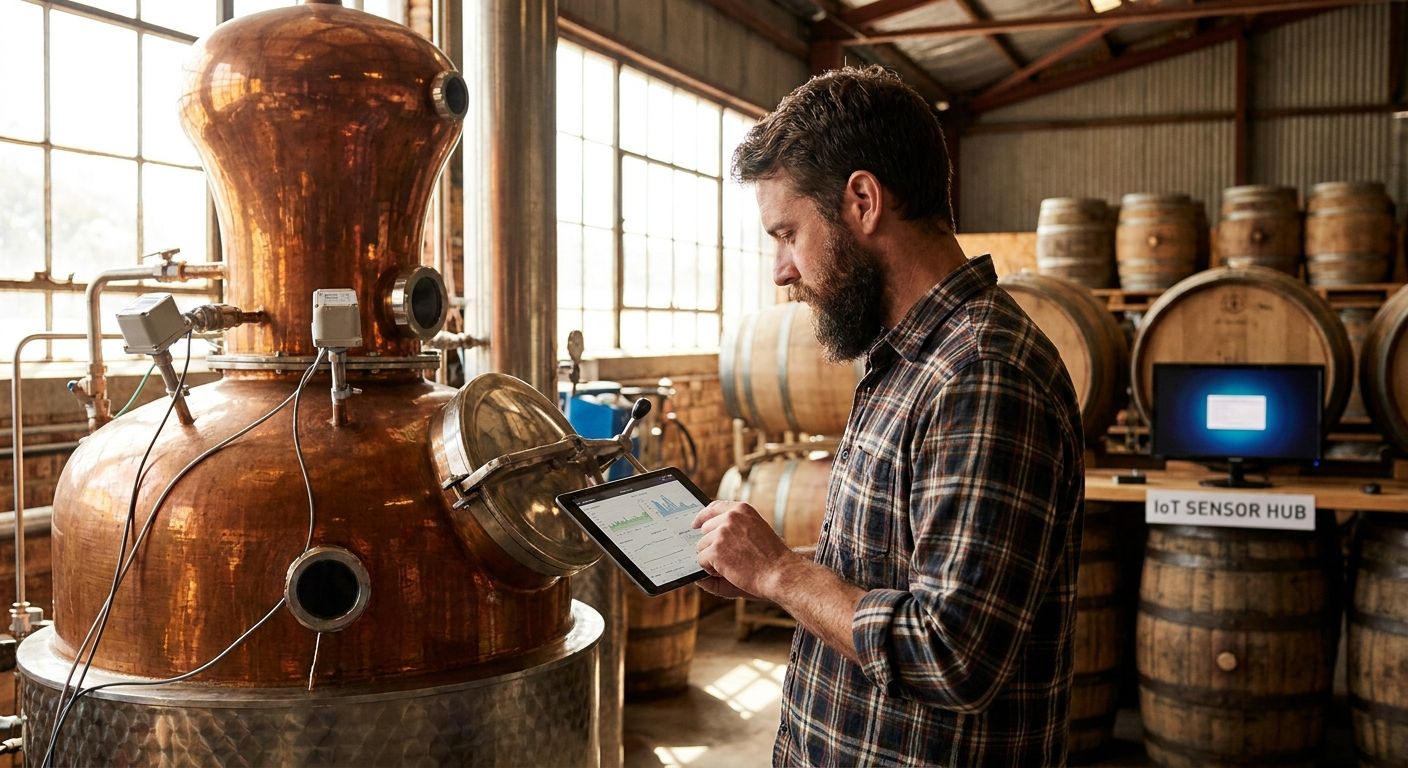
Craft distillery IoT monitoring tracks fermentation, mash cooking, barrel-aging, and bonded-storage conditions in real time, replacing clipboard walkthroughs with sensors, alarms, and a live dashboard across the whole spirits production line. A distillery's monitoring needs differ from a generic food plant: fermentation temperature swings ruin a batch in hours, rickhouse humidity drives evaporation loss, and ethanol vapor near a still is a combustible-gas problem, not just a comfort issue.
- IoT monitoring for craft distilleries and spirits production puts fermentation, still, and rickhouse conditions on one dashboard instead of a clipboard.
- Ethanol's lower explosive limit is 3.3% by volume in air (OSHA/NIOSH) — vapor sensors near stills need their own alarm threshold.
- Barrel warehouses need separate temperature and humidity tracking per rack level, not one sensor per room.
- The Kilo IoT Platform's free tier covers 5 devices and 1 dashboard at no cost in 2026, no card required.
- TTB bonded-storage record-keeping gets simpler when temperature and tank-level logs export automatically instead of manual entry.
Why does IoT monitoring matter for craft distilleries and spirits production
A distillery runs several processes that fail in different ways at different speeds. Fermentation drifts over hours. A stuck mash tun thermocouple can scorch a batch in minutes. A rickhouse that swings from 95°F on a summer afternoon to 40°F overnight drives barrel evaporation and inconsistent aging across the same floor. None of that shows up on a single walk-through log sheet, and none of it waits for the next shift to notice.
The same monitoring logic that works for breweries and beverage producers applies here, with a distillery-specific twist: bonded storage record-keeping for the Alcohol and Tobacco Tax and Trade Bureau (TTB), combustible ethanol vapor near stills, and barrel racks that need per-level tracking, not per-room. Getting this wrong costs product, and in the case of vapor buildup, it's a safety issue covered by NFPA 30's classification of ethanol as a Class IB flammable liquid.
How to set up IoT monitoring for a craft distillery
Monitor fermentation temperature in real time
Most distiller's yeast strains work reliably in the 68-86°F (20-30°C) range, and drift outside it stresses the yeast or stalls the fermentation entirely.
- Check wash or mash temperature every 2-4 hours with a handheld thermometer during active fermentation
- Log readings on a sheet at the fermenter, dated and initialed
- Watch for signs of a stuck fermentation: temperature climbing past the strain's tolerance without airlock activity slowing
- Note ambient room temperature too — a cool cellar and a warm production floor pull the same tank in opposite directions
Track mash cooking and still temperatures
Cooker and column temperatures determine conversion efficiency and cut points, and a missed reading during a run is a missed batch.
- Record cooker temperature at each mash-in and at set intervals through the cook
- Log column or pot still head temperature at each cut point (heads, hearts, tails)
- Check condenser output temperature to confirm the cooling water or glycol loop is keeping pace
- Cross-check hydrometer proof readings against still temperature to catch a miscalibrated gauge early
Watch barrel warehouse temperature and humidity separately
A rickhouse is not one climate zone. Top racks run hotter and age faster; ground-level racks run cooler and slower. Manual spot-checks with a sling psychrometer catch a snapshot, not a trend.
This is where a sensor network earns its keep over a clipboard: LoRaWAN temperature and humidity sensors placed at multiple rack levels report continuously to a dashboard, so a rack running hot for three straight weeks shows up as a pattern instead of a guess at the next audit. The Kilo IoT Platform pairs each sensor with a digital twin, so a facilities lead can click a specific rack row and see its temperature history rather than averaging the whole building.
- Place sensors at top, middle, and bottom rack levels in at least one representative bay per warehouse
- Track humidity alongside temperature — barrel evaporation and char interaction both respond to both
- Set a rules-engine alarm for sustained temperature above a defined threshold on any given rack, not just the room average
- Compare rack-level trends season to season instead of relying on a single midsummer check
Monitor tank and vessel levels across the process
Wash backs, spirit safes, holding tanks, and blending vessels all need level visibility, and a dry-run pump or an overflow both cost product and cleanup time.
- Check level manually with a dip stick or sight glass at shift change
- Log wash-back and holding-tank levels before and after each transfer
- Compare received volume against expected yield to catch a leaking valve early
- Use a rules engine to fire an alarm before a tank reaches a defined high or low threshold — this is the same approach covered in tank level monitoring for wineries and vineyards, where fermentation and holding-tank overflow risk works the same way
Set alarms for boiler rooms and ethanol vapor
Ethanol vapor has a lower explosive limit of 3.3% by volume in air, per OSHA and NIOSH chemical data, and NFPA 30 classifies ethanol as a Class IB flammable liquid with a flash point around 55°F (13°C). Vapor near a still, a doubler, or a barrel-fill station is a safety threshold, not a comfort reading.
- Position a combustible-gas detector near the still, doubler, and any barrel-fill or dump station
- Check boiler feedwater and steam pressure gauges each shift
- Log condenser cooling-water flow to confirm the loop hasn't lost pressure
- Route a gas or temperature alarm through an escalation chain with severity tiers, so a fill-station reading gets a different response than a routine boiler check — Kilo Cloud's MQTT connector accepts feed from any publishing gas detector or PLC alongside its own LoRaWAN and mioty sensors, and alarms escalate through email, SMS, or push with quiet hours for non-critical tiers
Track cold storage for finished and bottled product
Finished spirits are more forgiving than beer or wine, but bottled product storage and any refrigerated ingredient stock (fruit, botanicals, dairy for cream liqueurs) still need a temperature record.
- Check cold room temperature at open and close each day
- Log door-open events if the room sees frequent traffic during bottling runs
- Set a two-stage alarm: a warning at a soft threshold, a critical alert if temperature holds past a set duration
- Keep a rolling export of the data for retailer or distributor audits
See distillery monitoring on one dashboard
Free tier covers 5 devices and 1 dashboard, no card required in 2026.
Comparing monitoring options for craft distilleries
| Option | Best for | Key limitation |
|---|---|---|
| Paper logs and manual walkthroughs | Very small, single-still operations | No trend history; a 2am fermentation spike goes unnoticed until the next check |
| Standalone USB data loggers | Point checks in one warehouse rack or room | Data sits on the logger until someone plugs it in and downloads it |
| Building management system (BMS) tied to HVAC | Sites that already run a full BMS for the building | Rarely covers ethanol vapor, tank levels, or individual barrel racks |
| Kilo Cloud (LoRaWAN, mioty, MQTT IoT platform) | Multi-process sites tracking fermentation, aging, and bonded storage together | Sensors are sourced separately — Kilo Electronics ships hardware worldwide, or you connect your own MQTT-publishing devices |
Sensors for fermentation tanks, rickhouse racks, and boiler rooms ship worldwide through Kilo Electronics, Kilo's sister hardware company, if a distillery needs pre-configured LoRaWAN devices rather than connecting existing PLCs or gas detectors over MQTT.
Common mistakes craft distilleries make with IoT monitoring
- Treating the whole rickhouse as one climate zone. Top racks run hotter and age faster than ground level; a single room-average reading hides that difference.
- Skipping vapor alarms near the still because the space "smells like it always does." A slow leak builds toward the 3.3% LEL threshold long before anyone notices by nose alone.
- Logging TTB-relevant temperature and storage data by hand, then losing the sheet before an audit. Bonded storage record-keeping favors an exportable digital log over a clipboard.
- Setting one alarm threshold for the whole year. A rickhouse alarm tuned for winter fires constantly in a hot July, and gets ignored by the time it matters.
- No escalation path when a tank drifts overnight. An alarm that only sends one email at 2am does nothing if nobody checks their inbox until the morning shift.
FAQ
What is the best fermentation temperature range for craft distilling?
Most distiller's yeast strains work reliably between 68-86°F (20-30°C), though the exact range depends on the strain and the mash bill. Temperature outside that band stresses the yeast and risks a stuck fermentation.
How does IoT monitoring help with TTB bonded warehouse compliance?
IoT sensors log temperature, humidity, and tank-level data automatically and export it on demand, which replaces manual paper logs that are easy to lose before an audit. This does not replace TTB's own reporting requirements, but it makes the underlying records easier to produce.
What is the explosive limit for ethanol vapor near a still?
OSHA and NIOSH list ethanol's lower explosive limit (LEL) at 3.3% by volume in air. NFPA 30 classifies ethanol as a Class IB flammable liquid with a flash point near 55°F (13°C), which is why vapor detection near fill stations and stills matters.
Do craft distilleries need separate sensors for each barrel rack level?
Yes, in most cases. Top racks in a rickhouse run hotter than ground-level racks, and a single room-average sensor hides that spread, which affects both aging speed and evaporation loss.
Can an IoT platform monitor both fermentation tanks and boiler rooms on one dashboard?
A platform built on MQTT, LoRaWAN, and mioty can ingest data from PLCs, gas detectors, and wireless sensors into one dashboard, covering fermentation, still, boiler, and warehouse conditions together instead of running separate systems for each.
How much does IoT monitoring cost for a small distillery in 2026?
Costs vary by sensor count and connectivity choice. The Kilo IoT Platform's free tier covers up to 5 devices and 1 dashboard at no cost with no card required, and a paid Starter tier covers up to 25 devices for distilleries scaling past a single process.
What sensors matter most for a craft distillery starting IoT monitoring?
Fermentation and rickhouse temperature/humidity sensors, tank-level sensors on wash backs and holding tanks, and a combustible-gas detector near the still typically deliver the fastest payoff, since they cover the highest-risk failure points first.
The barrel-warehouse gap most distilleries miss
The detail that gets skipped most often isn't the still or the fermenter — it's rack-level granularity in the warehouse. A distillery that installs one temperature sensor per rickhouse floor still averages away the exact hot-rack pattern that drives inconsistent aging and higher evaporation loss batch to batch. Placing sensors at top, middle, and bottom rack levels in even one representative bay per warehouse, and comparing that data season over season starting in 2026, catches the pattern a single room reading never will.