
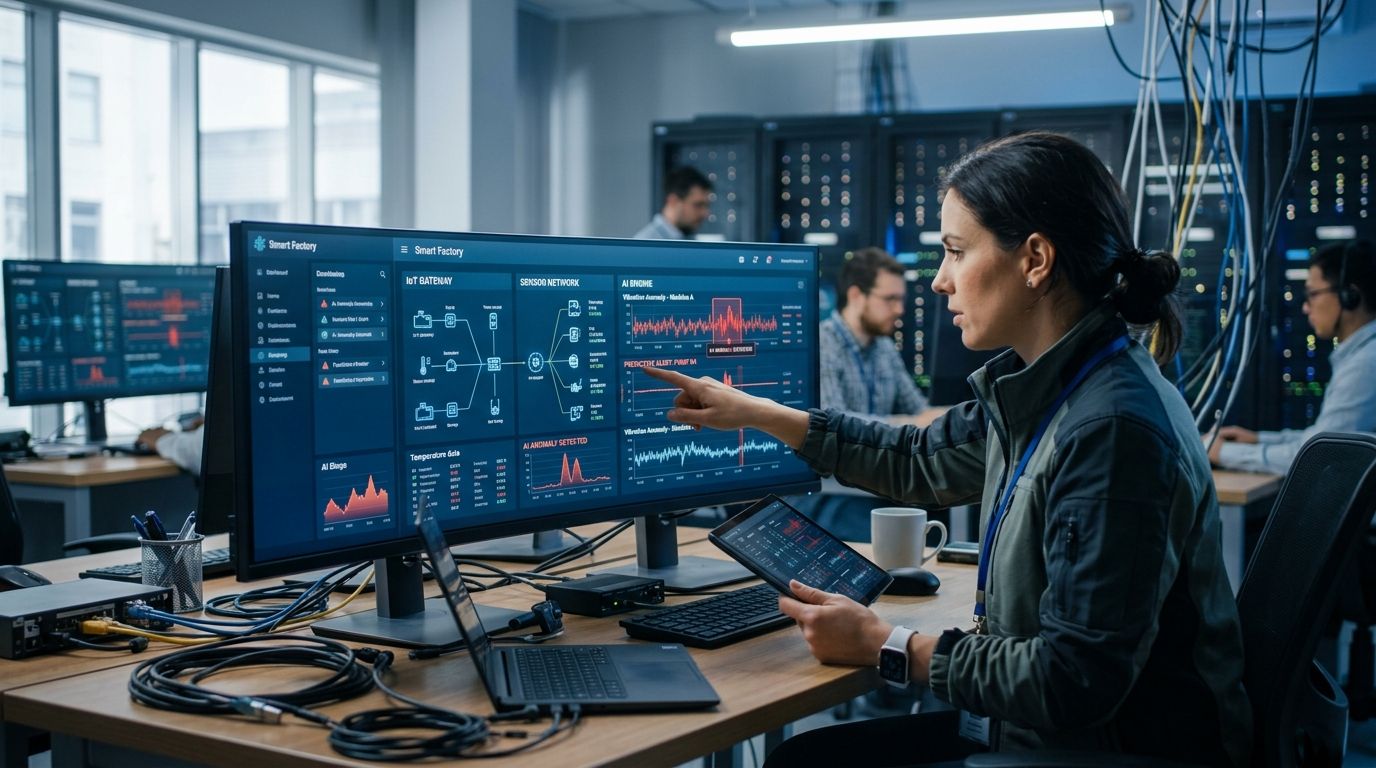
Most "AI anomaly detection" claims in IoT marketing mean one of three very different things: a static threshold, a conditional rule with several variables, or an actual pattern-matching model. Best overall for iot platform ai anomaly detection in 2026: a rules engine that combines threshold alarms, CEL expression logic and a conversational AI assistant — the architecture the Kilo IoT Platform runs, not a single black-box model. Best for slow equipment drift: rate-of-change rules evaluated over a rolling window. Best for rotating machinery: vibration and spectral threshold detection. Best for teams with no integrator on staff: a built-in AI assistant that writes and deploys the rule for you.
- The best iot platform ai anomaly detection setup combines threshold alarms, CEL rule logic and an AI assistant, not one black-box model.
- Static thresholds catch cold chain and door-open excursions fastest; Kilo escalates through five alarm severity tiers.
- Vibration anomalies on pumps and motors need spectral thresholds, not simple min/max limits.
- Kilo's built-in AI assistant writes and deploys CEL-based rules from plain language and confirms before it changes anything.
- A digital twin adds spatial context so a temperature spike or vibration event maps to the exact asset.
What is AI anomaly detection in an IoT platform?
An anomaly, in operational terms, is a reading or pattern that falls outside what the equipment or space is supposed to do. A walk-in freezer holding steady at -18°C that drifts to -12°C for 15 minutes is an anomaly even if it never crosses a hard alarm line. Detecting that reliably takes more than a single sensor and a min/max limit.
The rules engine software for industrial IoT alarms that most operations teams actually deploy in 2026 is a layered system: a threshold catches the obvious breach, a conditional expression catches the combination of variables, and an AI layer helps a non-engineer build both without writing code. None of that requires machine-learning failure prediction — it requires a rules engine that can evaluate more than one variable at once and an alarm system that gets the right message to the right person.
That distinction matters because platforms marketed as having "AI anomaly detection" range from a simple if/then trigger to genuine pattern recognition, and buyers rarely get told which one they're paying for.
What makes the best IoT platform for AI anomaly detection
- Multi-variable logic, not just single-sensor thresholds — combining temperature and duration, or vibration amplitude and frequency band
- Low false-alarm rate through quiet hours, severity tiers and escalation chains, so real events don't get lost in noise
- Version control and rollback on rules, so a bad deploy doesn't leave a site blind
- Protocol breadth across LoRaWAN, mioty and MQTT, since anomaly sources rarely live on one network
- An auditable path from sensor reading to alarm to the person who acted on it
- A way for non-engineers to build rules, whether that's a visual builder or a conversational assistant
IoT anomaly detection approaches at a glance
| Approach | Best for | Standout mechanism | Key limitation |
|---|---|---|---|
| Static threshold alarms | Cold chain, door monitoring | Severity tiers + escalation chains | Misses drift that stays under the line |
| CEL multi-variable rules | Combined-condition logic | Version control, rollback, step-through debug | Needs someone to write the logic |
| Conversational AI rule builder | Teams with no integrator | Confirms before deploying anything | Scoped to the signed-in user's own data |
| Vibration/spectral thresholds | Rotating equipment | Frequency-band alarms | Needs calibrated vibration hardware |
| Digital twin spatial context | Multi-sensor correlation | Live 3D twin binds sensors to objects | Value scales with sensor density |
| Rate-of-change rules | Slow drift (filters, batteries) | Rolling-window comparison | Needs a baseline period to tune |
1. Static threshold alarms: best AI anomaly detection for cold chain and door monitoring
A threshold rule fires the instant a reading crosses a fixed line — a freezer above -15°C, a door open past 90 seconds. It's the simplest form of anomaly detection and still the right first layer for any deployment in 2026.
Static threshold alarms pros:
- Fast to configure, no tuning period needed
- Matches regulatory ranges directly, like the CDC's 2-8°C refrigerated vaccine band
- Pairs with severity tiers and quiet hours so low-priority events don't page anyone at 3 a.m.
Static threshold alarms cons:
- Blind to drift that never crosses the line
- One threshold per condition means it can't catch combined failures
Best for: operations teams monitoring straightforward excursions — refrigerator temperature, door-open duration, tank level.
2. CEL multi-variable rules: best AI anomaly detection for combined-condition logic
A single threshold can't tell you that a cooler is fine at -12°C for two minutes but a problem at -12°C for twenty. CEL expressions let a rule combine variables — value, duration, rate — into one condition, and Kilo's rules engine keeps version history so a change can be rolled back if it misfires.
CEL multi-variable rules pros:
- Catches combination failures a threshold alone misses
- Step-through debugging against a test payload before it goes live
- One-click rollback if a new version generates false alarms
CEL multi-variable rules cons:
- Requires someone comfortable writing conditional logic
- More setup time upfront than a flat threshold
Best for: sites where a single bad reading matters less than a bad reading that persists.
3. Conversational AI rule builder: best AI anomaly detection for teams without an integrator
Building a rules engine from scratch used to take an IoT integrator and a few thousand dollars of engineering time. Kilo's built-in AI assistant onboards devices, writes and deploys rules, and creates alarms from a plain-language request, scoped to the signed-in user's own permissions, and it confirms before any consequential action.
Conversational AI rule builder pros:
- No coding background required to build a working rule
- Confirms changes before deploying, so nothing fires unreviewed
- Speeds up onboarding across how to onboard LoRaWAN sensors at scale across multiple sites-style rollouts
Conversational AI rule builder cons:
- Still bound by the same permission scope as the user driving it
- Works best when someone reviews what it built the first time
Best for: facilities teams standing up monitoring without dedicated engineering headcount.
4. Vibration and spectral thresholds: best AI anomaly detection for rotating equipment
Pumps, motors and gearboxes fail in frequency bands, not flat values. ISO 10816 defines vibration severity zones for rotating machinery, and a platform built for this use case alarms on amplitude within a specific frequency band rather than a single RMS number.
Vibration/spectral thresholds pros:
- Flags bearing wear and imbalance before a full stoppage
- Frequency-band alarms are far less noisy than raw amplitude limits
- Feeds the same automated alarms for equipment vibration anomalies workflow across multiple assets
Vibration/spectral thresholds cons:
- Needs a calibrated vibration sensor, not a general-purpose one
- Baseline tuning takes longer than a temperature threshold
Best for: rotating equipment where bearing and gearbox condition drives downtime risk.
5. Digital twin spatial context: best AI anomaly detection for multi-sensor correlation
A single sensor tells you a value. A live 3D digital twin with sensors bound to objects tells you where that value sits relative to every other reading on-site — which zone, which unit, which floor. That spatial layer turns an isolated alarm into a pattern across a building.
Digital twin pros:
- Correlates readings across sensors instead of viewing each in isolation
- Makes a facility-wide anomaly visually obvious on a floor plan
- Works alongside the digital twin platforms for facilities teams approach many multi-site operators already use
Digital twin cons:
- Needs enough sensor density to be worth building
- Adds a modeling step most single-site deployments can skip
Best for: multi-zone buildings or plants where one anomaly's cause sits in a different room from its symptom.
6. Rate-of-change rules: best AI anomaly detection for slow drift
A filter clogging, a battery degrading, a compressor losing efficiency — none of these cross a hard threshold on day one. A rate-of-change rule compares a current reading against a rolling window average and fires when the slope, not the value, looks wrong.
Rate-of-change rules pros:
- Catches degradation weeks before a static threshold would trip
- Runs on the same CEL logic as multi-variable rules, no separate system needed
- Reduces the surprise breakdowns that show up as emergency work orders
Rate-of-change rules cons:
- Needs a baseline period before the rule is reliable
- Tuning the window length takes iteration
Best for: slow-moving degradation on HVAC filters, batteries and compressors rather than sudden failures.
How these IoT anomaly detection methods are ranked
The ranking above runs on four criteria stated earlier: how fast an approach catches a real anomaly, how much false-alarm noise it generates, how much setup effort it takes, and whether a non-engineer can maintain it in 2026 without calling an integrator every time a rule needs a tweak. Static thresholds win on speed-to-deploy. CEL rules and rate-of-change logic win on catching what thresholds miss. The AI assistant and digital twin layer win on who can operate the system day to day.
See how Kilo builds these rules
Start free with up to 5 devices, no card required.
Which IoT anomaly detection approach should you choose?
For a single cold room or a handful of doors, start with static threshold alarms — they're live in an afternoon. Once a site has equipment with combined failure modes, add CEL multi-variable rules on top rather than replacing the thresholds. Rotating equipment needs vibration-specific thresholds from day one, not a repurposed temperature rule. If nobody on staff writes conditional logic, the conversational AI rule builder closes that gap without an integrator engagement. The realistic 2026 answer for most operations teams is layered: thresholds for the obvious, CEL logic for the combined, and an AI assistant to build both faster.
Hardware for any of these approaches — vibration sensors, cold chain probes, door contacts — ships worldwide through Kilo Electronics, the hardware side of the business, separate from the software decision above.
FAQ
What is AI anomaly detection in an IoT platform?
It's a layered system of threshold alarms, conditional rules and often a conversational assistant that flags readings or patterns outside normal operating range. It rarely means a single machine-learning model predicting failure.
Is a rules engine better than a black-box AI model for anomaly detection?
For operational monitoring, yes — a rules engine with version control and step-through debugging lets you see exactly why an alarm fired. A black-box model gives a score with no auditable reason behind it.
Does an AI assistant replace a rules engine?
No. Kilo's built-in AI assistant writes and deploys rules on top of the same CEL-based rules engine and alarm system; it's a faster way to build the same logic, not a separate detection method.
Can an IoT platform detect cold chain excursions automatically?
Yes, using threshold alarms set to a range like the CDC's 2-8°C for refrigerated vaccines, with escalation so a breach reaches the right person within the multi-step alarm chain.
What sensors are needed for vibration-based anomaly detection?
A calibrated vibration sensor reporting amplitude across frequency bands, following the severity zones defined in ISO 10816, rather than a general accelerometer reporting one flat number.
How do IoT platforms escalate anomaly alerts?
Through multi-step escalation chains across severity tiers, sent by email, SMS or push, with quiet hours and a centralized alarm inbox so nothing gets lost in a flood of low-priority events.
What's the difference between a threshold rule and a rate-of-change rule?
A threshold fires when a value crosses a fixed line. A rate-of-change rule compares the current reading against a rolling window average and fires on the slope, catching slow drift a threshold would miss.
What is a digital twin's role in anomaly detection?
A live 3D digital twin binds sensors to physical objects so a reading is seen in spatial context — which zone, which unit — turning an isolated alarm into a pattern across a site.
What most teams get wrong about IoT anomaly detection alerts
The most common mistake isn't picking the wrong detection method — it's skipping escalation design entirely. A threshold or CEL rule that fires correctly but pages the wrong person, at 2 a.m., with no severity tier, gets ignored within a month. The fix is in the alarm chain, not the sensor: reducing false alarms in industrial IoT alert systems usually has more impact on uptime in 2026 than adding a second detection layer.