
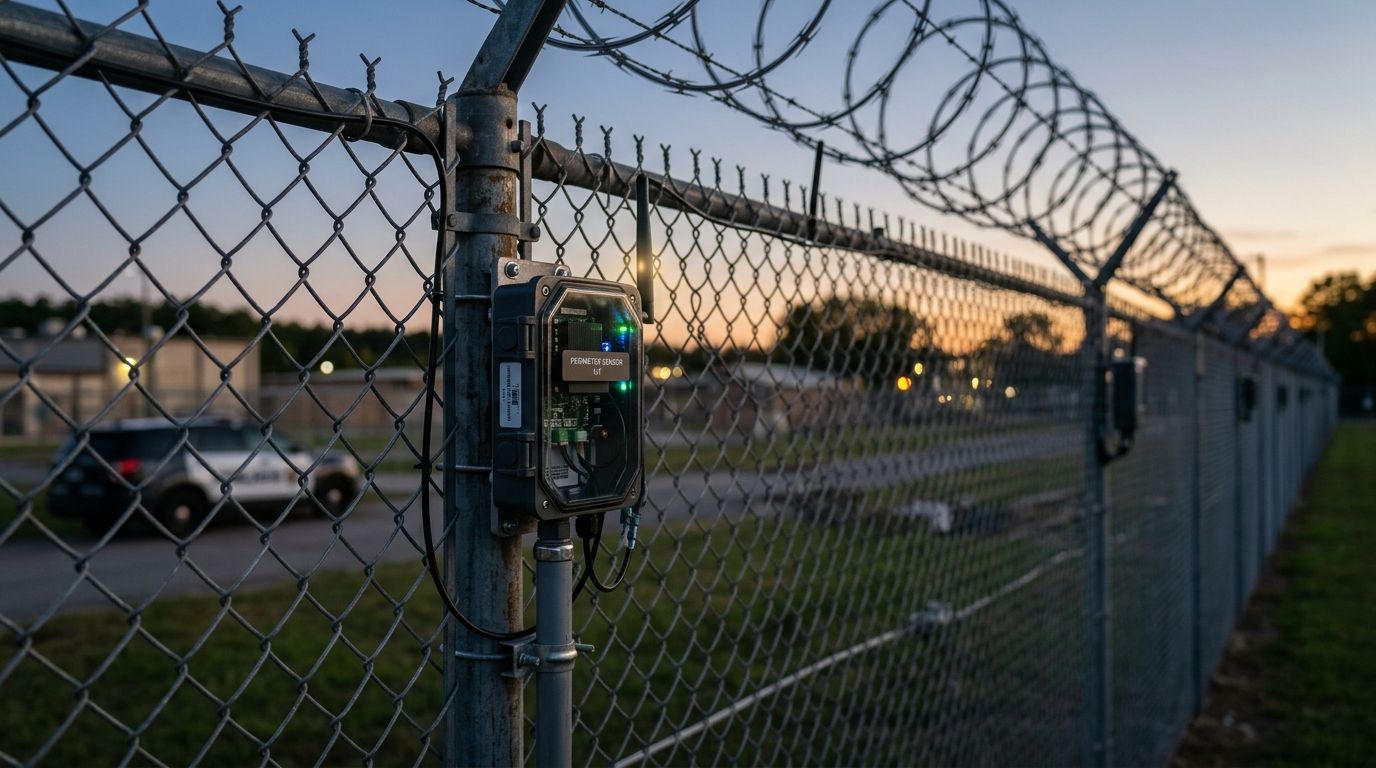
Six sensor technologies handle perimeter fence intrusion detection in 2026, and picking the wrong one means either a security desk drowning in false alarms or a fence line that misses a real climb-over. This guide ranks iot perimeter fence intrusion detection sensors by the job each one actually does best, then shows how the alarm data lands on a monitoring platform once a zone trips.
- Fiber optic distributed acoustic sensing wins for long, high-security perimeters over several kilometers of fence.
- Taut wire wins where a false alarm is not an option, such as correctional perimeters.
- Vibration-based fence sensors are the budget default for standard chain-link runs.
- A rules engine can require two adjacent zones to trip before paging anyone, cutting nuisance alarms.
- Battery-powered LoRaWAN nodes fit remote fence runs with no mains power nearby.
Why perimeter fence intrusion detection matters for facility security in 2026
A fence is only a delay, not a barrier. UL 639, the long-standing UL standard for intrusion-detection units, and NFPA 730's guide for premises security both treat the perimeter as the first detection layer, not the last line of defense. The time between a fence being touched and someone being notified is the entire point of the system.
Correctional facilities, airports, utility substations, data centers and distribution yards all run some form of perimeter fence intrusion detection because the cost of a missed breach is higher than the cost of the sensors. Many of these same sites also run IoT geofencing alerts for asset theft on vehicles and equipment inside the fence line, since a perimeter breach and an asset going missing are often the same event.
What changed by 2026 isn't the physics of the sensors, it's the connectivity. Wired loops that used to run back to a single control panel now report over LoRaWAN, mioty or MQTT into a platform like the Kilo IoT Platform, which turns a fence full of independent zones into one map with one alarm queue.
What makes an IoT perimeter fence intrusion detection sensor effective?
- Nuisance alarm rejection — can it tell wind and wildlife from a person
- Zone localization — does it say which 20 meters of fence tripped, or just that the fence tripped somewhere
- Power and connectivity for remote runs — battery and solar with a LoRaWAN or mioty uplink versus a trenched, mains-powered loop
- Outdoor rating — IP66/67 housing and a real operating temperature range, not a datasheet number that assumes a mild climate
- Integration path — dry contact, RS-485/Modbus, or a native LoRaWAN node that a platform can ingest directly
- Maintenance burden — does servicing it mean opening a cabinet, or cutting into the fence fabric
IoT perimeter fence intrusion detection sensors compared
| Sensor type | Best for | Standout feature | Key limitation |
|---|---|---|---|
| Fiber optic (DAS) | Long, high-security perimeters | Localizes an event to a few meters along kilometers of fence | Higher install cost, needs a trained integrator |
| Fence-mounted vibration | Standard chain-link on a budget | Clips onto existing fence fabric, no trenching | Prone to wind/debris nuisance alarms until tuned |
| Taut wire | Maximum-security, zero false-alarm tolerance | Mechanical displacement trip, very low nuisance rate | Rigid, costly to maintain, not covert |
| Microwave (bistatic) | Open perimeters, no fence | Detects motion in a volume, not just a line | Line-of-sight only, blocked by snow or tall grass |
| Buried/ported coax | Covert detection | Invisible below grade, hard to locate | Trenching cost, harder to service after install |
| PIR/active infrared beam | Gates and choke points | Cheap, simple pass/fail beam break | Short range, easy to defeat if mounted wrong |
1. Fiber optic (DAS) fence sensors: best for long, high-security perimeters
Fiber optic distributed acoustic sensing runs a single strand of fiber along or inside the fence fabric and listens for the acoustic signature of cutting, climbing or vehicle impact. One interrogator unit can cover several kilometers of fence line and estimate where along that run the disturbance happened, usually to within a few meters.
Fiber optic (DAS) pros:
- Covers long runs from a single interrogator, no per-post wiring
- Localizes an event to a short fence section instead of "somewhere"
- Immune to electromagnetic interference near substations or rail lines
Fiber optic (DAS) cons:
- Interrogator hardware and install labor cost more than clip-on sensors
- Needs a trained integrator to tune sensitivity per fence type and terrain
Best for: correctional facilities, airports and utility substations where the fence run is measured in kilometers. Verdict: Buy for long, high-security perimeters where the budget supports a proper install.
2. Fence-mounted vibration sensors: best for standard chain-link on a budget
Fence-mounted vibration or accelerometer sensors clip directly onto the fence fabric or posts and trigger on the shake pattern of climbing, cutting or ramming. They're the most common retrofit for existing chain-link and welded-mesh fences because wireless variants need no trenching and no continuous cable run.
Fence-mounted vibration pros:
- Installs on existing fence fabric without cutting or trenching
- Battery-powered variants report over LoRaWAN instead of a wired loop
- Lowest cost per meter of the fence-mounted technologies
Fence-mounted vibration cons:
- Wind, hail and loose fence fabric cause nuisance alarms until tuned
- Coverage is per-sensor, so long runs need more units and more provisioning
Best for: standard chain-link or welded-mesh perimeters where budget matters more than pinpoint localization. Verdict: Buy as the default for mid-size perimeters on a standard budget.
3. Taut wire sensors: best for maximum-security perimeters with zero false-alarm tolerance
Taut wire sensors run tensioned wires through posts along the fence top, or as a standalone barrier; wire displacement past a set tension threshold trips a switch. Because the trigger is physical displacement rather than sound or vibration, taut wire has one of the lowest nuisance alarm rates of any perimeter technology, which is why correctional sites still specify it.
Taut wire pros:
- Very low false-alarm rate since only physical movement of the wire trips it
- Doubles as a physical deterrent, not just a detector
- Covered under long-standing intrusion-detection listings like UL 639
Taut wire cons:
- Rigid mechanical system, more expensive to maintain than clip-on sensors
- Fully visible, so it offers no covert detection value
Best for: correctional facilities and other maximum-security perimeters where a missed detection and a false alarm both carry serious consequences. Verdict: Buy where site classification demands near-zero nuisance tolerance.
4. Microwave (bistatic) beam sensors: best for open perimeters without a fence line
Bistatic microwave sensors pair a transmitter and receiver across an open strip of ground and detect a person or vehicle breaking the beam between them. They work without a fence at all, which makes them the option for open perimeters, parking lot edges or setback zones around a building.
Microwave (bistatic) pros:
- No physical fence required, just line of sight between units
- Covers a defined volume, harder to crawl under or jump over than a line sensor
- Hardware rated for continuous outdoor use
Microwave (bistatic) cons:
- Requires clear line of sight; snow drift, tall grass or parked vehicles block the beam
- Needs its own mounting posts and power run at both ends
Best for: open perimeters and setback strips where installing a physical fence isn't practical. Verdict: Hold for sites with a fence already in place; a fence-mounted sensor is usually the simpler fit there.
5. Buried/ported coax cable sensors: best for covert perimeter detection
Buried or ported coax cable sensors run a pair of cables a few inches underground and detect the change in electromagnetic field between them when someone crosses. Because the cable sits below grade, there's no visible line to identify or route around, which makes this the covert option on this list.
Buried/ported coax pros:
- Invisible from above ground, harder for an intruder to locate or defeat
- Detects before someone reaches the fence line itself
- Works alongside a physical fence or as a standalone buried perimeter
Buried/ported coax cons:
- Trenching cost and disruption at install time
- Harder to service or reroute after burial, especially if landscaping changes
Best for: covert perimeter detection ahead of a visible fence line, common at correctional and defense sites. Verdict: Buy where a covert first line of detection justifies the trenching cost.
6. PIR/active infrared beam sensors: best for gates and short choke points
Active infrared beam sensors, sometimes paired with PIR motion detection, send a beam between two posts and alarm when it's broken. They're the cheapest and simplest option here and the standard choice for gates, vehicle entrances and short choke points rather than full perimeter runs.
PIR/infrared pros:
- Low cost per unit and straightforward to install
- Simple pass/fail logic, easy to wire into an existing gate controller
- Good fit for short spans like gates and doorways
PIR/infrared cons:
- Short range compared to fiber, microwave or buried cable
- Easy to defeat by crawling under a beam mounted too high, or stepping over one mounted too low
Best for: gates, vehicle entrances and short choke points, not full perimeter coverage. Verdict: Buy for gates and choke points; Skip for full-perimeter coverage on its own.
How are perimeter fence intrusion sensors ranked for 2026?
This ranking weights nuisance-alarm rejection and zone localization highest, because a sensor that pages security staff for every raccoon gets ignored within a month. Power and connectivity come next: a remote fence run needs battery-powered wireless sensors built for off-grid sites, not a technology that assumes mains power at every post. Integration path and outdoor rating round out the criteria, since a sensor that can't get its alarm into a dashboard is just a switch nobody watches.
“One zone tripping alone is usually wildlife; two adjacent zones tripping within the same rule window is what a real climb-over looks like.”
Which perimeter fence intrusion detection sensor should you choose?
Fiber optic DAS is the default for long, high-security perimeters in 2026 when the budget supports a proper integrator install. Fence-mounted vibration sensors are the default for standard chain-link perimeters on a normal facilities budget. Taut wire stays the answer for sites that cannot tolerate a false alarm, and microwave or buried coax fill in where a physical fence isn't the whole story. Whichever sensor a site runs, the alarm still has to reach the right person: the Kilo IoT Platform ingests LoRaWAN, mioty and MQTT sensor data into one digital twin of the fence line, with a visual rules engine that can require two adjacent zones before it pages anyone.
Hardware for most of these sensor types, including fence-mounted vibration nodes and battery-powered LoRaWAN units, ships worldwide through Kilo Electronics, Kilo's hardware sister company.
Route fence alarms to the right person
Set up SMS and email escalation for perimeter zone alarms.
FAQ
What's the best IoT sensor for perimeter fence intrusion detection?
Fiber optic distributed acoustic sensing is the best fit for long, high-security perimeters in 2026 because it localizes an event to a few meters along kilometers of fence. Fence-mounted vibration sensors are the better default for standard chain-link runs on a normal budget.
Is fiber optic or vibration sensing better for a fence line?
Fiber optic wins on long runs and precise localization; vibration sensors win on install simplicity and cost per meter. Pick fiber for kilometers of high-security fence and vibration sensors for standard chain-link retrofits.
Can LoRaWAN sensors monitor a long perimeter fence?
Yes, battery-powered LoRaWAN vibration and gate sensors are commonly used along fence lines because they don't need mains power at every post. A platform with a built-in LoRaWAN network server, like Kilo, ingests those uplinks without needing a separate network server deployed on site.
How do you reduce false alarms on a fence intrusion system?
Require two adjacent zones to trip within the same rule window before escalating, instead of alarming on a single zone. A visual rules engine with CEL expressions can encode that logic and version-control changes as tuning continues.
What connectivity does a perimeter fence sensor need?
Most fence sensors output a dry contact, an RS-485/Modbus signal, or a native LoRaWAN or mioty uplink. An MQTT connector bridges older relay-based panels into a cloud dashboard without replacing the sensor hardware.
How much does an IoT perimeter monitoring platform cost?
Kilo's free plan covers up to 5 devices and 1 dashboard at 0 EUR per month with no card required. The Starter plan is 25 EUR per month for up to 25 devices, with gateways unlimited on every tier.
Do perimeter fence sensors work in extreme weather?
Outdoor-rated fence sensors carry IP66 or IP67 housings and operating temperature ranges built for continuous exposure, but sensor choice still needs to match the site's actual climate rather than a generic datasheet number.
Can fence intrusion alarms integrate with existing security software?
Yes, through REST or gRPC APIs and webhooks once the alarm platform has ingested the sensor data. That lets a fence alarm post out to an existing security operations tool instead of living only in one dashboard.
What most fence intrusion detection deployments get wrong
Most teams spend the entire budget picking the right sensor and none of it planning the escalation path. A fiber optic system that pinpoints a breach to the meter is worthless if the alarm sits in a shared inbox for 20 minutes before anyone reads it. Kilo's alarm setup covers five severity tiers, multi-step escalation chains across email, SMS and push, quiet hours for non-critical zones, and a centralized inbox so a perimeter alarm doesn't get lost next to a routine temperature notice.
The other common miss is treating every zone the same. A fence section next to a public sidewalk trips constantly and should escalate differently than a buried-cable zone around a generator yard that almost never trips. Building that distinction into the rules engine, rather than into a spreadsheet nobody updates, is what keeps a 2026 perimeter system usable a year after install.