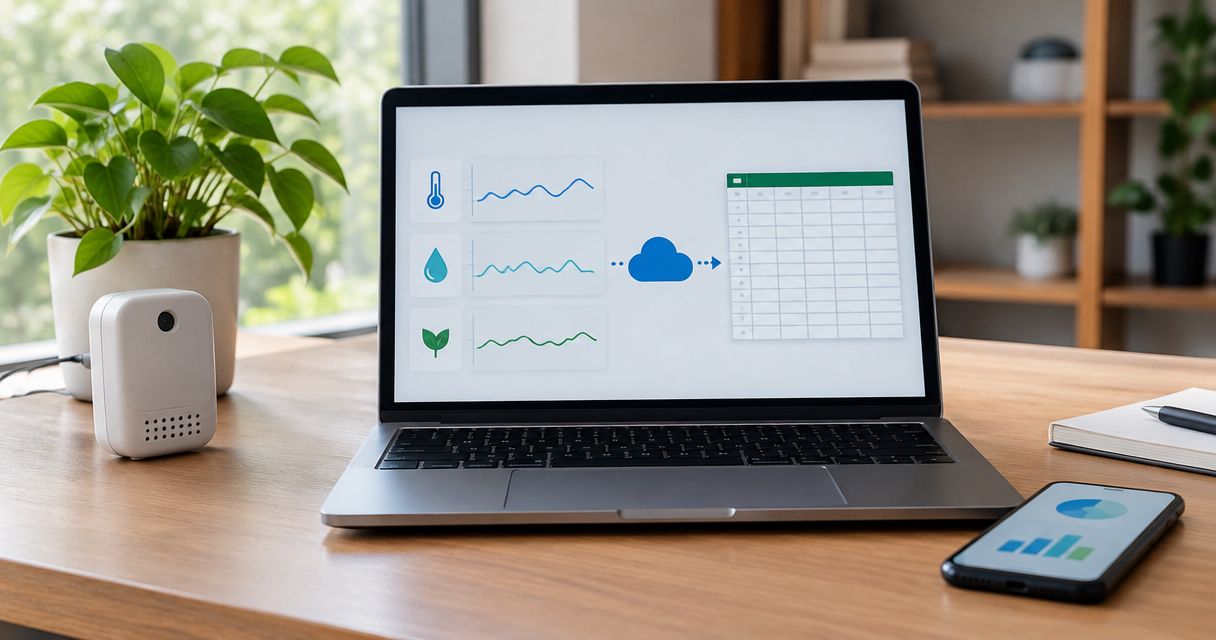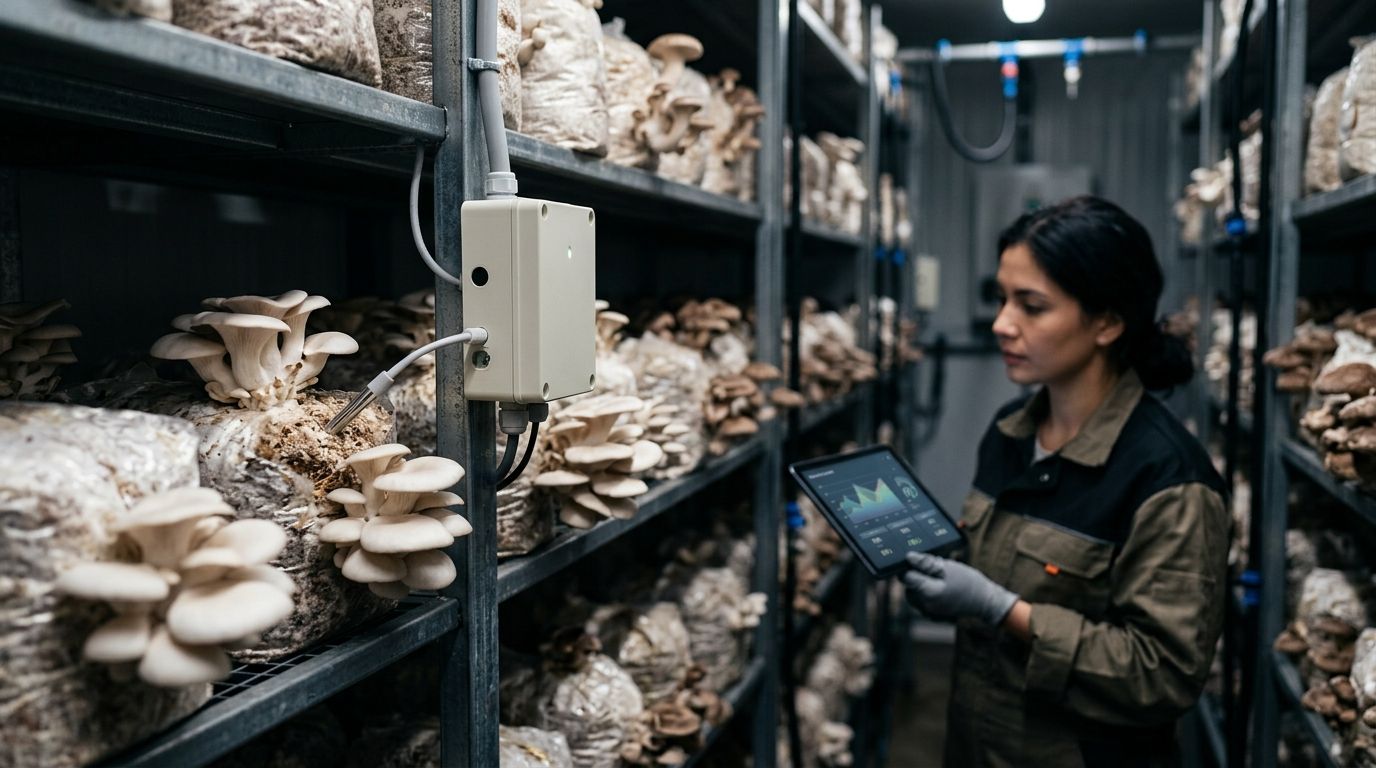
IoT sensors for mushroom cultivation measure the four variables that decide whether a flush pins clean or stalls: CO2, humidity, temperature and light, tracked at the resolution a walk-in cooler sensor was never built for. This guide ranks six sensor types by the specific mushroom-growing job each one solves, from CO2 control in a sealed fruiting room to substrate temperature during spawn run, and covers how to wire them into one dashboard in 2026 instead of six separate apps.
- NDIR CO2 sensors are the top pick among iot sensors for mushroom cultivation because fruiting rooms need CO2 held near 800-1,000 ppm.
- Wireless humidity sensors run a close second: oyster mushroom fruiting rooms hold 85-95% RH per Cornell Small Farms Program guidance.
- Wired temperature probes catch substrate self-heating during spawn run, roughly 75°F/24°C internally per Penn State research.
- Kilo connects these sensor types over LoRaWAN, mioty or MQTT and fires an alarm before a room drifts out of range.
- Start with one CO2 sensor and one humidity sensor per fruiting room before adding moisture, light or airflow sensors.
What sensors do mushroom cultivation facilities actually need in 2026?
A mushroom farm isn't one environment. Spawn run, casing, and fruiting each want different CO2, humidity and temperature setpoints, which is why a single generic grow-room sensor kit usually under-serves at least one phase. The same environmental logic that runs a IoT platform for greenhouse and vertical farming applies here, but the setpoints are tighter and the failure window is shorter.
During spawn run, bulk substrate or grain spawn runs warm, close to 75°F/24°C internally according to Penn State's mushroom research program, and CO2 can climb into the thousands of ppm without hurting anything. Move that same room into fruiting and the target flips: CO2 needs to drop toward roughly 800-1,000 ppm (Cornell Small Farms Program) to trigger pinning, and humidity needs to climb to 85-95% RH. Miss either transition by a few hours and you get long-stemmed, small-capped mushrooms or a stalled flush.
Worker-safety CO2 limits don't help here. OSHA's permissible exposure limit for CO2 is 5,000 ppm as an 8-hour time-weighted average — a room can pass a safety walkthrough at 3,000 ppm and still ruin a fruiting flush, because the production threshold sits far below the safety threshold.
What makes the best IoT sensors for mushroom cultivation
- Sensing range matched to real thresholds — CO2 sensors need headroom to 5,000+ ppm since spawn run and fruiting sit at opposite ends of that scale.
- Wireless connectivity that penetrates concrete grow rooms — many mushroom houses are windowless block buildings where LoRaWAN or mioty outperform Wi-Fi or Bluetooth.
- Battery life measured in years — a facility running a dozen fruiting rooms and hundreds of bags can't be swapping batteries monthly.
- Fast alarm escalation — a stuck humidifier or a stalled fan needs to reach someone before contamination sets in, not just get logged.
- Placement flexibility — in-bag probes, wall-mount RH/CO2 units, and duct-mount airflow sensors all need a home in the same room.
- Accessible calibration — a sensor that drifts silently produces false confidence, which is worse than no sensor at all.
IoT sensors for mushroom cultivation at a glance
| Sensor type | Best for | Standout feature | Key limitation |
|---|---|---|---|
| NDIR CO2 sensor | Fruiting room CO2 control | Direct ppm reading across 0-5,000+ ppm | Needs periodic calibration checks |
| Wireless humidity sensor | Fruiting and incubation RH | Catches humidity crashes within minutes | Drifts faster in condensing environments |
| Wired temperature probe | Substrate and spawn run temp | Reads substrate core, not just room air | Placement determines accuracy |
| Substrate/casing moisture sensor | Bag and bed moisture content | Flags drying substrate before shrinkage | Needs calibration for sawdust/straw, not soil |
| Light/lux sensor | Pinning-stage light cues | Confirms a light cycle actually ran | Doesn't measure spectrum |
| Differential pressure/air velocity sensor | Verifying fresh-air exchange | Confirms fan is physically moving air | Doesn't measure air quality itself |
1. NDIR CO2 sensors: best for fruiting room CO2 control
NDIR (non-dispersive infrared) sensors read actual CO2 concentration rather than estimating it, which matters because mushroom pinning is triggered by a real drop in CO2, not a proxy. In a sealed fruiting room, CO2 needs to fall toward the 800-1,000 ppm range cited by the Cornell Small Farms Program; stay higher and mushrooms grow tall stems with undersized caps instead of forming proper fruit bodies.
NDIR CO2 sensor pros:
- Measures CO2 directly at the ppm resolution fruiting decisions need
- Covers the full swing from spawn run (thousands of ppm) to fruiting (near 1,000 ppm) on one device
- Pairs cleanly with a fresh-air-exchange fan relay for automated venting
NDIR CO2 sensor cons:
- Costs more upfront than basic electrochemical CO2 modules
- Responds in minutes, not seconds, so it won't catch an instantaneous CO2 spike
- Needs a calibration schedule to stay trustworthy over a full growing season
Best for: facilities running a dedicated fruiting room separate from spawn run space. Verdict: Buy.
2. Wireless humidity sensors: best for fruiting and incubation humidity
Relative humidity sensors track the moisture level mushrooms actually breathe. Oyster mushroom fruiting rooms typically run 85-95% RH per Cornell Small Farms Program guidance, while spawn run and incubation tolerate cooler, somewhat drier conditions.
Wireless humidity sensor pros:
- Flags a stuck humidifier or an open door within minutes, not hours
- Cheap enough to deploy one or two per room without a budget fight
- Long battery life on most wireless models
Wireless humidity sensor cons:
- Drifts faster than temperature sensors in constant high-condensation air
- Tells you humidity crashed but not why it crashed
Best for: any room running active humidification, which is most fruiting rooms. Verdict: Buy.
3. Wired temperature probes: best for substrate and spawn run temperature
A contact probe buried in a grain spawn bag or a bulk substrate bed reads what the substrate is actually doing, not just the room's ambient air. That distinction matters because active mycelial colonization generates its own heat — a bag can run several degrees hotter at its core than the room around it, and an ambient-only sensor won't see it until the mycelium has already cooked.
Wired temperature probe pros:
- Reads substrate core temperature, which lags room air by hours during colonization
- Catches thermogenic runaway before it triggers contamination
- Durable in the wet, dirty conditions typical of grow room shelving
Wired temperature probe cons:
- Placement matters — a probe near the surface misses a hot core
- Wired runs need more careful routing than wireless units in tight shelving
Best for: any facility running bulk substrate or grain spawn at scale. Verdict: Buy.
4. Substrate and casing moisture sensors: best for bag and bed moisture content
Moisture content in the casing layer (button mushrooms) or the bag substrate (oyster, shiitake) sits at the center of yield. Widely cited substrate prep guidance puts the target around 60-65% moisture content; drift outside that range and you get either shrinkage or waterlogged, anaerobic pockets.
Substrate moisture sensor pros:
- Flags a drying bag before visible shrinkage shows up
- Covers many bags or beds without opening each one by hand
Substrate moisture sensor cons:
- Capacitive probes built for garden soil don't map onto sawdust or straw without adjustment
- Fewer mushroom-specific options on the market than generic agricultural soil sensors
Best for: facilities running casing-layer button mushroom beds or dense bag culture at volume. Verdict: Hold — add this after CO2 and humidity are dialed in.
5. Light and lux sensors: best for pinning-stage light cues
Several culinary species, including oyster and shiitake, need a low level of indirect light — commercial guidance commonly cites roughly 500-1,000 lux — to trigger pinning, even when CO2 and humidity are correct. Full darkness suppresses fruiting in these species regardless of everything else being dialed in. Sensor selection for this job overlaps with what growers already use for light and UV sensors for crop optimization in greenhouse settings.
Light sensor pros:
- Inexpensive and easy to add to an existing sensor network
- Confirms a light schedule actually ran instead of assuming a timer worked
Light sensor cons:
- Not every species needs a light cue — some strains fruit fine in darkness
- Lux alone doesn't capture spectrum, which matters more for research than routine production
Best for: farms growing light-sensitive species like oyster or shiitake. Verdict: Hold — add once CO2 and humidity are stable.
6. Differential pressure and air velocity sensors: best for verifying fresh-air exchange
A scheduled fan cycle isn't the same thing as a working fan. A differential pressure or air velocity sensor confirms air is physically moving through a fruiting room; in a sealed room, a stalled fan can push CO2 past the 800-1,000 ppm ceiling within hours, well before a CO2 sensor alone tells you why.
Air velocity sensor pros:
- Confirms mechanical action rather than inferring it from a CO2 trend
- Useful as a redundant check while a CO2 sensor is still stabilizing after a room reset
Air velocity sensor cons:
- Adds a second sensor type to install and wire per room
- Measures airflow, not air quality — it needs a CO2 sensor alongside it, not instead of it
Best for: multi-room facilities running fresh-air-exchange fans on a schedule. Verdict: Hold — pairs with CO2 sensors rather than standing alone.
How to choose IoT sensors for mushroom cultivation in 2026
Match the sensor to the phase, not the room. Spawn run needs a temperature probe watching substrate core heat; fruiting needs CO2 and humidity watched together, since either one drifting alone can stall a flush. Facilities scaling past a handful of rooms tend to add moisture, light and airflow sensors last, once the two highest-impact variables are under control.
Wiring matters as much as sensor choice. Kilo's built-in LoRaWAN and mioty network server means CO2, humidity and temperature sensors report into the same platform without a separate network server to stand up, and mioty's telegram-splitting handles the concrete-and-steel construction common in windowless mushroom houses better than Wi-Fi typically does. A CEL-based rule can watch a room's CO2 sensor and, if it holds above 1,000 ppm for a set period, escalate through Kilo's five alarm severity tiers to a grower's phone — Kilo's built-in AI assistant can help set that rule up in plain language rather than requiring anyone to write CEL by hand. Sensors themselves come from Kilo Electronics, Kilo's hardware sister company, which ships CO2, humidity and temperature sensors worldwide.
Which IoT sensor should you start with for mushroom cultivation?
Start with one CO2 sensor and one humidity sensor per fruiting room — those two variables cause more failed flushes than substrate moisture, light or airflow combined, and they're the cheapest pair to deploy. Add a wired temperature probe next if you're running bulk substrate or grain spawn at any volume, since substrate self-heating during colonization is invisible to ambient sensors. Moisture, light and airflow sensors earn their place once CO2 and humidity are already under alarm coverage, not before.
Set up alarms for your grow rooms
Connect CO2, humidity and temperature sensors to one dashboard.
FAQ
What's the best IoT sensor for mushroom cultivation?
An NDIR CO2 sensor is the highest-priority pick because mushroom fruiting rooms need CO2 held near 800-1,000 ppm, per Cornell Small Farms Program guidance. Pair it with a humidity sensor for the biggest coverage gain per sensor.
Is CO2 monitoring necessary for mushroom growing?
Yes — CO2 is the trigger for pinning in most cultivated species, and the production-relevant threshold sits well below OSHA's 5,000 ppm worker safety limit. A room can be safe for people and still fail a flush.
How much humidity do mushroom fruiting rooms need?
Oyster mushroom fruiting rooms typically run 85-95% relative humidity per Cornell Small Farms Program guidance. Requirements vary by species, so check the target for whatever you're growing.
What temperature should mushroom spawn run be kept at?
Many gourmet species run spawn run near 75°F (24°C) internally, based on Penn State mushroom research. Fruiting temperatures run cooler and vary by species.
Do mushrooms need light to grow?
Mycelial growth doesn't need light, but several culinary species need low indirect light, roughly 500-1,000 lux, to trigger pinning. Total darkness can suppress fruiting in those species even with correct CO2 and humidity.
What connectivity works best for mushroom houses with concrete walls?
LoRaWAN and mioty generally penetrate thick concrete and steel construction better than Wi-Fi or Bluetooth. Kilo runs both as a built-in network server so sensors report without a separate network server to deploy.
How many sensors does a small mushroom farm need to start?
One CO2 sensor and one humidity sensor per fruiting room is a reasonable starting point. Add temperature probes next if you run bulk substrate or grain spawn at volume.
Can IoT sensors prevent contamination in mushroom substrate?
They don't detect contamination directly, but they flag the temperature, humidity or CO2 drift that lets contaminants take hold. Faster alarm response narrows the window contamination has to spread.
Does CO2 or humidity fail first in a mushroom grow room?
Humidity failures show up fast and visibly — substrate starts drying within hours and a grower can spot it on a walkthrough. CO2 failures are invisible until the flush already shows long stems and small caps, which is why CO2 is the sensor most facilities under-prioritize in 2026 despite it being the more common root cause. A fan that quietly stopped moving air for three hours won't smell wrong or look wrong; it just produces a bad flush a week later with no obvious explanation, unless a CO2 sensor caught the climb in real time.