Growers picking IoT light and UV sensors for greenhouse crop optimization in 2026 need to match the sensor band to the decision it drives: PAR/PPFD sensors for lighting and irrigation calls, UV-A/UV-B sensors for stress and secondary-metabolite management, and full-spectrum lux sensors for photoperiod scheduling. Best overall for most greenhouses: a PAR/PPFD quantum sensor paired with a dedicated UV-A/UV-B sensor. Best for photoperiod compliance: a full-spectrum ambient light sensor. Best for research-grade trials: a multi-band spectral sensor. Best for retrofitting an older structure: a compact wireless LoRaWAN light/UV node.
- PAR/PPFD quantum sensors reading the 400-700 nm band are the default choice for iot uv light sensor greenhouse deployments tied to irrigation and supplemental lighting.
- Dedicated UV-A/UV-B sensors isolate 280-315 nm and 315-400 nm separately, which a combined lux sensor cannot do.
- Canopy-level wireless nodes and compact LoRaWAN retrofit sensors solve two different installation problems, not the same one.
- A rules engine that turns a UV or DLI threshold into an alarm matters more than the sensor raw accuracy spec.
Why greenhouse operators are adding IoT light and UV sensors in 2026
A handheld light meter tells you the reading at the moment you walk the row. It says nothing about the 3 a.m. cloud break that pushed PPFD past what a shade crop can handle, or the UV spike during a dry, high-altitude afternoon that triggered leaf bronzing before anyone noticed.
An IoT light and UV sensor network changes that by logging continuously and feeding a rules engine that fires the moment a threshold is crossed. That is the actual value of an iot uv light sensor greenhouse deployment: not a nicer chart, but an alarm that reaches a grower before the crop shows damage.
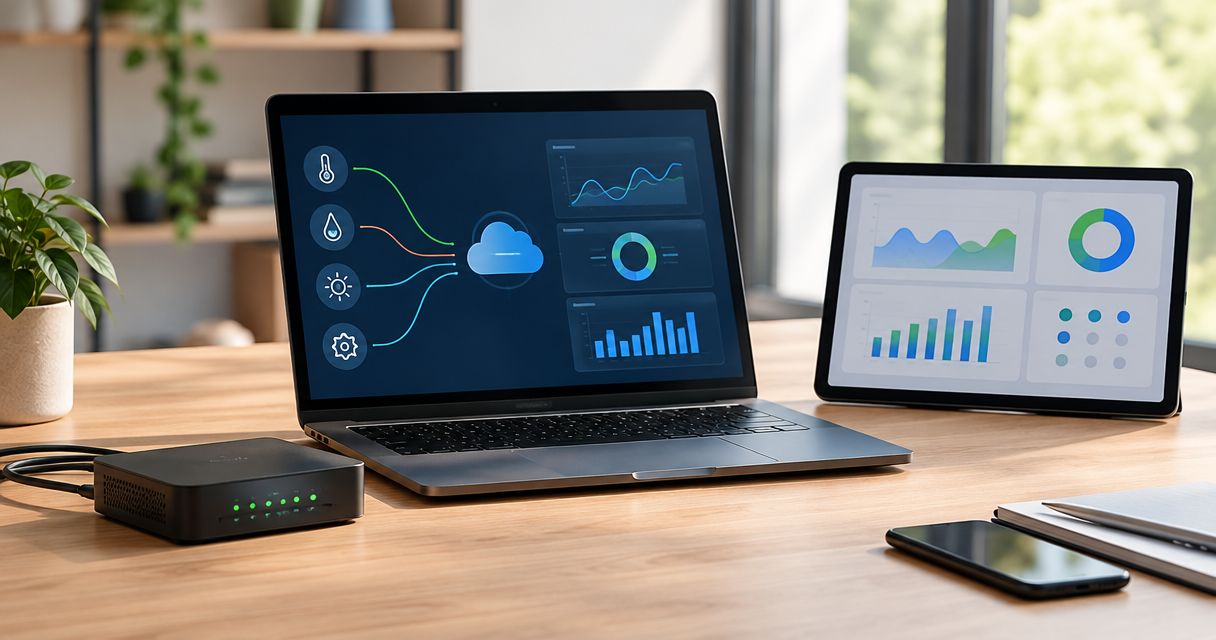
The greenhouse and vertical farming IoT platform approach that is gaining traction in 2026 pairs light and UV sensors with soil, temperature and CO2 sensors on the same LoRaWAN network, so a single dashboard shows the full growing environment instead of one metric in isolation.
What to look for in an IoT light and UV sensor for greenhouses
- Spectral band separation — a sensor that reports PAR (400-700 nm) is not measuring UV-A (315-400 nm) or UV-B (280-315 nm); confirm which bands you actually need before buying.
- IP rating for greenhouse humidity — condensation on an unsealed lens drifts readings within weeks.
- Wireless protocol and battery life — LoRaWAN and mioty both cover multi-acre greenhouse ranges without a Wi-Fi access point at every post.
- Calibration interval — UV and PAR sensors drift with lens fouling and UV exposure; know how often recalibration is needed.
- Rule and alarm integration — a threshold that cannot trigger an escalation to a grower phone is a number on a screen, not a control.
- Mounting flexibility — canopy-level tracking needs a different mount than a fixed roof-line sensor.
Best IoT light and UV sensors for greenhouse crop optimization at a glance
| Sensor type | Best for | Standout feature | Key limitation |
|---|---|---|---|
| PAR/PPFD quantum sensor | Photosynthesis-driven irrigation and lighting | Reads the 400-700 nm band used for daily light integral (DLI) targets | Blind to UV wavelengths outside PAR |
| UV-A/UV-B sensor | UV stress and secondary metabolite management | Separates 280-315 nm and 315-400 nm bands | Needs regular lens cleaning in dusty greenhouses |
| Full-spectrum lux/ambient sensor | Photoperiod scheduling and blackout compliance | Broad-spectrum reading close to visible light response | Less precise for crop-specific PAR math |
| Multi-band spectral sensor | Research-grade multi-crop trials | Reports PAR, UV and far-red from one node | Higher per-node cost and more data to manage |
| Canopy-level wireless sensor node | Multi-zone monitoring across large footprints | Battery-powered node moves with the canopy line | Needs gateway coverage planning per zone |
| Compact retrofit LoRaWAN sensor | Adding monitoring without rewiring an older structure | Wireless install, no trenching or conduit | Battery life depends on report interval and cold nights |
1. PAR/PPFD quantum sensors: best for photosynthesis-driven irrigation and lighting
A PAR/PPFD sensor measures photosynthetically active radiation, the 400-700 nanometer band plants actually use, and reports it in micromoles per square meter per second. Stacked over a day, that reading becomes daily light integral (DLI), the number growers use to decide whether supplemental lighting or shade cloth is needed.
PAR/PPFD sensor pros:
- Directly maps to the DLI targets most crop guides reference
- Works for both greenhouse and open-field deployments
- Pairs cleanly with a lighting or shade-cloth automation rule
PAR/PPFD sensor cons:
- Reports nothing about UV exposure
- Accuracy depends on keeping the sensor head level and unshaded
PAR/PPFD sensors are best for: growers making daily irrigation or supplemental-lighting calls based on cumulative light exposure. Buy this first if you only get one sensor.
2. UV-A/UV-B sensors: best for UV stress and secondary metabolite management
UV-B (280-315 nm) exposure drives measurable stress responses and, in some crops, changes secondary metabolite production — the compounds behind flavor, color and potency traits growers actively manage. UV-A (315-400 nm) carries a wider tolerance range but still affects leaf structure over time.
UV-A/UV-B sensor pros:
- Only sensor type that separates the two UV bands instead of lumping them into one light reading
- Useful for crops where controlled UV stress is a deliberate cultivation input
- Pairs with an alarm that fires before UV exposure crosses a damage threshold
UV-A/UV-B sensor cons:
- Narrower use case than a general PAR sensor
- Optical filters degrade with UV exposure and need periodic replacement
UV-A/UV-B sensors are best for: operations managing UV as a cultivation variable rather than just tracking total light. A PAR sensor that is not measuring UV is measuring half the spectrum a crop actually responds to.
3. Full-spectrum lux/ambient light sensors: best for photoperiod scheduling and blackout compliance
Photoperiod-sensitive crops need lights-out compliance down to the minute, and a general ambient light sensor is the cheapest way to confirm a blackout curtain actually sealed. It reads broad-spectrum light close to human visual response, not PAR-specific bands.
Full-spectrum lux sensor pros:
- Simple to deploy and interpret
- Confirms curtain or blackout failures immediately, not the next morning
- Low cost per node relative to multi-band sensors
Full-spectrum lux sensor cons:
- Not precise enough for DLI or crop-specific PAR calculations
- Does not distinguish UV exposure at all
Full-spectrum lux sensors are best for: photoperiod-sensitive crops where a light leak during dark hours is a compliance or yield problem, not just a data gap.
4. Multi-band spectral sensors: best for research-grade multi-crop trials
A multi-band spectral sensor reports PAR, UV-A/UV-B and often far-red light from a single node, which matters when comparing spectral response across multiple crop varieties in the same trial.
Multi-band spectral sensor pros:
- One node instead of two or three separate sensors
- Captures far-red data relevant to shade-avoidance responses
- Reduces mounting complexity for research plots
Multi-band spectral sensor cons:
- Costs more per node than a single-band sensor
- Generates more data channels to manage in a dashboard
Multi-band spectral sensors are best for: university trials, breeding programs and operations running side-by-side variety comparisons.
5. Canopy-level wireless sensor nodes: best for multi-zone monitoring across large footprints
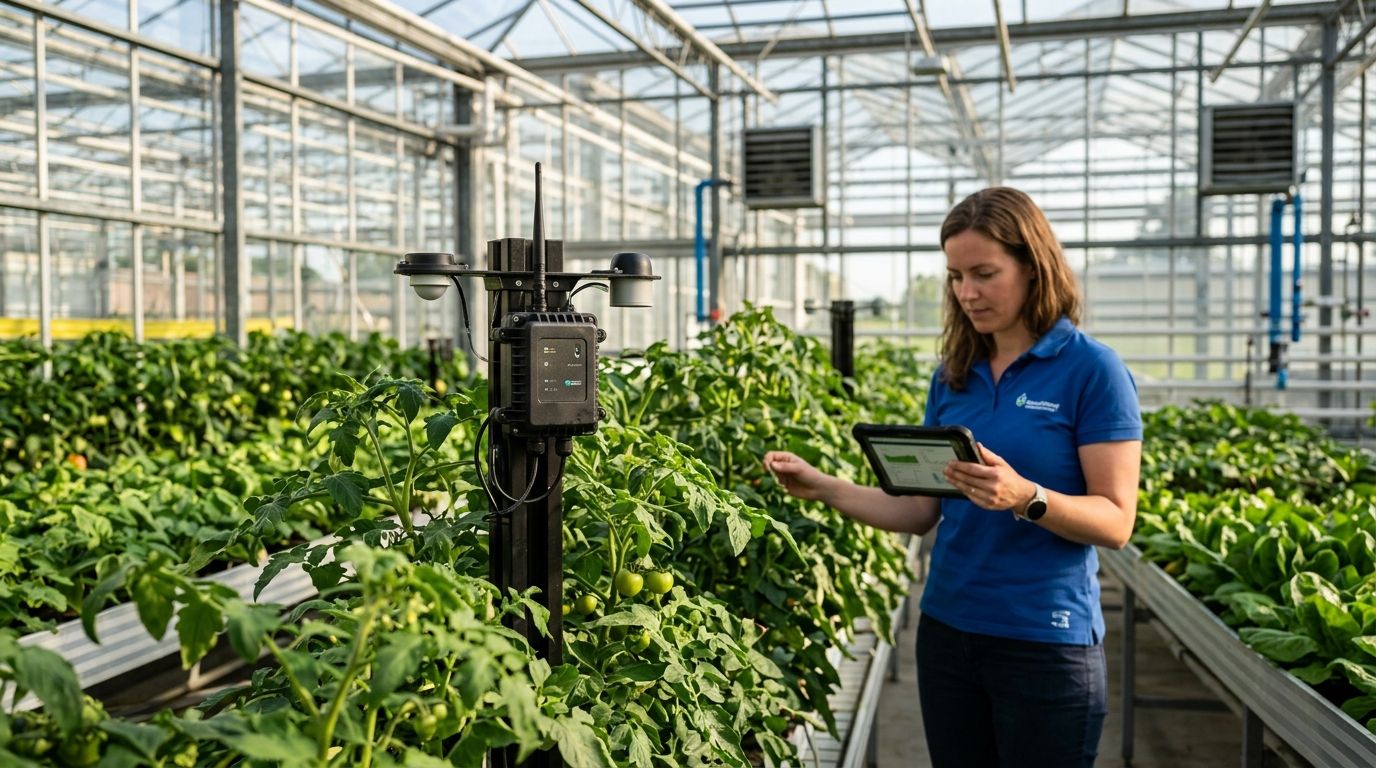
A fixed roof-line sensor misses shading from taller crops or structural elements. A canopy-level wireless node, battery-powered and repositioned as plants grow, reads light and UV where the crop actually sits.
Canopy-level sensor pros:
- Reads conditions at plant height, not roof height
- Moves with staking or trellis height changes
- Supports multiple zones on one gateway
Canopy-level sensor cons:
- Needs a coverage plan across every zone, not just one gateway near the entrance
- Battery swaps require physically reaching each canopy position
Canopy-level sensor nodes are best for: multi-acre or multi-zone greenhouses where light varies significantly from one bay to the next.
6. Compact retrofit LoRaWAN light/UV sensors: best for adding monitoring to an older structure
Older greenhouses often have no conduit, no spare Wi-Fi access points and no budget for rewiring. A compact, battery-powered LoRaWAN sensor solves that by installing wirelessly against a post or purlin.
Retrofit LoRaWAN sensor pros:
- No trenching, conduit or electrician needed for install
- Works alongside existing soil and temperature sensors on the same network
- Fast to relocate if greenhouse layout changes
Retrofit LoRaWAN sensor cons:
- Battery life depends heavily on reporting interval and cold-weather drain
- Range depends on gateway placement, which needs a signal check before a full rollout
Retrofit LoRaWAN sensors are best for: operations adding monitoring to a structure that was never wired for sensors in the first place.
“A PAR sensor that is not measuring UV is measuring half the spectrum a crop actually responds to.”
How to evaluate light and UV sensors for your greenhouse
Every sensor in this list was ranked against the six criteria above: spectral band separation, IP rating, wireless protocol and battery life, calibration interval, rule and alarm integration, and mounting flexibility. A sensor that scores well on accuracy but cannot trigger an alarm is still a data logger, not a monitoring system — the distinction that separates a spreadsheet from an operational tool in 2026.
Calibration drift is the detail most buying guides skip. UV filters degrade with exposure and PAR sensors drift with lens fouling, so the sensor spec sheet matters less than the recalibration schedule you actually follow. A guide to how to calibrate IoT sensors for accurate long-term readings is worth reading before locking in a sensor mix, regardless of which type you pick.
Which IoT light and UV sensor is right for your greenhouse?
For most greenhouse operations, the right starting mix is one PAR/PPFD sensor plus one UV-A/UV-B sensor per zone, wired into a rules engine that turns a DLI or UV threshold into an alarm rather than a chart nobody checks. Add a full-spectrum lux sensor only where photoperiod compliance is a hard requirement, and reserve multi-band spectral sensors for trial or research settings where the extra cost buys extra data channels you will actually use.
Kilo Electronics carries a catalog of compatible light and UV sensor nodes with worldwide shipping if you need hardware to pair with the platform side of this decision in 2026.
Build greenhouse light and UV alarms
Connect PAR, UV and DLI thresholds to alarms on the Kilo IoT Platform.
FAQ
What is the best IoT UV light sensor for greenhouse crop optimization?
A PAR/PPFD quantum sensor paired with a dedicated UV-A/UV-B sensor covers the two decisions most greenhouse operators actually make: lighting and irrigation calls from DLI, and UV stress management from separated UV-A and UV-B readings.
Is a UV sensor different from a PAR sensor?
Yes. A PAR sensor reads the 400-700 nm band plants use for photosynthesis, while a UV sensor reads 280-400 nm, split into UV-B (280-315 nm) and UV-A (315-400 nm). One sensor type does not substitute for the other.
Do greenhouse light sensors need to be wireless?
Not always, but LoRaWAN or mioty wireless sensors avoid trenching conduit across a greenhouse floor and make it easier to reposition sensors as crops grow or layouts change.
How often do UV and PAR sensors need recalibration?
Recalibration intervals vary by sensor and exposure conditions. UV filters degrade with UV exposure and PAR lenses drift with dust and condensation, so check the manufacturer calibration schedule rather than assuming a fixed interval.
Can one sensor network handle light, UV, soil and temperature data together?
Yes. A single LoRaWAN or mioty network can carry light, UV, soil moisture and temperature sensors on the same gateway, feeding one dashboard instead of separate systems per sensor type.
What is the difference between a lux sensor and a PPFD sensor?
A lux sensor measures broad-spectrum light close to human visual response, useful for photoperiod and blackout checks. A PPFD sensor measures only the 400-700 nm PAR band plants use for photosynthesis, which is what DLI calculations require.
Do I need a sensor per greenhouse zone or one sensor for the whole structure?
Large or multi-zone greenhouses need canopy-level sensors per zone because shading, height and orientation vary enough that one sensor near the entrance will not represent the far end of the structure.
What growers overlook when installing UV sensors in greenhouses
Mounting height gets more attention than mounting angle, but a UV sensor tilted even slightly off-level under a curved greenhouse roof reads a different exposure than the flat canopy below it. Check the mounting angle against the actual crop height, not the roofline, before trusting a UV threshold enough to build an alarm around it in 2026.